
RDP 2026-06: Perceived Monetary Policy Rules: Evidence from Professional Forecasters in Australia 2. Methodology
October 2026
As noted above, we build on the survey-based approach developed by Bauer et al (2024a) and Bauer et al (2024b). This framework estimates perceived Taylor rules by exploiting variation in professional forecasters' expectations for interest rates, inflation, and economic activity across horizons. Relative to these earlier papers, we focus on unemployment rather than output gaps as our measure of economic slack and employ dynamic panel estimators to account for policy inertia. This section outlines the framework, data, estimation approach, and identification assumptions.
2.1 Framework
We assume that forecasters believe the RBA sets the policy interest rate according to a Taylor-style rule (Taylor 1993; Taylor 1999), in which the cash rate responds to deviations of inflation and unemployment from their long-run benchmarks, as well as to its own lagged value:
where captures policy inertia; and measure the responsiveness to inflation relative to its target and unemployment relative to the NAIRU denotes the neutral real interest rate; and is a monetary policy shock.
Under this perceived rule, forecaster j's expectation at time t of the cash rate at horizon h can be written as
where hats denote perceived policy parameters, and captures forecaster-specific views about future policy shocks or model misspecification.
We allow beliefs about long-run “star” variables — the neutral real rate, inflation target, and NAIRU — to vary across forecasters and over time, but not across horizons within a given survey. That is, forecasters may revise their views about long-run benchmarks over time, but conditional on information at time t they do not expect these benchmarks to evolve systematically over the forecast horizon. Similarly, while perceived policy parameters may change over time, they are assumed constant across horizons within a survey. In other words, forecasters do not expect the RBA to place different weights on inflation or unemployment in the future than it does at present. We assess the plausibility of this assumption in Section 4.
To recover the perceived policy coefficients, we estimate the following panel regression:
where is a forecaster-specific intercept that absorbs persistent beliefs about the inflation target, the NAIRU, and the neutral rate. This formulation allows differences in long-run expectations to be correlated with forecasters' macroeconomic projections, ensuring that the estimated slope coefficients reflect perceptions of the RBA's responsiveness to changing economic conditions rather than differences in levels.
Our framework imposes a single, common perceived reaction function. To the extent that true heterogeneity in perceived policy rules exists, our estimates should therefore be interpreted as averages across forecasters. We explore the implications of this assumption in Section 5.
A key departure from Bauer et al (2024a) and Bauer et al (2024b) is our use of unemployment rather than an output gap. We do so for two reasons. First, unemployment aligns more closely with the RBA's dual mandate of price stability and full employment. Second, it requires weaker identifying assumptions. As Bauer et al (2024b) note, using GDP forecasts and output gaps requires imposing a common assumption about future potential output growth. By contrast, using unemployment only requires that forecaster-specific NAIRU beliefs are constant across horizons.[1]
Our baseline specification assumes that inflation and unemployment are the primary drivers of policy. If forecasters believe the RBA responds systematically to additional variables, omitted-variable bias may arise. We address this by extending the rule to include wage growth (Wage Price Index; WPI) and show that our main results are robust. The wage growth extension also provides additional insight into the role of labour-market conditions in shaping perceived policy.
2.2 Data
We use survey data from the RBA's Market Economist Survey (MES), a quarterly survey of approximately 10–20 professional forecasters. The MES collects quarterly forecasts for a range of macroeconomic variables at multiple horizons, extending up to roughly 2.5 years ahead. For this paper, we use forecasts of trimmed-mean inflation, the unemployment rate, and the cash rate, which are available from 2015 to 2025.
2.3 Estimation approach
The regression in equation (3) is estimated in a panel setting. Each forecaster–survey pair (t, j) is treated as a panel unit, with forecast horizons (h) forming the time dimension.
We estimate both a static specification, which abstracts from policy inertia by omitting the lagged interest rate, and a dynamic specification that allows for interest-rate smoothing. We present the static specification primarily as a simple benchmark, and for comparability with our later disagreement analysis where interpretation is clearer through the static framework. However, our preferred specification for most exercises is the inertial rule, consistent with the empirical importance of gradual policy adjustment. In the survey setting, the static rule can be interpreted as reflecting perceived medium-run policy responses over the forecast horizon, whereas the inertial rule captures perceived short-run responses (Bauer et al 2024a; Bauer et al 2024b). Standard errors are robust and clustered at the forecaster-by-time level.
Unlike Bauer et al (2024b), we estimate the inertial specification using a dynamic panel GMM estimator. The inclusion of a lagged dependent variable induces small-sample bias when fixed effects are present (often referred to as the Nickell bias). To address this, we employ an Arellano–Bond–style difference GMM estimator (Arellano and Bond 1991). We prefer difference GMM to system GMM because the latter requires the assumption that changes in expectations are uncorrelated with forecaster-specific fixed effects — an assumption that is unlikely to hold in this setting. For example, forecasters with higher neutral-rate beliefs are likely to expect smaller future declines in interest rates, all else equal. Difference-in-Hansen tests also reject the validity of the additional moment conditions required for system GMM.[2]
Inflation and unemployment expectations are treated as predetermined rather than strictly exogenous: past shocks to interest rate expectations may affect future inflation and unemployment forecasts, even if contemporaneous shocks do not. Accordingly, these variables enter as GMM-style instruments with appropriate lags. We find evidence that forecast errors are autocorrelated across horizons, with AR(2) dynamics in the differenced residuals. To address this, we use deeper lags of the instruments: third lags for interest rates and second lags for inflation and unemployment.
All dynamic specifications are estimated using the two-step GMM estimator with the Windmeijer (2005) finite-sample correction. As a robustness check, we vary the number of lagged instruments to assess potential effects of instrument proliferation; the results are very similar across specifications.
2.4 Identification and assumptions
Our survey-based approach is designed to recover perceived policy rules rather than the RBA's actual decision rule. Identification relies primarily on within-forecaster, across-horizon variation. For a given forecaster and survey date, we recover perceived policy slopes from how the expected path of the cash rate co-moves with that forecaster's own inflation and unemployment forecasts across horizons. Each forecaster therefore provides a “term structure” of expectations, and it is the slopes of these profiles — rather than their levels — that identify the perceived reaction function.
Figure 1 illustrates that forecast profiles exhibit substantial cross-horizon variation. For example, during 2021–22 forecasters anticipated sharp increases in inflation but relatively muted cash rate adjustments, whereas by 2023–24 expected rate increases became more closely aligned with inflation forecasts. These horizon-level differences underpin our identification strategy.
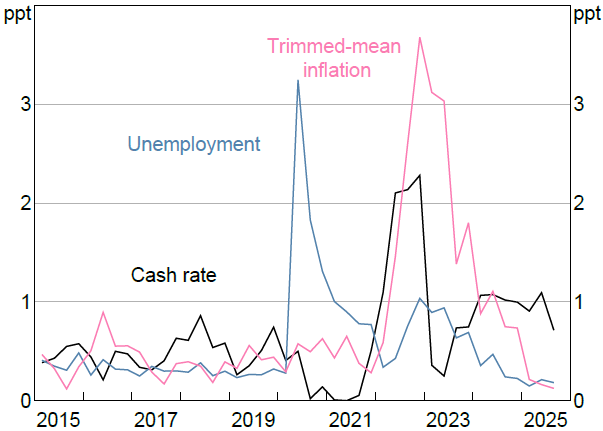
Note: Average cumulative absolute change calculated for each forecaster, and then averaged.
Sources: Authors' calculation; RBA
Cross-forecaster disagreement further enhances identification and precision. Figure 2 shows that disagreement over inflation, unemployment, and cash rate expectations varies considerably over time, particularly around major turning points such as the onset of the COVID-19 shock and the beginning of the tightening cycle in 2022.
As with any Taylor-rule regression, reverse causality is a potential concern: interest rates may influence inflation and unemployment as well as respond to them. In our setting, as discussed in Bauer et al (2024b), this concern is mitigated by the use of simultaneous survey expectations. At a given survey date, forecasters report expected paths for interest rates, inflation, and unemployment formed from a common information set. The co-movement we exploit therefore reflects how forecasters map their macroeconomic assumptions into policy expectations, rather than feedback from realised policy to subsequent outcomes. While the assumption that economic forecasts are independent of future policy shocks is unlikely to hold exactly, any resulting bias is expected to be limited. More generally, Carvalho, Nechio and Tristao (2021) show that bias in OLS estimation of Taylor rules is small when monetary policy shocks are not primary drivers of macroeconomic outcomes.
Footnotes
1 For the United States, Bauer et al (2024b) show that unemployment- and GDP-based specifications yield very similar time-series patterns.
2 The difference-in-Hansen test assesses the validity of the additional moment conditions required for system GMM. In our setting, these conditions are rejected, indicating that changes in expectations are correlated with forecaster-specific fixed effects, and motivating our use of difference rather than system GMM.