
RDP 2026-02: Shifts in Australian Price-setting Behaviour around Large Shocks 1. Introduction
May 2026
The sharp rise in inflation in 2022 and 2023 has renewed interest in the microeconomic foundations of price-setting behaviour, particularly how firms respond to large economic shocks. A growing body of international empirical research suggests that large supply shocks may increase the frequency of price adjustments, reducing the degree of price rigidity. In such periods, firms appear to pass through cost changes more rapidly than in normal times. This challenges a common assumption in standard macroeconomic models that the frequency of firms' price changes is invariant to economic conditions. Under this assumption, the pass-through of cost shocks to final prices is stable and the inflationary effects of large shocks are simply scaled-up versions of small ones. If price setting instead becomes more flexible after large shocks, inflation may respond more strongly and faster than conventional frameworks predict.
This has direct implications for policymakers. Central banks and other macroeconomic policy institutions typically rely on models that assume stable price-setting behaviour when forecasting inflation and calibrating policy. If this assumption breaks down during large shocks – such as those seen during and after the COVID-19 pandemic, or potentially in the context of future geopolitical or climate-related disruptions – forecasts may be systematically biased and policy responses miscalibrated. Quantifying how price-setting behaviour changes in such episodes is therefore critical for improving inflation forecasts and guiding policy decisions. It also informs how price rigidity should be modelled more generally, which matters for a broader set of questions, including how costly inflation is for the economy and households.
In this paper, we examine how price rigidity in Australia changed between 2018 and 2023, using a novel dataset of item-level prices collected from the websites of around 60 large retailers (Figure 1). We focus particularly on the inflation surge from late 2021 to 2023, documenting shifts in the frequency of price changes during this time. These findings are incorporated into the Reserve Bank of Australia's (RBA's) benchmark dynamic stochastic general equilibrium (DSGE) model to assess implications for inflation dynamics, policy transmission and policy trade-offs.
Our results suggest that price-setting behaviour became significantly less flexible at the peak of COVID-19 economic uncertainty than it was before COVID-19. But as inflation surged in 2022 and 2023, prices became more flexible, with firms adjusting prices more frequently than they did before the pandemic. This ‘state-dependent’ pricing – in which firms adjust prices in response to economic conditions rather than on a fixed schedule – implies that large shocks may have disproportionately larger effects on inflation (i.e. that the inflationary effects of a shock are nonlinear in the size of the shock).
Using the RBA's DSGE model, we find that failing to account for changes in price-setting frequency during the 2022–2023 inflation surge would have led to a substantial underprediction of inflation. Our estimates suggest that the decline in rigidity could explain up to 1.2 percentage points of inflation in this period, meaning that changes in price-setting behaviour accounted for a sizeable share of the increase in prices. To better capture these dynamics when the economy faces large shocks in the future, forecasters should consider using models that allow for shifts in price-setting frequency, such as ‘menu cost’ models, or apply explicit judgement when using standard models that assume frequency is constant.
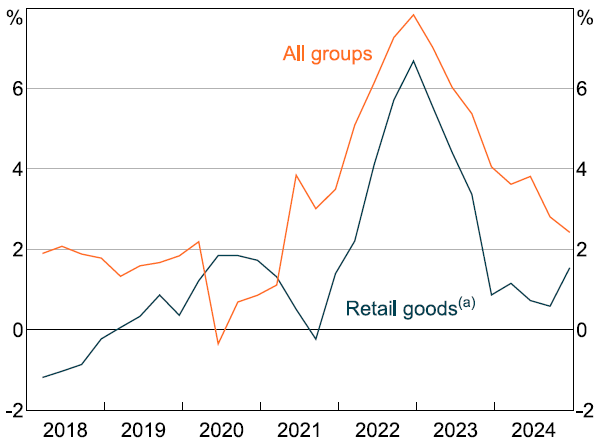
Note: (a) ABS CPI goods component excluding items not in web-scraped dataset: food & non-alcoholic beverages, tobacco, new dwellings, motor vehicles and automotive fuel.
Sources: ABS; Authors' calculations; RBA.
Monetary policymakers typically face a trade-off between lowering high inflation and supporting economic growth and employment, particularly in the wake of a supply shock, because reducing inflation in these circumstances requires curbing demand and activity to create slack and ease price pressures. In assessing the implications of our findings for monetary policy, we find that reduced price rigidity lessens the central bank's trade-off between stabilising inflation and real activity during large supply shocks. In this environment, policymakers can lower inflation with fewer real economic costs, suggesting a stronger focus on inflation stabilisation is warranted compared to a situation in which rigidity did not change.
We quantify these effects in the post-COVID-19 high-inflation period, using a so-called ‘optimal control’ exercise. This exercise uses the RBA's DSGE model to calculate the policy path that would have minimised deviations of inflation and unemployment from target, given the shocks that hit the economy, the structure of the model, and some set of simple fixed preferences for trading off between inflation and unemployment in the face of a supply shock. We compare these policy paths with and without the change in rigidity.
Relative to a scenario where rigidity remained unchanged, this exercise calls for policy that raises interest rates more aggressively – by up to around 40 basis points more than otherwise – followed by a sharper subsequent easing. Importantly, this does not imply that actual rates should have been higher than they were at the time. Our work compares these ‘optimal’ policy paths under different assumptions about price rigidity, rather than against the realised cash rate path. Moreover, the exercise uses a specific set of policy preferences around the trade-off between inflation and unemployment, which may differ from those used by policymakers during the high-inflation episode in 2022 and 2023. And the exercise relies on the structure of the model, which by its nature is a simplification of reality. Rather than prescribing a specific policy stance, our findings suggest that the observed decline in price rigidity would have made a front-loaded tightening more appealing for a central bank having to trade-off between inflation and unemployment, relative to the case where rigidity had not changed.
Beyond shedding light on this high-inflation episode, our paper contributes to the broader economic literature in several ways. First, it adds to the growing international empirical evidence on variability in price-setting frequency and nonlinear inflation dynamics. Our dataset covers a broader range of products than much of the existing literature using web-scraped data, including many discretionary and non-perishable items that may be less flexibly priced in normal times. Second, we are the first in this literature to apply formal duration modelling approaches to estimate price-setting frequency. These offer advantages over simpler ‘share of prices changing’ methods. Finally, we contribute to the relatively sparse literature on price-setting dynamics in Australia, focusing on a more recent period than previous studies and using web-scraped Australian data for the first time.
The objective of our analysis is to assess whether Australian firms' price-setting behaviour shifted over time within our dataset, and if so to explore the policy implications of those shifts. The remainder of the paper proceeds as follows. Section 2 reviews the existing literature in this area. Section 3 introduces our dataset. Section 4 introduces our preferred rigidity measure, price duration, and presents a time-varying measure estimated using a regression-based survival analysis approach that maps to the well-known Calvo parameter. Sections 5 and 6 explore the implications of changing price rigidity for inflation dynamics and monetary policy. Section 7 concludes with a discussion.