
RDP 2026-01: Shock-percentile Restrictions for SVARs 5. Uncertainty and Business Cycles Revisited
March 2026
This section uses the shock-percentile restrictions to revisit the relationship between real activity and uncertainty in the United States, which is the empirical setting examined by LMN. Section 5.1 describes the collection of identifying restrictions imposed by LMN and shows that their shock-magnitude restrictions play a pivotal role in generating their key results. Section 5.2 re-examines these results when replacing the shock-magnitude restrictions with shock-percentile restrictions. Section 5.3 imposes an additional shock-percentile restriction related to the 1998 Russian Financial Crisis. Consistent with LMN, I focus on estimating identified sets and abstract from sampling uncertainty.[23]
5.1 Identifying restrictions in LMN
LMN impose two broad classes of identifying restrictions: 1) ‘external variable constraints’; and 2) ‘event constraints’, which include shock-magnitude restrictions.
5.1.1 External variable constraints
The external variable constraints require the structural shocks to be correlated with variables that are external to the VAR. These constraints do not constrain the external variables to be exogenous with respect to any shocks in the system, unlike much of the literature that makes use of ‘external instruments’ for identification (e.g. Mertens and Ravn 2013; Stock and Watson 2018).
Let St = (S1t, S2t)’ denote a vector of external variables, where S1t is a real stock market return and S2t is the log difference in the real price of gold.[24] The external variable constraints require that
That is, the two uncertainty shocks are required to be negatively correlated with the real stock market return and positively correlated with the change in the real price of gold. Since , it follows that cov The external variable constraints are therefore inequality restrictions on Q. The restrictions depend on the covariances between the external variables St and the reduced-form innovations ut; these covariances constitute additional reduced-form parameters. In what follows, assume additionally contains .
5.1.2 Event constraints
As discussed in Section 2.3, event constraints restrict the values of the structural shocks in specific periods. LMN impose the following event constraints:
- at
- at
- at
- for
- and at
- and at
Constraints (i)–(iii) are shock-magnitude restrictions. Constraint (i) requires the financial uncertainty shock in the Black Monday episode to exceed k1 standard deviations. Constraint (ii) requires the financial uncertainty shock and/or the macroeconomic uncertainty shock in September 2008 (the Lehman Brothers collapse) to exceed k2 and k3 standard deviations in size, respectively. Constraint (iii) requires the macroeconomic uncertainty shock in December 1970 (leading up to the collapse of the Bretton Woods system of fixed exchange rates) to exceed k4 standard deviations. LMN elicit the bounds k = (k1,..., k4)′ using the procedure described in Section 3. In the exercises below, I set these bounds equal to the 75th percentiles of the shock distributions implied by the RWZ algorithm, consistent with one of the specifications in LMN. In practice, this means that k = (4.16,4.57,4.73,4.05)′.
Constraints (iv)–(vi) are additional event constraints motivated by narrative information. Constraint (iv) requires the sum (equivalently, average) of the ‘real activity shocks’ from December 2007 to June 2009 to be positive, corresponding to the Great Recession. Constraints (v) and (vi) require both uncertainty shocks to be non-negative during October 1979 (the Volcker episode) and during the two months corresponding to the US debt ceiling crisis.
5.1.3 Numerical implementation
I approximate identified sets using a large number of draws of Q from the uniform distribution over .[25] Obtaining these draws using the RWZ algorithm and an accept-reject step (as is standard) is computationally burdensome, because is ‘small’ relative to . I therefore employ the ‘soft sign restrictions’ approach developed in Read and Zhu (2025), which can be more computationally efficient when identification is tight. I use around 300,000 draws to approximate the identified sets, motivated by Montiel Olea and Nesbit (2021), who provide results about the number of draws required to approximate identified sets with a specified level of accuracy.[26] See Appendix C.1 for additional details.
5.1.4 Results under LMN restrictions
Figure 5 presents identified sets for the impulse responses under different subsets of the identifying restrictions from LMN.[27] Under the full set of restrictions, a positive financial uncertainty shock unambiguously decreases output at all horizons. A positive macroeconomic uncertainty shock unambiguously increases output at short horizons, which is consistent with ‘growth-options’ theories of uncertainty. Positive shocks to real activity increase financial uncertainty at short horizons but lead to a persistent decrease in macroeconomic uncertainty. These results together suggest that elevated macroeconomic uncertainty during recessions is likely to reflect an endogenous response to adverse shocks associated with business cycle fluctuations. In contrast, heightened financial uncertainty may be an exogenous driver of recessions.
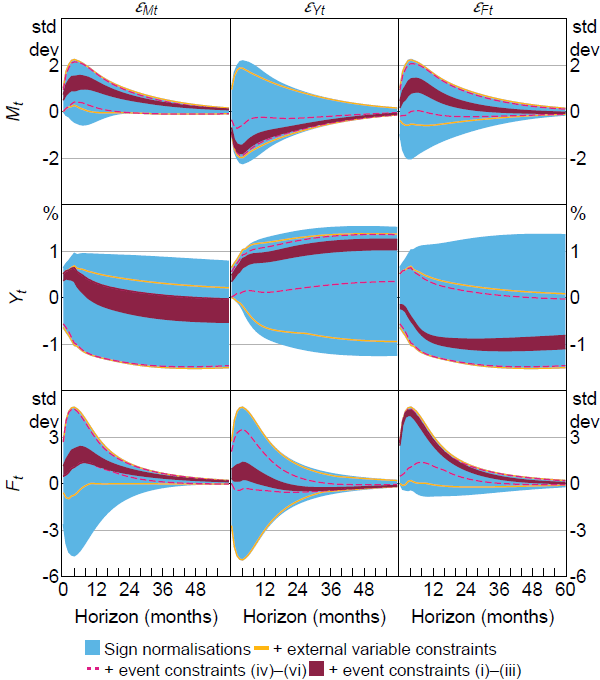
The results under weaker sets of restrictions make it clear that the shock-magnitude restrictions are crucial for obtaining the key results in LMN; in the absence of the shock-magnitude restrictions, identified sets for the output responses to both macroeconomic and financial uncertainty shocks span zero at all horizons. The credibility of the shock-magnitude restrictions is therefore a crucial ingredient in assessing the overall credibility of the results.
5.2 Shock-percentile restrictions
Consider replacing the shock-magnitude restrictions (i)–(iii) with shock-percentile restrictions.[28] More specifically, constraints (i)–(iii) are replaced with:
- * at
- * at
- * at
I initially set , so these shock-percentile restrictions are in a sense analogous to the shock-magnitude restrictions in Section 5.1.2. Constraint (i*) requires the financial uncertainty shock in the Black Monday episode to exceed the 75th percentile of the shock's historical distribution. Constraint (ii*) requires the financial uncertainty shock and/or the macroeconomic uncertainty shock in the Lehman episode to exceed the 75th percentiles of these shocks’ respective historical distributions. Constraint (iii*) requires the macroeconomic uncertainty shock in December 1970 to exceed the 75th percentile of the shock's historical distribution. These restrictions represent the belief that relatively large uncertainty shocks occurred in these periods, without taking a stand on the exact numeric bound that constitutes a ‘large’ shock.
5.2.1 Impulse responses
Figure 6 presents impulse-response identified sets when replacing shock-magnitude restrictions (i)–(iii) with shock-percentile restrictions (i*)–(iii*). The identified sets under the shock-magnitude restrictions are also presented for comparison. Under the shock-percentile restrictions, a positive financial uncertainty shock unambiguously leads to a decline in output at all horizons, which is consistent with the results in LMN. In contrast, identified sets for the output response to a macroeconomic uncertainty shock include zero at most horizons, and the sign of the output response is largely ambiguous. It remains the case that a positive output shock unambiguously decreases macroeconomic uncertainty, consistent with the idea that elevated macroeconomic uncertainty during recessions is likely to reflect an endogenous response to adverse shocks associated with business cycle fluctuations. In contrast, the sign of the response of financial uncertainty to a positive output shock is ambiguous at all horizons; in principle, heightened financial uncertainty during recessions could reflect the endogenous response of financial uncertainty to business cycle fluctuations.
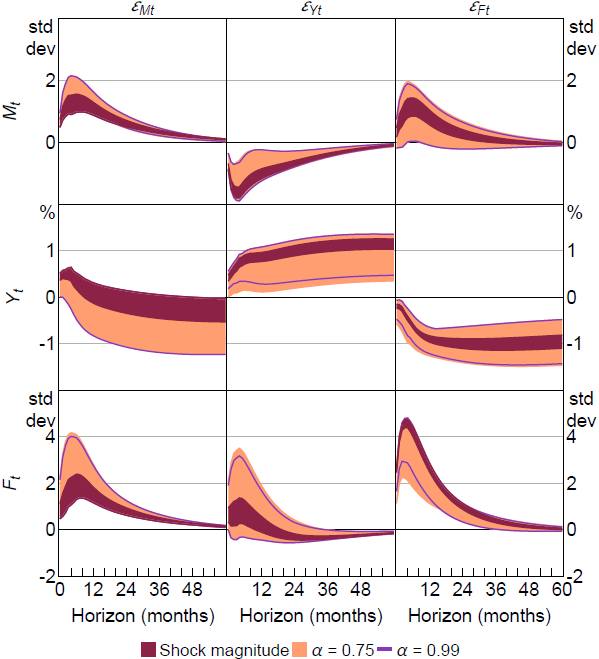
Notes: ‘Shock magnitude’ corresponds to identifying restrictions from LMN, with lower bounds on shock magnitudes based on 75th percentile of shock distribution from bound-elicitation procedure. and replace shock-magnitude restrictions (i)–(iii) with shock-percentile restrictions (i*)–(iii*).
To summarise, replacing the shock-magnitude restrictions with analogous shock-percentile restrictions yields qualitatively similar conclusions about the output effects of financial uncertainty shocks and the response of macroeconomic uncertainty to output shocks. In contrast, there is no longer unambiguous evidence about the output effects of macroeconomic uncertainty shocks or the response of financial uncertainty to output shocks.
Figure 6 also plots the responses obtained under stronger versions of the shock-percentile restrictions, where . These restrictions require the financial and macroeconomic uncertainty shocks in the selected episodes to lie in the upper 1 per cent of the historical distributions of these shocks. Imposing these stronger restrictions narrows the identified sets a little in some cases, but overall there is little substantive difference relative to when .
5.2.2 How important are uncertainty shocks?
To quantify the importance of different shocks for driving variation in output and uncertainty on average over time, Figure 7 presents identified sets for FEVDs. The identified sets are obtained under the shock-percentile restrictions with and . For comparison, the figure also presents identified sets based on the shock-magnitude restrictions.
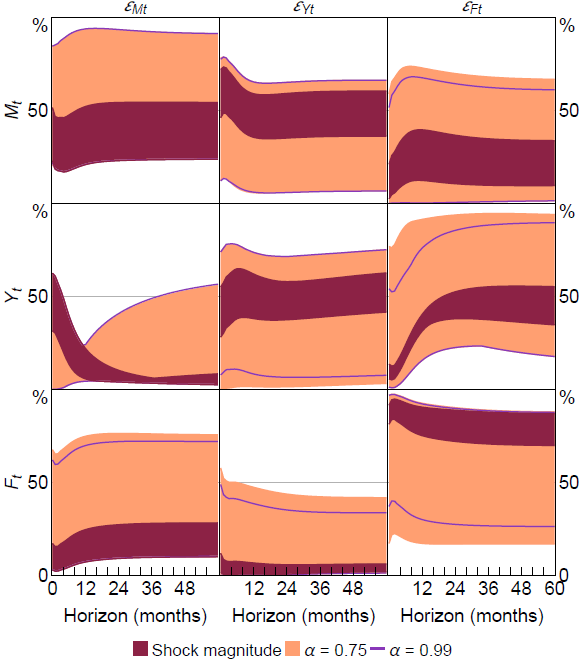
Notes: ‘Shock magnitude’ corresponds to identifying restrictions from LMN, with lower bounds on shock magnitudes based on 75th percentile of shock distribution from bound-elicitation procedure. and replace shock-magnitude restrictions (i)–(iii) with shock-percentile restrictions (i*)–(iii*).
The shock-magnitude restrictions in LMN unambiguously imply that: 1) macroeconomic and financial uncertainty shocks are important drivers of output fluctuations at different horizons, with macroeconomic uncertainty shocks making substantial contributions at shorter horizons and financial uncertainty shocks at longer horizons; 2) the bulk of the variation in financial uncertainty is driven by exogenous shocks to financial uncertainty; and 3) a large share of the variation in macroeconomic uncertainty represents the endogenous response of macroeconomic uncertainty to other shocks.
Under the shock-percentile restrictions, the identified set for the contribution of macroeconomic uncertainty shocks to the forecast error variance of output includes values close to zero at all horizons. This means that there is no longer unambiguous evidence that macroeconomic uncertainty shocks are quantitatively important drivers of output fluctuations at short horizons. The identified sets now also admit the possibility that macroeconomic uncertainty shocks contribute materially to unexpected variation in output at longer horizons.
While the identified sets for the contribution of financial uncertainty shocks to output are substantially wider than obtained under the shock-magnitude restrictions, they still unambiguously imply that financial uncertainty shocks explain a non-trivial share of output fluctuations beyond short horizons; financial uncertainty shocks explain no less than about 20 per cent of unexpected changes in output at the 2-3 year horizon. So these shocks may indeed be an important driver of business cycles, consistent with the VAR analyses in Bloom (2009), Caggiano, Castelnuovo and Groshenny (2014), Leduc and Liu (2016) and Andreasen et al (2024), among others. The identified sets also admit the possibility that financial uncertainty shocks are not the primary driver of output fluctuations at business cycle frequencies, consistent with Brianti (2025).
In terms of what shocks drive measured uncertainty, the identified sets now admit the possibilities that financial uncertainty is largely driven by other (non-financial uncertainty) shocks and that macroeconomic uncertainty is primarily driven by macroeconomic uncertainty shocks. These qualitative conclusions hold both when or when imposing stronger shock-percentile restrictions with .[29]
Overall, relative to the shock-magnitude restrictions, the shock-percentile restrictions deliver less-conclusive evidence about the importance of uncertainty shocks for driving measured uncertainty and real activity.
5.2.3 Understanding the results
While the shock-percentile restrictions in this example generate wider identified sets than the shock-magnitude restrictions, the results are obtained without relying on the arbitrary algorithm used to simulate parameter values. In that sense, replacing shock-magnitude restrictions with shock-percentile restrictions in this application can be viewed as an example of the trade-off between ‘credibility’ and ‘certitude’ discussed in Manski (2003, 2011). But why do the shock-percentile restrictions generate wider identified sets than the shock-magnitude restrictions?
To examine this question, the left panel of Figure 8 visualises the joint unconstrained identified set for the financial uncertainty shock in the Black Monday episode and the 75th percentile of the historical distribution of financial uncertainty shocks . Each point in the shaded region represents a pair corresponding to a value of Q in the unconstrained identified set . Points lying above the dashed line satisfy the shock-percentile restriction . Points lying above the solid horizontal line satisfy the shock-magnitude restriction . It is evident that there are no values of where the shock percentile exceeds the bound on the shock; in this sense, the shock-percentile restriction is strictly weaker than the shock-magnitude restriction. This is also the case for the other periods where these restrictions are imposed. Hence, the shock-percentile restrictions, when combined with the other identifying restrictions, generate wider identified sets than the shock-magnitude restrictions.
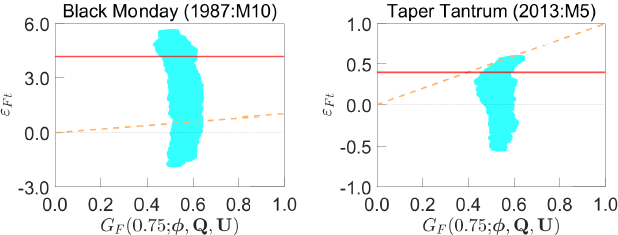
Notes: Shaded region represents joint unconstrained identified set for financial uncertainty shock in selected episode and historical shock percentiles . Points lying above the dashed line satisfy the shock-percentile restriction and points lying above the solid line satisfy the shock-magnitude restriction.
A natural question is: will it always be the case that a shock-percentile restriction is weaker than an analogous shock-magnitude restriction when the bound is elicited using the procedure in LMN? The answer is no. To illustrate, consider the financial uncertainty shock in the Taper Tantrum episode ; this was a period of volatility in financial markets, which was triggered by suggestions that the Federal Reserve might reduce the pace of bond purchases under its quantitative easing program. The right panel of Figure 8 shows that all values of that satisfy a shock-percentile restriction based on this episode also satisfy the analogous shock-magnitude restriction. The shock-percentile restriction would therefore be unambiguously stronger than the shock-magnitude restriction.
5.3 Additional restrictions
The shock-percentile restrictions considered above yield conclusions about the effects of uncertainty shocks that are qualitatively consistent, along some dimensions, with the results obtained under the shock-magnitude restrictions. However, as discussed, the identified sets tend to be substantially wider, so while the results are arguably more credible, they are in a sense less economically informative. It is therefore valuable to impose additional credible identifying restrictions to sharpen identification.
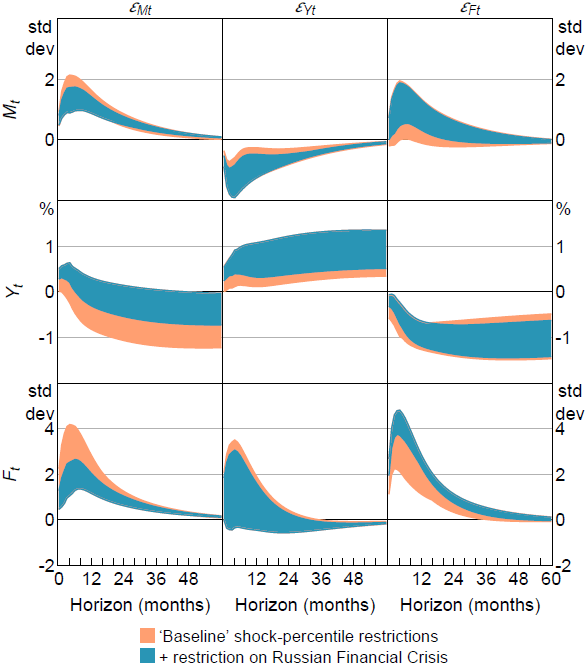
To that end, I impose an additional shock-percentile restriction related to the 1998 Russian Financial Crisis. More specifically, I restrict the financial uncertainty shock in August 1998 to exceed the 75th percentile of the historical distribution of uncertainty shocks. This is the month in which Russia defaulted on ruble-denominated government debt and devalued the ruble, triggering a spike in uncertainty in financial markets; for example, the CBOE Volatility Index (VIX) roughly doubled over August. This episode led to the near collapse of the hedge fund Long-Term Capital Management, which was subsequently (in September 1998) bailed out by a consortium of private banks in a deal facilitated by the Federal Reserve (e.g. Lowenstein 2000).
Augmenting the restrictions from Section 5.2 with the additional shock-percentile restriction substantially sharpens identification of the impulse responses to the uncertainty shocks, better disentangling shocks to macroeconomic and financial uncertainty (Figure 9). For example, output unambiguously increases at short horizons following a positive macroeconomic uncertainty shock, and macroeconomic uncertainty unambiguously increases following a positive financial uncertainty shock; these results are broadly consistent with the results from LMN.
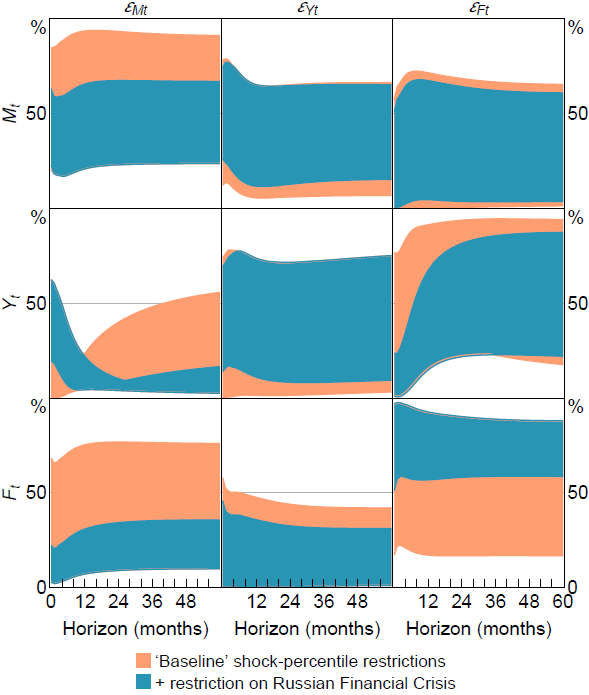
The additional shock-percentile restriction also tightens identified sets for the FEVDs, delivering less-ambiguous evidence about the importance of the different shocks for driving variation in output and measured uncertainty (Figure 10). More specifically: financial uncertainty shocks unambiguously explain at least half of the forecast error variance of financial uncertainty at all horizons, so most of the variation in financial uncertainty is driven by exogenous shocks to financial uncertainty; a substantial share of the variation in macroeconomic uncertainty is now unambiguously ascribed to other shocks; and macroeconomic uncertainty shocks unambiguously make a material contribution to output fluctuations at short horizons and a limited contribution at longer horizons, and vice versa for financial uncertainty shocks. These results are broadly consistent with those obtained under LMN's shock-magnitude restrictions. Importantly, however, they are obtained without specifying an arbitrary numeric lower bound on shock magnitudes, and so may be viewed as more credible.
Footnotes
LMN use a bootstrap to account for sampling uncertainty in one exercise (see their Figure 6), though the theoretical properties of their bootstrap are unknown. Section 6 presents an additional empirical application in which I account for sampling uncertainty using a prior-robust Bayesian method. [23]
S1t is the Center for Research in Security Prices value-weighted stock market index return. S2t is the log difference in the real price of gold (deflated using the US Consumer Price Index). See LMN for details about how these variables are constructed. [24]
Under the identifying restrictions, it is not guaranteed that identified sets for the parameters of interest are convex. If the identified sets are non-convex, the interval estimates presented below can be interpreted as estimating convex hulls of identified sets. See Giacomini and Kitagawa (2021a, 2021b) for sufficient conditions under which impulse-response identified sets are convex. [25]
This contrasts with the treatment in LMN, who obtain 1.5 million draws of Q from and approximate identified sets using only those draws that satisfy the identifying restrictions; for example, the identified sets under the event and external variable constraints described above are approximated using the 169 draws that satisfy the restrictions. [26]
The estimated identified sets are very similar to those presented in LMN, though they are slightly wider, reflecting the larger number of draws used to approximate identified sets and the consequent reduction in approximation error. [27]
LMN also motivate the timing of their shock-magnitude restrictions based on the RWZ algorithm, which could be problematic when the identified timing of large shocks depends on the distribution for Q. For example, the identified set for consists of (at least) 13 different months, so the period where the largest financial uncertainty shock occurred is not pinned down by the data. However, the timing of the restrictions is additionally motivated using narrative information. I therefore proceed under the assumption that the timing of these restrictions is credible. [28]
Appendices C.2 and C.3 apply the shock-percentile restrictions to revisit additional empirical questions considered in LMN. Appendix C.2 reaffirms the results in LMN that the data are inconsistent with recursive identification schemes, which have been widely used to identify uncertainty shocks. Appendix C.3 presents evidence that the structural shocks possess non-Gaussian features, which is inconsistent with the common Gaussianity assumption in Bayesian SVARs. [29]