
RDP 2026-01: Shock-percentile Restrictions for SVARs 6. Estimating the Effects of US Monetary Policy
March 2026
This section applies a shock-percentile restriction to help identify the effects of US monetary policy, building on Antolín-Díaz and Rubio-Ramírez (2018) (henceforth, AR18). They identify US monetary policy shocks using a combination of sign restrictions on impulse responses (as in Uhlig (2005)) and narrative restrictions. I consider augmenting their narrative restrictions with a shock-percentile restriction, reflecting the belief that the monetary policy shock in October 1979 (the Volcker episode) was large relative to the historical distribution of monetary policy shocks, consistent with the view that the shock in this episode represented a ‘major anti-inflationary shock to monetary policy’ (Romer and Romer 1989, p 142).
6.1 Reduced-form VAR
The reduced-form VAR is from Uhlig (2005). The endogenous variables are real GDP, the GDP deflator, a commodity price index, total reserves, non-borrowed reserves (all in natural logarithms) and the federal funds rate. The data are monthly, with the sample beginning in January 1965 and ending in November 2007. The VAR includes 12 lags. As discussed further below, I estimate the model using a prior-robust Bayesian method under the assumption that the structural shocks are normally distributed. The prior for the reduced-form parameters is the uninformative Jeffreys’ prior, so the posterior is normal-inverse-Wishart.
6.2 Identifying restrictions
As identifying restrictions, AR18 impose a mix of sign restrictions on impulse responses and narrative restrictions. The sign restrictions follow Uhlig (2005): the response of the federal funds rate to a positive monetary policy shock is non-negative for h = 0,1,...,5; and the responses of the GDP deflator, the commodity price index and non-borrowed reserves are non-positive for h = 0,1,..., 5. As narrative restrictions, they impose that the monetary policy shock in October 1979 was positive and was the ‘overwhelming contributor’ to the observed unexpected change in the federal funds rate. The narrative restrictions represent the belief that the monetary policy shock in this episode was large relative to other shocks in the same period in terms of the shocks’ contributions to the change in the federal funds rate. In an additional exercise involving a richer set of narrative restrictions, the restrictions are that the monetary policy shock was: positive in April 1974, October 1979, December 1988 and February 1994; negative in December 1990, October 1998, April 2001 and November 2002; and the ‘most important contributor’ to the observed unexpected change in the federal funds rate in these months.[30]
To examine the identifying power of a shock-percentile restriction in this setting, I additionally impose the shock-percentile restriction that the monetary policy shock in the Volcker episode exceeded the 90th percentile of the historical distribution of monetary policy shocks.[31] Unlike the restrictions on the historical decomposition, this shock-percentile restriction represents the belief that the monetary policy shock in the Volcker episode was large relative to monetary policy shocks occurring in other periods. Imposing both restrictions in this episode therefore represents the belief that the monetary policy shock was ‘large’ along two dimensions: 1) its contribution to the change in the federal funds rate in this period relative to the contributions of other shocks; and 2) relative to other periods.
6.3 Results
I estimate the impulse responses to a 100 basis point monetary policy shock both under the identifying restrictions from AR18 and when additionally imposing the shock-percentile restriction. To do this, I use the prior-robust Bayesian approach to inference developed in Giacomini and Kitagawa (2021a) and extended to the case of narrative restrictions in Giacomini et al (2023). This approach to inference provides a tractable way to account for sampling uncertainty when estimating identified sets; the ‘set of posterior medians’ under this approach can be interpreted as an estimator of the identified set and the ‘robust credible interval’ can be interpreted as an asymptotically valid frequentist confidence interval for the identified set.[32]
Figure 11 plots the impulse responses of the federal funds rate and output to a monetary policy shock that increases the federal funds rate by 100 basis points on impact. Under the original Volcker restrictions (left panels), the set of posterior medians for the output response contains zero at almost all horizons considered.[33] In contrast, when augmenting these restrictions with the shock-percentile restriction, the set of posterior medians excludes zero at most horizons within the first three years. One way to quantify the evidence about the output response is to use the ‘posterior lower probability’; this is the smallest posterior probability assigned to a particular hypothesis under the ‘class of posteriors’ underlying the robust Bayesian approach to inference. The posterior lower probability that the output response is negative at the six-month horizon is less than 1 per cent under the original restrictions, whereas it is around 65 per cent when additionally imposing the shock-percentile restriction. Hence, there is much stronger evidence of a decline in output at this (relatively short) horizon following a monetary policy shock. Overall, augmenting the baseline narrative restrictions with the shock-percentile restriction yields stronger evidence that output falls following a positive monetary policy shock, particularly at shorter horizons.
Under the extended set of restrictions from AR18 (right panels, Figure 11), the set of posterior medians includes zero at all horizons within the first year or so. This is no longer the case when additionally imposing the shock-percentile restriction; the estimator of the identified set unambiguously points to an output decline at almost all horizons beyond the first six months. The posterior lower probability that the output response is negative at the six-month horizon is about 65 per cent when imposing the shock-percentile restriction, compared with only 14 per cent under the original set of restrictions. So, again, there is much stronger evidence of a decline in output at short horizons when additionally imposing the shock-percentile restriction.
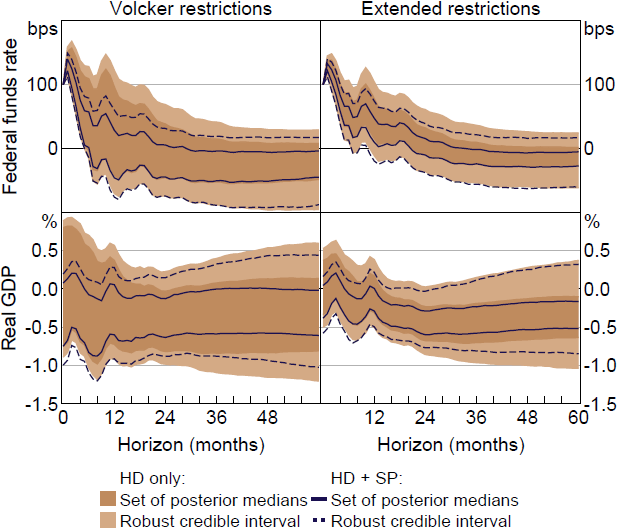
Notes: Impulse responses are to a 100 basis point monetary policy shock. ‘HD only’ represents results under identifying restrictions from Antolín-Díaz and Rubio-Ramírez (2018); ‘HD + SP’ additionally imposes shock-percentile restriction. Robust credible intervals are at the 68 per cent level.
To summarise, imposing a single shock-percentile restriction related to the Volcker episode substantially sharpens identification of the output effects of US monetary policy, yielding stronger evidence that output declines following a positive monetary policy shock, particularly at short horizons. This is the case even when imposing this restriction on top of an already rich set of narrative restrictions.
Footnotes
Let Hi,j,t be the contribution of shock j to the one-step-ahead forecast error in variable i in period t. The restriction that the first shock was the ‘overwhelming contributor’ to variable i in period t is and the restriction that it was the ‘most important contributor’ to variable i in period t is . [30]
Giacomini et al (2021) and Read (2022) impose the ‘shock-ranking’ restriction that the monetary policy shock in the Volcker episode was the largest absolute realisation of the shock in the sample period, which is stronger than the shock-percentile restriction considered here. [31]
See Appendix C.1 for details about how the approach to inference is implemented numerically. [32]
The estimates under the Volcker restrictions from AR18 coincide with those presented in the Online Appendix to Read (forthcoming). The results presented here are not directly comparable to those in AR18, because the impulse responses are normalised differently. [33]