
RDP 2025-08: Ageing and Economic Growth in China 4. Sectoral Divergence
November 2025
Looking beyond the aggregate economic effect of the ageing population, demographic trends are likely to have divergent effects on different sectors of the economy. Sectors for which an ageing population would increase demand, such as health care, are generally expected to be beneficiaries, whereas sectors that have previously benefited from a fast-growing population, like real estate, are expected to suffer. This is borne out in the experience of countries further along in their ageing process such as France, Germany, Italy, Japan and South Korea. As these countries have aged, health expenditure as a proportion of GDP has generally risen, while value added by the construction sector as a proportion of total value added has mostly declined (Figures 9 and 10).
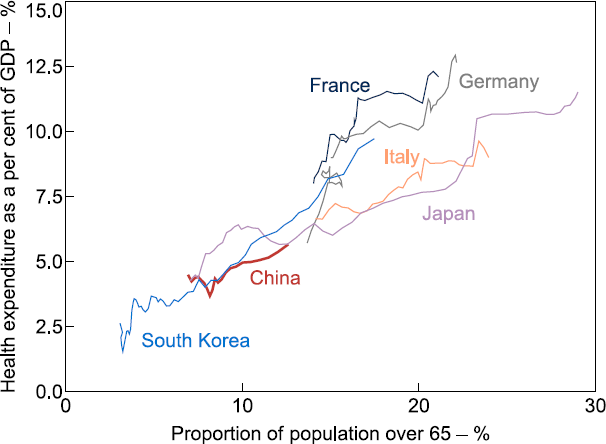
Sources: Author's calculations; OECD.
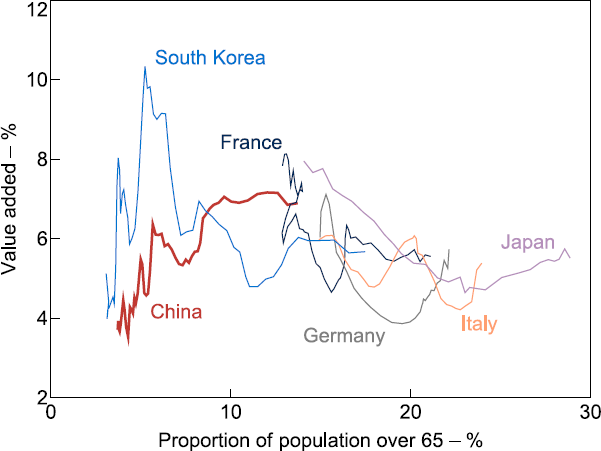
Note: Includes both residential and non-residential construction.
Sources: Author's calculations; OECD.
To test whether this is also the case for China, I take the panel approach described above, and replace GDP per capita as the dependent variable with sectoral contributions to GDP. In particular, I examine the effect of ageing on the proportion of provincial GDP that is contributed by the services sector (excluding real estate services), and the proportion contributed by construction. Formally, I estimate:
where Sector is services (excluding real estate) or construction. I again estimate this equation using decadal data to align with the census years, and construct the 20-year lag instrument in the same way described in Section 2.2. While I am able to estimate this equation for the construction sector contribution for each of the decades between 1990 and 2020, China's provinces only began reporting real estate services (which is needed to construct services excluding real estate) in their GDP data in 1992. I therefore estimate the model for the effect on services excluding real estate from 2000 onwards. I illustrate the relationship between the ageing instrument and each of these measures in Figures 11 and 12.
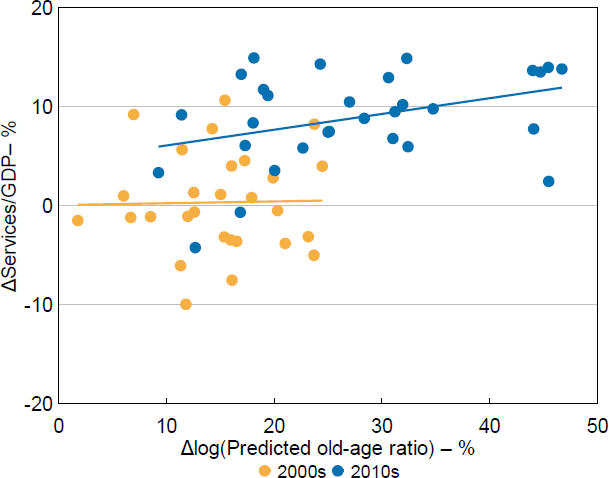
Note: Line of best fit shown for each decade.
Sources: Author's calculations; CEIC Data; National Bureau of Statistics of China.
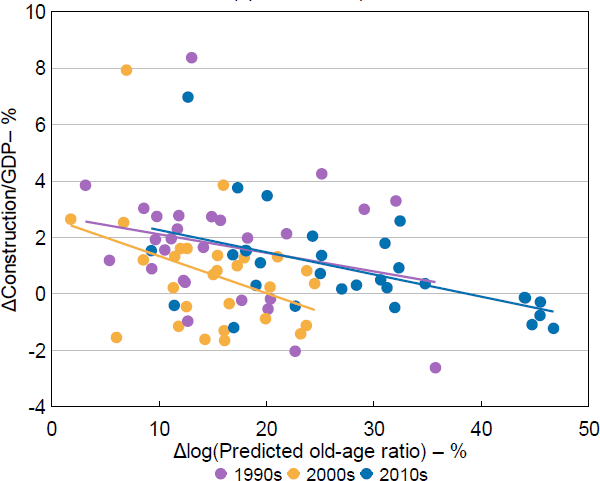
Note: Line of best fit shown for each decade.
Sources: Author's calculations; CEIC Data; National Bureau of Statistics of China.
As might be expected, these regressions suggest that an increase in the proportion of population aged over 60 results in an increase in the contribution of services to provincial GDP, with a 10 per cent increase in the proportion of the population over 60 leading to around a 1 percentage point increase in the sector's contribution to GDP (Table 5). On the other hand, an increase in the proportion of population aged over 60 leads to a 1 percentage point decrease in the contribution of construction to GDP. This aligns with the intuition that as the population ages, the structure of consumption shifts more towards services (such as health and aged care), while there is less need for new residential and infrastructure construction, as the formation of new households slows and the need for newly built infrastructure declines.
Applying these point estimates to China's national projected ageing trajectory would imply that the contribution of the services sector (excluding real estate) to national GDP could increase from its 2023 level of 48.7 per cent to 51.7 per cent by 2030. The construction sector's contribution would fall further from its 2023 level of 6.8 per cent to 3.6 per cent by 2030, using these estimates. In short, although China's demographic outlook poses a long-term headwind for the construction sector, it creates new opportunities to supply goods and services demanded by the ageing population.
| Services (excluding real estate) | Construction | |
|---|---|---|
| log(old-age ratio) | 0.099* (0.053) |
−0.104*** (0.031) |
| Controls | ||
| Year | Y | Y |
| Is Coastal | Y | Y |
| Is Coastal*Year | Y | Y |
| Observations: clusters | 58: 30 | 85: 30 |
|
Notes: ***, ** and * denote statistical significance at the 1, 5 and 10 per cent levels, respectively. Standard errors are in parentheses and clustered at a provincial level. |
||