
RDP 2025-08: Ageing and Economic Growth in China 3. Results
November 2025
3.1 Main estimates
Estimating the regression using ordinary least squares (OLS) and without the instrument suggests that a 10 per cent increase in the proportion of the population aged over 60 is associated with a 2.7 per cent decrease in nominal GDP per capita and is not statistically significant (Table 2). Applying the instrument in the regression, the coefficient is increasingly negative and becomes highly statistically significant. With the instrument, I find that a 10 per cent increase in the proportion of the population aged over 60 leads to a 7.2 per cent decrease in nominal GDP per capita.[8] Following MMP, this functional form relies on per cent (rather than percentage point) changes in the old-age ratio, such that a 10 per cent increase in the old-age ratio here refers to, for example, an increase in the old-age ratio from 10 per cent to 11 per cent, or from 20 per cent to 22 per cent (I test a specification with percentage point changes below). As a point of reference, in the 2010s the old-age ratio increased around 3.6 per cent per year. Running the instrumental variable regression without the time-varying control for whether a province is coastal, the estimate is somewhat more negative, with a 10 per cent increase in the old-age ratio leading to around a 9 per cent decrease in GDP per capita.
| OLS | Instrumental variables | ||
|---|---|---|---|
| 20-year lag | 20-year lag | ||
| log(old-age ratio) | −0.270 (0.181) |
−0.716*** (0.210) |
−0.899*** (0.202) |
| Controls | |||
| Year | Y | Y | Y |
| Is Coastal | Y | Y | N |
| Is Coastal*Year | Y | Y | N |
| Observations: clusters | 84: 28 | 84: 28 | 84: 28 |
| Notes: ***, ** and * denote statistical significance at the 1, 5 and 10 per cent levels, respectively. Standard errors are in parentheses and clustered at a provincial level. | |||
Unlike in MMP, in which the OLS estimates are more negative than the instrumental variable estimates, the OLS estimates here appear to be biased towards zero. That is, there may be some unobserved variables inducing a spurious positive correlation between ageing and growth which is corrected by the instrument. For example, if economic growth substantially improves life expectancy, greater growth in a province leads to a greater proportion of the population living to an older age, increasing the old-age ratio. In comparison, MMP argue that the OLS is biased away from zero for the United States due to younger migrants choosing to migrate to higher growth states. Over the period of observation in this paper, China's life expectancy increased significantly faster than that of the United States in the MMP study. The bias induced by the positive correlation between life expectancy and growth may therefore have a larger effect in the Chinese data than in the US data. That is, it could be that the unobserved factors inducing a negative correlation for the United States are dominated by unobserved factors inducing a positive correlation in China.[9]
I also test four other specifications for robustness (Table 3). First, instead of controlling by geographic location, I follow MMP in controlling for initial industry employment shares by province, interacted with the time fixed effect. This allows for the possibility that provincial industry structure is systematically related to the prior population age structure and future GDP per capita growth. This is another way of getting at the possibility of persistent shocks affecting both industry structure and age structure, and therefore inducing a correlation between ageing and growth through the incidence of later industry-specific shocks. Second, instead of controlling by geographic location, I use province fixed effects, to account for the possibility of persistent fixed differences in trends between provinces. Third, I extend the instrument to be calculated at t −20 (i.e. a 30-year lag), which makes the possibility of the age structure at that time being systematically related to growth prospects in the decade under study more remote. Fourth, I extend the instrument to t −30 (a 38-year lag, given the 1982 Census timing), for the same reason. All four of these specifications return significant negative estimates for the effect of ageing on growth around the value of the main specification: ranging from a 5.7 per cent to an 8.7 per cent decrease in nominal GDP per capita in response to a 10 per cent increase in the proportion of the population aged over 60.
| 20-year lag | 20-year lag | 30-year lag | 40-year lag | ||
|---|---|---|---|---|---|
| log(old-age ratio) | −0.868*** (0.199) |
−0.569** (0.287) |
−0.615*** (0.182) |
−0.806*** (0.180) |
|
| Controls | |||||
| Year | Y | Y | Y | Y | |
| Industry | Y | N | N | N | |
| Industry*Year | Y | N | N | N | |
| Is Coastal | N | N | Y | Y | |
| Is Coastal*Year | N | N | Y | Y | |
| Province fixed effect | N | Y | N | N | |
| Observations: clusters | 84: 28 | 84: 28 | 58: 30 | 28: 28 | |
|
Notes: ***, ** and * denote statistical significance at the 1, 5 and 10 per cent levels, respectively. Standard errors are in parentheses and clustered at a provincial level. |
|||||
An additional consideration is whether the log difference on log difference functional form is the most appropriate. The implication of this functional form is that equal per cent changes in the old-age ratio have the same effect on economic growth, rather than equal percentage point changes. For example, by this assumption, a doubling in the old-age ratio from 5 to 10 per cent should have the same effect as a doubling from 10 to 20 per cent. Another way of estimating the equation would be as a log difference in GDP per capita on a difference in the old-age ratio. That is, estimating the effect of a percentage point change in the old-age ratio (e.g. an increase in the old-age ratio from 20 per cent of the population to 21 per cent of the population). Formally:
This specification yields qualitatively similar effects of ageing on growth. The effect of ageing on growth is negative and significant, and a 1 percentage point increase in the old-age ratio (which would be equivalent to a 10 per cent increase when the old-age ratio is 10 per cent of the total population, and a 5 per cent increase when the old-age ratio is 20 per cent) would decrease GDP per capita by 3.7 per cent (Table 4). However, this functional form would have slightly different implications for how China's national-level ageing will affect its economy in the coming years.
| 20-year lag | |
|---|---|
| log(old-age ratio) | −3.710*** (0.985) |
| Controls | |
| Year | Y |
| Is Coastal | Y |
| Is Coastal*Year | Y |
| Observations: clusters | 84: 28 |
|
Notes: ***, ** and * denote statistical significance at the 1, 5 and 10 per cent levels, respectively. Standard errors are in parentheses and clustered at a provincial level. |
|
3.2 Applying the estimates nationally
To understand what these estimates imply about China's macroeconomic trends and growth outlook, I next apply the estimates to national level data. This exercise requires caveats. As MMP point out, estimates derived from variation amongst sub-national units cannot account for the effects of national level policies, such as a nationwide increase in the retirement age, or an increase in pension payments. It also cannot account for general equilibrium effects of population ageing. For example, an increase in the older population beyond current levels could put increasing strain on the fiscal sustainability of old age pensions, which could cause a decrease in government spending elsewhere, thereby reducing economic growth through other channels. Ageing would likely also affect the balance of savings and investment, which would have implications for the neutral rate of interest and the exchange rate. The bias on these estimates when applied nationally could be upwards or downwards, as it depends on the nature of the policies and general equilibrium effects at play.
For this exercise, I take the estimate of the effect of ageing on growth as a 7.2 per cent decrease in nominal GDP per capita for a 10 per cent increase in proportion of population aged over 60 and apply it to the UN's national-level projections of the old-age ratio (Figure 8). From 1981 to 1990, when the old-age ratio declined by around 3 per cent, demographic change added around 2.3 percentage points to nominal GDP per capita growth compared to the counterfactual of no change. In contrast, between 2011 and 2020, population ageing detracted around 28 percentage points from nominal GDP per capita growth relative to the counterfactual of no growth in the old-age ratio, as a result of the old-age ratio increasing 39 per cent.
For comparison, China's nominal GDP per capita in practice grew by 98 per cent over that period. That is, the estimates imply that nominal GDP per capita growth would have been more than a quarter higher in the absence of any increase in the old-age ratio over 2011 to 2020. Or put differently, the estimates imply GDP per capita in 2020 to be around 12 per cent smaller than if the old-age ratio had not changed over the 2010s. Between 2021 and 2030, ageing would be expected to detract another 28 percentage points from nominal GDP per capita growth relative to the counterfactual of no increase in the old-age ratio.
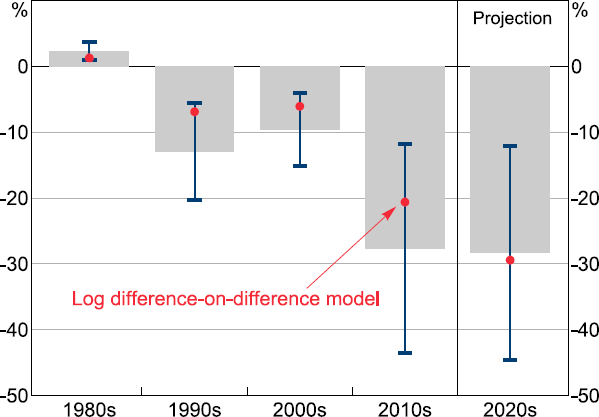
Notes: Effect of change in the old-age ratio on GDP per capita growth relative to a counterfactual of no change in the old-age ratio. Whiskers indicate 95 per cent confidence intervals.
Sources: Author's calculations; UN World Population Prospects 2022.
The implied reduction in GDP per capita growth in the 2010s is somewhat comparable to the reduction of potential output in OECD economies after the global financial crisis (Ball 2014).[10] The scale of the effect is testament to the importance of demographic structure for medium- to long-run economic growth. Another relevant illustration is the sizeable contribution to growth of the ‘demographic dividend’ that an expanding working-age population had for several east Asian economies in the 1970s (Mason et al 2022). However, it is also worth noting that China's nominal GDP per capita grew 253 per cent over the 2000s, meaning the overall decline in GDP per capita growth between the 2000s and 2010s was more than five times the amount of the decline that could be explained by the effect of ageing.
The 95 per cent confidence interval around this estimate suggests that the reduction of growth over the 2020s could be between 12 and 45 percentage points. An alternative approach would be to use the log-differences on differences functional form, discussed above. Over both the 2010s and the 2020s the old-age ratio is projected to increase by around a third. But in percentage point terms, the increase over the 2020s would be larger, implying that the effect of ageing on growth – shown as dots in Figure 8 – will increase from around 21 per cent in the 2010s to 29 per cent in the 2020s, rather than being about the same. Both estimates imply that ageing will have a large effect on growth in the 2020s relative to a counterfactual of no increase in the old-age ratio.
3.3 Implications
While these projections suggest a challenging demographic outlook for the economy, demographics are not necessarily destiny. Lim and Cowling (2016) point out that the economic effects of an increase in the dependency ratio driven by population ageing could be offset by policies that: increase the fertility rate, increase the retirement age, improve total factor productivity (TFP), increase the urbanisation rate, or increase the participation rate.
One approach to offsetting the demographic decline would be to directly attempt to reverse, or slow the decline through pro-natalist policies. Authorities have introduced policies designed to increase the birth rate such as by lifting the limit on the number of children a family can have, introducing financial and administrative incentives to have children in certain regions and seeking to address factors which increase the cost of child rearing (Department of Education, Skills and Employment 2022; Ji 2023). These approaches have failed to lift fertility so far, and the UN Population Division continues to project that fertility will not return to the levels of the early 2010s (Cai 2021; United Nations Population Division 2024). However, media have recently reported the possibility of wider-ranging support in the future directly from the central government to families with more than one child (Reuters 2024), and authorities have also introduced a nationwide childcare subsidy (Xinhua 2025). A step-up in support from the central government could impact fertility decisions more than incentives previously administered at the local government level.
Another approach to slowing the decline in the working-age population is to increase the retirement age. After rumours that such a policy was under consideration for some years, China adopted new legislation in September 2024 to gradually increase the statutory retirement age over the course of 15 years starting from 2025 (Zhao 2021; Reuters 2023; Xinhua 2024). The change entails an increase in the statutory retirement age from 60 to 63 for men, 55 to 58 for white-collar women, and 50 to 55 for blue-collar women. This policy, although gradual, could imply that the effect of ageing on growth in the future may be slightly smaller than estimated in this paper as the retirement age increases.
Rather than directly offsetting the decline in growth through demographic policies, another approach would be to attempt to keep growth stable by pursuing policies that would increase growth, all else equal. In particular, TFP improvements could play this role, with researchers identifying increasing human capital and continued urbanisation as a potential boon for China's productivity (Cai and Lu 2013; Marois, Gietel-Basten and Lutz 2021). The average years of schooling received by China's working-age population is expected to increase significantly over coming decades, as the cohorts newly entering the workforce are much higher educated than the cohorts leaving the workforce. Additionally, the rapid mechanisation of China's industrial production, and increasing focus on high-tech industries which are less labour intensive, are a salient source of growth in the capital stock, and potentially TFP growth. Indeed, China's top authorities have signalled that this approach, along with expanding services segments that serve the elderly population – the ‘silver economy’ – will be important aspects of the policy response to the ageing population (Xi 2024).
The risk of this kind of structural change is that it could increase the wage gap between more- and less-educated workers (especially between rural and urban labour; see, for example, Rozelle and Boswell (2021)). That is, although the average education will increase, the returns from this increase in human capital may disproportionately go to the highest educated, leaving behind less-educated cohorts, especially rural residents. Indeed, this kind of inequality could further inhibit consumption growth in China, in line with literature that argues that increased income inequality can be growth-inhibiting (Cingano 2014). Authorities could mitigate these concerns by improving the social safety net, thereby unleashing high household savings (Cai 2021).
Urbanisation is another continuing positive trend for China's productivity and growth. The productivity of China's urban labour force is substantially higher than for the rural population (reflecting factors such as industrial structure, health and educational attainment), and the process of urbanisation brings with it increased consumption and investment (IMF 2019). China's urbanisation rate of around 66 per cent is still well below that of developed countries, which tend to have urbanisation rates around 80 per cent or above.
However, despite the tailwinds of education, urbanisation and the increasing technological complexity of manufacturing, improving productivity growth in China remains a challenge. Similar to global trends, productivity growth in China has been in secular decline. In the Chinese context, researchers and international organisations variously attribute the slowing to declining business dynamism, resources misallocation between state-owned and private firms, a reduction in the exit of inefficient state-owned firms, and reduced efficiency of capital usage (particularly in infrastructure) (Brandt et al 2022; Cerdeiro and Ruane 2022; IMF 2023). That is, further structural reforms are needed to ensure expanding TFP growth and capital accumulation if authorities seek to exert upward pressure on China's growth rate at a time when demographics are pushing down potential growth.
Footnotes
By comparison, MMP estimate that a 10 per cent increase in the old-age ratio decreases real GDP per capita by 5.5 per cent for the United States. [8]
Or more pessimistically, it could be that the instrument is better at purging unobserved variable bias that induces a positive correlation than that which induces a negative correlation. [9]
Ball (2014) estimates an 8.4 per cent loss of potential output for a weighted average of OECD economies after the global financial crisis. These estimates are not directly comparable to those in this paper: the Ball estimates are real aggregate growth rates over around eight years, whereas this paper examines nominal per capita rates over ten years. However, the comparison does illustrate the importance of long-run structural features of the economy, even compared to major macroeconomic demand shocks. [10]