
RDP 2025-08: Ageing and Economic Growth in China 1. Introduction
November 2025
China's ageing population is often seen by commentators as one of the primary factors weighing on China's medium- to long-term economic growth prospects (e.g. Yiu et al 2023; Bicker 2024). The demographic challenge is also often cited as a reason for pessimism over long-term fundamental housing demand, and therefore as a factor expected to gradually reduce China's demand for materials used in construction, such as steel (Baird 2024). This paper seeks to test these assumptions by constructing quantitative estimates for how ageing affects economic growth in China, as well as the extent to which different sectors are expected to be affected by an increase in population ageing.
To do so, this paper applies the instrumental variable approach of Maestas, Mullen and Powell (2023) (hereafter ‘MMP’) to Chinese data in order to estimate the decadal effect of ageing on GDP per capita. A popular approach in the literature has previously been to estimate the effect of ageing on growth by estimating panel regressions of GDP per capita growth on the change in the old-age ratio in Chinese provincial data (Song and Gao 2022; Jiang and Zhao 2023; Yan, Li and Pan 2023; Yang, He and Chen 2023).[1] However, directly regressing growth on population ageing is potentially a problematic approach due to confounding variables such as internal migration, which is likely responsive to provincial growth, and life expectancy, which is likely to increase more rapidly in faster growing provinces.
To counter these kinds of unobserved variable bias in a study on US ageing and growth, MMP use the ‘predetermined component’ of population ageing in US states as an instrumental variable for ageing. This predetermined component is the growth in the old-age ratio that would be implied by the state's population structure in a prior period, aged forward to present. This paper applies the same instrumental variable approach to Chinese provincial-level data from national censuses between 1982 and 2020. Using this approach, I estimate the effect of ageing on nominal GDP per capita growth, as well as the effect of ageing on the contribution of services and construction to GDP.
Using this instrument, I find that population ageing has a negative and significant impact on nominal GDP per capita growth. Specifically, a 10 per cent increase in the proportion of the population aged over 60 (e.g. from 20 to 22 per cent of the population) leads to a 7.2 per cent decrease in nominal GDP per capita in the baseline specification. Applying this estimate to the national level requires some caution, as the provincial panel approach cannot account for common national policy changes in response to population ageing or general equilibrium effects of national ageing. But with these caveats in mind, the estimates in this paper imply that China's GDP per capita growth would have been more than a quarter higher in the 2010s, absent any increase in the old-age ratio.
These estimates suggest that the ageing population has already had a significant impact on economic growth in China and will continue to do so in the coming decades. However, the decline in growth in China since the 2000s has also been much larger than the contribution of ageing implied by these estimates. That is, demographic change is an important factor for China's growth prospects, but does not explain the majority of the slowing in China's growth rate.
1.1 Background and literature
China's old-age population is increasing relatively rapidly, with the proportion of the population aged over 60 expected to increase by more than a third over the 2020s. China's fertility rate has declined sharply since the mid-2010s, with the country experiencing a notable decline in fertility in recent years, including relative to other countries with ageing populations (Figure 1). The United Nations's (UN's) latest population projection scenarios now imply a significantly higher dependency ratio in the long-term, exacerbating the potential consequences of the demographic transition identified in prior literature (Cai and Lu 2013; Lim and Cowling 2016). The UN's 2022 baseline dependency ratio projection runs close to what was considered to be a low-fertility scenario in 2015 (Figure 2).
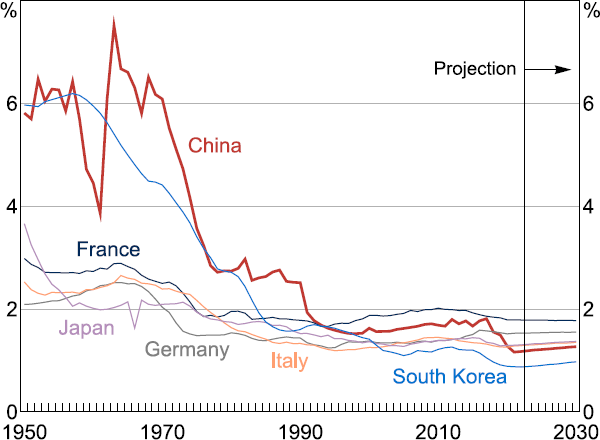
Source: UN World Population Prospects 2022.
Economic commentators generally believe ageing to have a negative effect on economic growth (IMF 2019; Cai 2021; Mason, Lee and Park 2022). An ageing population may be expected to put downward pressure on labour supply through a decreasing proportion (or even outright decline) of the working-age population, a decreasing support ratio (the ratio of workers to consumers), and decreasing labour productivity growth through factors such as decreasing investment (especially in infrastructure) due to reduced demand and potentially reduced political willingness. Population ageing may also lead to increased taxation being needed to finance old-age pensions and less flexible allocation of resources in the economy, such as through a less adaptable workforce to new technologies or to sectoral reallocation.
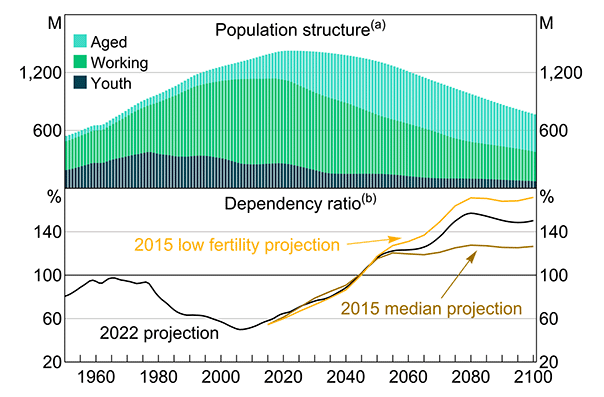
Notes:
(a) Youth is defined as 0–14 years, aged is defined as over 55 years for females and over 60 years for
males.
(b) Ratio of non-working-age to working-age population.
Sources: Author's calculations; Lim and Cowling (2016); UN World Population Prospects 2022.
However, theory does not guarantee a negative effect on growth per capita. The decrease in labour availability could also cause businesses to increase investment in technology, which could theoretically lead to a net increase in GDP per capita (Acemoglu and Restrepo 2017). That is, increased capital expenditure and labour productivity due to technological upgrading could outweigh the decline in the labour force and labour productivity resulting from the ageing population. For the most part though, the international empirical literature tends to find that the technology-upgrading effect is only a partial offset, and the overall effect of ageing on growth per capita is negative (Aksoy et al 2019; IMF 2019; Bodnár and Nerlich 2022; MMP).
As in the international literature, there are a mix of views in the Chinese academic literature, though most of the evidence finds a negative effect of ageing on China's economic growth (see Ni, Chen and Qiu (2014) for a literature review). Cai (2021) argues that demographic change may weigh on China's growth through: reducing demand for infrastructure and business investment; labour shortages and wage inflation, leading to the loss of traditional comparative advantage in labour-intensive exports; and declining consumption growth.
1.2 Approach
As discussed above, prior literature has attempted to address the question of how ageing affects per capita growth in China by estimating panel regressions of GDP per capita growth on the change in the old-age ratio in Chinese provincial data. This approach suffers from potential unobserved variable bias through factors that may relate to both ageing and growth, such as internal migration and life expectancy.
For example, suppose a negative trade shock hit a trade-exposed province, which caused a decline in economic growth due to reduced trade receipts. This shock may also induce younger workers to move to another province for work. This negative trade shock would therefore induce a correlation between economic growth and the proportion of the old-age population in the province, which could be mistaken for causation running from a change in the old-age population. Indeed, migration has historically been positively correlated with provincial GDP growth, indicating that migrants may choose their destinations in a way correlated with provincial growth (Figure 3). Another source of bias could be the fact that increased economic growth may itself increase life expectancy and therefore the old-age ratio, which would induce a spurious positive correlation between ageing and growth. Supporting this concern, life expectancy has been positively correlated with provincial economic growth over the past two decades (Figure 4).
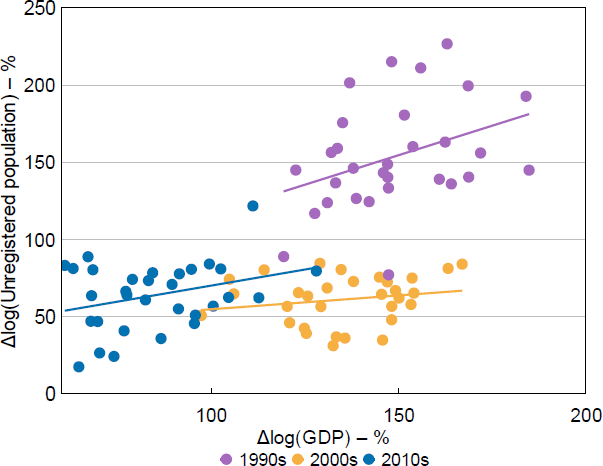
Note: Measures migration as the log difference in the ratio of the total usual population of the province to the population with household registrations in that province.
Sources: Author's calculations; CEIC Data; National Bureau of Statistics of China.
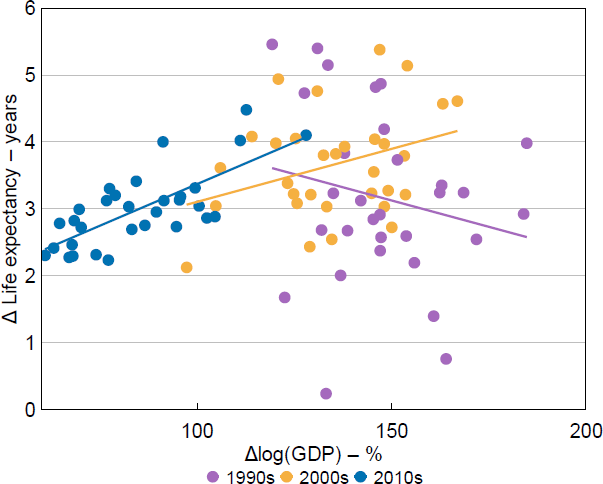
Sources: Author's calculations; CEIC Data; National Bureau of Statistics of China.
The approach in this paper applies the instrumental variable approach in MMP to Chinese data to counter these possible biases. The instrument in MMP is the predetermined component of ageing. Specifically, MMP use the US decadal censuses to estimate the effect of population ageing on growth over a 10-year period. For example, regressing states' GDP per capita growth on the change in the ratio of the population aged over 60 to the total population between 2000 and 2010, MMP would use as an instrument the change in the ratio of the population over 60 to the total population implied by a state's age distribution in 1990. MMP would age the 1990 distribution forward to 2000 and 2010 using the national-level survival rates. The idea behind this instrument is that this predetermined component of ageing should be correlated with realised ageing, but be sufficiently pre determined that it is uncorrelated with expectations of changing economic outcomes, or other shocks, in the decades ahead.
This paper is most closely related to Ye, Chen and Peng (2021), who also use the MMP instrumental variable approach for China, and find that a 10 per cent increase in the old-age ratio decreased real GDP per capita growth by 2 per cent over five years. This paper differs in that it uses a 10-year lag instrument (and 20- and 30-year lags for robustness) rather than only a 5-year lag in Ye et al (2021), and is therefore likely to be more robust to persistent shocks or endogenous expectations (see Section 2.3). It also uses 10-year rather than 5-year brackets of ageing and growth, comparable to MMP. Additionally, this paper has the benefit of the full decade of 2010–2020 census data rather than ending at 2015, as well as conducting additional sectoral exercises using the instrument in Section 4.[2]
Footnotes
In this paper, the old-age ratio refers to the population aged over 60 as a proportion of the total population. [1]
This paper also uses nominal GDP per capita rather than real GDP per capita as in Ye et al (2021). These estimates therefore also include the relative regional effects of population ageing on prices. [2]