
Reserve Bank of Australia Annual Report – 1971 The Year in Brief
For the Australian economy, 1970/71 was a year of mixed performance. The rate of increase in prices (5.4 per cent according to the consumer price index), although towards the lower end of the range experienced recently in other countries, was the highest in more than a decade. In addition, problems of important rural industries worsened. On the credit side were the maintenance of a generally high level of activity in the economy and the continued expansion of non-farm production, even if at a rate somewhat lower than in the past few years. Australia's international liquidity increased strongly during the year and at 30 June 1971 was at its highest level ever. This outcome owed much to an unprecedented level of private capital inflow in the second half of the year.
Signs of growing pressure on resources had led the Reserve Bank in March/April 1970 to adopt a more restrictive monetary policy; this, plus the impact of the unusually large surplus in Commonwealth Government transactions during the June quarter, resulted in a marked tightening in domestic financial markets during the closing months of 1969/70. As 1970/71 opened, the overall rate of expansion in demand appeared to be slackening; the dwelling industry, in particular, was being affected by a substantial fall in the availability of finance. While, at that stage, the future course of demand was far from certain, the balance of probability was against undue easing. Spending by public authorities was expected to continue to rise strongly in the year ahead and some action had already been taken to stimulate an increase in the flow of lending for housing. On the external side, Australia's international liquidity at the beginning of 1970/71 was at a reasonably satisfactory level, due in part to the upsurge in private capital inflow in the June quarter 1970. Prospects on current and capital accounts together suggested that the balance of payments was unlikely to pose problems during 1970/71.
With these prospects, it was not at all clear whether, or when, policy would need to be modified. In the event, monetary policy remained restrictive and financial conditions, although moderated by capital inflow, were fairly constrained throughout 1970/71. There were some movements at the short end of the market, but interest rates generally maintained high levels. Government securities were in strong demand during 1970/71; in the period of seasonal upswing in liquidity, demand was heavily directed to short term securities, especially Treasury notes, but in the final four months of the financial year investor preference tended to shift towards longer term securities. The large take-up of government debt by the non-bank private sector contributed significantly to the tightness in private financial markets and to pressure on trading banks' liquidity. Trading bank lending was quite restrained throughout the year; in April 1971 the Statutory Reserve Deposit ratio was lowered by 0.5 per cent to 8.9 per cent to avoid undue pressure on bank liquidity and bank lending.
The announcement in February of the failure of a large mining investment company and subsequent share market disturbances had pronounced repercussions in financial markets in the second half of the year. By June 1971, financial markets had become somewhat more settled but some effects of the disturbances, among them a more cautious attitude by investors, were still evident.
The growth in total spending, in real terms, tended to ease in 1970/71 to a rate slightly below that of potential supplies. This was reflected in easier conditions in the labour market as indicated by declines in job vacancies and by some increase in the number of registered unemployed. Nevertheless, by earlier and everseas standards the rate of unemployment was still quite low. In real terms, consumer spending increased by only a little over 3 per cent in 1970/71 and outlays on dwellings fell slightly. Business investment recorded a substantial increase. On the production side, output of minerals and metals continued to grow strongly but the increase in industrial production was lower than in other recent years; rural output fell slightly.
Rising prices were a matter of concern in the early part of the year but there were grounds for hoping that, with demand pressures somewhat reduced, the rate of increase would gradually moderate. However, the decision announced in December in the National Wage Case to raise award wages by 6 per cent made it necessary to re-examine this view. Not only did it make an early easing in the rate of price increase less likely but it added to the possibility of inflationary expectations developing within the economy. Monetary policy was not tightened further but the Government, whose expenditure was running ahead of the levels envisaged in the Budget, announced early in 1971 cuts in its spending and suspension of the taxation allowance on investment in manufacturing plant and equipment. It foreshadowed possible action to increase the degree of competition both within the economy and from abroad; legislation has since been passed to prohibit resale price maintenance and a review of the tariff structure has been instituted.
GRAPH 1 SELECTED ECONOMIC INDICATORS
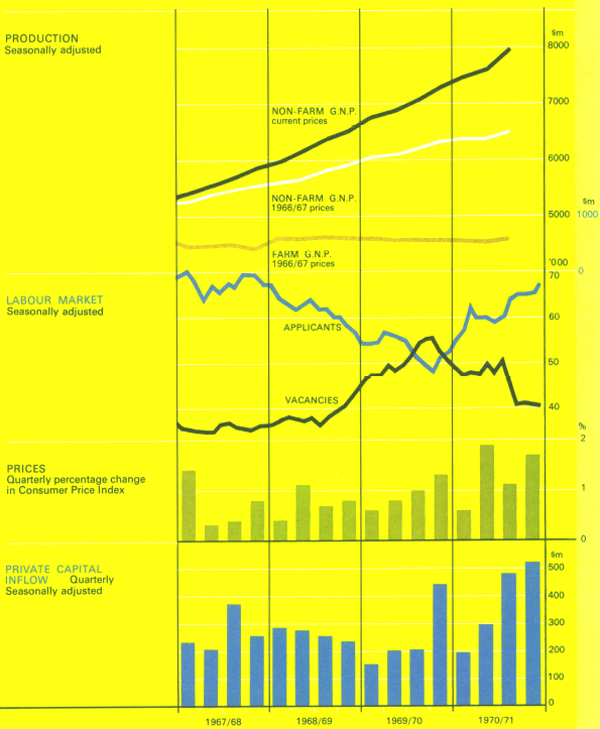
The rate of increase of spending did not accelerate during the second half of the year, as might have been feared, and, over this period, appeared to be slightly below the rate of growth in capacity to produce. However, little evidence was seen of easing in the growth of prices and this continued to argue against any early relaxation in monetary policy.
Export earnings in 1970/71 fell short of expectations, mainly because of a further substantial decline in wool prices. However, capital inflow reached a very high level, especially in the second half of the year, and was sufficient to finance the current account deficit and yield a substantial addition to Australia's international liquidity.
The progressive relaxation of monetary policy in the United States led to a marked easing in international money markets during 1970/71. In a number of countries in which policies of monetary restraint were in force, among them Australia, this development contributed to large inflows of capital. In the case of Australia, it is probable that the sensitivity of capital flows to differences vis-a-vis the rest of the world in the cost and availability of finance has been increased by growing links between Australian institutions and overseas financial markets. A high degree of responsiveness of capital flows, in a system of fixed exchange rates, raises difficulties for the conduct of an independent monetary policy. The increased capital flows into Australia during the seasonally tight months towards the end of both 1969/70 and 1970/71 demonstrated the potential for inflows of funds to ease financial stringencies and soften the impact of monetary policy.
The large short term international capital flows in 1970/71, mainly between the United States and Europe, were at first largely a response to a shift in interest rate differentials but in early 1971 they became increasingly speculative in nature; the strains these caused in foreign exchange markets led in May 1971 to West Germany and the Netherlands allowing their currencies to float and to Austria and Switzerland appreciating their exchange rates. Although the speculative flows into Europe declined after these actions, the changes did little towards solving the broader problem of the large continuing deficit in the United States balance of payments and the resulting outflows of United States dollars which have been major factors contributing to the recent currency instability.