
Reserve Bank of Australia Annual Report – 1971 Balance of Payments
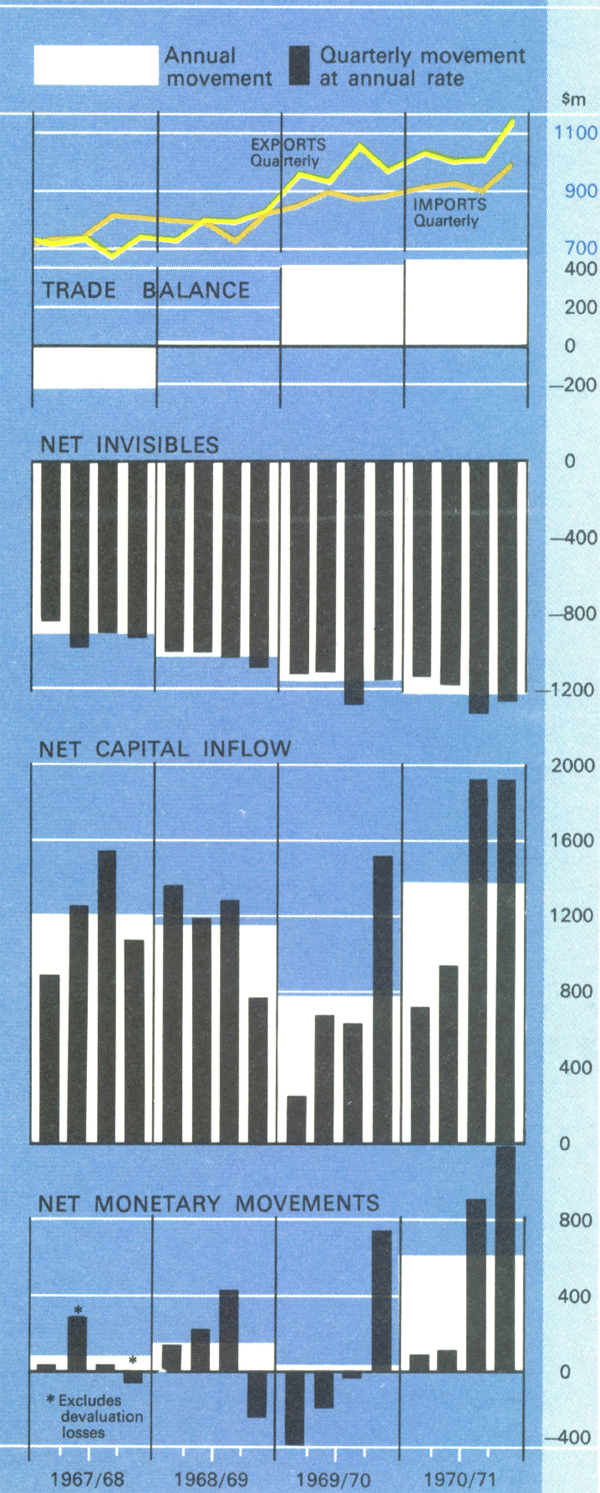
The growth of both exports and imports slackened in 1970/71; at $446 million, the trade surplus was a little higher than in 1969/70. However, with net invisible payments continuing to rise, the current account deficit widened. Capital inflow reached very high levels, especially in the second half of the year, and was sufficient to finance this deficit and yield a sizeable overall surplus in the balance of payments.
Exports
Exports increased by 6.5 per cent in 1970/71, compared with 23 per cent in the previous year. A major cause of the slackening in growth was the decline of about 28 per cent in the value of wool exported. Non-rural exports recorded a solid rise but the rate of increase was markedly lower than in other recent years. In 1970/71, non-rural exports were, for the first time, about equal in value to rural exports.
GRAPH 7 EXPORT AND IMPORT PRICE INDEXES
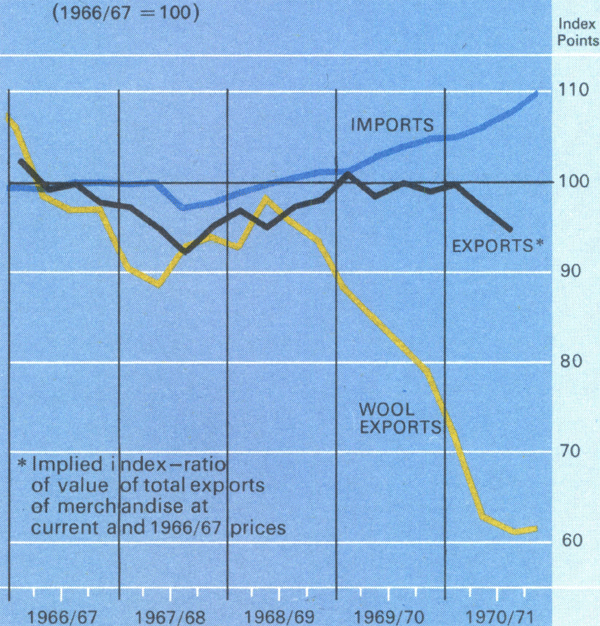
Proceeds from wool exports were the lowest in more than 20 years. This reflected both substantially lower prices and a decline in the quantity of wool exported; there were sizeable additions to stocks of wool in Australia, on farms as well as with the Australian Wool Commission. Other rural commodities fared better. Unfavourable harvests in some producing countries abroad contributed to the improved market conditions for wheat and most other cereals. Wheat and flour exports increased by 26 per cent to $454 million which was their highest level ever for a financial year. They included substantial credit sales to the United Arab Republic and several other countries which previously had not been important customers; these sales more than offset a decline in shipments to China. The value of sugar exports rose by 29 per cent in 1970/71 to $150 million. Following the large increase in the previous year, meat exports recorded only a small rise in value in 1970/71.
Exports of minerals and metals grew by 11 per cent in 1970/71, well below the rate of increase of other recent years. Shipments of iron ore again rose strongly, and totalled $374 million for the year. Japan continued to provide the market for over 85 per cent of these shipments. Exports of coal amounted to $206 million, an increase of 20 per cent over 1969/70; although demand from Japan weakened in the course of the year demand from other markets remained strong. Shipments of iron and steel declined considerably, reflecting mainly the impact of growth in local demand on tonnages available for export. Following two years of strong growth, exports of non-ferrous metals and alloys showed little change in 1970/71.
Exports of manufactured goods maintained the rate of increase of about 25 per cent recorded in 1969/70; sales of motor vehicles and machinery again rose strongly.
Imports
Imports grew by about 6 per cent in 1970/71 compared with 11 per cent in the previous year. A major reason for the slower growth was the effect on petroleum imports of expanded production from the Bass Strait fields; there was also a decline in purchases abroad of government equipment and civil aircraft. Other categories of imports rose by about 10 per cent, or at about the same rate as domestic expenditure; in 1969/70, when domestic resources were under greater pressures, the rate of growth of imports had been considerably above that of expenditure.
The United Kingdom's share of the Australian market continued to decline in 1970/71; Japan, the United States and the European Economic Community all recorded gains in market shares.
Current Account
The current account deficit in 1970/71 of $777 million was a little over $30 million above that of the previous year. The trade surplus increased by $35 million but this was more than offset by the rise in net invisible payments from $1,157 million in 1969/70 to $1,223 million in 1970/71. The rate of growth in the net deficit on invisibles (6 per cent) was considerably below that of the previous few years, a major factor being a slackening in the growth of income payable abroad on direct and other investments.
Capital Movements
A feature of Australia's balance of payments in 1970/71 was the strength of capital inflow. The total for the year of $1,380 million was the highest ever recorded in a financial year.
There was again a net outflow on official capital account, but it was considerably below the previous year's outflow. Redemptions of maturing loans were substantially greater than new loan raisings abroad by the Commonwealth Government but the excess was not as great as in 1969/70. Only $15 million of new money (a loan in Dutch guilders) was raised abroad in 1970/71; new raisings in 1969/70 amounted to $48 million. However, redemptions also declined sharply. Credits associated with purchases of civil aircraft and defence equipment gave rise to a net inflow of $26 million in 1970/71 compared with an outflow of $19 million in 1969/70. After allowing for other items, the net outflow on official capital account amounted to $67 million, less than half the previous year's figure. Exports of wheat on credit again exceeded receipts from credit shipments, giving rise to a net outflow of $39 million from marketing authority transactions; the previous year's outflow was $47 million.
Net private capital inflow in 1970/71 was a little under $1,500 million compared with $1,007 million in the previous year. In the September quarter the rate of inflow was relatively low; there appear to have been substantial repayments in this period of funds borrowed during the tight financial conditions of the final quarter of 1969/70. Capital inflow rose strongly in the December quarter and increased further in each of the following two quarters. Both direct investment and portfolio investment (including institutional loans) appear to have increased strongly during 1970/71. Statistics of remittances through the banking system indicate that the increase in capital inflow was spread over a fairly wide range of sources. In the first half of the year net remittances from the United States were low but they rose very sharply during the remainder of the year.
GRAPH 8 BALANCE OF PAYMENTS
Seasonally adjusted
As in earlier years, the existence of favourable opportunities for long term investment, particularly in the development of natural resources, was undoubtedly a major factor underlying the large inflow of foreign capital. An important additional influence in 1970/71 seems to have been the change in domestic financial conditions relative to those abroad. Financial conditions in Australia tightened significantly in the June quarter of 1969/70 and remained generally tight during 1970/71 but, in overseas financial markets, interest rates declined sharply in the course of 1970 and early 1971 and funds became more readily available. There is evidence that a good number of businesses, including companies with overseas affiliations, responded to these developments by switching from domestic to overseas sources of finance. Although the information available is far from complete and is subject to a number of reservations, indications are that a significant proportion of this borrowing was on a fairly short term basis. Recent experience suggests an increased consciousness, at least among some larger businesses, of overseas sources of finance as alternatives to domestic borrowing; to some extent, this has been a consequence of the growing links between overseas and Australian financial institutions. The guidelines policy, in reducing access by overseas controlled companies to the Australian capital market, is another factor tending to encourage capital inflow.
| As at 30 June | $ Million | ||||
|---|---|---|---|---|---|
| 1960 | 1965 | 1969 | 1970 | 1971 | |
| Gold | 133.0 | 205.0 | 230.5 | 240.9 | 227.1 |
| Special Drawing Rights with I.M.F. | – | – | – | 78.6 | 146.4 |
| I.M.F. Gold Tranche | 64.8 | 111.6 | 203.5 | 216.8 | 186.4 |
| US Dollars | 73.3 | 120.2 | 368.2 | 370.9 | 696.4 |
| Sterling | 737.3 | 965.1 | 586.0 | 617.1 | 947.1 |
| Other Foreign Exchange | 1.1 | 1.5 | 31.5 | 13.8 | 76.7 |
| TOTAL | 1,009.5 | 1,403.3 | 1,419.7 | 1,538.1 | 2,280.1 |
The particularly high level of capital inflow into Australia in the second half of 1970/71, which coincided with the re-emergence of disturbances in the international monetary system, prompted suggestions that speculative inflows of funds might have been involved. During and after the currency crisis in Europe in May, the Reserve Bank kept a close watch on movements of funds into Australia. However, none of the available information gave reason to believe that substantial speculative inflows took place.
Monetary Movements
In 1970/71, capital inflow was well in excess of the deficit in the current account of the balance of payments and there was a positive net monetary movement of $602 million ($37 million in 1969/70). Official reserve assets, changes in which are the major component of the net monetary movement, rose by $742 million in 1970/71; $64 million of this increase represented Australia's share of the second allocation of Special Drawing Rights with the International Monetary Fund. The level of official reserve assets at 30 June 1971, $2,280 million, was the highest ever recorded; however, there have been earlier periods when their level expressed as a proportion of imports has been higher.
The table shows the disposition of official reserve assets. Holdings of United States dollars and sterling increased strongly in 1970/71 and remained the main components; there were also increases in holdings of deutschemarks and Swiss francs. The amount of Special Drawing Rights held, $146 million, comprised $139 million received in the two allocations made so far and $7 million which Australia exchanged into foreign currencies for other participants in the scheme. In December 1970, Australia's quota with the International Monetary Fund was increased by $148 million to $594 million. Of the increased subscription $37 million was paid in gold; this increased Australia's gold tranche position and so did not affect the level of official reserve assets. The gold tranche position is the amount that Australia may draw essentially automatically from the International Monetary Fund. In addition, Australia may draw its credit tranches subject to certain conditions; as a result of the quota increase, the amount of the credit tranches was raised from $446 million to $594 million.
Other Developments
Australian links with international institutions were extended during the year. In December 1970 the Reserve Bank became a shareholder of the Bank for International Settlements and in June 1971 Australia joined the Organisation for Economic Co-operation and Development.
In the field of foreign exchange, the Reserve Bank, in consultation with the other banks, is reviewing the procedures by which foreign transactions are handled within the Australian banking system. Existing foreign exchange practices have been virtually unchanged for many years, while substantial changes have taken place in the pattern of international trade and finance.
During the May currency crisis in Europe some precautionary actions were taken by Australian banks. Between 6 May and 10 May the trading banks suspended quotations for Continental currencies and the Japanese yen. The Reserve Bank, which usually quotes to the banks rates at which it will buy and sell United States dollars, pitched its rates conservatively in this period and, for a time, reduced the term of its forward dollar quotations from six months to one month.