
Reserve Bank of Australia Annual Report – 1971 Economic Developments Abroad
Economic developments abroad during 1970/71 that were of relevance to Australia included continued rapid rates of price increase in many of the industrial countries, a generally lower level of interest rates in major international money markets and, towards the close of the year, the re-emergence of severe disturbances in foreign exchange markets.
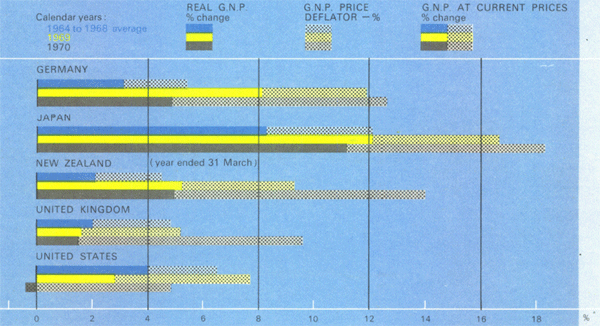
Strong inflationary pressures, already much in evidence in 1969 in most of the major industrial countries, continued in 1970; France, Germany, Italy, Japan, the United Kingdom and the United States all experienced price increases, as measured by G.N.P. deflators, of more than 5 per cent. The rate of price increase in 1970 for the major industrial countries as a group was about 5.5 per cent compared with 4.6 per cent in the previous year and an average around 2.5 per cent per annum in the first half of the nineteen-sixties. Analysis of broader groups of countries reveals a less uniform picture but nevertheless indicates that the tendency towards more rapid price increases has been fairly general among the more developed countries.
Most countries had responded to the emergence of strong inflationary pressures by moving at various stages towards policies of restraint. Because of institutional and political factors, use of fiscal measures was limited; heavy emphasis was placed on monetary policies. The policies followed have had more effect on production and employment than on costs and prices. Real output of the major industrial countries grew by only 2.4 per cent in 1970, about half the average annual rate of growth during the previous decade. This overall result for 1970 owed much to an absolute decline in output in the United States. Canada, France, Germany, Italy and Japan also experienced slower growth than in 1969, and in the United Kingdom the growth of real output was below 2 per cent for the second successive year.
In most of these countries aggregate demand at end 1970 had fallen below productive capacity; however, the extent of unused capacity differed considerably among countries. In the United Kingdom and the United States, substantial slack had developed and unemployment had increased markedly. At the other extreme, Germany and Japan experienced some easing in demand pressures, but activity and employment remained quite high. In the first half of 1971, signs of any significant easing in inflation were few; rates of price increase of 5 per cent per annum and higher continued to be common.
During the first half of 1971, domestic policies in most countries continued to reflect the persistence of inflation. However, in the United States, despite continuing cost inflation, domestic policies have shifted to an overall expansionary stance. Monetary policy was progressively relaxed during 1970 and early 1971 and there was also some easing of fiscal policy. Modest growth resumed in the United States in the first half of 1971.
The slowdown in growth in the major industrial countries appears to have had some impact on world trade. In the latter part of 1970 and in early 1971, the growth in the value of world trade, whilst still fairly strong, fell from the extremely high rates in evidence since 1968; both prices and volume appear to have been affected. Of particular relevance to Australia were declines in prices for wool and non-ferrous metals.
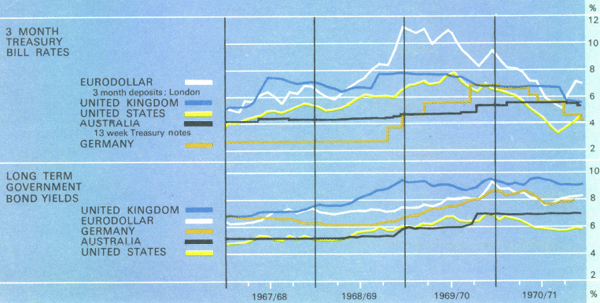
The change in stance of monetary policy in the United States had significance well beyond that country's domestic economy. As financial conditions eased in the United States interest rates declined substantially, resulting in a heavy outflow to Europe of funds that had been borrowed, particularly by United States banks, during the tight monetary conditions of 1969. The large capital movements exerted strong downward pressures on Eurodollar interest rates and European money market rates. Despite a rise in some rates in the June quarter 1971, the declines, especially in short term interest rates, over 1970/71 were substantial (see graph 3). In addition, the large capital inflows posed serious problems for a number of European countries, particularly where domestic conditions called for a continuation of tight monetary policies.
GRAPH 2 PRODUCTION AND PRICES IN SELECTED COUNTRIES
Despite the slack in the domestic economy and continued restraints on certain capital outflows, the United States balance of payments remained in heavy deficit in 1970 and the first half of 1971 and foreign central banks added further to their holdings of United States dollars. Concern over this situation was the underlying cause of a massive speculative movement in early May out of United States dollars and mainly into European currencies. In response, a number of European countries took exchange rate action. The German and Netherlands authorities withdrew official support of their exchange rate parities and allowed their currencies to float; during June 1971, the average rates for the deutschemark and the Dutch guilder were 4.2 per cent and 1.6 per cent respectively above their par values. Two other European countries appreciated their currencies, Austria by 5.05 per cent and Switzerland by 7.07 per cent. Belgium allowed its “free market” rate for capital transactions to appreciate beyond the official rate.
The speculative disturbances had little apparent impact on sterling, reflecting the strengthening that has taken place in the United Kingdom balance of payments. The current account remained in substantial surplus during 1970/71 and with interest rate differentials attracting a large inflow of capital, the United Kingdom was able to reduce considerably its short term official borrowings and to add substantially to official reserves. The Sterling Guarantee Agreements, drawn up in 1968 between the United Kingdom and other sterling area countries, including Australia, as part of a scheme for the support of sterling, expire in September 1971. The United Kingdom has not yet announced the result of negotiations concerning extension of the Agreements. Terms for entry by the United Kingdom into the European Economic Community were agreed in negotiations concluded towards the end of June 1971, but a decision regarding entry will not be taken before late 1971. It has been agreed that in the event of its joining the Community, the United Kingdom will discuss with its Community partners possible ways of effecting an orderly and gradual rundown of the official sterling balances. No specific undertakings on methods and timetables have been given; these would be matters for discussion after entry. The United Kingdom has stated a number of conditions that any proposed change in the reserve role of sterling would have to satisfy. It would have to be acceptable to official holders of sterling, who would need an alternative reserve asset; it should not impose an unacceptable burden on the United Kingdom's resources and balance of payments; and it should promote the stability of the international monetary system.
GRAPH 3 INTEREST RATES —
AUSTRALIA & OVERSEAS
The major source of the record increase in international liquidity in 1970/71 (about US $20,000 million) was the large accumulation of United States dollars by various central banks. For the most part, this accumulation reflected the deficit in the United States balance of payments. However, part of it was the result of some central banks investing, in the Eurodollar market, funds which were loaned to commercial borrowers and subsequently sold back to the central banks. Major European central banks have agreed for the time being not to place additional funds in the market and in appropriate circumstances to withdraw funds; they have also set up a committee to consider the need for guidance and supervision of the Euro-currency market.
International liquidity was augmented by a second allocation on 1 January 1971 of Special Drawing Rights with the International Monetary Fund totalling the equivalent of US $2,949 million. Member countries' borrowing rights from the International Monetary Fund also were increased substantially in 1970/71 as a result of increases totalling US $7,600 million in their quotas with that institution.