
Reserve Bank of Australia Annual Report – 1971 Other Activities of The Bank
NOTE ISSUE
GRAPH 16 NOTES IN CIRCULATION
Value at end June
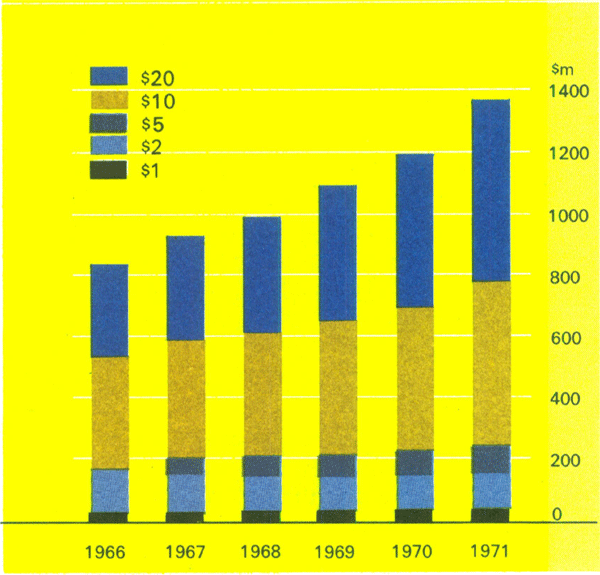
The upward trend in Australian notes in circulation continued during the year with an increase of $174 million compared with $104 million in 1969/70. The greater part of the increase was again in the $20 denomination which now represents about 44 per cent of the value of notes in circulation.
The volume of major items of security printing produced over the last four years by the Printing Division of the Note Issue Department is shown in the table below.
| Millions of pieces | |||||
|---|---|---|---|---|---|
| YEAR ENDED JUNE | Australian Notes | Postage Stamps | Postal Orders | Other Postal Material | Cheques |
| 1968 | 151 | 1,236 | 13 | 80 | 57 |
| 1969 | 257 | 1,148 | 14 | 83 | 49 |
| 1970 | 306 | 1,194 | 15 | 117 | 9 |
| 1971 | 328 | 1,303 | 17 | 95 | 8 |
GRAPH 17 RESERVE BANK RURAL CREDITS ADVANCES
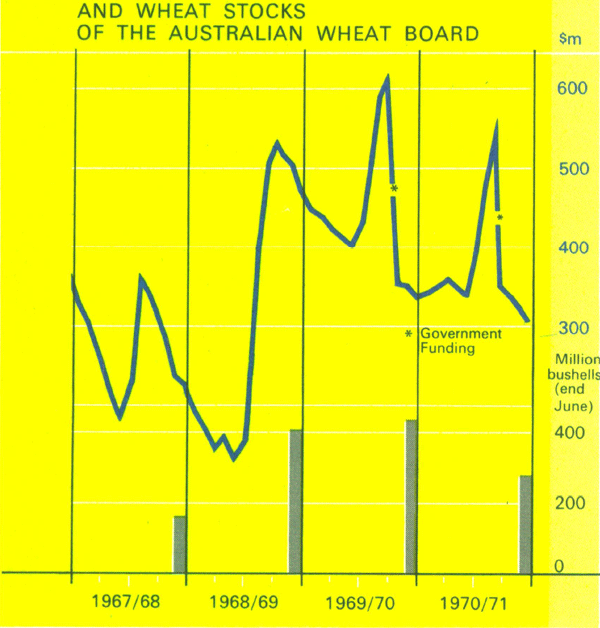
RURAL CREDITS DEPARTMENT
Advances of the Rural Credits Department of the Bank, which provides seasonal finance to assist in the marketing, processing or manufacture of primary produce, reached a peak of $566 million in March 1971, $56 million lower than the record seasonal peak of $622 million in March 1970. The reduction reflected falls in advances for wheat and dairy produce, partly offset by higher advances for barley, oats, rice and sugar. At 30 June 1971 outstanding advances totalled $308 million compared with $358 million a year earlier.
The Australian Wheat Board' indebtedness on account of the 1969/70 Wheat Pool was repaid on 31 March 1971 from proceeds of a loan of $190 million by the Commonwealth Government to the Wheat Board. This followed similar action a year earlier when the Government provided $250 million for the previous pool.
In addition to the commodities already mentioned, finance was provided for a variety of others, including canned and dried fruits, cotton, eggs, superphosphate, almonds, grain sorghum, peanuts, ginger, coffee, wine and spirits.
BONDS AND STOCK
Four Commonwealth cash loans were handled during the year by the inscribed stock registries conducted by the Bank for the Commonwealth Government. Each cash loan was combined with offers of conversion to holders of maturing securities. These loans increased the number of non-rebate series on issue from 25 to 32 while maturities reduced the number of series attracting a 10 per cent taxation rebate on interest from 42 to 38.
Two series of Special Bonds matured during the year and the holders were offered the option of converting them to the series then on issue. The tap issue of 13 and 26 week Treasury notes continued throughout the year. The first series of Drought Bonds closed on 31 August 1970; Series 2 came on issue the following day.
EXCHANGE CONTROL
No restrictions are placed on current payments from Australia; in addition, overseas-owned capital has continued to be freely remittable.
Proposals involving direct investments overseas by Australian residents generally have been readily approved, as in past years, especially where resident participation in overseas ventures might be expected to bring significant benefits from the national viewpoint, such as the promotion of Australian exports. Portfolio investment abroad by Australian residents normally has not been permitted.
BORROWING IN AUSTRALIA BY OVERSEAS INTERESTS
The Government' guidelines policy, which was first introduced in 1965 and revised in 1969, continued in operation. Under the policy, all companies (including finance companies), which are more than 25 per cent owned directly or indirectly by overseas interests are asked to consult with the Reserve Bank about their local borrowing plans. Borrowing plans of up to $100,000 in any one year by any one group are exempted from this request.
The policy provides for reasonable access to local borrowings for normal requirements of working capital and for approval to be readily given to borrowings for the specific purpose of financing export transactions.
Borrowings to assist finance capital expenditure are determined on the basis of formulae related to increases in funds employed, the period the overseas enterprise has been established in Australia and the proportion of equity held by Australians.
LIAISON
In addition to its meetings with banks and other financial institutions, the Bank maintains close contacts with rural and other industry and commerce. These contacts yield an important part of the information available to the Bank for analysing current trends and assessing future prospects in the economy. The co-operation the Bank receives in its liaison activities is greatly appreciated.
RESEARCH AND OTHER GRANTS
The Rural Credits Development Fund approved grants totalling $695,000 during 1970/71. Grants were made for research and extension projects concerned with primary industries. In addition three Senior Research Fellowships (Agriculture) were awarded during the year. The Fellowships provided the opportunity for experienced research workers to apply their talents towards the resolution of practical problems in agriculture in the relatively short term. The Fund is financed by a transfer each year of half the net profits of the Rural Credits Department.
The Economic and Financial Research Fund continued to provide support for post-graduate research in economic and financial topics with particular reference to Australia. In 1970/71, grants amounting to $74,000 were approved from the Fund.
PUBLICATIONS
During the year another two papers were published in the series relating to a project being undertaken in the Bank to construct a quarterly model of the Australian economy. Further papers on the model are still to be issued. A volume entitled “Australian Banking and Monetary Statistics 1817–1945” was recently published; a second volume covering the period 1945–1970 is in preparation.
In addition, the Bank continued to publish a range of statistical and other information, including its monthly Statistical Bulletin.