
Reserve Bank of Australia Annual Report – 1971 Reserve Bank Policy
GRAPH 14 SELECTED INTEREST RATES
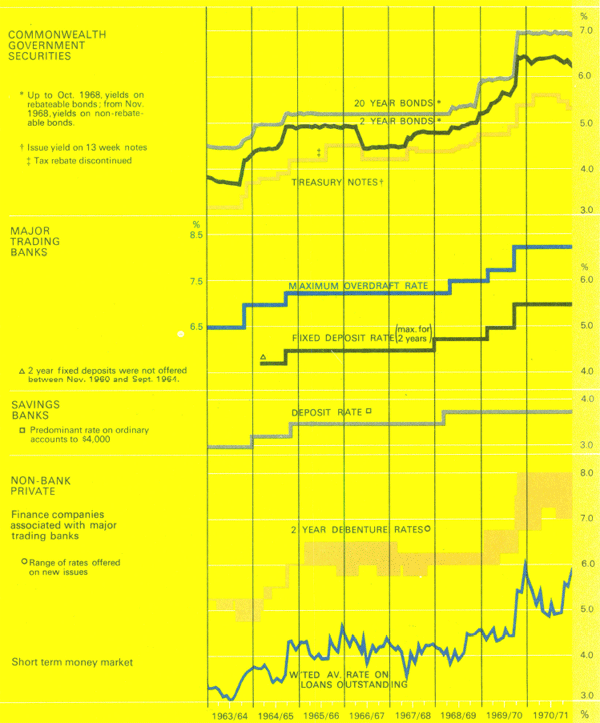
During the early months of 1970, there had been evidence of rising pressure on resources. The rates of growth in wages and prices were accelerating, conditions in the labour market were becoming increasingly tight, and the balance of payments was beginning to cause some concern. The Bank responded to this situation by tightening monetary policy. The measures taken included increases in both trading and savings bank interest rates. In the bond market, the Bank became an increasingly reluctant buyer; this more restrictive stance, together with the seasonal tightness of money, led to a sharp rise in yields. The effect of these measures was reinforced by a larger than usual surplus in Commonwealth Government transactions in the June quarter and only partly relieved by the large inflow of capital in that quarter. The net result was a fairly abrupt tightening of financial conditions with substantial increases in interest rates throughout private financial markets in the closing months of 1969/70.
As 1970/71 opened, the pace of economic expansion appeared to be slackening. In the labour market, the number of unfilled job vacancies was tending to decline and the number of unemployed applicants to rise. There was a slowing in the growth of civilian employment, industrial production, consumer spending and imports. Dwelling commencements were falling as a result of a substantial decline in the availability of finance.
However, activity was still at a high level and the rate of price increase was causing some concern; any immediate general relaxation of monetary policy in the early months of 1970/71 seemed premature. The danger of undue easing in the housing industry appeared to have been averted. Savings banks had increased their housing lending, in response to a request from the Reserve Bank, and other lending for housing was also rising. In the event, the easing tendencies in the economy seemed to come to an end about September, giving way to a situation of reasonable balance between demand and supplies.
In financial markets the onset of the seasonal upswing in liquidity was accompanied by a considerable reversal of the earlier sharp rise in short term private interest rates. However, medium and long term rates showed no signs of easing and financial conditions remained constrained. An important factor tending to reduce the availability of funds to the private sector was the greatly increased take-up of government paper. The magnitude of the Commonwealth Government's borrowing requirement was about the same in the first half of 1970/71 as in the corresponding period of 1969/70. However, the proportion financed by trading and savings banks and non-bank groups increased greatly in the first half of 1970/71 and, as a result, the amount of financing that the Reserve Bank was called on to provide was far lower (see graph 15). In the case of savings banks, a large part of the increase represented a switch into Treasury notes from deposits with the Reserve Bank with little consequence for overall liquidity. Of greater significance was the strong increase in holdings of both Treasury notes and other securities by non-bank groups. Although investors made substantial acquisitions of longer term bonds the strongest demands were at the short term end, particularly for securities due to mature within the financial year. The major trading banks entered 1970/71 with their free liquidity at the lowest level for many years. Apart from seasonal movements, prospects suggested little relief in the year ahead. It did not seem likely that the rise in private sector liquidity would be particularly strong. A fairly sizeable increase in Australia's international liquidity seemed likely and Rural Credits advances, which had fallen in the previous year, were not expected to show much change. On the other hand, indications were that the growth in the Commonwealth Government's spending would be largely matched by higher receipts and that the net increase in government debt would be fairly small. In its domestic transactions, the Commonwealth was expected to have a larger surplus than that recorded in 1969/70. A stronger rise in Government security holdings by non-bank groups was also expected to work towards a tight liquidity position for banks. By the beginning of 1970/71 there had already been a considerable cut-back in new lending approvals by the banks following the Reserve Bank's request in March 1970 for restraint and any further reduction did not seem called for. Accordingly, in September the Reserve Bank indicated to the trading banks that while the maintenance of generally tight financial conditions continued to be appropriate and no significant general easing in policy was envisaged, it did not wish the banks to reduce further their rate of new lending and accepted that some moderate rise in new lending from the low levels reached in June/July could be appropriate.
GRAPH 15 HOLDINGS OF GOVERNMENT SECURITIES
Redeemable in Australia–face value Quarterly movements Seasonally adjusted
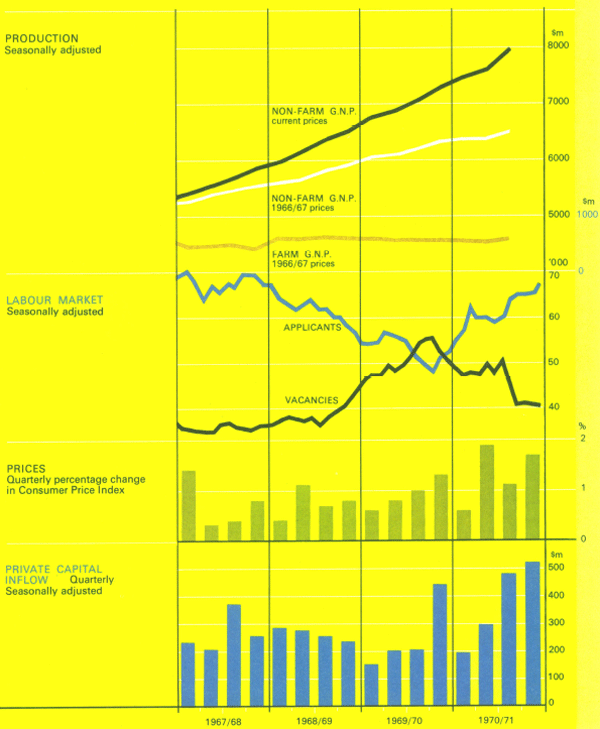
The rate of new lending by the trading banks did in fact show some increase but this was to a considerable extent due to their meeting demands for finance additional to their normal lending; besides providing additional export finance and loans to cover farmers' extra needs arising from drought and flood, the banks made a substantial contribution to the financing requirements for the new wool marketing arrangements.
The rate of increase in domestic prices, which had been tending to quicken during 1969/70, showed no sign of abating in the first half of 1970/71. In December the announcement of the decision in the National Wage Case to increase award wages by 6 per cent served to heighten concern over inflation. At this stage the level of activity was still high but there was little evidence of excessive demand pressure; in particular, conditions in the labour market had shown little overall change since September and imports were not growing rapidly. However, it was likely that, apart from its immediate effect on costs, the increase in wages would exercise some stimulus on private spending, and additions to Government spending not foreseen in the Budget indicated there was likely to be a sizeable deficit rather than the small surplus budgeted for. The Government considered various possible measures to deal with the situation. In the event, it announced a reduction in its own spending of $75 million over the remainder of the financial year and the suspension of the taxation allowance on investment. It also foreshadowed possible action to increase the degree of competition both within the economy and from external sources. Measures to dampen spending on non-dwelling building construction were proposed but not proceeded with.
In view of the Government's actions, no further tightening of monetary policy was considered necessary. There did not seem to be a convincing case for higher interest rates. Demand for Government securities continued firm. There were also doubts as to the desirability of the stimulus to capital inflow that might result from a further tightening of Australian financial conditions relative to those abroad. Nor did further curtailment of trading bank lending seem appropriate; for some time, lending by banks had been restrained and prospects were that their liquidity would continue to be tight. Subsequent disturbances in financial markets and their sobering influence on investor behaviour strengthened the case against additional monetary measures. With the further passage of time it became increasingly apparent that pressures on the banks' liquidity could be such as to cause severe restrictions in their lending and possibly force them to seek central bank loans to satisfy the LGS convention unless action were taken to relieve them. Banks were adhering closely to Reserve Bank lending policy and, accordingly, it was decided in April to reduce the Statutory Reserve Deposit ratio from 9.4 per cent to 8.9 per cent.
Developments in the economy in the second half of the year seemed to confirm that as far as demand management was concerned the policy response following the National Wage Case decision was broadly adequate. The rate of growth of real spending did not accelerate as might have been expected but appeared to be about the same as in the first half of the year. Although activity was still at a high level, conditions in the labour market at the close of 1970/71 were a little easier than they had been a year earlier and there were also indications of some reduction in use of capacity by businesses.
Despite the easing of pressures of demand on supplies, disquiet about price increases continued. Compared with the experience of most other industrial countries, the rise in consumer prices of 5.4 per cent over 1970/71 may not have seemed unduly high. However, the rise was the largest for many years and in the absence of any signs by the end of the year of slackening in the rate of increase, inflation was a major concern of policy.
| $ Million | ||||||||||||||||||
|---|---|---|---|---|---|---|---|---|---|---|---|---|---|---|---|---|---|---|
| 1968/69 | 1969/70 | 1970/71 | ||||||||||||||||
| Year | 1st half | 2nd half | Year | 1st half | 2nd half | Year | ||||||||||||
| p | p | |||||||||||||||||
| Government Debt (net)† | +189 | +1,088 | −773 | +315 | +1,052 | −972 | +80 | |||||||||||
| Reserve Bank items: | ||||||||||||||||||
| Gold and foreign exchange | +210 | −302 | +349‡ | +47‡ | +23 | +761‡ | +784‡ | |||||||||||
| Rural Credits advances | +260 | −80 | −60 | −140 | +24 | −63 | −39 | |||||||||||
| Statutory Reserve Deposits | −(+110) | −(+91) | −(+20) | −(+111) | −(−43) | −(−16) | −(−59) | |||||||||||
| Term Loan Fund accounts | −(−22) | −(−9) | −(−1) | −(−10) | −(+10) | −(−5) | −(+5) | |||||||||||
| Farm Development Loan Fund accounts | −(−21) | −(−10) | −(−5) | −(−15) | −(+19) | −(+3) | −(+22) | |||||||||||
| Miscellaneous | −17 | −178 | +247 | +69 | −336 | +140 | −196 | |||||||||||
| Total L.G.S. assets of private sector | +575 | +456 | −251 | +205 | +777 | −116 | +661 | |||||||||||
| Less private non-bank holdings of L.G.S. assets | −(+285) | −(+189) | −(+68) | −(+257) | −(+381) | −(+52) | −(+433) | |||||||||||
| L.G.S. assets of banks | +290 | +267 | −319 | −52 | +396 | −168 | +228 | |||||||||||
| of which: Savings banks | +67 | +132 | −84 | +48 | +155 | −58 | +97 | |||||||||||
| Trading banks | +223 | +135 | −235 | −100 | +241 | −110 | +131 | |||||||||||
| * Figures other than Government Debt (net) and private non-bank holdings
of Government securities are movements in June averages or interpolated
June averages. † Allows for movements in Commonwealth Government deposits with Reserve Bank and coin on issue. ‡ Include increases in Special Drawing Rights with International Monetary Fund of $79 million in 1969/70 and $68 million in 1970/71. These changes include allocations of $75 million in 1969/70 and $64 million in 1970/71 which have been offset in the miscellaneous item. p Preliminary. |
||||||||||||||||||
THE PROBLEM OF INFLATION
In the period since the Second World War most countries have come to regard gradually rising prices as an inevitable accompaniment to the successful pursuit of policies of high employment and economic growth. Recently, however, without any apparent change in aims regarding either employment levels or economic growth, the rate of inflation has tended to quicken significantly in many of the developed countries of the world. This has led to considerable speculation regarding possible causes and to various suggestions for restoring a greater degree of price stability. In particular, the recent experience has raised the question of whether the traditional weapons of fiscal and monetary policy are, by themselves, adequate to combat inflation.
Even if there is a case for a wider range of policies, the importance of adequate demand management remains. Inadequacies in this regard in a number of countries appear to have been an important factor in the current bout of inflation. An example is perhaps provided by the United States which experienced a prolonged period of excess demand prior to 1969. During this period not only did inflation accelerate but the community appears to have come increasingly to expect that prices would go on rising and to have acted accordingly. This inflationary psychology has been manifest, even after the elimination of excess demand, in wage contracts which allow for likely price rises during the period of the contracts and in greater willingness by employers to grant wage increases given the prospect that they could be covered by higher prices. It seems that once the view that prices are going to continue rising strongly becomes entrenched, fairly drastic measures may be required to modify this expectation.
Such indicators as labour market statistics and imports suggest that, with the possible exception of a period towards the end of 1969 and in early 1970, aggregate demand in Australia in recent years has been broadly within the capacity to produce. Hence, it is harder to attribute the recent acceleration of inflation in this country to excess demand pressures. In fact, the recent impression, both in Australia and abroad, is of rates of inflation a little higher than might have been expected on the basis of past relationships between levels of activity and changes in prices. The evidence has given rise to widespread doubts in other countries about the possibilities of containing inflation within acceptable limits and at the same time avoiding unacceptably high unemployment. While such doubts may seem somewhat premature in Australia, this need not preclude consideration of other measures which might contribute to achieving greater price stability.
Measures to increase the degree of competition among domestic producers can be expected to exert a restraining influence on prices and one such step in Australia was the recent passage of legislation to prohibit resale price maintenance. A greater degree of competition from abroad could also have a stabilising influence. While care would be needed to avoid disruptive effects, including those on employment, some liberalisation of tariff policy, at present under consideration, could ease the task of restraining price increases. In the present state of Australia's international liquidity, there should be little objection from a balance of payments point of view to removing some of the impediments to a higher flow of imports.
Prominent among approaches tried in some other countries have been prices and incomes policies which, although varied in form, essentially involve the establishment of norms for increases in incomes and prices. Adherence to these norms may be sought through persuasion or compulsion. Countries that have tried such policies have had considerable practical problems in their operation and their effectiveness beyond fairly short periods has yet to be established. Possible detrimental effects on resource allocation would need to be offset against any success in slowing inflation. Some countries have also appreciated their exchange rates as part of an anti-inflationary policy package.
The traditional approach to dealing with inflation relies heavily on management of demand. However, supply policies can also ease inflationary pressures. Essentially, such policies involve encouraging labour and other resources into areas where prospective returns are greatest. More rapid productivity growth provides greater scope to meet demands for increased money incomes without increasing prices.