
Reserve Bank of Australia Annual Report – 1971 Papua New Guinea
Substantial progress was made during the year in bringing Papua New Guinea closer to internal self-government. The Australian Government accepted the recommendations of the Papua New Guinea House of Assembly Select Committee on Constitutional Development as agreed upon by that House in March 1971 and is introducing legislation to give effect to constitutional changes. The Select Committee recommended that developments should be geared to preparing the country for internal self-government during the life of the next House of Assembly (1972–1976).
Under current banking legislation, the Reserve Bank has statutory responsibilities in Papua New Guinea. In carrying out its functions there, the Bank is especially concerned to ensure that banking and financial services are adequate to meet the needs of the developing country and provide for increasing involvement of the local people. For some years the Bank has been developing, by arrangement with the Administration, savings and loan organisations among Papuans and New Guineans and has been co-operating with other banks in programmes of financial education and in providing facilities for the training of indigenous staff through sponsorship of the Papua New Guinea Bankers' College. The Australian banks operating in Papua New Guinea provide valuable assistance to the savings and loan movement by seconding staff for service with the Registry of Savings and Loan Societies.
The Reserve Bank's Advisory Committee on Central Banking in Papua New Guinea met three times during 1970/71. This Committee, which was set up in Papua New Guinea in 1966, gives the Bank opportunities to discuss with its members, who include five Papuans and New Guineans, local economic, banking and financial matters pertinent to the development of central banking in the country.
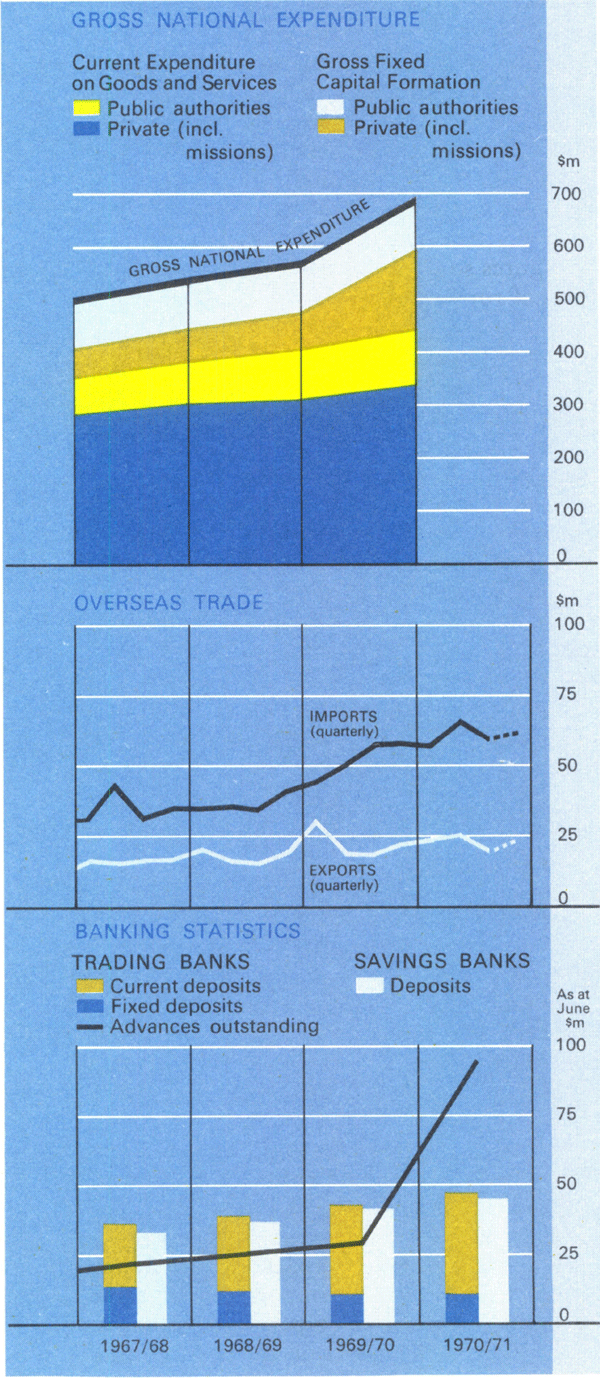
GRAPH 18 PAPUA NEW GUINEA
Early in 1970/71 Papua New Guinea became an associate member of the Economic Commission for Asia and the Far East. In April 1971 it was admitted to full membership of the Asian Development Bank; the Port Moresby office of the Reserve Bank was designated official depository.
Economic Activity
National income estimates suggest an annual growth of around 9 per cent in gross national product (G.N.P.) in recent years. In 1969/70, however, G.N.P. increased by 14.5 per cent to $544 million; much of the impetus came from the Bougainville copper project which was largely responsible for a sharp increase in fixed capital expenditure in the private sector. Estimated subsistence sector income increased only slightly, resulting in a further decline in its share of G.N.P. Projections of G.N.P. suggested that growth would be at a less spectacular rate in 1970/71.
Progress on the Bougainville copper project during 1970/71 was generally in line with timetables; having reached a peak during the year, employment on the project is now declining. Production is planned to commence mid 1972.
Figures so far available indicate a generally higher level of rural production in 1970/71. Manufacturing output seems to have been sustained during 1970/71 although there appears to have been some falling off in the second half of the year. Several major industries expanded capacity, assisted in part by a rise in the demand for locally made goods for use in association with the Bougainville copper project. During 1970/71 346 new local companies and 104 foreign companies were registered. Further steps were also taken towards greater involvement of local people in economic development. They included the establishment of a Department of Business Development to assist indigenous businessmen, and the passage of legislation to set up an Investment Corporation to take up equity in business ventures on behalf of the local people.
Indicators of private expenditure suggest a rate of growth in both consumption and investment outlays during 1970/71 somewhat slower than the rapid rates in 1969/70.
Public expenditures (which in 1969/70 accounted for a third of gross national expenditure) rose by about 20 per cent in 1970/71, compared with an increase of almost 13 per cent in the previous year. Expenditure by the Administration was about 18 per cent higher in 1970/71 than in 1969/70; expenditure by Commonwealth departments and instrumentalities was also above the level of the previous year.
Although prices of the chief export commodities, copra, coffee, cocoa and rubber, were lower than in the previous year, the value of total exports in 1970/71 rose by about 5 per cent to around $95 million. Under the impact of developments in Bougainville, however, imports in the same period rose sharply, by about 16 per cent, leaving an excess of imports over exports of about $150 million.
It has been estimated that net private investment in Papua New Guinea from overseas (including Australia) in 1969/70 was a little over $110 million. The figure for 1970/71 is expected to exceed this. A loan of $20.7 million was approved by the World Bank for the Upper Ramu Hydro-Electricity Project in April 1971 but no funds were drawn against this loan during the year. Drawings against previous loans for agriculture, roads and telecommunications projects totalled $3 million.
Finance
Further development of the financial sector was seen during the year. Papua New Guinea branches of the Australian banks found further opportunity to respond to the country's needs; new lending by banks in Papua New Guinea is not restricted by any general limitations under lending policy current in Australia. The operations of non-bank institutions expanded; greater use was made of facilities available from finance companies, especially for mortgage and leasing financing, and the value of life insurance business increased. The public equity issue by Bougainville Mining Company gave Papuans and New Guineans an opportunity to share directly in a large local enterprise.
The Administration financed a greater share of its own expenditure in 1970/71. Over 59 per cent of the Administration's expenditure was met from local sources, 44 per cent from revenue and 15 per cent from loan raisings; in the previous year, 41 per cent of expenditure was met from local sources. Part of the increase in local revenue in 1970/71 came from the imposition of a general import levy. Funds provided to the Administration by the Commonwealth Government in 1970/71 are likely to have exceeded the Budget estimate of $126 million, which represented an increase of 10 per cent on the amount provided in the previous year.
The Administration achieved record loan raisings of $24.5 million for 1970/71. This included a loan of $12.5 million for a second equity payment to Bougainville Copper Pty Limited (of which the Commonwealth Government took up a shortfall of $5.8 million) and a further $12 million borrowed from Australian and Papua New Guinea sources. In addition, as mentioned earlier, drawings from the World Bank Group provided $3 million. At the end of June 1971, Administration securities on issue stood at about $80 million.
Banking aggregates during 1970/71 were strongly influenced by developments associated with the copper project in Bougainville but, even after allowing for this, steady growth was discernible. The influence was particularly evident in trading bank advances outstanding, which at June 1971 amounted to $95 million, an increase of 219 per cent during the year, and in overdraft limits outstanding which rose by $88 million to $124 million at the end of the year. Deposits with trading banks increased by 11 per cent to $47 million at June 1971; as in previous years, the increase was in current deposits.
Savings bank deposits rose by about 8 per cent to $45 million at June 1971, compared with a rise of 12 per cent in the previous year, and the average savings account balance was about $101 ($103 at June 1970). The number of operative accounts rose by about 40,000 during the year to 443,000.
The activities of the Papua New Guinea Development Bank expanded further during 1970/71. Advances outstanding rose by 20 per cent to $17 million at June 1971; advances made to Papuans and New Guineans increased markedly, both in number and amount.
The Rural Credits Department of the Reserve Bank again provided finance to assist marketing of the coffee crop.
The Savings and Loan movement expanded at a somewhat faster rate after some slowing down in 1969/70. Development of urban savings and loan societies contributed to the expansion. The total number of societies increased by 44 to 285 over 1970/71 and total funds increased by 24 per cent to $1,129,000. In addition, there were 224 savings clubs with funds of $199,000 at June 1971.
Employment and Training of Local Staff
About three quarters of the Bank's staff in Papua New Guinea are Papuans and New Guineans, including the Deputy Manager of the Bank's Port Moresby office and the Registrar of Savings and Loan Societies, Lae. Both these officers were appointed to their positions during the year.
A number of local officers attended the Papua New Guinea Bankers' College. Twelve local staff attended the University of Papua New Guinea on full-time Bank scholarships and one graduated in 1970. Additional scholarships were provided at other tertiary institutions and secondary schools in Papua New Guinea and Australia.