
Reserve Bank of Australia Annual Report – 1971 Domestic Activity
Activity remained at a high level during 1970/71 but the growth in domestic supplies was the smallest for several years, mainly reflecting an apparent slower growth in output per worker. Mineral production continued to rise strongly but the rate of increase of industrial production slowed and there was a further small decline in rural output. Recourse to supplies from abroad also grew less rapidly than in some other recent years. Public expenditure and private capital expenditure, other than on dwellings, both accelerated but in the case of public expenditure this was due largely to increased prices. Growth in consumer spending in real terms was the lowest since 1965/66; there was a marked increase in personal savings.
In the course of the year the overall pressure of demand on supplies showed some tendency to ease. However, the rise in prices was the strongest for many years.
SUPPLIES
Employment
Growth in the labour force in 1970/71 was a little less than in the previous year; natural growth and a high rate of immigration were the main sources of expansion. An increasing propensity for females to enter employment has for a number of years been a major source of additions to the labour force but in 1970/71 female participation rates grew less rapidly.
Civilian employment increased by a little over 3 per cent in 1970/71 compared with 4.1 per cent in the previous year. After some hesitation around mid 1970, civilian employment rose strongly until December but in the following months the rate of increase again slowed. In absolute terms, the increase in total employment over the whole of 1970/71 was a little below that of the labour force with the result that there was a small increase in unemployment. Labour market pressures had been easing towards the end of 1969/70 and this tendency continued into the September quarter of 1970/71; however, neither the rise in registered unemployed nor the decline in vacancies was particularly large. Between September and January labour market conditions showed little change but over the remainder of the year there was a further slight easing. Between June 1970 and June 1971 the number of registered unemployed increased from 51,500 to 66,200 and the number of vacancies fell from 39,900 to 31,800. In seasonally adjusted terms, the proportion of the labour force registered as unemployed, 1.0 per cent at June 1970, increased to 1.2 per cent in the September quarter and remained at about this rate over the remainder of 1970/71; although the highest recorded since the beginning of 1969, this figure was below the unemployment rate for most of the nineteen-sixties. The easing in labour market conditions over 1970/71 was most pronounced in New South Wales and Victoria, the two states in which the situation had previously been tightest. Although the easing was also primarily in metropolitan areas, the overall ratio of vacancies to registered unemployed in these areas remained substantially higher than that for country areas. Average hours of overtime worked maintained the previous year's high level during most of 1970/71 but declined a little towards the end of the financial year.
Production
Real gross national product increased by about 4.5 per cent in 1970/71; this was the lowest annual increase since 1967/68, a year in which rural production was reduced substantially by drought. There was little change in gross farm product in 1970/71. The increase in non-farm production, estimated at a little under 5 per cent, was somewhat lower than in other recent years.
The mineral industry was again the pace-setter as far as growth in production was concerned; output of most major minerals was well up on 1969/70. With further development of the Bass Strait fields, there was a spectacular rise in output of crude oil and natural gas. Production of iron ore, bauxite and nickel also rose strongly. The only significant declines were in lead and zinc production.
Industrial production, which had shown little change in the second half of 1969/70, declined in the September quarter of 1970/71. Production recovered during the December quarter but subsequently showed little change. The increase over the whole of 1970/71, of about 3 per cent, was somewhat below the increase of other recent years.
The volume of rural output is estimated to have fallen, but by less than in the previous year when it declined by 4 per cent. In 1970/71 the decline was due mainly to a drop of about 30 per cent in wheat production; the overall wheat quota was lower than in 1969/70 and unfavourable weather conditions, especially in northern New South Wales and Queensland, further reduced production. There was a small decline in the quantity of wool produced. The major increases in production in 1970/71 were recorded by sugar and cereals other than wheat. Meat production was slightly higher than in the previous year.
DEMAND
Public Expenditure
Public sector expenditure on goods and services rose strongly in 1970/71; the increase was approximately 12 per cent compared with about 8.5 per cent in each of the previous two years. The large increase partly reflected various wage decisions during the year. In real terms, the growth in public sector spending appears to have been about the same as in 1969/70. Defence expenditure rose by about 7 per cent in 1970/71 following the small decline in the previous year; other current spending of Commonwealth authorities increased very strongly as did current spending of state and local authorities. The Commonwealth's capital expenditure rose substantially for the second year in succession. The increase in capital expenditure of state and local bodies may have been close to the rise of 6 per cent recorded in 1969/70.
Personal Consumption
Reflecting the effects of lower income tax rates and rapid increases in wage and salary earnings, personal disposable incomes rose by about 12 per cent in 1970/71, the largest annual increase for many years. A significant part of the rise in incomes was added to savings; the increase in consumer spending, measured in current prices, was not particularly strong, amounting to about 8.5 per cent compared with 9 per cent in the previous year. In real terms, the growth of consumption fell from 5.3 per cent in 1969/70 to a little over 3 per cent in 1970/71. This was the smallest annual increase in real consumption since 1965/66 which, unlike 1970/71, was a year of slow growth in earnings and of increases in personal income tax rates. Rent and other services were again major growth items but spending on vehicles grew much less rapidly than in 1969/70. Spending on other consumer durables, food and clothing rose at about the same rate as in 1969/70 but recorded only small increases in real terms.
Private Fixed Investment
Expenditure on dwellings was fairly subdued throughout 1970/71 but the other components of private fixed capital expenditure continued to rise strongly.
The number of commencements of private dwellings which had increased by 2.8 per cent in 1969/70 fell by about 6 per cent in 1970/71. Following a substantial fall beginning in the March quarter 1970 in loan approvals, mainly by permanent building societies, commencements declined in the June and September quarters of 1970. In the following three quarters the rate of commencements was somewhat higher, reflecting increased availability of funds from savings banks and permanent building societies, but did not regain the levels achieved around the end of 1969. For the whole of 1970/71, expenditure on dwellings, at current prices, was about 3 per cent higher than in 1969/70; in real terms there was a decline.
GRAPH 4 GROSS NATIONAL EXPENDITURE
(excluding stocks and discrepancy)
Seasonally adjusted
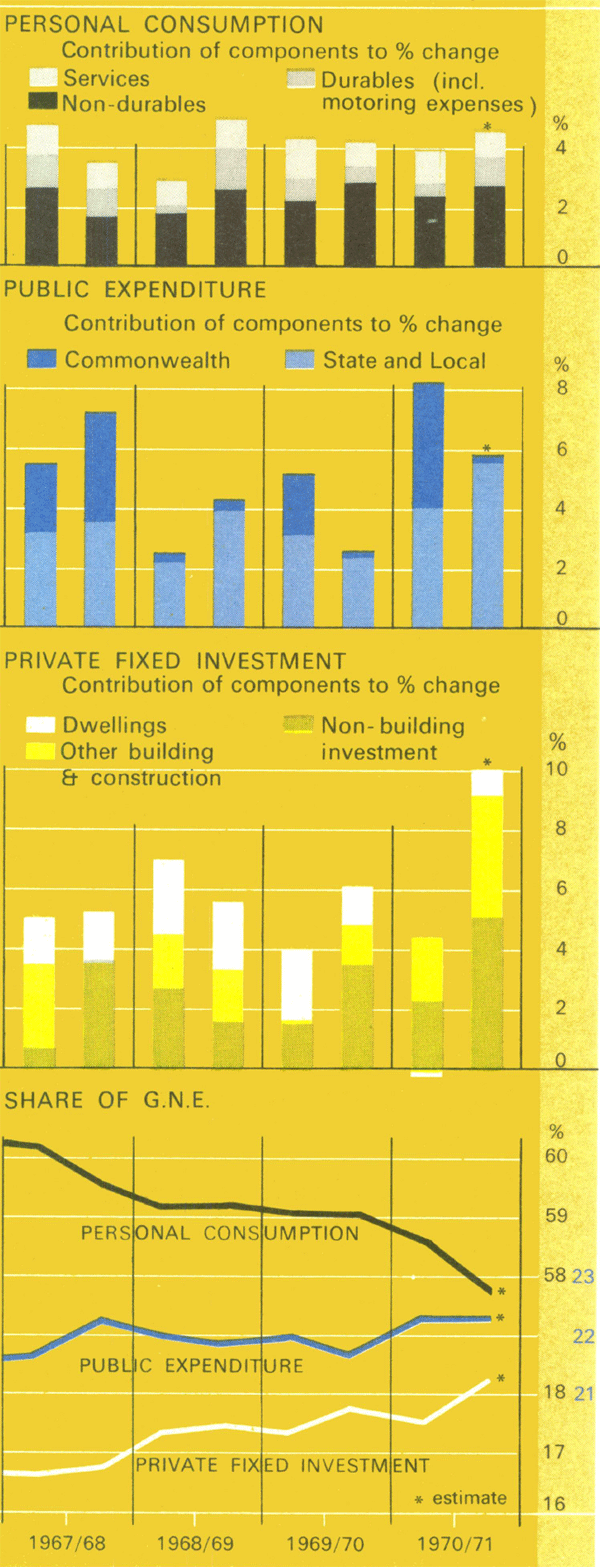
Heavy expenditure on office construction and in mining and related manufacturing industries such as refining and smelting was primarily responsible for the strong growth of private non-dwelling investment in 1970/71. Spending on private nonresidential building and construction rose by about 25 per cent at current prices and 17 per cent in real terms. Outlays on plant and equipment also grew very strongly in 1970/71 despite an apparent further fall in farm investment; at current prices, the increase for the year was about 12 per cent and, in real terms, a little less than half that rate. The taxation allowance on investment was suspended in February 1971 but significant effects on spending could not be expected to show before 1971/72.
Stocks
Non-farm stocks, which had increased sharply in the final quarter of 1969/70, continued to rise strongly in the first three quarters of 1970/71. Acquisition of wool by the Australian Wool Commission (counted in non-farm stocks) contributed to the rise, mainly in the March quarter. The value of the physical increase in non-farm stocks in the twelve months to March 1971 was almost double that of the previous twelve months.
The level of farm stocks declined in 1970/71; this reflected the lower wheat crop and the high level of sales achieved. Nevertheless, wheat stocks at 30 June 1971 were still very high at 281 million bushels, and the delivery quota for 1971/72 has been raised by 6.6 per cent.
INCOMES AND PRICES
Farm income declined for the second year in succession and the growth of company income appears to have been considerably slower than in other recent years; other major categories of income grew strongly. The increase in total incomes was well in excess of the increase in production and prices rose strongly.
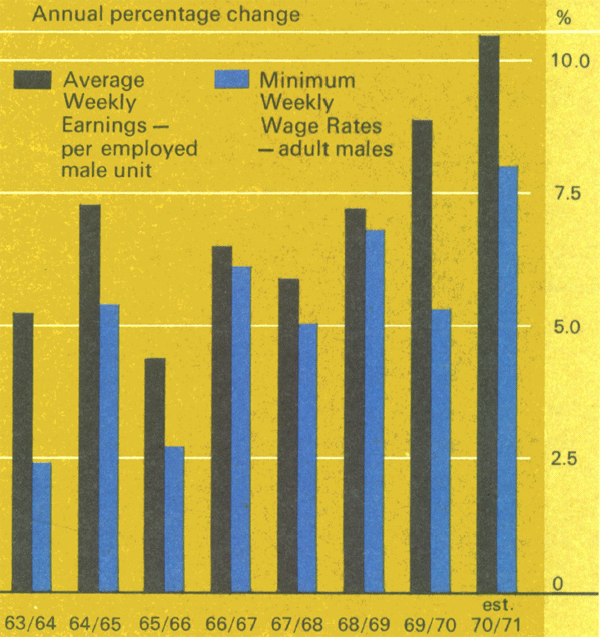
The rate of increase in average weekly earnings of wage and salary employees accelerated for the third year in succession (see graph 5); the increase in 1970/71 was over 10 per cent compared with 8.9 per cent in the previous year. Average minimum weekly wage rates rose by about 8 per cent; a large part of this increase occurred in the March quarter, reflecting the impact of the National Wage decision in December. This decision by the Conciliation and Arbitration Commission provided for an increase in award wages of 6 per cent; the minimum wage for adult males, dealt with separately, was increased by $4 per week. The increases were substantially greater than those awarded in the previous year. In both 1969/70 and 1970/71 there were large gaps between the growth in average minimum weekly wage rates and the growth in average weekly earnings. A strong increase in overtime worked and, hence, in overtime earnings would have accounted for a significant part of the gap in 1969/70; however, this factor would have had considerably less effect in 1970/71. In both years strong rises in above-award payments were evident.
The strong growth in earnings is reflected in national income figures of “wages, salaries and supplements” which grew by about 15 per cent in 1970/71 compared with an increase of 12 per cent in the previous year. The gross operating surplus of non-farm trading enterprises increased less rapidly than in other recent years, primarily because of a slower growth in the surplus of companies.
GRAPH 5 AVERAGE WEEKLY EARNINGS
Annual percentage change
Farm income recorded a fall of about 18 per cent in 1970/71, slightly greater than the decline in the previous year. The wool industry was most affected. The size of the clip was a little lower than in the previous year but wool prices, which had weakened throughout 1969/70, fell sharply in the early months of 1970/71. Although, from November 1970, purchases by the newly established Australian Wool Commission had steadied the market, prices remained low throughout the first half of 1971 and at June were about 30 per cent below the level of two years earlier, and not much above the lowest level since the Second World War. With incomes sharply reduced, rural debts were becoming a heavier burden on producers and of increasing concern to major lenders. Support for the market from the Wool Commission and emergency financial assistance from the Commonwealth Government have afforded some immediate relief to producers; as 1971/72 opened, consideration continued to be given to additional steps of various kinds designed to ease the difficulties of the industry.
There seems to be increasing recognition that the problems of some of the rural industries stem to a large extent from imbalance between supply and demand and that, accordingly, policies should not aim at maintaining production but rather should promote structural changes, including, as necessary, the orderly shifting of resources to activities offering better economic prospects. On these lines, the Commonwealth Government, with the states, has formulated a reconstruction scheme for rural industries generally but with particular relevance to the sheep and sheep-wheat industries. It seeks to improve the viability of farms through providing finance for debt reconstruction and for the amalgamation of uneconomic properties; the scheme also provides for financial help to farmers leaving the land and who face financial hardship. A related scheme is being formulated for the retraining, where necessary, of those leaving the land.
In the wheat industry, excess supply is still evidenced by the continuing high level of stocks. Quotas continue to be used with the object of limiting production. In considering the amount of the first advance payment to wheatgrowers, a balance must be struck between providing for growers' financial needs and reducing the incentive to maintain production. It was again with some reluctance that the Bank agreed to provide finance through its Rural Credits Department for a first advance payment to growers for the 1971/72 crop at $1.10 a bushel less freight.
GRAPH 6 CONSUMER PRICE INDEX
Quarterly percentage change in components
* current weight in index
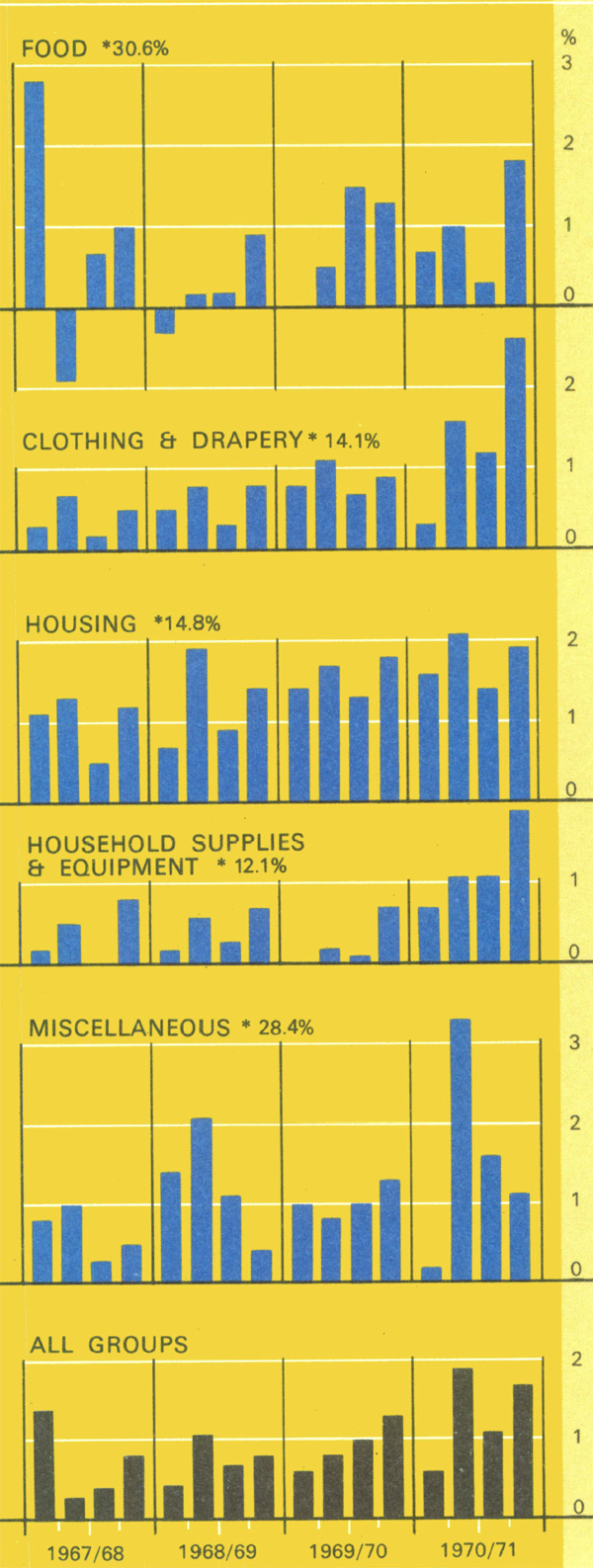
Price increases accelerated in 1970/71 for the second year in succession. Between the June quarters of 1970 and 1971, the consumer price index rose by about 5.4 per cent. Part of the increase during the December quarter reflected increases in taxes and charges imposed in the Commonwealth Government's Budget; even after discounting this effect, the rate of increase in the index over 1970/71 represented a marked acceleration. A broader measure of price increases, the implicit deflator for gross national expenditure, indicates a similar movement. After adjusting for the effects of increased taxes and other government charges, the rate of price increase was considerably greater in the second half of the year than in the first. This was probably a consequence of the substantial increases in wages and salaries following the National Wage decision.
Percentage changes in the major components of the consumer price index are shown in graph 6. All sections of the index showed an acceleration in 1970/71, particularly “clothing and drapery”, “household supplies and equipment” and “miscellaneous”. “Household supplies and equipment” is normally the most stable component of the index, presumably because it includes some areas of production in which there is a fairly high degree of competition and in which productivity increases have been considerable; however, in 1970/71 this component recorded an increase of 5 per cent. The “housing” component has shown the strongest rate of increase in recent years, reflecting substantial rises both in rents and in costs of home ownership. This component continued to rise strongly in 1970/71. The “miscellaneous” category has also tended to increase at an above-average rate in past years and continued to do so in 1970/71; changes in taxes and other government charges have a considerable impact on this category.
Australia's terms of trade worsened during 1970/71. The rate of increase in the import price index accelerated; the rise over the year of about 5 per cent was only slightly below the increase in domestic prices. The average return on exports declined in 1970/71. A number of export items, including sugar, dairy products, cereals and coal, recorded significant increases in prices in 1970/71. However, the average price for wool fell substantially and prices of most non-ferrous metals were lower than in 1969/70.