
Reserve Bank of Australia Annual Report – 1969 The Year in Brief
The Australian economy grew rapidly in 1968/69. Domestic output and spending both rose strongly but with some evidence of pressure on domestic resources emerging in the second half of the year. Towards the end of the year there was a faster tightening of conditions in the labour market and there appeared to be some widening of the gap between award wages and average weekly earnings; there was, however, no acceleration in the rate of increase in prices in 1968/69. Despite early expectations of an unfavourable balance of payments, there was a smaller current account deficit than in 1967/68 and with capital inflow continuing at high levels Australia added substantially to its international reserves. Activity in financial markets was at a high level and, although government financial operations contributed less to the liquidity of the private sector than in the previous year, the addition to international reserves and a substantial increase in Rural Credits advances resulted in a sizeable increase in liquidity. In this context, the Bank's policy throughout the year was designed to exercise a cautionary influence over the developing situation, seeking particularly in the last part of the year to restrain private sector liquidity.
An important development within the Australian banking system in 1968/69 was the approval, in May 1969, of a merger of the Australia and New Zealand Bank Limited and The English Scottish and Australian Bank Limited to form Australia and New Zealand Banking Group Limited. Merger discussions between the Bank of New South Wales and The Commercial Bank of Australia Limited, announced late in 1968, terminated during the year without reaching agreement and another proposed merger was under discussion between The National Bank of Australasia Limited and The Commercial Banking Company of Sydney Limited. Australian banks continued to extend their overseas interests through membership of international groups of banks and through the establishment of overseas representative offices and a number of overseas banks also established representative offices in Australia during the year. The range of deposit facilities available to Australian bank clients was increased during 1968/69 with the introduction of marketable certificates of deposit by trading banks and of progressive savings accounts by some savings banks. Outside the banking system, there was continued strong growth in the services provided by specialist finance houses, many of which are associated with overseas financial institutions. In April 1969 arrangements between the Reserve Bank and authorised dealer companies in the short-term money market were modified to allow dealers more flexibility in their operations.
In the previous year, a substantial increase in the workforce and continued growth in productivity had provided the basis for a strong expansion in production. Economic performance was adversely affected by drought, however, and although non-farm output grew rapidly the growth in total output slackened over the year. On the external side, there was a substantial deficit on current account but this was more than covered by a very large capital inflow. Demand for funds was strong throughout that year but conditions in financial markets were generally easy and there was little change in interest rates. Bank lending rose strongly in 1967/68 and the liquidity of the trading banks had declined to a low level by the end of the year.
At the beginning of 1968/69, continued growth in workforce and productivity, coupled with improved seasonal conditions, promised well for production and most categories of expenditure appeared to be rising. On external account an improvement in the balance of trade seemed likely; a continued source of uncertainty, however, was whether the high level of capital inflow would continue in 1968/69, especially in view of the restrictions already imposed on capital outflow from the United Kingdom and United States.
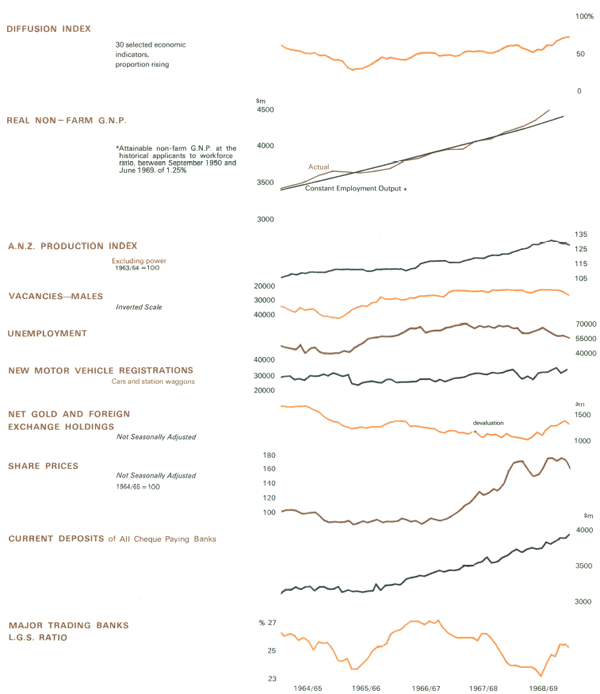
In the event, output rose strongly during the year. With a solid increase in civilian employment and further gains in productivity, real gross national product rose by more than 8 per cent over the year. Industrial production expanded rapidly and there was a strong recovery in rural output; output from the mining industry again increased at a fast pace. On the demand side, expenditure (excluding accumulation of stocks) rose at a slower rate than in the previous year, with the growth in personal consumption lower, though accelerating from a low level at the beginning of the year, and a slowing down in the very rapid recent growth of public expenditure. Supported by a high level of expenditure on dwelling construction, private fixed investment grew quite strongly. A large part of the increase in output in 1968/69, however, was absorbed in an increase in stocks; a substantial portion of this was in the form of quantities of wheat which may be difficult to sell. In view of the current wheat surplus, which is a reflection of trends in Australian production and world demand, during the year Australian governments and wheatgrowers' organisations discussed proposals to limit the output of wheat in 1969/70.
Average earnings increased strongly in 1968/69, again exceeding the overall growth in output per worker; much of the increase was attributable to award wage increases granted by wage fixing authorities but there was evidence of a renewed earnings drift in the second half of the year. Consumer prices rose at the same rate as in recent years. Towards the end of the year, increasing pressure on domestic resources was suggested by a more rapid tightening in the labour market.
On the external side, the increase in imports in 1968/69 was distinctly lower than the average rate in recent years and well below the increase in domestic spending and with a recovery in exports there was a marked improvement in Australia's balance of trade. However, net invisible payments again resulted in a large current account deficit. As in 1967/68, this deficit was more than covered by capital inflow and there was a substantial addition to Australia's international reserves.
Graph 1
SELECTED ECONOMIC INDICATORS
Seasonally Adjusted
Over recent years, there has been some change in the composition of Australia's international reserves; the proportion of total reserves held in sterling has declined and that in U.S. dollars and gold has increased. In 1967/68 the sterling proportion was further reduced by a change in the Australian currency value of sterling holdings as a result of sterling devaluation. In September 1968, following negotiations between the Commonwealth and the United Kingdom governments, Australia accepted that it would aim to hold in sterling about the same proportion of its total reserves (specially defined for this purpose) as it then held and undertook to maintain a minimum sterling proportion of 40 per cent; for its part the United Kingdom Government undertook to maintain the sterling value, in terms of United States dollars, of Australia's sterling balances in excess of 10 per cent of its total reserves.
Both public and private sectors again ran substantial financial deficits in 1968/69 but with a continued high rate of capital inflow and with heavy advances to the rural sector by the Rural Credits Department in the second half of the year, the tightening which was expected to occur in financial markets in 1968/69 did not eventuate. The public sector's deficit in 1968/69 was less than in the previous year and with overseas borrowing yielding a larger amount than in 1967/68 the public sector's domestic borrowing requirement was smaller. The Commonwealth Government raised a greater amount through public loans in 1968/69 but Treasury notes on issue declined and the Commonwealth reduced its temporary borrowing from the Reserve Bank. The deficit of the private sector was about the same as in 1967/68 but a considerably greater increase in the sector's total assets and liabilities indicated the high level of activity in financial markets.
Deposits with trading banks grew strongly in 1968/69. The greater part of the increase was in fixed deposits whose growth was stimulated by an increase in interest rates in June 1968 and by the introduction of certificates of deposit in March 1969. Outstanding advances of trading banks increased at a fast pace in the early part of the year and with no evidence of the expected tightening in liquidity the Reserve Bank increased the Statutory Reserve Deposit ratio in two equal steps in October and November 1968 and the maximum interest rate on overdraft lending was raised in October. In November, trading banks were told that some tapering down in the rate of new lending would be appropriate. From about the middle of 1968/69 advances outstanding levelled out and, although there was renewed growth towards the end of the year, the overall increase in 1968/69 was moderate and well below that of the previous year. Trading banks' holdings of liquid assets and Government securities (on a seasonally adjusted basis) rose steeply in the second half of the year and at June 1969 the L.G.S. ratio was higher than it had been a year earlier. Savings bank deposits also grew strongly in 1968/69 but despite a high rate of new lending the rate of growth in outstanding loans over the year was slightly less than in 1967/68.
Activity in most other sections of the financial market was at high levels in 1968/69. New capital raisings by companies grew strongly, outstanding loans by finance companies increased at a solid pace though somewhat below that in 1967/68, loans by life offices rose and permanent building societies continued to expand rapidly, increasing their share of total finance for housing. Activity in the short-term money market was at a higher level in 1968/69 though there was little change in the level of dealers' liabilities over the year as a whole. Stock exchange prices fluctuated during the year, with peaks early in 1968/69 and again in the first months of 1969, but remained high. Credit conditions generally were easy and there was little movement in private non-bank interest rates.
The strong increase in bank deposits, particularly fixed deposits, over 1968/69 meant that a large part of the addition to the private sector's liquidity was channelled through a sector closely influenced by the Reserve Bank. There was, however, a substantial increase in the private non-bank sector's holdings of other financial assets, particularly in the second half of the year following the payment of Rural Credits advances to the Australian Wheat Board. The increase in private non-bank holdings of Government securities in 1968/69 was the lowest since 1964/65; although local and semi-governmental authorities increased their borrowings during the year this left a substantial increase in the funds available to finance spending in the private sector.
Throughout the year the Reserve Bank's open market operations were designed to absorb part of the increase in liquidity. The Bank's holdings of bonds, which had increased considerably in 1967/68, were reduced during the year. The activities of monetary authorities in the bond market supplemented the cautionary measures implemented through the banking system in the second quarter of the year. Towards the end of 1968/69, with liquidity buoyant, with a heavy programme of loan maturities ahead, and with evidence of increasing pressure on domestic resources, the authorities took a stronger selling initiative in the bond market and in the last month of the year there was a sharp rise in bond yields, which had not moved greatly in the earlier part of the year. Early in 1969/70 higher issue yields were offered on new bonds and some other market rates responded to the increase in bond yields. Subsequently bank interest rates were increased and a further call was made to Statutory Reserve Deposits of trading banks.
At the end of 1968/69, output and expenditure were growing strongly and the prospects for 1969/70 are again for a high rate of growth. With a larger current account deficit in prospect for 1969/70, a continued high rate of capital inflow is needed if rapid growth is to be maintained without international reserves falling substantially. Within Australia the continuing expansion of Australian industry and the discovery and exploitation of new mineral deposits suggest that Australia could hope to continue to attract the necessary large flow of foreign funds; however the rate of capital inflow also depends a good deal on developments in overseas financial markets. On the domestic front, evidence of increasing pressure on domestic resources and the generally high level of private liquidity indicate that policy in 1969/70 will have to pay particular regard to the preservation of internal balance while maintaining overseas confidence in Australia and sustaining the underlying growth of the economy.