
Reserve Bank of Australia Annual Report – 1969 The External Environment
In recent years, the persistence of large surpluses and deficits in international payments and associated uncertainties about the value of certain key currencies have placed severe strains on international monetary arrangements. These developments have a clear relevance to Australia's position as a country heavily dependent on international trade and capital inflow and with the greater part of its foreign reserves held in other countries' currencies.
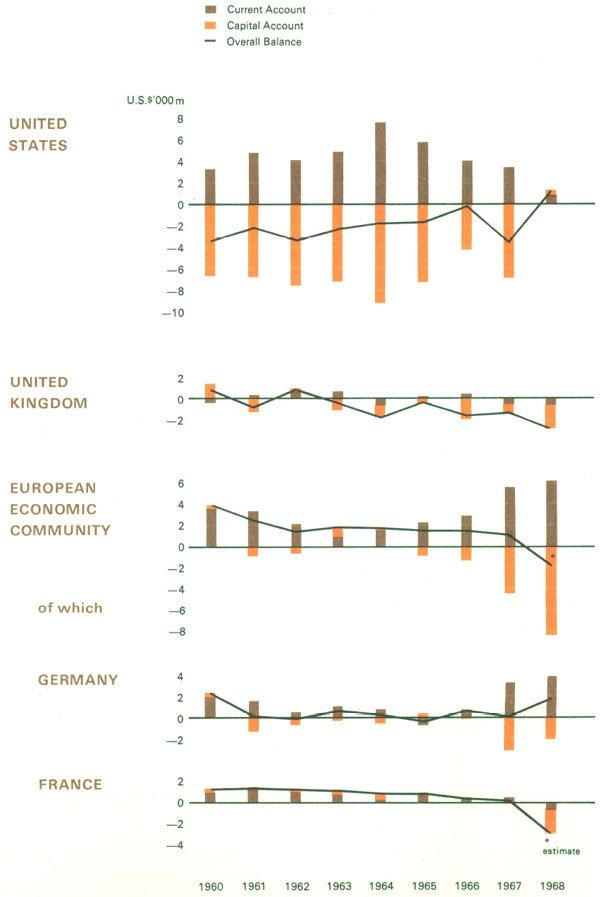
Although in 1968/69 there were no fundamental institutional changes in the international monetary mechanism, continued speculation on changes in currency parities, which produced crises in November 1968 and May 1969, again forced governments to take action to offset the immediate effects of speculative capital movements and to attack the problems of balance of payments disequilibria.
The growth in volume of world trade and the continuance of balance of payments disequilibria in particular countries have led to a strong rise in the demand for international liquidity; deficit countries require funds to finance their deficits while surplus countries accumulate reserves. But while the demand for liquidity has been increasing, the supply of gold to monetary stocks has not; in the last three years, 1966 to 1968, there was a net reduction in monetary gold stocks. At the same time, continued balance of payments deficits in the United Kingdom and United States—which were the source of increases in the supply of the reserve currencies—have affected the willingness of some to accept and hold United States dollars and sterling. The growing gap between the demand for gold and its supply put severe pressures on the gold market and led to the creation in March 1968 of a two-tier system in which transactions in gold between monetary authorities, at the official price of US $35 per ounce, were distinguished from those in the non-official market, in which price fluctuated with demand and supply. (These developments were discussed in the Reserve Bank's annual report last year). This halted the drain on monetary authorities' gold stocks but did not increase the level or improve the composition of international liquidity.
Graph 2
BALANCE OF PAYMENTS
SELECTED INDUSTRIAL COUNTRIES
Concerted international action to augment international liquidity is envisaged in a proposed amendment to the Articles of the International Monetary Fund. This would establish a new reserve facility based on special drawing rights in the Fund; the special drawing rights would be allocable among Fund member countries in proportion to their Fund quotas, and could be used as reserve assets, available unconditionally to participating countries to meet balance of payments needs. Ratification of the amendment requires its acceptance by 60 per cent of the members of the Fund having 80 per cent of the total voting power. By the end of 1968/69, sixty-one countries (55 per cent of the membership) with about 77 per cent of the voting power had passed the necessary legislation. Australia became one of the ratifying countries in December 1968. The scheme will become operative only after countries having 75 per cent of the total voting power have agreed to participate. Subsequent activation further requires the vote of an 85 per cent majority of the total voting power of participating countries.
A major element in the problem of meeting countries' demands with respect to the volume and composition of international liquidity arises from inadequate working of the adjustment process between surplus and deficit countries.
The persistence of deficits or surpluses in a country's balance of payments suggests a disequilibrium between domestic demand and supplies or between domestic and external prices (or both). A recurring balance of payments deficit, for example, may be due to excess demand for goods and services or to an overvaluation of the country's currency. Policies to remedy imbalance should therefore contain the appropriate mixture of measures to promote domestic and external balance. If a deficit country seeks to restore balance by devaluing its currency when the fundamental problem is one of an excess of demand over domestic supplies, the pressure on domestic supplies is likely to be increased and excess demand will push domestic prices up again and perpetuate the imbalance. If, on the other hand, a deficit country seeks to restore balance through restrictive fiscal and monetary policies when the fundamental problem is one of an overvalued currency, the effect is likely to be domestic unemployment and a loss to world trade.
Within the framework of postwar monetary arrangements countries generally have been reluctant to vary exchange rates. As a consequence, the main burden of adjustment has fallen on domestic fiscal and monetary policies, particularly in the deficit countries. Such measures as have been adopted, however, have not corrected the imbalance between major deficit and surplus countries. The continuance of this situation has tended to undermine confidence in certain currencies and to promote speculation on an eventual realignment of exchange rates.
In 1968/69 there were two major peaks of speculative activity. In November 1968 rumours of an impending appreciation of the German mark, together with a weakening in the external position of France and continued adverse trade balances in the United Kingdom, produced uncertainty in European foreign exchange markets, resulting in a sharp increase in capital inflow to Germany and increased pressure on the French franc and sterling. Between 20 and 22 November the major European exchange markets were closed. A meeting of the Finance Ministers of the Group of Ten countries endorsed the decision of the German Government to maintain the parity of the mark; the countries expressed their willingness to contribute effectively to the stability of the international monetary system through appropriate and concerted economic policies and agreed on measures to counter speculative capital movements. In April-May 1969 there was further heavy speculation on a change in the parities of the German mark and French franc; sterling also came under pressure as did some other European currencies. Further measures were taken in May to counter speculation and offset the effects on reserves of the short-term speculative flows.
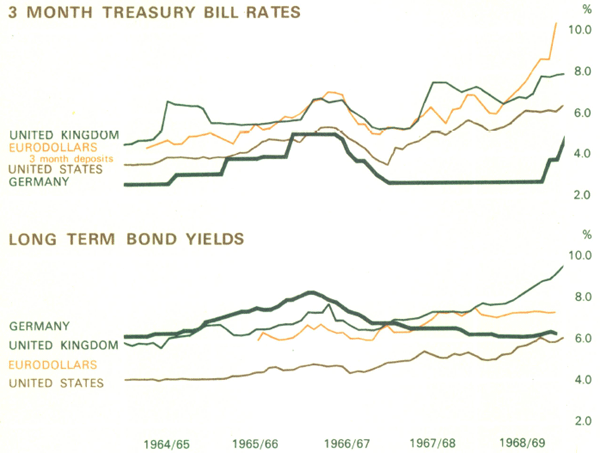
Short-term capital movements have become larger and more unpredictable in recent years with the growth in Europe of a substantial market in United States dollars and European currencies outside the control of the central banks. While this market has facilitated the movement of funds to finance trade and capital transactions, it has also provided a pool of funds available to finance speculative flows. Recent demands on this market from United States banks and corporations in Europe, largely the result of domestic credit restrictions in the United States, have exerted pressure on Eurodollar interest rates, adding to the upward movement in other European interest rates already brought about by restrictive credit policies in the deficit countries. (See graph 3).
Graph 3
SELECTED OVERSEAS INTEREST RATES
The provision of support for existing currency values in the face of large speculative capital movements has placed considerable strains on national monetary authorities, particularly those of the deficit countries. To meet such a situation, in recent years a network of reciprocal currency arrangements (“swap facilities”) has been established by a number of central banks, notably the United States Federal Reserve System, and the Bank for International Settlements. Under these arrangements, a central bank may draw on the currency of another country, up to a specified maximum amount and for a specified short period, in exchange for an equivalent amount of its own currency, and use these funds to support its own currency in the foreign exchange market and maintain its reserves. During 1968/69 there was heavy recourse to these facilities.
Proposals made in November 1968 for a recycling of speculative funds resulted in an agreement in February 1969 that, in a time of crisis, central bankers of the Group of Ten countries will immediately create additional support facilities through the Bank for International Settlements and that in any new group arrangement designed to recycle speculative flows, both the shares of the participants and the timing of drawings should reflect the direction of the flows involved. This scheme was called into use in the currency crisis of May 1969.
Such measures to support existing currency values against market forces have staved off disruptive tendencies in international finance but this has been achieved largely by increasing the foreign currency liabilities of deficit countries.
In the last analysis a solution to the problem of international adjustment requires domestic and international policies which contribute to a reduction in countries' overseas deficits and surpluses and enable them to achieve the level and composition of international reserves they desire. Domestic policies so far have failed to achieve these ends and restrictions on imports and capital outflow and reductions in foreign aid have tended to dampen the growth of world trade and output; attempts to regulate short-term capital movements have not restored confidence in the weak currencies. While additions to international liquidity, such as through special drawing rights, may help relieve some of the pressure on currencies, adjustment between surplus and deficit countries seems likely to require a greater degree of flexibility in the exchange rate structure.