Reserve Bank of Australia Annual Report – 1969 Reserve Bank Policy in 1968/69
Monetary Policy
In recent years monetary policy in Australia has been exercised to maintain credit conditions consistent with a high rate of economic growth, without promoting an expansion which would place undue pressure on domestic resources or the balance of payments. In 1968/69, with production and expenditure growing strongly without immediate threats to internal or external stability, the broad aim of policy was to exercise a cautionary influence over developments without impeding the underlying growth of the economy.
The outlook for policy at the beginning of 1968/69 was determined largely by the developments of the previous year. In 1967/68, despite early expectations of a decline in international reserves and some tightening of financial conditions, the Australian economy enjoyed a reasonably high rate of growth with little apparent pressure on domestic resources and with a small balance of payments surplus. A very large capital inflow in that year helped to finance a high level of domestic spending and credit conditions were fairly easy throughout the year. In October 1967 restraints on trading bank lending were eased ; at the same time banks were requested to maintain a high rate of overdraft cancellations and reductions. Over 1967/68 bank advances increased strongly and with deposits growing at a slower rate there was a tightening in bank liquidity over the year.
| $ million | |||||||||
|---|---|---|---|---|---|---|---|---|---|
| 1966/67 | 1967/68 | 1968/69 | |||||||
| 1st Half | 2nd Half | Year | 1st Half | 2nd Half | Year | 1st Half | 2nd Half p | Year p | |
| Government debt (net)† | +1,009 | −463 | +546 | +976 | −469 | +507 | +917 | −731 | +186 |
| Reserve Bank transactions | |||||||||
| Gold and foreign exchange | −100 | −70 | −170 | +25‡ | −16 | +9‡ | +27 | +183 | +210 |
| Rural Credits advances | −95 | +279 | +184 | −161 | +19 | −142 | −90 | +350 | +260 |
| Statutory Reserve Deposits | −(−11) | −(+13) | −(+2) | −(+19) | −(−36) | −(−17) | −(+79) | −(+31) | −(+110) |
| Term Loan Fund accounts | −(+5) | −(−13) | −(−8) | −(−11) | −(+22) | −(+11) | −(−7) | −(−15) | −(−22) |
| Farm Development Loan Fund accounts | −(−7) | −(−10) | −(−17) | −(−13) | −(+26) | −(+13) | −(−11) | −(−10) | −(−21) |
| Miscellaneous | −67 | +46 | −21 | −102‡ | +133 | +31‡ | −157 | +140 | −17 |
| Total | +760 | −198 | +562 | +743 | −345 | +398 | +636 | −64 | +572 |
| Less private non-bank holdings of L.G.S. assets | −(+410) | −(−34) | −(+376) | −(+326) | −(−28) | −(+298) | −(+354) | −(−72) | −(+282) |
| L.G.S. assets of banks | +350 | −164 | +186 | +417 | −317 | +100 | +282 | +8 | +290 |
| of which : Savings banks | +106 | +15 | +121 | +145 | −39 | +106 | +80 | −13 | +67 |
| Trading banks | +244 | −179 | +65 | +272 | −278 | −6 | +202 | +21 | +223 |
| * Figures other than Government debt (net) and private non-bank holdings
of Government securities are movements in June averages or interpolated
June averages. † Allows for movements in Commonwealth Government deposits with Reserve Bank and coin on issue. ‡ Both items exclude the effect of the writing down of the Australian currency value of the Reserve Bank's foreign exchange holdings as a result of the devaluation of sterling. p Preliminary |
|||||||||
At the end of June 1968, following a marked slackening in the growth of trading bank fixed deposits and some increases in non-bank interest rates, interest rates on these deposits were increased. In August, savings bank deposit and lending rates were also raised. These measures exerted a mild tightening influence in financial markets, though they were designed largely to maintain the attractiveness of banks' liabilities. The increase in savings bank interest rates on housing loans, however, had little apparent impact on the demand for housing finance and expenditure in this field continued at a high rate throughout the year.
At the outset of 1968/69, prospects appeared much as they had a year earlier. Output and expenditure were growing strongly and despite the modest tightening in the labour market, there appeared to be no immediate threat to internal balance. The main uncertainty again concerned external balance. Although exports were expected to improve in 1968/69, another large current account deficit was anticipated and with the possibility of a slowing down in the rate of capital inflow, a loss of international reserves seemed likely. There was a danger, also, that a sudden deterioration in Australia's balance of payments might undermine overseas confidence in the Australian dollar and bring about some reversal in the flow of private capital. From the point of view of internal balance, a less expansionary Commonwealth budget in 1968/69 and an initially lower level of bank liquidity seemed likely to add to the tightening in domestic financial conditions which would result from a decline in reserves.
Graph 14
MAJOR TRADING BANKS
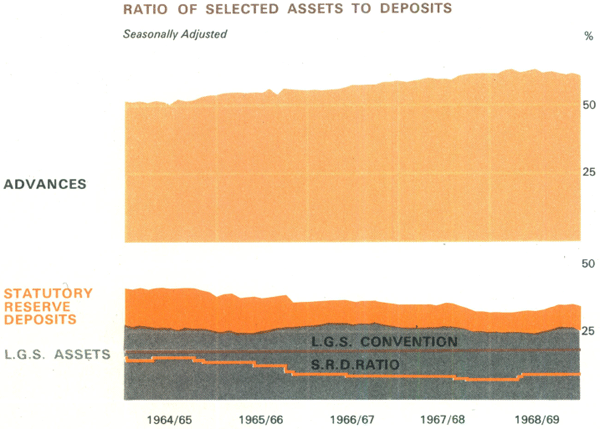
There was, however, little evidence of the expected tightening of liquidity in the early months of 1968/69. Capital inflow continued at a high rate and credit conditions remained easy. There was a rapid increase in bank lending in the first quarter of the year and lending by most other financial institutions also grew strongly. Labour market statistics suggested that pressure on domestic resources was slowly increasing. The Statutory Reserve Deposit ratio was therefore increased from 8.0 per cent to 9.0 per cent in two equal steps in October and November 1968 and in October the maximum overdraft interest rate chargeable by trading banks was increased. In November the trading banks were told that some tapering down in the rate of new lending would be appropriate and were requested to continue their close supervision of rates of cancellation and reduction of overdraft limits so as to avoid undue slack emerging in the use of limits. Banks were informed also that Statutory Reserve Deposits would be administered to maintain restraint on bank liquidity over the year. (See graph 14). In addition the Reserve Bank sought to absorb liquidity through acting as a keen seller and a reluctant buyer in its open market operations.
The liquidity of the private sector (after allowing for seasonal factors) continued to rise strongly during the second half of 1968/69. Capital inflow remained at a high rate and with no upsurge occurring in the demand for imports it became apparent that Australia would not only cover its current account deficit but would add to its holdings of gold and foreign exchange. This removed the immediate threat to external balance in 1968/69 but added to the funds available to finance domestic spending. Moreover, from December-January, the liquidity of the private sector was further boosted by large advances from the Rural Credits Department, mostly to finance wheat stocks and thereby adding to potential spending without increasing supplies.
Much of the increase in the funds of the private sector in 1968/69 was channelled through the banking system. Trading bank deposits rose strongly during the year and there was a high rate of cancellations and reductions in overdraft limits. Part of the increase in trading banks' liabilities was absorbed in Statutory Reserve Deposits with the Reserve Bank; the trading banks also increased substantially their holdings of Commonwealth Government securities, in part through purchases from the Reserve Bank. Trading bank lending levelled out after the first quarter of 1968/69 and although a strong upward movement reemerged towards the end of the year, the increase in advances outstanding during the year was moderate and was well below the increase during 1967/68. The slow growth of advances in the middle months of the year, however, was probably as much a reflection of the ready availability of funds from other sources as it was evidence of a strong inhibiting effect of credit policy measures. A part of the increase in savings banks' liabilities was absorbed in an increase in their deposits with the Reserve Bank but the increase in savings banks' holdings of Government securities in 1968/69 was the smallest for several years.
| Changes—$ million | |||||
|---|---|---|---|---|---|
| 1964/65 | 1965/66 | 1966/67 | 1967/68 | 1968/69 § | |
| Reserve Bank—Treasury bills* | −66 | −36 | +9 | +51 | −127 |
| —Treasury notes | — | — | — | — | +13 |
| —Other | +192 | −78 | +113 | +175 | −80 |
| Trading banks | −19 | +170 | +85 | −7 | +164 |
| Savings banks | +68 | +50 | +62 | +72 | +35 |
| Authorised money market dealers | −17 | +38 | +83 | +30 | +30 |
| Other non-government holders | +79 | +155 | +198 | +179 | +144 |
| TOTAL | +236 | +299 | +550 | +500 | +179 |
| * Face value. Allows for movement in Commonwealth Government deposits with Reserve Bank. § Estimate. | |||||
Outside the banking system, the demand for Government securities weakened in the latter part of the year and the ratio of the increase in private non-bank Government security holdings to that in total liquid assets of the private sector was the lowest for some years (see graph 15), leaving a greater volume of funds available to finance private spending. The relatively low demand for Government securities in 1968/69 may have been influenced by the fact that a large part of the increase in incomes in the private sector occurred in the rural sector, whose demand for Government securities is probably lower than that of the rest of the private sector. More important, however, with little change in terms of the Government's loan raisings in 1968/69 and with the removal of the tax rebate, there was a decline in the relative attractiveness of Government securities to some holders. The poor response to the May 1969 cash loan and the concentration of subscriptions in shorter term securities suggested that the market expected an increase in bond rates.
Graph 15
LIQUIDITY
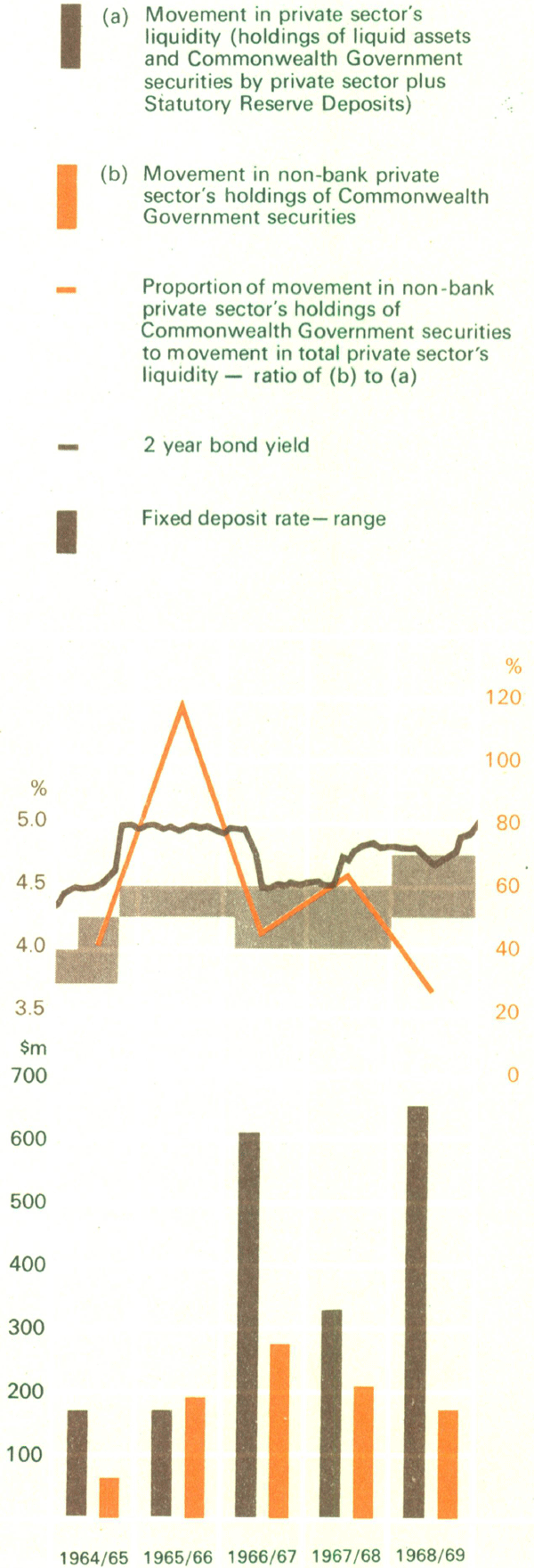
Towards the end of the year, with liquidity continuing to rise (after allowing for seasonal factors) and some evidence of greater pressure on domestic resources, monetary policy was thus directed more strongly at reducing the liquidity of the private sector and pressing the transfer of claims on resources from the private to the public sector. A heavy programme of loan maturities in 1969/70 also argued for some increase in the relative attractiveness of Government securities. The issue yields on Treasury notes were therefore raised appreciably in the last months of the year and the Reserve Bank became a more active seller of bonds in its open market operations; over the year as a whole the Bank ran down its holdings of bonds by $78 million, having made a net purchase of $178 million in 1967/68. Bond yields, which had risen only slightly over most of 1968/69, rose sharply in the last month of the year and the upward movement was consolidated early in 1969/70 by an increase in the issue yield on new securities. These measures were expected to bring about some shift of funds from the private to the public sector and, to the extent that the movement is reflected in private interest rates, to exercise a restraining influence over private spending.
Disposition of Reserves
A country's international reserves represent its holdings of assets, in the form of gold or claims on other countries, available to monetary authorities to finance temporary deficits in its balance of payments. The main requirement of a reserve asset is liquidity, to ensure its usefulness as a means of settling international transactions; however, in selecting the composition of its reserves a country has regard also to its current and likely future patterns of trade and borrowing and to the relative returns on alternative assets in the form of interest, possible capital gains or losses and any special advantages conferred by holding reserves in particular assets.
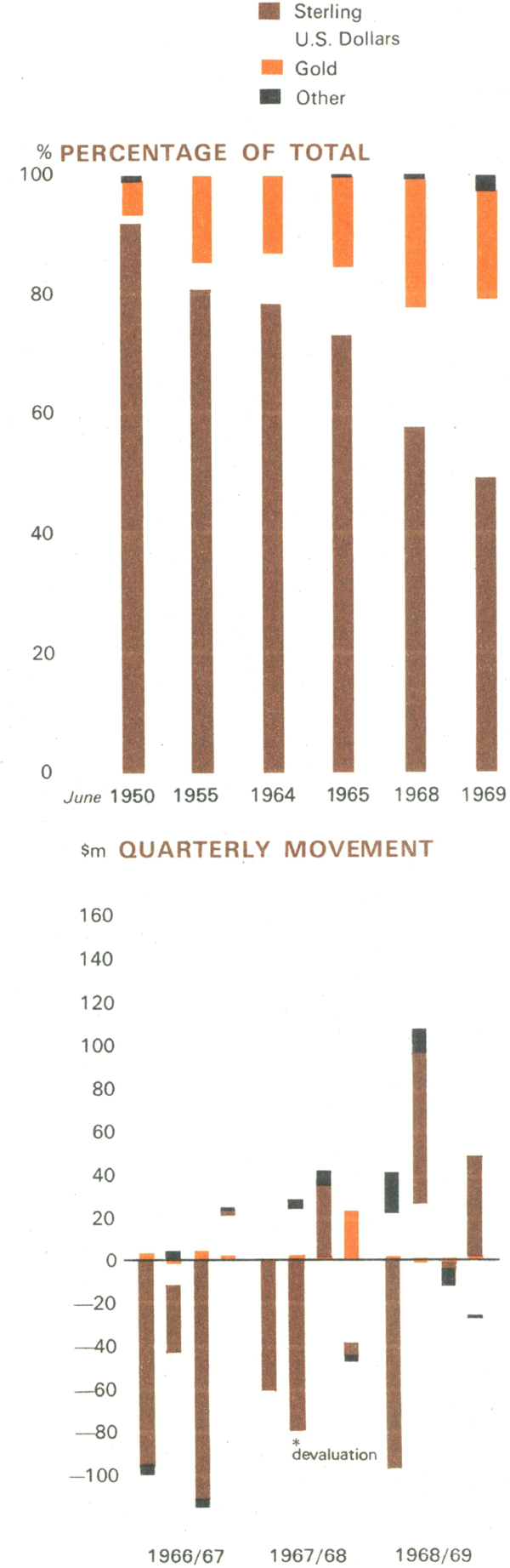
Over recent years, there has been a gradual shift in the composition of Australia's international reserves. (See graph 16). The proportion of sterling in Australia's reserves has fallen while U.S. dollars and gold have increased their share of total reserves. In 1967/68 the composition of Australia's reserves was further affected by a change in the Australian currency value of sterling holdings following the devaluation of sterling in November 1967.
In September 1968, as part of a scheme for the support of sterling, the major European countries along with Canada, Japan, the United States and the Bank for International Settlements undertook to provide to the United Kingdom Government an amount available to be drawn in the event of a rundown in the sterling balances of the overseas sterling area in the next three years. In conjunction with this scheme the United Kingdom Government sought to stabilise official sterling holdings of other sterling area countries by guaranteeing to maintain the value, in terms of United States dollars, of the greater part of each country's holdings, provided that the country concerned maintained a certain minimum proportion of its reserves in sterling. Following negotiations between the governments of the Commonwealth of Australia and the United Kingdom, in September 1968 Australia accepted that it would aim to hold in sterling about the same proportion of its total reserves (specially defined for this purpose) as it then held—about 45 per cent on the basis of the special definition—and undertook to maintain a minimum sterling proportion of 40 per cent. For its part, the United Kingdom Government undertook to maintain the sterling value, in terms of United States dollars, of Australia's official sterling balances in excess of 10 per cent of its total reserves. The agreement is to remain in force for three years with provision for possible extension for a further two years.
Graph 16
AUSTRALIAN
INTERNATIONAL
RESERVES