
Reserve Bank of Australia Annual Report – 1969 PAPUA AND NEW GUINEA
The Bank's responsibilities extend to Papua and New Guinea and are concerned with developing the banking and financial system and with expanding participation in the financial institutions by Papuans and New Guineans during the transition to self-government or independence.
ECONOMIC ACTIVITY
The economy continued to grow steadily in 1968/69. As in previous years, the pace of economic development was supported by a high level of government spending. Demand for imports remained high and there was a further substantial trade deficit.
Increases in production were recorded in most of the major export crops—copra, cocoa and rubber—but coffee production appears to have been somewhat lower. There was an expansion in the cattle industry and in the exploitation of local timber for domestic use and for export. Oil palm plantings proceeded; nearly 600 blocks have been allocated to Papuan and New Guinean settlers in New Britain, who are being financed by the Papua and New Guinea Development Bank. Commercial production of palm oil is expected to begin in 1971/72.
Substantial expenditure on the search for oil and natural gas continued during the year but with no commercial result. Planning of development of the Bougainville copper mining project proceeded. The operating company envisages investment of about $300 million and forecasts production of more than two million tons of concentrate over a 15 year period from 1972.
Factory output and employment rose under the stimulus of private investment estimated at over $60 million in 1968/69. Although planned expenditure on new factories and other building remained substantial, there was evidence of some excess capacity in the building and construction industry during the year. In part this might be absorbed by expenditures of the newly established Housing Commission, which aims to provide low cost housing to Papuans and New Guineans. In 1968/69 the Commission spent nearly $700,000on housing construction.
The expansion in rural output together with higher prices for most commodities resulted in a further increase in export income in 1968/69. Exports of cocoa benefited from a general world shortage and high prices, and small amounts of good quality tea were exported. Prices of rubber were higher than expected at the beginning of the year but copra and coffee prices were below earlier levels. The increased export income, however, was insufficient to meet the high level of imports and the trade deficit remained substantial.
Government finance plays an important role in the rural and industrial growth of Papua and New Guinea. The 1968/69 Budget formed part of the Administration's Economic Development Programme for the five years to 1972/73. This Programme set priorities for rural and industrial production and tertiary services and provided for Papuans and New Guineans playing a greater part in development. Total government spending of nearly $1,000 million is envisaged over the five year period.
Funds provided by the Commonwealth Government in 1968/69 amounted to $112 million, about the same as last year. An increase of $10 million to $87 million in the annual Commonwealth grant was almost offset by a fall in direct expenditure by Commonwealth Departments. However, internal current revenue of $55 million was about $12 million higher than in 1967/68. This, together with loan raisings of $7 million, meant that 38 per cent of government spending in 1968/69 was financed from funds raised internally; this was higher than the proportion in 1967/68.
International institutions provided further funds to assist in the development of Papua and New Guinea. In addition to the loan of $6.3 million negotiated with the International Bank for Reconstruction and Development, for improved telecommunications, the International Development Association provided a credit of $1.3 million to help finance palm oil development in New Britain. Drawings on these two loans in 1968/69 were small. Assistance was provided under the United Nations Development Programme for a country-wide transport survey and for the Goroka Teachers' College.
BANKING AND FINANCIAL DEVELOPMENTS
There was in 1968/69 a continued expansion in the range of services provided by financial institutions in Papua and New Guinea and in the use made of these facilities by Papuans and New Guineans.
Savings bank deposits rose by about 13 per cent to $37.2 million at June 1969, slightly more than the growth in 1967/68. The number of operative accounts rose by about 12 per cent over the year. Deposits with trading banks increased by about 7 per cent to $38.5 million at the end of June 1969, having risen by 12 per cent in 1967/68; over both years the increase was in current rather than fixed deposits. Advances by trading banks increased by about 17 per cent to $26.0 million at June compared with a rise of about 18 per cent in 1967/68. The average rate of new and increased lending commitments was higher and limits outstanding rose by $4.4 million to $31.6 million at the end of the year. Also, seasonal finance was provided by the Rural Credits Department of the Reserve Bank to a marketing authority and to co-operatives for the purchase and processing of copra, coffee and cocoa. The trading and savings banks gave further support to the Administration's loan programme by subscribing $2.8 million as private treaty loans. This brought the banks' loans to $13.8 million, about 40 per cent of subscriptions from all sources.
Graph 19
PAPUA AND
NEW GUINEA
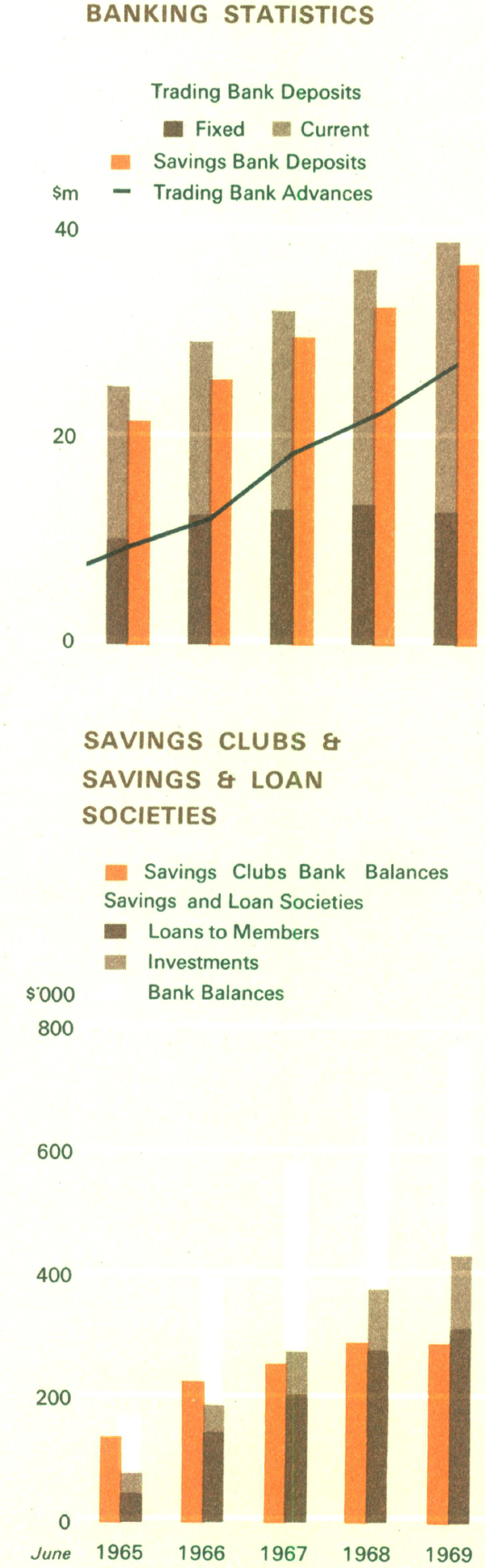
With capital of $6.0 million provided through the Papua and New Guinea Budgets over the last three years, the Papua and New Guinea Development Bank extended its activities. In January, the bank took over from the Ex-servicemen's Credit Board 289 loans which had provided $6.9 million to ex-service farmers. At June 1969 loans outstanding amounted to $10.0 million; a further $1.0 million had been used by the bank for equity investment.
The Savings and Loan Society movement continued to expand during the year. Increased activities in some areas where previous contact had been limited may mean a rise in tempo in 1969/70. At 30 June 1969 there were 221 Savings and Loan Societies with membership of over 11,000 persons and funds of $782,000; members' loans outstanding amounted to $318,000. (See graph 19). In addition there were 253 Savings Clubs in operation with nearly 10,000 members and funds of $281,000.
There was some evidence of heavier trading in shares and other securities and two Australian sharebrokers are now operating in Port Moresby. In addition there are representatives of three Australian dealers on the short-term money market. Hire purchase business increased in volume, trade credit continued to expand and there was a further growth in the activities of life assurance companies.
The Reserve Bank Advisory Committee on Central Banking in Papua and New Guinea met at Goroka and Madang during 1968/69 to discuss aspects of the economy and the Bank's activities in Papua and New Guinea. Three Papuan and New Guinean members were appointed during the year to fill vacancies on the Committee.
As part of the Bank's continuing financial education programme, booklets on banking and financial matters were widely distributed and officers of the Bank visited many schools and other training institutions. Research on economic and financial matters continued and the Bank's staff maintained liaison with representatives of business, banks and the Administration.
STAFF IN PAPUA AND NEW GUINEA
The Bank's policy is that its Papuan and New Guinean staff should assume increasing responsibility. One senior New Guinean officer became Executive Assistant to the Manager, Port Moresby during the year and another was appointed Deputy Registrar of Savings and Loan Societies. At June 1969, three quarters of the staff working in the Territory were Papuans or New Guineans.
Other banks seconded four members of staff for service with the Registry of Savings and Loan Societies.
Further special training was given to Papuan and New Guinean staff during the year. One officer attended the SEANZA Central Banking Course in Ceylon in 1968/69 and later spent about five months overseas, taking part in a course organised by the International Monetary Fund. Thirteen others were on full-time Bank scholarships at the University of Papua and New Guinea and a New Guinean scholarship student was undertaking university training in Australia. Two undergraduate members of staff spent some time working in administrative departments of the Bank in Sydney and four other officers visited Australia for training purposes.
Local staff training included induction courses conducted by the Papua and New Guinea Bankers' College. Staff have also been studying for an Elementary Banking Certificate at the College.