
Reserve Bank of Australia Annual Report – 1969 Other Activities of the Bank
Note Issue
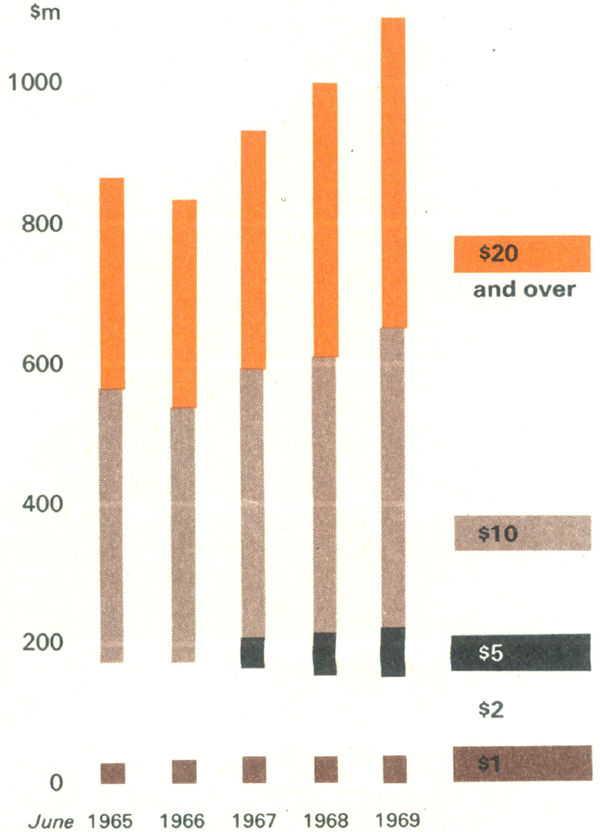
Australian notes in circulation rose by a net $93 million during the year making total circulation at 30 June 1969 $1,091 million. Growth was again particularly strong in the $20 denomination. (See graph 17).
Details of major items of security printing produced by the Printing Division of the Note Issue Department during the last four years are set out below.
Centralised Cash Facilities for Banks
Direct cash servicing arrangements between Reserve Bank centres and branches of banks were augmented during the year by the extension of services to Victoria in February 1969. At 30 June 1969 cash services were available to some 3,600 bank branches in New South Wales, Victoria and South Australia.
Graph 17
VALUE OF NOTES
IN CIRCULATION
Foreign Exchange Operations and Control
During 1968/69 turnover in foreign exchange through the banking system was higher, by about 18 per cent, than in 1967/68. Over the last decade, and more particularly since sterling devaluation, an increasing proportion of banks' foreign currency turnover has been settled in U.S. dollars. This year banks' receipts and payments of U.S. dollars comprised 33 per cent of their foreign currency business compared to 22 per cent five years ago.
Periods of uncertainty in foreign exchange markets abroad again created some problems for the banks. In November 1968, the London, French and West German markets were closed for three days and on that occasion the Reserve Bank fixed the United States dollar rate for Australian banks' transactions with their customers, as it had done at the time of the gold crisis in March 1968.
A wide range of forward exchange facilities is available through the Australian banks. Whilst the facilities do not extend to transactions of a capital nature or those involving speculation in exchange, they are available for most exchange risks arising out of trade transactions and invisible transactions of a non-capital nature. Broadly, by using these facilities Australian companies and marketing authorities exposed to an exchange risk through having sold or bought goods overseas for settlement in foreign currency at a future date are thus able to fix the amount of Australian currency which they will receive or pay when the foreign currency settlement is made. In part because of uncertainties about the exchange parities of major European currencies, very extensive use was made of these facilities in 1968/69. As the Reserve Bank accepts the exchange risk on forward exchange contracts in sterling, as well as the Australia/London component of the risk on contracts in other currencies (except United States and Canadian dollars for which special covering facilities are provided), the Bank's contingent liability in respect of forward exchange contracts current at the present time is substantial.
| millions of pieces | |||||
|---|---|---|---|---|---|
| Year Ended June | Australian Notes | Postage Stamps | Postal Orders | Other Postal Material | Cheques |
| 1966 | 283 | 1,275 | 27 | 90 | 60 |
| 1967 | 190 | 1,061 | 12 | 74 | 58 |
| 1968 | 151 | 1,236 | 13 | 80 | 57 |
| 1969 | 257 | 1,148 | 14 | 83 | 49 |
Certain procedural changes were made during the year in the exchange control field. These reduced the number of written applications required for most classes of remittances from Australia and for transactions in Australian securities on account of overseas residents. The authority of banks to approve applications for forward exchange cover without prior reference to the Reserve Bank was extended.
As in past years, the withdrawal of overseas-owned funds (both capital and income) was freely allowed and Australian residents were permitted to make certain types of direct investments in overseas countries.
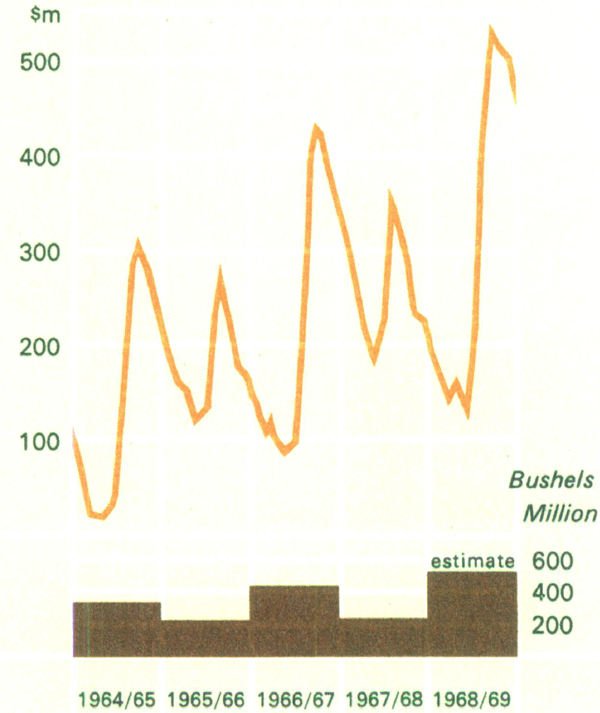
Graph 18
RURAL CREDITS ADVANCES
and Annual Intake
by Australian Wheat Board
Borrowings in Australia by Overseas Interests
In 1968/69 the Commonwealth Government maintained its “guidelines” policy of requesting overseas companies or Australian companies in which there is a substantial overseas shareholding to consult with the Reserve Bank on proposals for borrowing in Australia, in order to avoid too great a recourse to the Australian capital market in substitution of funds that otherwise would be provided from overseas sources. During the year the Bank received an increased number of approaches on behalf of companies for consultations under these arrangements.
Rural Credits Department
Seasonal finance provided by the Bank's Rural Credits Department to assist marketing, processing or manufacture of primary produce reached a peak of $543 million in advances outstanding in April 1969. This peak was higher than those of recent years and well above the 1967/68 figure of $367 million, which was affected by the decrease in rural production caused by drought. The lowest level of finance provided by the Department in 1968/69 was $129 million during December 1968.
Commodities financed included wheat, dairy produce, canned fruits, barley, cotton, rice, oats and eggs.
Outstanding advances at 30 June 1969 were $480 million, compared with $230 million a year earlier. The increase was caused principally by the amount of finance provided for the record wheat intake but there were additional amounts also for barley, cotton and oats.
The first advance from the Rural Credits Department to the Australian Wheat Board in 1968/69 was fixed at a rate of $1.10 per bushel. Receivals from wheat-growers by the Wheat Board in 1968/69 amounted to 515 million bushels. In view of the difficulties of disposing of this production, the Commonwealth and state governments and wheatgrowers' organisations met in April to discuss proposals for restricting wheat production. The Commonwealth Government subsequently agreed to guarantee a loan to the Wheat Board from the Reserve Bank of up to $440 million for the 1969/70 crop. Assuming deliveries of not more than 357 million bushels (the amount set for total deliveries in 1969/70 by the Australian Wheatgrowers' Federation), this would allow for an advance payment of $1.10 per bushel.
Following the increase in the maximum overdraft rate, interest rates on Rural Credits advances were increased by 0.25 per cent per annum as from 1 December 1968, to 4.75 per cent on government guaranteed loans and 5 per cent on other loans.
Bonds and Stock
The Bank conducts an Inscribed Stock Registry for the Commonwealth Government at each of its Australian branches. In addition, registries are maintained by the Bank at Sydney for the Australian currency flotations of the Fiji Government, at Brisbane for some semi-governmental bodies and at Port Moresby for the Territory of Papua and New Guinea.
On behalf of the Commonwealth Government, the Inscribed Stock Registries handled the flotation of four cash loans during 1968/69 and continued the tap issues of Special Bonds and Treasury notes. Two of the cash loans were combined with offers of conversion to holders of maturing securities. A series of Special Bonds also matured and holders were offered the opportunity to convert to the current series.
The 10 per cent taxation rebate applicable to interest on Commonwealth securities, which was introduced in 1942, ceased to apply to loans floated on and after 1 November 1968. To establish a range of non-rebateable securities, thirteen new securities with maturities within the range of 3 to 35 years were offered in the next three loans.
Daily issues of Treasury notes with currencies of either 13 or 26 weeks were maintained over the year and the Bank continued to offer rediscounting facilities for these notes.
Research and Other Grants
Grants are made from the Rural Credits Development Fund to universities and other organisations in Australia and Papua and New Guinea to support research and extension activities aimed at the promotion of primary production. The Fund is financed by the transfer each year of half the net profits of the Rural Credits Department. During 1968/69 grants amounting to $730,000 were approved, taking the total granted since 1960 to more than $4 million.
The Economic and Financial Research Fund provides support for post-graduate research in economic and financial topics with particular reference to Australia. In 1968/69 grants amounting to $56,000 were approved from the Fund; since its inception in 1952 grants have totalled $482,000.
Publications
During the year the Bank continued to publish a range of financial and economic statistics in its monthly Statistical Bulletin, weekly balance sheet and periodic statements on the short-term money market, international reserves and, since May 1969, certificates of deposit. Supplements to the Statistical Bulletin, on Papua and New Guinea, Company and Flow-of-Funds statistics, were again published.
The Bank also published a second occasional paper, entitled The Indicator Approach to the Identification of Business Cycles, a revised edition of Reserve Bank of Australia (which describes the Bank's functions and operations) and Australia's Dollars and Cents, a booklet for primary school children.
Liaison
During the year the Bank maintained regular contact with industry, commerce and finance and with the academic community, and the Rural Liaison Service continued to carry out its function of providing information on rural matters to banks.
Moves were made by the Australian banks in 1968/69 to co-ordinate research and planning of computer usage. The Reserve Bank has indicated its willingness to participate in these activities and has offered to second an officer experienced in this field.
The Governor, Deputy Governor and several senior officers of the Bank visited central banks and international financial institutions in Africa, Asia, Europe and North America during the year.
A group of leading European central bankers visited the Bank in October 1968 for informal discussions. The central banks of Austria, Belgium, Germany and the Netherlands and the Bank for International Settlements were represented. Senior officers of a number of central banks and commercial and financial institutions called at the Bank at the time of the second Annual General Meeting of the Asian Development Bank, held in Sydney in April.
The Presidents of the Federal Reserve Banks of New York and Minneapolis and the Governors of the central banks of India, Malaysia and New Zealand visited the Bank during the year. Visitors also included representatives of several other central banks, the International Monetary Fund and the International Bank for Reconstruction and Development.