
Review of Payments System Regulation 1. Background
Issues Paper
June 2026
Download the complete Document 1MB
The RBA has regulatory powers in respect of payment systems and their participants under the PSRA. Under the Reserve Bank Act 1959, the RBA’s payments system policy is set by the Payments System Board (PSB) and aims to control risk in the financial system, promote the efficiency of the payments system and promote competition in the market for payment services consistent with the overall financial safety of its participants.
Recent amendments to the PSRA enable the RBA to consider a wider range of entities and activities within the payments ecosystem when assessing whether regulatory action may be warranted in the public interest. This comes at a time of significant innovation and structural change in the payments landscape, with new technologies and business models continuing to reshape how, and by whom, payments are initiated, processed and settled. Changes in user preferences, industry structure and new participants in the payments value chain can raise new policy or regulatory issues in ensuring the ongoing efficiency, competitiveness and safety of Australia’s payments system.
Following the conclusion of the Review of Merchant Card Payment Costs and Surcharging, the RBA is commencing a broader review of payments system regulation under the amended PSRA. This Review focuses on issues including:
- merchant choice of payment methods and providers
- A2A payments and competition with card payments
- mobile wallets, non-designated card networks and BNPL services
- cryptography and fraud prevention.
There are some issues that are not intended to be within the scope of this Review. The RBA is not intending to revisit the issues that were addressed in the recent Review of Merchant Card Payment Costs and Surcharging (in the absence of substantial new or unanticipated developments) or that are the subject of current or recent reviews by other regulatory agencies. Issues relating to the availability of cash are also being considered separately, as part of the RBA’s ongoing work to maintain the availability of cash for as long as Australians want or need to use it as a means of payment.2
Stakeholders are invited to submit evidence in writing on issues that they consider raise competition, efficiency or financial safety considerations that may warrant regulatory intervention by the RBA. The RBA will review submissions received and intends to engage with stakeholders in August and September 2026 to discuss their feedback in more detail. From October 2026, the RBA intends to focus on assessing the evidence submitted, engaging further with stakeholders only where clarification or additional information will assist the RBA or the RBA otherwise considers it appropriate to do so. The RBA intends to publish a list of regulatory priorities by the end of 2026 and commence further consultation on prioritised issues by mid-2027.
1.1 The Australian payments landscape
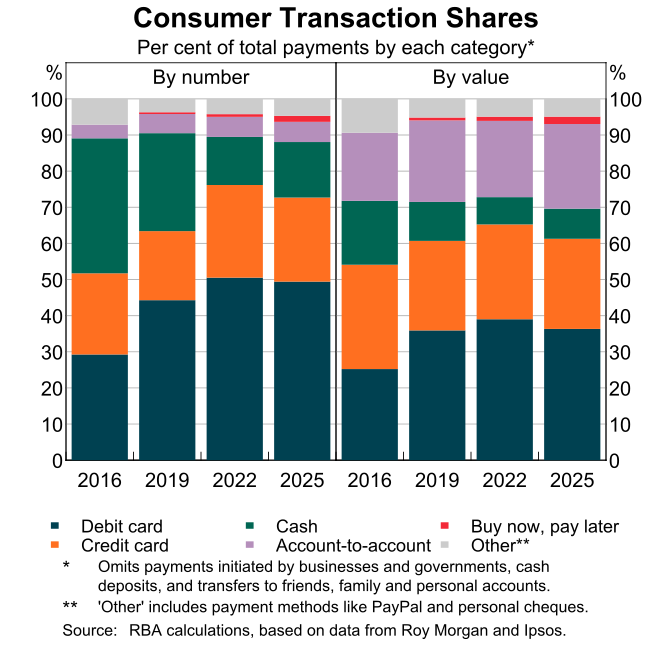
The ways in which Australians make and receive payments have changed significantly over the past decade.3 According to the RBA’s 2025 Consumer Payments Survey, debit cards account for around half of all consumer payment transactions, up from around 30 per cent in 2016 (Graph 1). This increase reflects widespread acceptance of these cards and the reduced use of cash. Credit cards remain an important payment method for some consumers, particularly higher-income households, and they account for around one-quarter of all consumer transactions. BNPL services have grown rapidly over the past decade, although they still only account for a relatively small share of consumer payments. Australians have also been able to make real-time, 24/7 A2A payments since the launch of the New Payments Platform (NPP) in 2018. A2A payments accounted for 6 per cent of consumer payments in 2025.
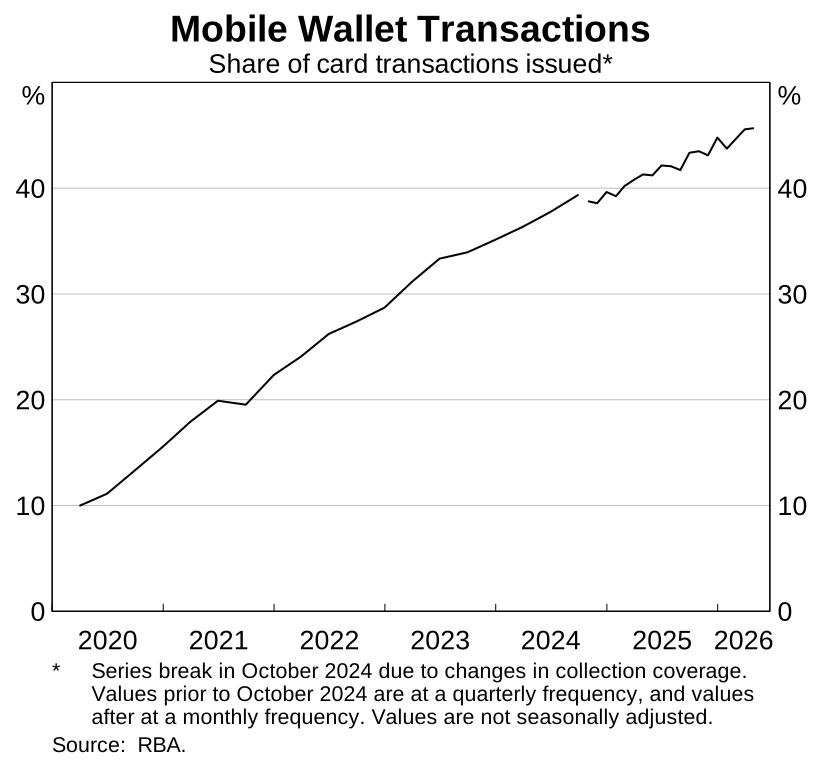
Consumers increasingly make payments via mobile wallets and online. In 2016, nearly all in-person payments were made by inserting cards or tapping contactless cards. With the rapid adoption of mobile wallets by Australian consumers since then, around 45 per cent of all card payments in 2026 were made by consumers tapping devices through services like Apple Pay, Google Pay and Samsung Pay (Graph 2). By contrast, less than 5 per cent of consumer transactions are now made by consumers inserting cards. Online payments have also grown rapidly in recent years and now account for around 20 per cent of all consumer payments, up from around 14 per cent in 2016. The use of AI agents in e-commerce could accelerate changes in how payments are made.
The ways in which merchants accept and interact with payments have also evolved. New entrants in the acquiring segment have steadily gained market share, in part reflecting the increasing popularity among merchants of simplified payments plans bundled with other products and services. Notable examples include e-commerce platforms and point-of-sale platforms that integrate payment acceptance services with other non-payment services that assist merchants with running their business. These developments, alongside a growing diversity of consumer payment methods, may make it more difficult for merchants – and in particular small businesses – to understand and manage their payment costs.
Much like the broader environment in which it operates, the payments system has become increasingly complex. This is giving rise to new challenges for ensuring the payments system remains safe, and for controlling risk to the financial system. Advances in computing are increasing the need to strengthen cryptographic practices. At the same time, the growth of online commerce has been accompanied by an increase in card fraud, particularly at overseas merchants. The need to modernise the infrastructure underlying payments can also create transitional risks, as illustrated by the proposed decommissioning of the Bulk Electronic Clearing System (BECS).
Overall, the payments system has experienced significant growth and innovation in recent years. These developments have the potential to make payments more convenient and safer, facilitate the entry of new players and lower costs for end users. At the same time, they could raise issues for competition, efficiency and financial safety in the payments system. This underscores the need for the RBA to review payments system regulation to ensure it continues to promote the public interest.
Endnotes
2 See Bullock M (2026), ‘Opening Statement to the House of Representatives Standing Committee on Economics’, Canberra, 6 February.
3 For further details, see Kim S and M Reschke (2026), ‘Consumer Payment Behaviour in Australia’, RBA Bulletin, May.