
Review of Payments System Regulation 4. Account-to-account Payments
Issues Paper
June 2026
Download the complete Document 1MB
Account-to-account (A2A) payments involve the transfer of funds between accounts held at authorised financial institutions (authorised deposit-taking institutions and certain providers of purchased payment facilities). A2A payments are commonly used for the payment of wages, superannuation, welfare and bills, as well as transfers of money to family and friends.
There are currently two clearing streams for payments between accounts held by Australian consumers, businesses and government agencies: BECS, which is administered by the Australian Payments Network (AusPayNet); and the NPP, which is operated by Australian Payments Plus (AP+).12 For both of these clearing systems, settlement (the movement of funds between the paying and receiving financial institution) occurs through the RBA’s settlement system.
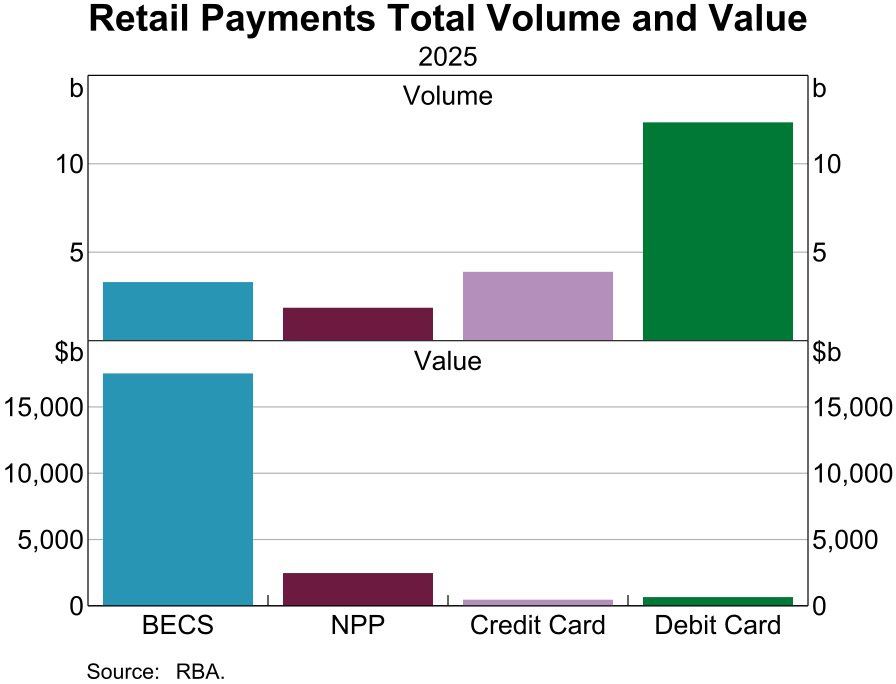
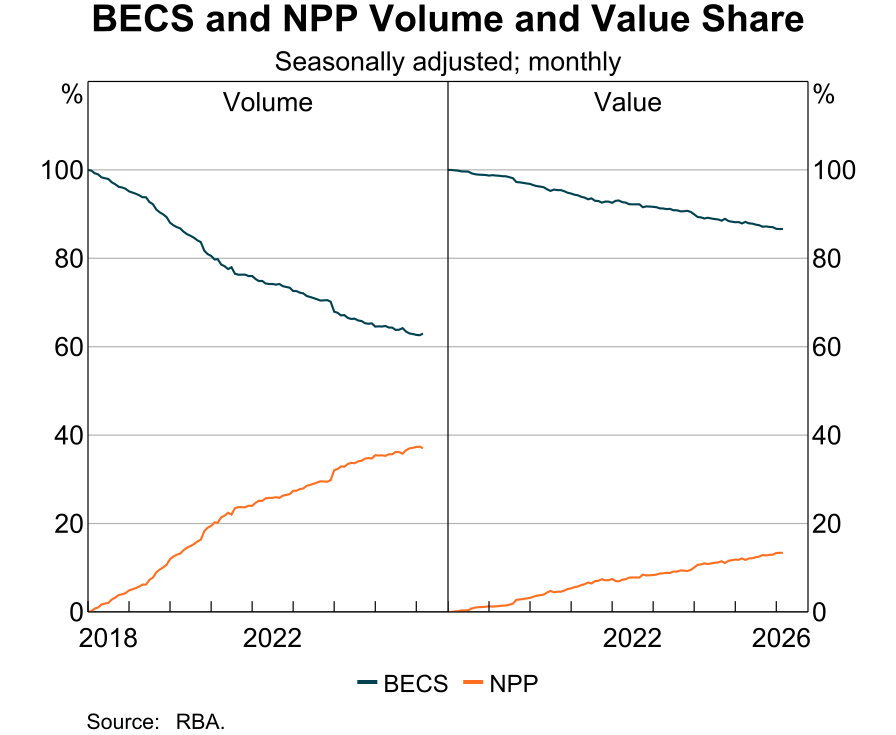
Australians use A2A payments less frequently than cards, but the total value of transactions processed via BECS and the NPP far exceeds the total value of card payments each year. BECS is Australia’s largest retail payment system by value, facilitating most salary, welfare and pension payments and recurring bill payments such as insurance premiums or utility bills (Graph 6). The NPP is Australia’s fast payments system, which processes transactions on a 24/7, near real-time basis. The NPP’s share of retail A2A payments has grown steadily since it was launched in 2018 (Graph 7), although it is still primarily used for lower value payments.
4.1 Future of A2A payments
In 2023, AusPayNet communicated an intention to decommission the BECS framework by 2030, contingent on the successful migration of all BECS payments to safe and reliable alternatives. The RBA publicly identified a number of risks with this plan in March 2025. In December 2025, AusPayNet announced that it was removing the target end date of June 2030 after the industry determined that it was unable to achieve it. It indicated that it would not set a new target date until after a clear roadmap has been developed for the future of A2A payments in Australia.13
In August 2025, an A2A Payments Roundtable was established to shape a shared vision for the future of A2A payments in Australia and define a roadmap of deliverables and timelines to achieve that vision. The intention of this work is to provide certainty to stakeholders on the long-term strategic direction for A2A payments, and anchor the industry’s development of A2A payments products, services and underlying infrastructure. The Roundtable is made up of AusPayNet, AP+, the RBA and the Australian Treasury. This Roundtable process has been authorised with conditions by the Australian Competition and Consumer Commission under competition law to run until 31 January 2027.14
On 30 April 2026, the A2A Payments Roundtable released a draft vision for the future of A2A payments for public consultation.15 The draft vision sets out the desired long-term outcomes for Australia’s A2A payments system – that it remains safe, reliable, low cost, easy to use and inclusive for consumers, businesses and government agencies. It also defines the qualities that the system (encompassing A2A payments infrastructure, product and services) needs to demonstrate to consistently deliver these outcomes.16
Some industry participants and end-users have raised concerns about aspects of A2A payments that may adversely affect competition, efficiency and financial safety in the broader payments system. For example:
- Access to A2A payment systems: A2A payment systems in Australia are characterised by a relatively small group of direct participants providing access to a larger number of indirectly connected entities. This model is often the most efficient and secure way for payments providers to arrange access to network infrastructure. However, there are cases where indirect access does not meet providers’ needs. Eligibility criteria for directly accessing A2A payment systems generally favour authorised deposit-taking institutions, and there are limited options for small institutions and non-bank PSPs to participate directly. Further, the process for obtaining access to A2A payment systems can often be lengthy, challenging and uncertain, involving substantial entry and ongoing costs. There may also be barriers and challenges for some providers – such as new entrants and those with low payments volumes – in indirectly accessing A2A payments. These could relate to the fees charged by intermediary financial institutions and technology providers as well as product, operational and technical connectivity requirements. Barriers to accessing payment systems can result in gaps in payment capabilities within the A2A system and significant variation in end-users’ payments experience.
- Standardisation within and across A2A payment systems: Standardisation can promote efficiency, competition and innovation by reducing complexity in the supply of payments, lowering entry costs for providers and platforms, improving the consistency of services provided to end users, enabling user choice of payment rails and facilitating the switching of providers. Appropriate standardisation can also help to control risk to the financial system by facilitating interoperability. In disruptions, interoperability may allow PSPs to reroute and failover payments between systems. This enables PSPs to preserve service continuity to end users and enhance certainty regarding the outcome and timing of payments. Without standardisation and interoperability, the payments system – and the broader financial system – is less able to absorb shocks to its components. A2A payment rails tend to be less compatible with each other than other aspects of the payments system due to a combination of technical, procedural and coordination challenges. Although standardisation has many benefits for payment systems, excessive standardisation may be counterproductive; it can constrain competition and innovation by limiting payment service providers’ ability to offer differentiated products and services.
The RBA is seeking views on whether there is a role for the RBA to take action to address any existing or emerging issues in the A2A payments system that may impact efficiency, competition or financial safety, or pose risks to the financial system.
Q11: What are the challenges faced by participants and end-users in the A2A payments system? Do these limit efficiency, competition or financial safety in relation to A2A transactions?
Q12: Is there a case for the RBA to take any regulatory action in relation to A2A payments to support efficiency, competition or financial safety, or control risk to the financial system? If so, what regulatory actions should be considered?
4.2 Competition between cards and A2A payments
Payment methods such as cards and A2A payments largely operate on distinct payment rails with limited scope for direct competition at the point-of-sale, particularly in the in-person environment. Innovation in the payments ecosystem, including the growth of digital wallets and overlay services, may enable such payment methods that use different rails to coexist and compete more seamlessly at the point of transaction. Examples include PSPs that offer services that make customer choice between A2A and card payments seamless for online transactions, and mobile wallets, which could leverage NFC technology to enable a similar frictionless experience particularly for in-person payments.
Increasing competition across payment methods that use different underlying payment rails – such as card networks and the NPP for A2A payments – can deliver:
- Competition and efficiency benefits: Greater adoption of A2A payments in in-person and online retail settings could enhance competition with card payments. Developments such as mobile devices and digital wallets could facilitate more seamless consumer use of A2A payments, supporting their use in a wider range of retail payment contexts and lowering frictions at the point of sale. Greater competition across payment rails could place additional downward pressure on merchant payment costs, contributing to improved efficiency outcomes across the payments system. These potential benefits would need to be considered alongside any implications arising from functionality or other differences across payment methods.
- Better control of risk: Greater consumer use of payment methods operating on different rails could allow for continued payments activity if one system experiences substantial outages, delays or disruptions, maintaining confidence in the payments system and controlling risk to the financial system.
The RBA is interested in views on whether there is a role for the RBA to take action to facilitate the development of such competition between card and A2A payments, consistent with its mandate to promote efficiency, competition and safety in the payments system. For these different payment methods to meaningfully compete across rails, the underlying market incentives and infrastructure supporting those payment rails may need to continue to evolve to support broader retail use.
Q13: What are the barriers to more seamlessly enabling A2A payments in the in-person and online environments through, for example, digital wallets, and do they warrant the RBA taking action to address them?
Q14: What regulatory action, if any, should the RBA take to promote more standardisation and interoperability across cards and A2A payments?
Endnotes
12 A2A payments can also be processed through the High Value Clearing System, which is primarily a wholesale payment system used for large interbank payments (where financial institutions are the ultimate beneficiary of the payment). Cheques are another method of making A2A payments. However, a wind-down of the cheques system is currently underway via the Australian Government’s Cheques Transition Plan. For further details, see Treasury (2024), ‘Australia’s Cheques Transition Plan’, November.
13 See RBA (2025a), RBA (2026c) and AusPayNet (2025c).
14 The authorisation extends to reaching an in-principle agreement on how the desired future state of A2A payments should be achieved. Implementation of any agreement would require a separate application for authorisation. See ACCC (Australian Competition and Consumer Commission) (2025) ‘Australian Payments Network Limited and Ors’, 1 August.
15 See RBA (2026d), ‘Roundtable Opens Public Consultation on Draft Vision for Account-to-Account Payments in Australia’, Media Release No 2026-11, 30 April.
16 The draft vision is consistent with the RBA’s Public Interest Framework for a Successful Account-to-Account Payments System. See RBA (2025c), ‘Public Interest Framework for a Successful Account-to-Account Payments System’, July.