
Review of Payments System Regulation 3. Mobile Payments, Non-designated Card Networks and Buy Now Pay Later
Issues Paper
June 2026
Download the complete Document 1MB
Stakeholders have raised with the RBA a range of other issues that could have implications for competition efficiency and/or financial safety in the payments system. These relate to mobile wallets, non-designated card payment systems and BNPL providers.
3.1 Mobile payments
Consumer use of mobile wallets to make payments has increased strongly in recent years. By the end of 2025, Apple Pay, Google Pay and Samsung Pay transactions collectively accounted for around 45 per cent of all card payments (by number). Most of these transactions were made in the in-person environment.
Mobile wallets offer a range of benefits for consumers and merchants, including the convenience of contactless payments without needing to carry physical cards and enhanced security (through ‘tokenisation’ and biometric authentication). In the online environment, mobile wallets also serve a pre-fill function, allowing consumers to securely transact with merchants through tokenisation without having to re-enter their credentials for their preferred payment method.
Some stakeholders have raised concerns that practices by some large mobile wallet providers may adversely affect competition and efficiency in the payments system. For example:
- Access to near field communication (NFC) technology: Not all operating systems allow fee-free direct access to NFC technology (which is used to make contactless in-person payments) on terms equivalent to the native mobile wallet for third-party apps in Australia. Such policies might limit the amount of competition faced by the native mobile wallet on devices that use these operating systems, as well as limiting opportunities for innovation or competition across payment rails. An example that many stakeholders have raised with the RBA is the limited degree of competition faced by the Apple Pay wallet on iOS devices.
- Costs associated with mobile wallets: Using a recent survey of Australian issuers by the RBA, issuer costs when a transaction is initiated via a mobile wallet are estimated to be around 2 cents per debit transaction and 0.06 per cent of transaction value for credit transactions on average.11 Some stakeholders have raised concerns that these costs could rise as consumer demand for mobile wallet payment services increases or if mobile wallet providers were to increase the fees they levy when transactions are initiated through a mobile wallet.
- Contract terms: Some mobile wallet providers contractually prevent issuers from disclosing the fees associated with mobile wallet transactions, which may limit competitive pressure on those fees. Some industry participants have also raised concerns that mobile wallet providers contractually restrict the ability of participants to develop, support and steer customers to alternative payment methods that could compete with mobile wallets. This may limit competition and innovation in the payments system.
On the other hand, given the growing consumer use of mobile wallets, mobile wallet providers have an opportunity to play a role in promoting innovation and competition in the payments system. Mobile wallet providers have made progress in enabling LCR, which supports competition between debit card networks. Wallet functionality could extend further to enable competition between cards and alternative payment methods. For example, the RBA is aware that wallet-based payment methods are being developed in other jurisdictions that would allow consumers to make in-person A2A payments and offer consumers an alternative to cards at the point of sale with a similar user experience to cards. These payment methods may involve different frameworks for consumer protections compared with card payments, including in areas such as fraud, chargebacks and liability allocation.
The RBA is interested in views on whether the practices of mobile wallet providers raise issues for competition, efficiency or financial safety in the payments system. The RBA is also seeking views on whether regulatory action may be warranted to address any identified concerns.
Q7: Are there competition, efficiency and/or financial safety issues relating to mobile payments? If so, are there any regulatory actions that the RBA should consider?
3.2 Non-designated card networks
3.2.1 Three-party networks
Three-party card networks involve direct relationships between the merchant, the cardholder and card network, with the card network fulfilling the role of card issuer and acquirer. For merchants, the network provides card acceptance services and charges merchant service fees. For cardholders, it collects card balances, fees and interest (if applicable), and offers incentives to encourage card use.
American Express is the most prominent example of a three-party network in Australia. American Express offers a broad range of credit and charge card products that primarily target businesses and affluent consumers. American Express typically offers rewards and other incentives for cardholders to use their cards. Unlike designated, four-party networks, three-party networks such as American Express do not charge interchange fees – as they are both the issuer and acquirer – and so are not subject to the RBA’s interchange regulation.
Some stakeholders have highlighted to the RBA the regulatory asymmetry between American Express and designated systems, including during the Review of Merchant Card Payment Costs and Surcharging. These stakeholders have raised the following competition, efficiency and safety concerns:
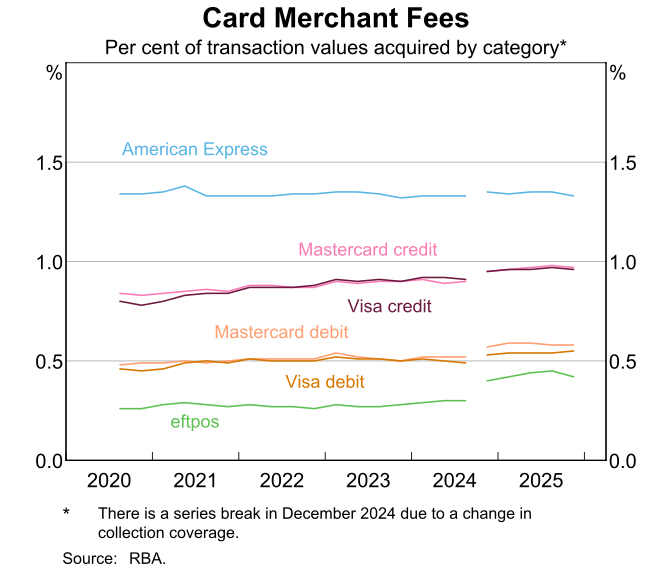
- Card-use incentives: American Express charges merchant fees that are, on average, higher than those associated with Visa and Mastercard credit cards (Graph 4). This in turn can help fund benefits and privileges that may incentivise consumers to use American Express cards at the expense of lower cost payment methods. Over time, this may result in the cross-subsidisation of American Express cardholders by users of cheaper payment methods.
- Merchant steering and price signals: Some stakeholders have raised with the RBA examples of practices by American Express that they argued may disincentivise merchants from leveraging steering options, like surcharging and discounting, and weaken effective price signals. These concerns are likely to be most relevant for industries like travel where acceptance of American Express cards is strongly expected by cardholders.
- Commercial card market share: American Express accounts for a large share of the commercial card transactions in Australia. As American Express is not subject to interchange regulation, American Express retains the flexibility to fund benefits and privileges that incentivise businesses to use American Express commercial cards. Some stakeholders have argued this can make it more difficult for other card networks and issuers to compete and, over time, could contribute to higher payment costs for merchants.
- Competitive dynamics in other segments: Stakeholders have raised concerns that American Express fees could rise as acceptance and use of American Express cards grows more widespread and merchants become more constrained in their ability to stop accepting American Express cards.
The RBA is seeking views on whether there is a case to consider regulatory action in relation to three-party networks.
Q8: Are there competition, efficiency and/or financial safety issues relating to three-party networks? If so, what regulatory action should the RBA consider?
3.2.2 Other non-designated card networks
Australian merchants also accept cards issued by card networks such as JCB and UnionPay that are not designated by the RBA. These networks account for a much smaller share of card payments in Australia than the designated card networks or American Express, and acceptance of these cards is typically concentrated in tourism-related sectors and among merchants servicing overseas cardholders.
Some stakeholders have suggested that competition and efficiency concerns could arise as a result of these card networks remaining outside of the RBA’s regulation. Cards issued on non-designated networks may cost merchants more to accept than designated network cards, including on cross-border transactions, as they are not subject to the RBA’s interchange caps. This could be keeping payment costs inefficiently high for merchants, particularly in industries that service foreign cardholders frequently and where merchants may feel greater pressure to accept these cards.
The RBA is interested in views on whether non-designated networks that account for a small share of card payments in Australia (such as JCB and UnionPay) pose competition, efficiency or financial safety issues for the payments system and whether there may be a case for formal regulation. In considering this, the RBA is mindful of the need to balance the potential competition benefits that smaller or emerging networks can provide against the importance of maintaining a regulatory framework that supports competition, efficiency and financial safety across the card payment systems.
Q9: Does the current regulatory treatment of non-designated card networks such as JCB and UnionPay remain appropriate given their limited scale in Australia, or would formal regulation of these networks by the RBA better support competition, efficiency and financial safety in the payments system?
3.3 BNPL providers
BNPL services generally offer consumers the ability to make payments in several instalments that gives them access to short-term credit and budgeting flexibility, while allowing merchants to receive payment upfront and potentially gain higher sales. The BNPL sector has grown rapidly in recent years, with transactions more than doubling in the past five years, but remains a small share of retail payments at 2 per cent in 2025 (see Graph 1).
The regulation of BNPL providers has evolved over time. In 2021, the RBA concluded that requiring BNPL providers to allow surcharging on BNPL transactions would promote competition and efficiency in the payments system. However, the RBA did not introduce regulations to prohibit such rules given uncertainty at the time over whether BNPL providers fell within the scope of the RBA’s powers under the PSRA. Since 2025, BNPL has been regulated as a form of consumer credit under the National Consumer Credit Protection Act 2009 which is administered by the Australian Securities and Investments Commission.
Stakeholders have previously raised the following potential competition and efficiency issues in relation to BNPL:
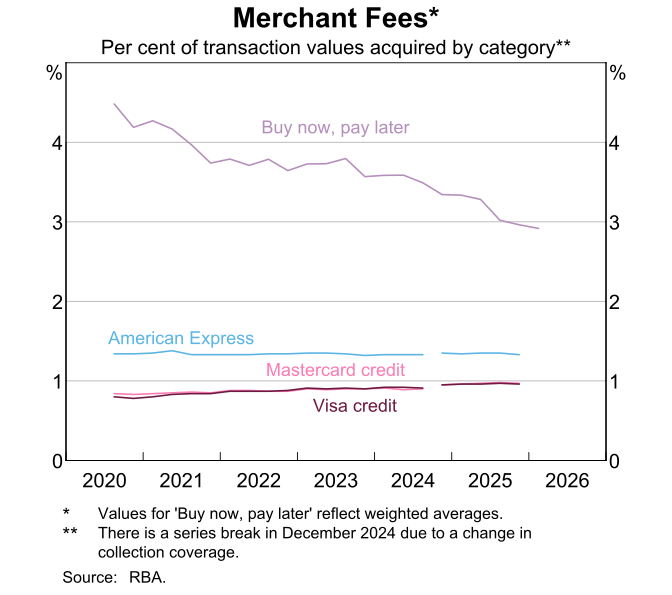
- Higher merchant fees: The cost of accepting BNPL transactions has declined in recent
years but remains materially higher on average than for card payments (Graph 5). Stakeholders
have suggested this may be particularly concerning in industries where accepting BNPL services is
viewed as necessary to remain competitive. This is because merchants in these industries likely lack
the ability to exert downward pressure on fees with BNPL providers or to steer customers towards
lower-cost payment methods. In combination with no-surcharge rules imposed by some BNPL providers,
this could raise potential efficiency concerns where users of lower-cost payments can cross-subsidise
users of higher-cost payments like BNPL.
Graph 5
- Market concentration: The BNPL market has become more concentrated over time, which could result in decreasing competition in the space, ultimately limiting merchants’ ability to negotiate fees and terms with BNPL providers. The RBA also notes the withdrawal of smaller providers from segments of the BNPL market in recent years.
- Fee transparency: BNPL providers typically do not publish the fees that they charge merchants, limiting visibility of acceptance costs and reducing merchants’ ability to benchmark their costs with their peers to assist in their price negotiations.
The RBA is seeking views on whether there is a case to consider regulatory action in relation to BNPL providers.
Q10: Are there competition, efficiency and/or financial safety issues relating to BNPL services? If so, what regulatory action should the RBA consider?
Endnotes
11 Estimates of mobile wallet transaction costs are approximated by scaling the issuer cost data using 2024/25 RBA Retail Payments Statistics data by the share of debit and credit card transactions conducted via mobile wallets. See RBA (2026a).