
Review of Payments System Regulation 2. Merchant Choice in Payments
Issues Paper
June 2026
Download the complete Document 1MB
Merchant choice of payment methods and payment service providers (PSPs) connects to a number of issues relevant to competition, efficiency and safety in the payments system. When merchants can easily switch to alternative providers, payment system operators and PSPs face stronger incentives to innovate, improve their service offerings, build safer and more resilient systems and compete on price. However, if developments in payments technology and e-commerce were to constrain merchant choice, this could have adverse implications for competition, efficiency and financial safety in the payments system.
2.1 Competition across debit card networks
The RBA has sought to promote competition and efficiency across debit card networks by expecting large debit card issuers to issue dual-network debit cards (DNDCs) and acquirers to enable least-cost routing (LCR) for merchants. DNDCs allow domestic payments to be processed via two different debit networks (these include eftpos, Debit Mastercard or Visa Debit). As a result of this, around 92 per cent of debit cards issued in Australia are DNDCs. LCR should give merchants and their payments service providers the ability to route DNDC transactions via whichever of the two networks on the card costs less to accept.
LCR can reduce card payment costs for merchants by increasing the competitive pressure on debit networks to lower their wholesale fees, thereby putting downward pressure on payment costs across the economy. The RBA has found that, on average, merchants that enable LCR tend to have a lower cost of acceptance for debit card transactions.4 Potential cost savings were the largest for small merchants and those on plans that blend together prices for different card types. There is also evidence to suggest that the introduction of LCR can exert downward pressure on scheme fees. For example, the average net scheme fee declined across all networks for online debit acquiring following the introduction of eftpos online transaction functionality in 2022/23 (Graph 3). This occurred despite scheme fees for in-person transactions increasing.
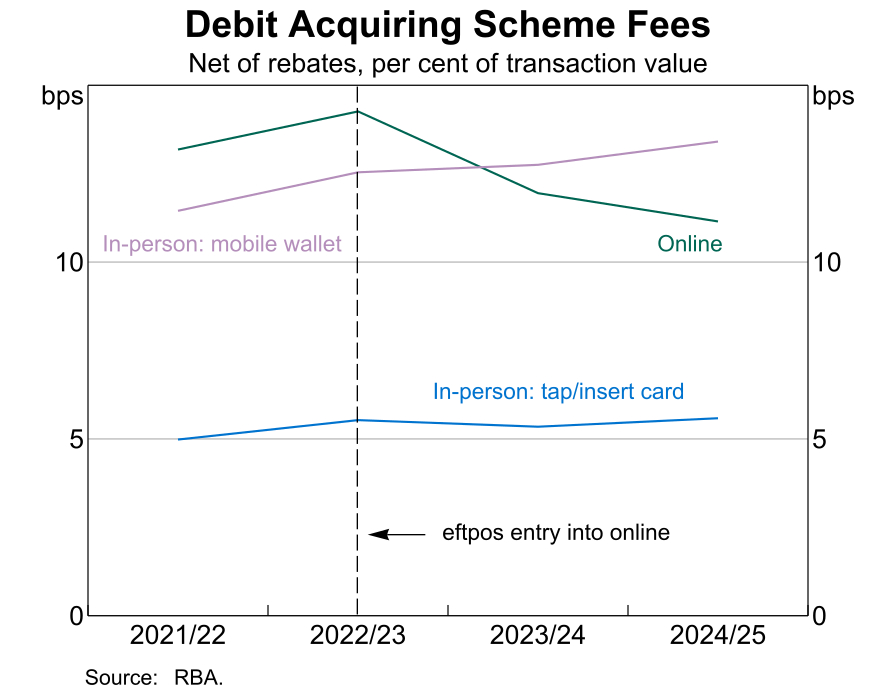
The payments industry has made substantial progress on lifting take-up of LCR in the in-person environment (excluding mobile wallet transactions). As of December 2025, LCR for these transactions is available to 100 per cent of merchants and enabled for 84 per cent of merchants. The RBA’s recent Review of Merchant Card Payment Costs and Surcharging concluded that there was not a strong case for a formal regulatory requirement to enable LCR for in-person transactions (excluding mobile wallets), given the additional costs involved and progress to date.5
In this Review, the RBA is considering whether there is a case for further action on LCR to enhance the competition across debit networks in other environments. This includes the mobile and online environments, which account for a large and growing share of transactions.
In-person mobile wallet transactions
The industry has made material progress in recent years towards enabling merchants to choose their preferred routing network for in-person mobile wallet transactions, with issuers and wallet providers facilitating the provisioning of tokens from both networks on DNDCs in mobile wallets. As a result, the RBA estimates that LCR may now be technically possible for more than half of DNDCs provisioned into mobile wallets, and this is expected to continue rising. Nevertheless, there appear to be some barriers remaining: some issuers have been slower in enabling LCR for their cards that were already uploaded in mobile wallets; there are differences in LCR availability across mobile wallet providers; and there may be some technical issues at acquirers or terminals. The RBA is continuing to work with mobile wallet providers, debit card networks and issuers to encourage the prompt resolution of these remaining barriers that may be inhibiting LCR for mobile wallet transactions.
Online transactions (including via mobile wallets)
Progress has been slower in the online environment. This partly reflects that eftpos enabled online functionality later than Mastercard and Visa, by which time some participants had already built their online payment capabilities for just the two international card networks. For those participants, integrating an additional debit network to facilitate LCR required significant further system changes and investment.
There also remains a significant gap between LCR on online transactions being available and being enabled for merchants. Large acquirers reported that LCR for online transactions was available to 97 per cent of merchants as at end December 2025. However, only three out of 11 large providers have reported that LCR for online transactions is turned on for most of their merchants.6
The competition benefits of DNDCs therefore remain unavailable for many merchants for online DNDC transactions. There are a range of barriers to improving the effectiveness of LCR for online debit transactions:
- The delivery of online LCR is reliant on a larger number of participants and intermediaries, and complex integrations between them. In addition to acquirers and PSPs, enabling LCR for some merchants may require payment gateways to build functionality. In some cases, gateways may have limited incentives to develop this capability. Once functionality has been built, additional work is also required to integrate with acquirer/PSP and merchant systems to fully enable LCR.
- New online payment methods have largely focused to date on solutions that enable transactions on DNDCs to be routed to a single debit network, typically an international debit network. It can take some time after new payment methods are launched for functionality to be introduced for routing DNDCs via a second debit network, such as eftpos. For example, the RBA understands that online transactions initiated via mobile wallets and Click-to-Pay do not currently support LCR functionality. Such approaches may constrain competition between debit networks in new and fast-growing segments.
Some emerging payment use cases, such as agentic commerce, rely on technologies used for online payments. Some stakeholders are predicting that these use cases will be rapidly adopted by consumers and merchants. If this is the case, existing constraints on competition between debit networks for online payments will have a broader impact.
The RBA is interested in views on the key factors that currently limit competition between debit networks for DNDC transactions in the mobile and/or online environments. The RBA is also interested in views on whether further formal regulatory action might be required. In considering these issues, the RBA is mindful of the need to balance the benefits of competition – such as lower costs and improved outcomes for end users – against the implementation costs and potential effects on efficiency and innovation in the payments system.
Q1: What are the impediments to competition between debit card networks for merchants’ transactions on DNDCs across mobile and/or online environments? Are there practices by industry participants that limit competition, efficiency or financial safety in relation to debit card transactions?
Q2: Is there a public interest case for the RBA to take further action to support competition across debit card networks in mobile and/or online environments?
2.2 Integrated platforms and bundling of payment services
Payment services are increasingly being integrated with other products and services. Merchants and consumers can benefit from the convenience of having a range of services, including payments processing, integrated and supplied together by one provider. For example:
- E-commerce platforms provide services that allow merchants to sell their products online, including the essentials for a merchant to get started – from website development to checkout and payments processing, as well as postage and delivery services. E-commerce platforms help to match merchants with suppliers of those different individual services in an integrated and automated way. E-commerce platforms can also provide some of those individual services in-house through their own product or service offerings.
- Point-of-sale (POS) platforms have evolved significantly over the past decade, shifting from standalone checkout terminals into integrated platforms at the core of merchants’ physical business operations. What were once systems focused primarily on processing in-store payments now typically combine payments, software, hardware and a growing suite of operational services into a single integrated offering.
These platforms do not solely compete for merchants based on their processing of payments. Rather, they also compete on the range of services they offer that help the merchant to run their business (e.g. e-commerce, POS facilities, accounting, payroll) and integrate these services with payments processing.
Some stakeholders have argued that, in some cases, the way payments processing services are provided by large integrated platforms can create potential competition and efficiency issues for the payments system:
- Potential constraints on competition in payments processing: The RBA understands large integrated e-commerce platforms can have a ‘preferred’ payments provider and some may engage in ‘self-preferencing’. These platforms may limit the ability of their merchant customers to integrate with competing or non-preferred PSPs or charge them higher fees for doing so. While some of these practices may be related to costs associated with the platform integrating additional providers, it can also make it uneconomic for merchant customers of these platforms to use competing PSPs. An example that many stakeholders have raised with the RBA is the widely used e-commerce platform Shopify, which appears to charge their merchant customers a third-party transaction fee for using a PSP other than Shopify Payments.
- Barriers to switching PSPs: Some merchant customers may choose to continue using such integrated platforms and forego access to cheaper or more innovative payments processing, because of the high cost of switching. Merchants that move away from an integrated platform can lose access to services that are core to running their business, which increases the cost of switching platforms. These barriers reduce competition in payments processing for merchants.
As small and medium-sized merchants are the predominant users of integrated platforms, these competition or efficiency concerns may have greater impact on these merchants.
The RBA is seeking views on whether the bundling of payment services with non-payment services, including in integrated platforms, is raising competition, efficiency or financial safety concerns in the payments system. For example, the RBA is interested in whether bundling practices detrimentally limit or influence merchant choice, pricing outcomes or the ability of other PSPs to compete effectively.
The RBA is also seeking views on whether regulatory action may be warranted to address any identified concerns, such as measures to provide merchants with greater choice of PSPs on integrated platforms.
Q3: How difficult is it for merchants to switch away from their existing integrated platform services provider to access their preferred PSP? To what extent do merchants receive clear and sufficient information from integrated platform providers prior to joining about potential challenges in switching PSPs, and are there areas where greater transparency could help them better understand potential costs and risks?
Q4: Does the bundling of payments with other services, such as in integrated platforms, raise competition, efficiency and/or financial safety issues in the payments system? If so, should regulatory action be considered and what form should it take?
2.3 Tokenisation of card information
Tokenisation of card payments involves replacing sensitive information – the cardholder’s primary account number (PAN) – with a unique token that contains less critical information than the PAN and can be restricted for use on a particular device and/or at a specific merchant.
This process reduces the risk that cardholders’ payments information is stolen and used for fraud, scams or other criminal activity such as identity theft.7 An increasing number of merchants and PSPs have adopted the use of tokens instead of the cardholder’s PAN for recurring payments (such as subscriptions) and other use cases where card information is stored. To support the enhancement of card security, the RBA issued a set of expectations for the tokenisation of payment cards and storage of PANs in May 2024.8 The expectations require merchants and PSPs to meet card industry security requirements when storing card information or use tokens instead of PANs, conditional upon token portability and token synchronisation.
The RBA understands that, at present, token portability presents challenges for merchants looking to switch between PSPs.
- Portability: Currently, most tokens (including network tokens) are specific to a particular merchant, while proprietary tokens created by PSPs or gateways are also typically specific to that PSP or gateway. This can create difficulties when a merchant seeks to change their PSP. Different practices for network token migration across networks can also complicate switching.
- Other switching constraints: Where PSPs instead rely on PANs to simplify migration processes, the re-tokenisation process can fail once those PANs have been migrated to the new PSP if the PAN has already expired.
These issues can create barriers to merchants changing PSPs and reduce competition for acquiring services. For example, the merchant may need to ask their existing customer base to re-enter card details for future transactions, adding frictions to customer retention and relationship management.
AusPayNet has released a technical Standard with a common set of requirements for the transfer of data between PSPs to support merchant switching.9 The RBA expects industry participants to comply with the Standard by 1 July 2026.10 The RBA notes that the Standard focuses on providing a standardised process for porting merchant payment-related data, rather than addressing the portability of tokens themselves. Stakeholders continue to report difficulty porting tokens across PSPs.
There are also broader operational issues associated with tokenisation. For example, network tokens can remain valid after a card expires or is replaced, which supports continuity of payments. However, following card lifecycle events (such as card replacement), the two network tokens on a DNDC may not be updated simultaneously. This can limit merchants’ ability to choose a debit network to route online payments made with the DNDC.
Collectively, these issues may affect the adoption of tokenisation by merchants and PSPs. As a result, there continues to be extensive retention of PANs by merchants and PSPs. This means the full security benefits of tokenisation, including fraud reduction, are yet to be realised.
The RBA is interested in views on whether there is a case for further action to promote the portability of tokens for payment cards, or other competition, efficiency or financial safety issues associated with implementing tokenisation across card payment systems.
Q5: How do stakeholders assess the functioning and effectiveness to date of the RBA’s tokenisation expectations? Is further regulatory intervention needed to promote the portability of tokens for payment cards, or to address other competition, efficiency or financial safety issues associated with implementing tokenisation across card payment systems? If so, what regulatory actions should be considered?
2.4 Use of AI agents for payments in e-commerce
The use of AI agents in e-commerce is a rapidly developing area. AI agents are already used in e-commerce to help consumers find and compare options. A small number of industry trials are underway with international technology firms or international networks where AI agents are used to finalise a purchase and make a payment with a ‘human in the loop’ (i.e. the consumer reviews and confirms the purchase before a payment is made).
Consumer decisions about whether to use an AI agent for making payments in e-commerce may be influenced by convenience and the agent’s ability to bundle payments processing with other services.
Developments in the use cases, rules and protocols for agentic commerce, including their acceptance of payment methods, are currently led by the international technology companies and payment networks. This highlights potential competition, efficiency and financial safety issues for the payments system:
- Merchant choice of payments: Payments processing using AI agents may initially be limited to international card networks, and it is not yet clear how and when merchants may be given a choice of debit networks for processing debit payments. Depending on how they are configured, AI agents may choose a payment method for processing payments based on factors such as incentive programs rather than lowest cost. These factors can limit merchants’ ability to choose a lower cost debit network for payments processed using an AI agent.
- Costs for merchants if AI agents become more widely adopted: While these services may offer convenience and automation benefits for consumers, the RBA is aware that some payments processed using an AI agent can incur an additional fee for merchants. If AI agents become more widely adopted by consumers and payments users, such fees can add to the cost of accepting payments for merchants.
- Disputes and liability: In the future, consumers may also use AI agents to make more autonomous payments decisions. This use case creates a risk of disputed transactions over questions such as the consumer’s intent to make a payment, whether the purchase meets the consumer’s expectations, and new categories of fraud, which can create operational complexity and add costs for merchants and payments system participants.
The RBA is interested in views on whether these developments in the use of AI agents for processing payments raise issues for competition, efficiency or financial safety for payment systems that interact with agents or in the broader payments system.
Q6: Are there competition, efficiency and/or financial safety issues relating to the use of AI agents for payments in e-commerce? If so, are there any regulatory actions that the RBA should consider?
Endnotes
4 See Dobie B and B Watson (2024), ‘The Effect of Least-cost Routing on Merchant Payment Costs’, RBA Bulletin, April.
5 For further details, see RBA (2026a).
6 See RBA (2026b), ‘Update on Availability and Enablement of Least-cost Routing for Merchants – Data as at December 2025’, March.
7 For more details on tokenisation of card payments, see RBA (2023) ‘The Australian Debit Card Market: Default Settings and Tokenisation’ Conclusions Paper, September.
8 See RBA (2024), ‘Expectations for the Tokenisation of Payment Cards and Storage of PANs’, May.
9 See AusPayNet (Australian Payments Network) (2025a), ‘Standard for Payment Service Provider Porting of Merchant Payment-Related Data’, 1 July.
10 See RBA (2025b), ‘Payments System Board Update’, Media Release No 2015-14, 5 June.