
Statement on Monetary Policy – November 2026Box C: Insights From Liaison
This Box highlights key messages collected by the RBA’s liaison teams based in New South Wales, Queensland, South Australia, Victoria and Western Australia during discussions with around 240 businesses, industry bodies, government agencies and community organisations from early-August to end-October 2026.
Liaison contacts report that cost and price pressures remain elevated and are expected to ease only moderately over the year ahead (Graph C.1). Wages growth outcomes and expectations have picked up since the middle of the year. Demand conditions generally remain around longer-run averages, with softening conditions in retail and dwelling investment being broadly offset by relatively stronger conditions in other areas of business activity. Expectations for growth in demand, investment and employment are also close to their longer-run averages, although with some variation across regions.
Businesses across most industries continue to report sustained labour and non-labour cost pressures, which are flowing through to prices. Most firms continue to expect above-average increases in their selling prices over the year ahead. Retail conditions are increasingly mixed; food retailers, for example, report fairly solid underlying growth, while more discretionary spending is softer than earlier in the year. Housing construction activity is currently being supported by existing pipelines of work in many regions, but a marked slowdown in forward sales suggests a weaker outlook. Nationally, non-residential construction and other business investment spending has been solid, and investment intentions are a bit above average at present. Employment intentions are close to average, having stabilised since earlier in the year.
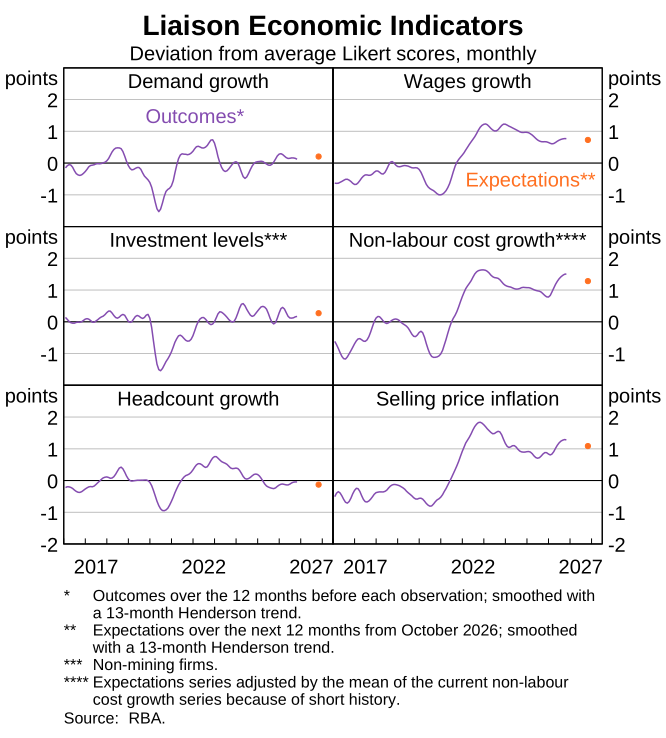
Cost and price pressures remain broadly based and elevated and are expected to ease only a little over the year ahead.
Businesses continue to report widespread increases in operating costs. Higher fuel costs are flowing through in the form of surcharges and general transport-related expenses. While some firms are singling this out as a specific cost driver, others report that fuel-related costs are increasingly mingled into the broader elevated operating cost environment they are facing. Higher global costs for other oil-derived products are also flowing through to offshore and domestic supply chains and to consumer prices, though some contacts note that the appreciation of the Australian dollar is helping to moderate some of this impact.
There is also ongoing upward pressure on other cost base components. Faster growth in IT costs, in part driven by global competition for memory chips, has been highlighted by many firms. Where firms are purchasing services from global and domestic IT vendors, these firms are passing through their own upstream costs into service and subscription prices. Other frequently cited components of operating cost increases include occupancy expenses, professional services, other labour-intensive third-party services, government charges and regulatory compliance costs. Many contacts observe that these categories have experienced repeated increases over recent years. Firms are generally expecting cost growth to remain above longer-run averages over the year ahead.
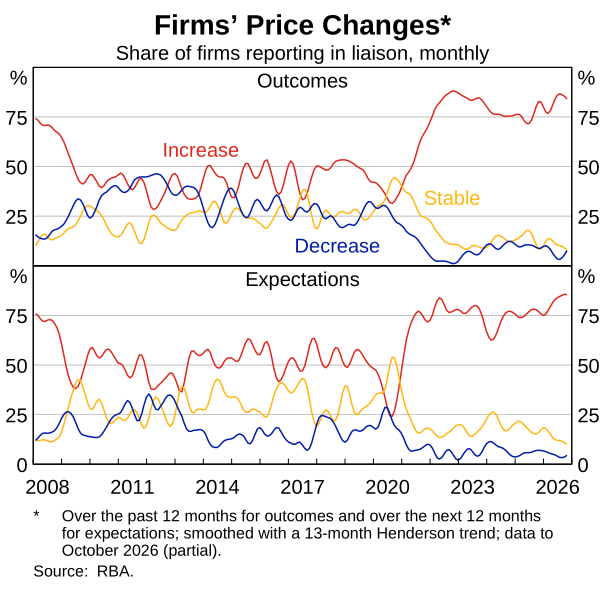
Reflecting this cost environment, price increases – both business-to-business and consumer-facing – remain broadly based across firms in the liaison program (Graph C.2). Over three-quarters of firms reported increasing prices over the past year; this share had drifted a little lower through to 2025 but picked up again over the past year. In contrast to the experience pre-pandemic, very few firms reported that prices had been reduced or held steady over the past year.
Within this, the size of increases in consumer-facing prices has been mixed, in part reflecting different demand conditions. Price increases for household goods have been relatively modest in general, although an exception has been consumer electronics given global IT hardware cost developments. New detached dwelling price growth is increasingly uneven across states. Builders have generally been able to pass cost increases through to prices in markets where demand conditions are stronger and land supply relatively tight, whereas pass-through has been more limited in Victoria and New South Wales, with some contacts in those states reporting some discounting to support sales.
Looking ahead, the share of firms expecting to increase prices is elevated and has increased further over recent months. Firms generally expect above-average increases in selling prices in the year ahead. Given firms generally see little prospect of moderating upstream cost pressures, in many cases contacts note that margins are under pressure and therefore they continue to look for ways to adjust their cost structures to manage this.
Household spending growth has been fairly steady overall, although discretionary spending is softer than earlier in the year.
Food retailers continue to report solid growth in consumption spending, broadly tracking trends in population and household income growth. In contrast, household goods retailers report that conditions are more challenging now than they were six months or so ago. Contacts attribute this to persistent household budget pressures, including from higher interest rates and the effects of the Middle East conflict on fuel prices. Consistent with this, some contacts have flagged an increase in consumers trading down and a greater focus on bargain hunting than was seen earlier in the year. Businesses in the tourism sector similarly report softer conditions than earlier in the year, although major sporting and cultural events continue to generate strong demand. Contacts generally expect that current softer conditions for consumer discretionary spending will continue into 2027.
Retailers with exposure to multiple states report better conditions in Queensland and Western Australia and relatively weaker conditions in Victoria. Higher fuel prices and general cost-of-living pressures are reported to be having a greater effect in remote areas and for lower-income households than in major urban centres and higher-income groups.
As has been the case for some time, community services organisations report elevated demand for their services, with a growing trend of more acute and complex needs. Over recent years there has been a larger cohort of people looking for support from these organisations to address housing stress and budget pressures, including dual-income households.
Housing construction activity is currently solid, but declining forward sales point to a weaker outlook …
Residential builders in most markets report solid activity levels at present, with earlier strength in sales supporting current work pipelines. This is expected to maintain momentum in construction activity into early 2027; contacts in Sydney and Melbourne report around six months of work compared with longer pipelines for those operating elsewhere. Softer activity is expected over the year ahead, given the decline in sales since earlier in 2026. Builders and developers variously attribute this to higher interest rates, tax reforms, and broader economic uncertainty. Several contacts have reported more buyers are adopting a ‘wait-and-see’ approach, reflected in longer decision-making timeframes and weaker sales, as well as some increase in contract cancellation rates over recent months.
Apartment builders continue to report affordability constraints and poor project feasibility as key factors weighing on development activity, with viable projects mainly concentrated in more premium segments of the market. Contacts note that demand fundamentals – strong population growth, low unemployment and ongoing housing shortages in many markets – are supportive, but there remains a significant gap between current market pricing and the price at which most apartments can be profitably built.
… while conditions for non-residential construction and other business investment are more resilient.
Firms’ investment intentions have been resilient over recent months and remain a little above longer-run averages. Within this, a number of businesses have noted upward revisions to capex costs over recent months, in part due to increases in construction and technology costs, but this has not materially changed plans. Firms with above-average investment intentions are primarily spending on projects to expand their businesses and to slow growth in operating costs. Commonly cited project types include construction to expand sites and capacity, new machinery and equipment (including automation), and technology programs.
Consistent with this, firms in the non-residential construction sector report solid demand conditions; public and private sector spending is fairly strong at present, and contacts are anticipating a good pipeline of activity over the next year or so across many regions. Firms associated with data centre developments continue to report particularly buoyant conditions, although contacts have flagged some uncertainty from approval processes and constraints on construction resource availability, as well as fluidity in underlying client demand. Developers of renewable energy generation assets generally see the data centre pipeline as a positive for their sector, but note that these renewables projects are more difficult to progress than was the case a few years ago and also typically involve longer timelines than data centres. Challenges cited include approval delays, longer investment decision-making timetables and interdependencies with grid expansions. Revenue projections for some proposals could also be at risk if the relatively low and stable wholesale electricity prices seen over the past year were sustained.
Some contacts in the higher education sector note discretionary capex is being deferred or scaled back given reduced fee revenue from weaker international student enrolments; instead, capex is being increasingly concentrated in committed projects and essential maintenance. Current and expected spending across other categories of public investment remain solid, including in defence, transport infrastructure, water utilities and healthcare projects in many regions.
Firms report hiring intentions are around their long-run average and wages growth has strengthened.
Consistent with broadly steady demand conditions, firms’ employment intentions are currently sitting close to their long-run average, having strengthened a little since earlier in the year (when some contacts noted uncertainty in hiring plans during the acute period of the Middle East conflict and oil price increases). Contacts expecting headcount growth report this as being supported by project work, expansion activity, ongoing growth in regulatory and compliance obligations, as well as underlying demand conditions. Firms’ characterisations of labour market conditions have not changed materially over recent months. While recruiting and retaining staff is generally reported to be easier than a couple of years ago, some firms note competition for labour remains strong, particularly in sectors such as health care, mining, transport and construction trades, though with some variation across regions.
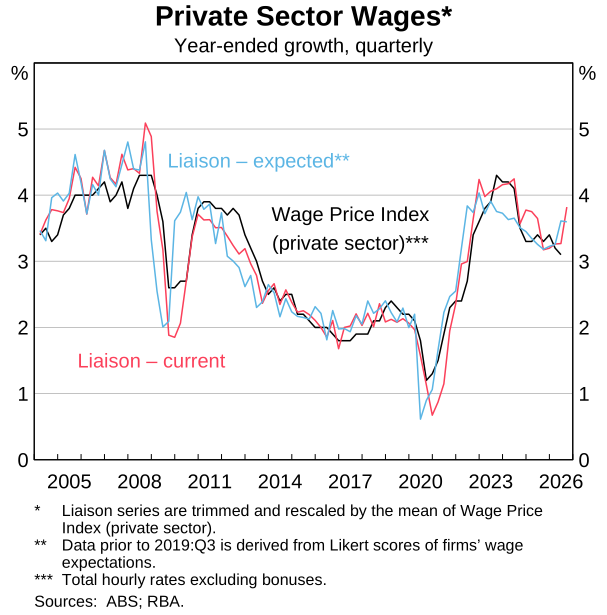
Labour costs remain a focus for firms, amid a recent pick-up in wages growth. Reported wages growth has lifted to be around 3¾ per cent over the September quarter, a marked move upwards from earlier in the year (Graph C.3). This is consistent with the flow-through since July of the Fair Work Commission’s 4.75 per cent award wage increase decision. Firms also note general cost-of-living pressures and labour market tightness in some areas as factors influencing wage outcomes over recent months. Contacts expect these factors to also bear on outcomes over the year ahead and are generally not expecting wages growth to slow materially from the current pace.
Given this, many contacts have noted they are looking to drive efficiency gains from improved rostering, staff reallocations and technological improvements. For most firms, AI has not affected headcount and is not expected to do so over the next year. Many firms are hopeful that AI-driven productivity gains will support more efficient use of existing staff resources and may influence future hiring decisions. To date, though, firms have reported mixed productivity experiences; while some more routine tasks are being successfully automated, some contacts have noted the increased overhead associated with exploring and implementing AI as well as responding to AI-generated material from customers and other third parties.