
RDP 2026-03: Designing an Efficient Reference Rate: Lessons from SOFIA Appendix B: Why SOFIA Warrants a Higher Expert Judgement Threshold than the BBSW or the Cash Rate
June 2026
- Download the Paper 3,250KB
Expert judgement (EJ) is typically applied to a benchmark rate when transaction volume is below a pre-established liquidity threshold. For the cash rate, EJ is triggered if on a given day there are fewer than three transactions, or at least four counterparties, or the total transaction volume is less than $500 million. For the BBSW, the threshold is similar, three transactions by four counterparties, but the volume threshold is lower at $100 million. We are unable to identify a set of principles used to set these EJ thresholds. In our study, we use a criterion based on information efficiency to propose a significantly higher EJ threshold for SOFIA: $0.75 to $1.5 billion, 10 to 20 transactions and 6 to 14 distinct counterparties. During the review process, a referee asked why SOFIA warrants a higher EJ threshold? We provide evidence suggesting that SOFIA-eligible trades have greater price dispersion and for this reason it warrants a higher EJ threshold.
If all markets shared similar characteristics and their EJ thresholds are calculated using the same methodology, we would expect similar levels of EJ across benchmark rates. However, the repo market, which underpins SOFIA, is less information efficient than the cash market (cash rate) or the bank bills market (BBSW). The reason is that the repo market is not solely a market for cash as are the other two, but it is also a market for collateral. That is, some participants engage in the market not to raise cash, but to borrow securities, for example, to facilitate short selling. Moreover, the repo market has a wider set of counterparties, which means greater diversity in trading motives and intentions. In the context of our study, less-information-efficient rates tend to exhibit a higher degree of noise. We define noise as a transitory deviation from the efficient repo rate that subsequently reverses. Based on this, we argue that SOFIA is inherently noisier than its peer benchmark rates and for this reason needs a higher EJ threshold to ensure rate efficiency.
To compare the noise in the three benchmark rates we apply a slightly different concept of noise; here we focus on intraday price disagreement between market participants. While our main empirical strategy estimates noise using local projection, which explores the time series dimension of the data, this exercise uses the cross-section dimension. We define price disagreement as the difference between individual transaction prices and the daily mean price. This is equivalent to calculating the standard deviation (Figure B1). A larger standard deviation indicates that the eligible transactions are taking place further away from the mean, suggesting greater dispersion in pricing.
As predicted, SOFIA-eligible transactions exhibit greater price divergence than BBSW-eligible or cash rate-eligible transactions. Because the tenor of the 3-month BBSW is greater than SOFIA, which only encompasses overnight transactions, its yields tend to be higher. For example, the mean yield between 2022 and 2025:Q1 was 3.40 per cent for BBSW and 3.23 for SOFIA. Based on this yield differential, one might expect BBSW to exhibit greater variance, but this is not supported by the data. The average intraday standard deviation from SOFIA is 2.13 basis points, and from 3-month BBSW is 1.58 basis points. The comparison between the cash rate and SOFIA is more straightforward as both have the same overnight tenor. However, SOFIA consistently displays a higher standard deviation, reinforcing the conclusion that it is the noisier of the two (cash rate standard deviation equals 0.32 basis points).
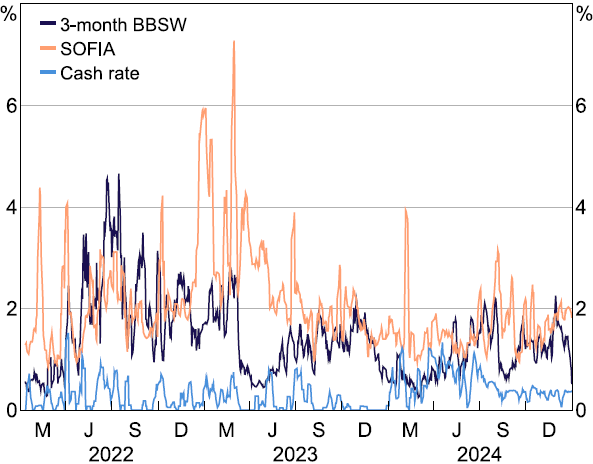
Sources: ASX; Authors' calculations; RBA.
Thus, our conclusion is that SOFIA is noisier than both BBSW and the cash rate. In other words, SOFIA is less information efficient. In our main estimates we show that in days with very low liquidity, SOFIA's noise spikes.[11] Because SOFIA is less information efficient, the cut-off threshold at which noise spikes is higher for SOFIA than for either BBSW or cash rate.
Footnote
Low liquidity days in SOFIA were mainly due to state-specific holiday in the periods. Although our prior is that this would not affect the price mechanism, this is an important caveat. [11]