
Reserve Bank of Australia Annual Report – 1970 The Year in Brief
The Australian economy continued to grow at a high rate throughout 1969/70. Civilian employment rose strongly and earnings again increased solidly. Domestic output, apart from farming, again rose sharply. Rural production was almost as high as the record level in 1968/69. All major categories of spending moved ahead firmly. Imports rose considerably over the year and exports increased at an even faster pace. During the first half of the year, Australia's international liquidity declined as capital inflow slackened markedly. Some strains on domestic resources began to emerge from early in the second half of the year; conditions in the labour market tightened, the strong rise in earnings was continuing and prices rose at a faster pace than in the first half of 1969/70. By the end of 1969/70, the balance of payments position had improved significantly as capital inflow rose strongly. Although there was some easing in the labour market, the rise in prices was accelerating as economic activity remained at a very high level.
Early in the year, demand for labour continued to rise and production was growing strongly, although it was clear that the growth in rural production achieved in 1968/69—a year of recovery from drought—could not be repeated in 1969/70. Prospects were that demand for goods and services would remain at a high level. Spending was rising significantly and some upward pressure on earnings and prices appeared likely. While sharply rising exports could be expected to exceed a higher level of imports, net invisible payments would continue to rise and the outlook for capital inflow seemed much less favourable in view of generally tightening financial conditions abroad. Australia's international liquidity was at a fairly comfortable level but seemed likely to fall over the year.
In this situation, the Reserve Bank moved towards a tighter monetary policy to meet inflationary tendencies. At the beginning of August 1969, trading bank deposit and lending interest rates were raised and it was announced that the Statutory Reserve Deposit ratio of the major trading banks would be increased in two equal stages; the first increase took effect in mid August and the second in early October. The banks were also asked to restrict their new lending. Furthermore, the Reserve Bank's operations in the bond market as a willing seller and a reluctant buyer of Government securities contributed towards tighter financial conditions. Although the Commonwealth Government budgeted for a smaller deficit in 1969/70, an expected outflow on account of official loan transactions abroad indicated that the Government's domestic borrowing requirement would not decrease as much as the deficit.
As the year progressed, employment expanded strongly in response to rising demand. Civilian employment rose markedly as large numbers of both school leavers and immigrants were absorbed into the work force; the high demand for labour encouraged greater female participation in the labour force. These additions to the labour supply were most pronounced in the first half of the year; in the second half, some shortage of labour emerged as economic growth continued strongly.
With high employment and rising output per worker, production (other than rural) rose by about 6.5 per cent in 1969/70, after excluding price increases; this was similar to the rise in 1968/69. Mineral production showed major gains and longer term prospects were further enhanced by the discovery of new natural resources. Industrial production increased significantly. In the farm sector, production of wool and various other commodities expanded but gains were broadly offset by declines in output of other rural products, particularly wheat.
Private fixed capital expenditure rose significantly during 1969/70, with outlays in many sectors of non-farm investment rising sharply. Spending on dwellings and other new buildings increased particularly strongly; housing commencements, however, slackened considerably towards the end of the year. Personal consumption rose at a faster pace than in the previous year and public spending increased strongly.
Imports responded to expanding demands and rose by about 12 per cent in 1969/70, exceeding the growth in aggregate spending. However, exports rose even faster than imports; growth in exports was spread across a wide range of commodities, with particularly sharp increases in sales abroad of minerals and metals. The balance of trade was in considerable surplus although net invisible payments continued to rise; the current account deficit was significantly less than that recorded in 1968/69. With tighter financial conditions abroad, capital inflow slackened considerably over the first three quarters of the year; however, the net inflow rose sharply in the June quarter. Overall, Australia's international liquidity rose somewhat over the year although it would have increased only marginally without the initial allocation in January 1970 of Special Drawing Rights with the International Monetary Fund.
Graph 1
SELECTED ECONOMIC INDICATORS
Seasonally Adjusted
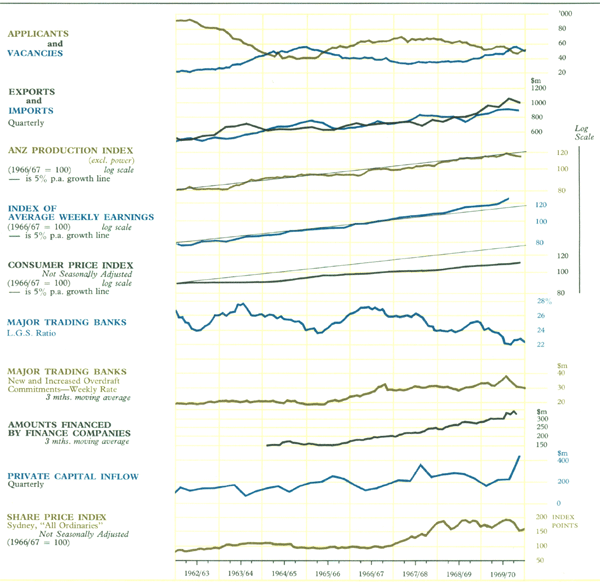
With high and strongly rising levels of activity at the beginning of 1969/70, the Bank was concerned that the rise in spending should not outstrip the growth in productive capacity. The policy changes introduced in August 1969 appeared adequate over the remainder of the first half of the year; although the balance of payments position was beginning to cause some concern, Australia's international liquidity was at a satisfactory level and there was no evidence of undue strain on domestic resources.
However, early in 1970, pressure on domestic resources strengthened. Average weekly earnings were rising at a high rate with the increase in award wages in December 1969 an important contributing factor. Moreover, with increasing demands on the labour market, the margin of earnings above the minimum awards widened considerably; overtime remained at high levels and other above-award payments increased at a faster pace. The gap between the growth of earnings and productivity was widening and there was some acceleration in the rate of increase in prices.
Up to early 1970, financial conditions had been generally easy. In particular, lending by banks and non-banks had continued at a high level. Trading banks had expanded their rate of new lending while savings banks' lending approvals for housing had been maintained at a rate about the same as in the second half of 1968/69. Lending by finance companies had risen very strongly since the beginning of the financial year. New loans for housing by permanent building societies increased rapidly and, in the second quarter of 1969/70, approached the level of savings banks' lending for housing. The large takeup by the Reserve Bank of Government securities, mainly Treasury bills associated with the Government's domestic borrowing requirement, was tending to accentuate the upswing of liquidity but the substantial fall in Australia's international liquidity and the decline in Rural Credits advances by the Reserve Bank were restraining factors.
By March 1970, with evidence of rising pressures on resources, further measures of restraint were considered necessary. Early in the month, interest rates on trading bank deposits and advances were increased; in April, savings bank interest rates were also raised. At this time, the Reserve Bank became increasingly unwilling to buy Government securities. This more restrictive stance, together with the seasonal tightness of money, led to a rise in bond yields by April of up to 1 per cent. The domestic surplus in the Commonwealth government's transactions was also providing a considerably larger restraint on liquidity than in the latter part of the previous year. The increases in bond yields and the run-down in liquidity were reflected in higher interest rates throughout the capital market and a general scarcity of funds was experienced throughout the financial system.
In the latter part of the year, a major development in financial markets was the very rapid increase in private capital inflow. During the June quarter, private capital inflow rose much more than seasonally and amounted to a little over $500 million, almost half of the total for the full year; the sharp rise could be explained in part by the tighter monetary conditions in Australia. In these circumstances, there was a substantial increase in Australia's international liquidity tending to ease the normal seasonal tightening of financial conditions. However, lending by some financial institutions, including banks, slackened somewhat over this period; in particular, loan approvals by permanent building societies, which had been a major source of finance for the housing industry in the earlier part of the year, fell markedly. Financial assets held by the private non-finance group showed little change over the June quarter, compared with a sizeable increase in the same period in 1968/69; however, the group's holdings of Government securities increased marginally over this period, compared with a substantial fall in the same period in 1968/69. This stronger demand for Government securities reflected the increase in their yields.
In 1969/70 there was remarkable activity in Australian Stock Exchanges. Turnover, especially in mining shares, reached unprecedented levels with announcements of important mineral discoveries a major stimulating factor. After little movement over the September quarter, share prices rose particularly sharply in the December quarter and reached peak levels in early January. Subsequently, prices declined markedly to the end of May but rose a little over June. The largest fluctuations over the year occurred in prices of speculative mining stocks although there were fairly sharp price changes across a wide range of other stocks. The depressed state of major share markets abroad in the latter part of the year may have been responsible, in part, for lower prices in Australian share markets over this period.
At the end of 1969/70, the growth of demand was continuing strongly but appeared not to be running far ahead of the growth of available resources. In particular the earlier urgency of demand for labour was tending to ease as the year concluded Fixed capital formation was expanding strongly. Rising incomes were sustaining a high level of personal consumption Following the sharp increase in capital inflow towards the end of the year Australia's international liquidity was rising. However, with economic activity continuing at high levels and price rise accelerating, it appeared that any genera relaxation of monetary policy would be premature.