
Reserve Bank of Australia Annual Report – 1970 Reserve Bank Policy in 1969/70
Monetary Policy
Australia entered 1969/70 with economic activity already at a high level and some tendency for spending to rise more rapidly than the ability to produce. However, conditions in the labour market were tightening only gradually and price rises were moderate. The adverse balance on current account in overseas transactions remained large but was being reduced; capital inflow slackened from the previous high rates and resulted in a decline in Australia's international liquidity. Because of the strong rise in liquidity over 1968/69, credit conditions were generally easy and lending by financial institutions was proceeding at a high rate. Towards the end of 1968/69, with evidence of increasing pressure on domestic resources and the prospect of heavy loan redemptions, the Bank became more active as a seller of bonds in its open market operations; consequently, there was a marked rise in yields on Government securities in June and July 1969 (see graph 16).
Prospects were that there would be a steady expansion in activity during 1969/70. With conditions continuing to tighten in overseas capital markets, capital inflow appeared likely to slacken further; Australia's international liquidity would probably decline to some extent. The Bank took further precautionary measures early in 1969/70 to counter the growth of inflationary tendencies in the economy. In August, the maximum trading bank interest rates were raised by between 0.25 per cent and 0.65 per cent. Both trading and savings banks were asked to moderate their lending. In a further measure, the major trading banks' Statutory Reserve Deposit ratio was raised in August and October in two equal stages from 9 per cent to 10 per cent. In its bond operations, the Bank was firmer in its position as a willing seller and a reluctant buyer of Government securities; this stance led to a rise in bond yields, particularly at the short end.
Graph 16
SELECTED INTEREST RATES
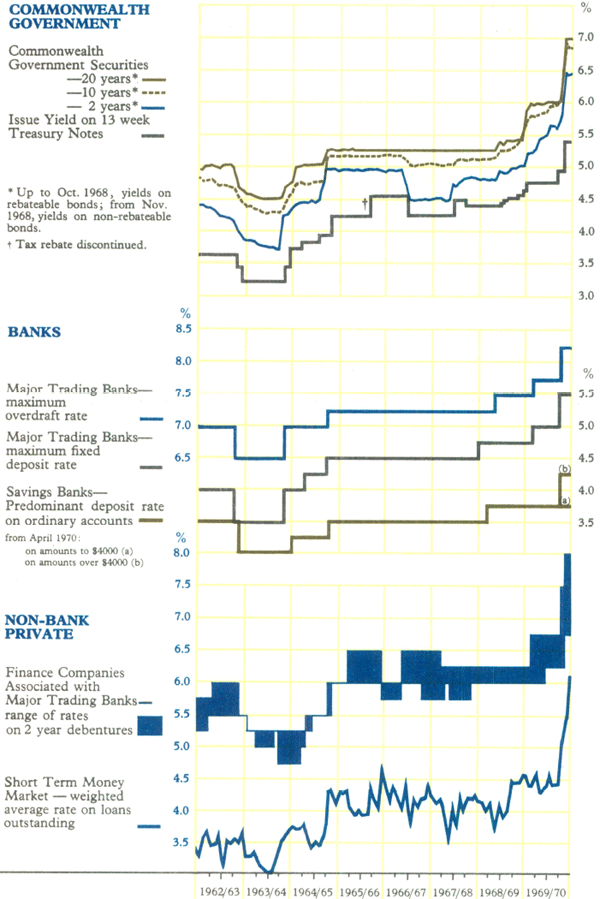
Some restraints were also incorporated in the Commonwealth Government's budget for 1969/70. Expenditures and receipts were estimated to rise at a substantial rate but a smaller budget deficit was envisaged for the year. The domestic surplus in the Commonwealth Government's transactions was considerably larger than in the previous year. The degree to which financial conditions would be tightened by fiscal measures would depend, to a large extent, on the willingness of the community to finance the Government's domestic borrowing requirement.
As the year progressed, Australia's international liquidity continued to fall. Exports were growing faster than imports but net invisible payments were rising and capital inflow had slackened considerably. Developments in the balance of payments were beginning to cause a little concern but Australia's international liquidity was still at a satisfactory level. Domestic trends showed no evidence of undue strain. Demand in the labour market was high but not increasing and earnings were not rising at a particularly rapid pace. The rate of increase in prices was about the same as in the second half of 1968/69.
Financial conditions remained generally easy, with lending proceeding at a high rate. The usual seasonal upswing in liquidity was being accentuated by a substantial take-up by the Bank of Government securities, mainly Treasury bills to finance the Government's domestic borrowing requirement. However, the falls in international liquidity and in Rural Credits advances by the Bank were providing some offset. The Bank's prevailing policy was considered adequate for the situation; however, there was need to watch carefully the effectiveness of existing restraints. In particular, continued high rates of bank and non-bank lending and the expansive effects of the Bank's take-up of Government securities were matters for some concern.
In the opening months of 1970, increased pressure on domestic resources was evident. The rate of increase in prices accelerated and the economy moved into a state of moderate boom. The tightness in the labour market was comparable with that of the rather over-active period of 1964/65 but was considerably less pronounced than the chronic pressures during much of the 1950's. The substantial import surpluses of some earlier periods were not being repeated but net monetary movements in the balance of payments remained unfavourable. Pressures on wages and prices seemed to be growing. The high rate of spending, if maintained, could increase costs and, with domestic resources heavily used, there could be increasing demands for imports. Failure to take policy action at this stage may have required more drastic measures later.
| 1967/68 | 1968/69 | 1969/70 | |||||||||
|---|---|---|---|---|---|---|---|---|---|---|---|
| $ million | 1st half | 2nd half | year | 1st half | 2nd half | year | 1st half | 2nd half p | year p | ||
| Government debt (net)† | +975 | −469 | +506 | +917 | −729 | +188 | +1088 | −771 | +317 | ||
| Reserve Bank transactions | |||||||||||
| Gold and foreign exchange | +25‡ | −16 | +9‡ | +27 | +183 | +210 | −302 | +349§ | +47§ | ||
| Rural Credits advances | −161 | +19 | −142 | −90 | +350 | +260 | −80 | −60 | −140 | ||
| Statutory Reserve Deposits | −(+19) | −(−36) | −(−17) | −(+79) | −(+31) | −(+110) | −(+91) | −(+20) | −(+111) | ||
| Term Loan Fund accounts | −(−11) | −(+22) | −(+11) | −(−7) | −(−15) | −(−22) | −(−9) | −(−1) | −(−10) | ||
| Farm Development Loan Fund accounts | −(−13) | −(+26) | −(+13) | −(−11) | −(−10) | −(−21) | −(−10) | −(−5) | −(−15) | ||
| Miscellaneous | −106‡ | +132 | +26‡ | −164 | +129 | −35 | −191 | +227 | +36 | ||
| Total L.G.S. assets of the private sector | +738 | −346 | +392 | +629 | −73 | +556 | +443 | −269 | +174 | ||
| Held by: | |||||||||||
| Trading banks | +272 | −278 | −6 | +202 | +21 | +223 | +135 | −235 | −100 | ||
| Savings banks | +145 | −39 | +106 | +80 | −13 | +67 | +132 | −84 | +48 | ||
| Other private | +321 | −29 | +292 | +347 | −81 | +266 | +176 | +50 | +226 | ||
| * Figures other than Government debt (net) and private non-bank holdings
of Government securities are movements in June averages or interpolated
June averages. † Allows for movements in Commonwealth Government deposits with Reserve Bank and coin on issue. ‡ Both items exclude the effect of the writing down of the Australian currency value of the Reserve Bank's foreign exchange holdings as a result of the devaluation of sterling and the New Zealand dollar. § Includes +$79 million Special Drawing Rights with the International Monetary Fund, including the initial allocation of $75 million. The initial allocation is offset in the miscellaneous item. p Preliminary. |
|||||||||||
In this situation, the Bank moved to effect some further tightening of financial conditions. Trading bank maximum deposit and lending interest rates were increased in March 1970 by 0.5 per cent and savings bank interest rates were raised in April. Trading banks, whose advances were expanding rapidly, were asked to cut back new lending approvals and to maintain a high rate of cancellation and reduction of overdraft limits. The trading banks were also informed that they could not assume that policy action would be taken by the Bank to relieve their liquidity positions which were becoming very tight.
It was evident, however, that additional measures were required. The measures already taken restrained the availability of finance through banks but had limitations in view of the existence of alternative sources of finance. In particular, funds which would otherwise be held in Government securities could be bid away to satisfy the heavy demands for finance. A broader-based adjustment of interest rates could be expected to impose an additional restraint on spending. Further, a general increase in interest rates would narrow the gap between domestic and overseas interest rates and thereby encourage capital inflow.
The case for higher bond yields was strengthened by the effect such a rise would have in relieving pressures on the Bank to take up Government debt. Longer term securities, in particular, were generally not proving attractive to investors. With demand for Government securities substantially less than in the same period in 1968/69, the Bank was financing considerably more of the Government's domestic borrowing requirement, thus increasing its holdings of Government securities (including Treasury bills) and easing financial conditions. An increase in yields on Government securities, by improving their general attractiveness to investors, would reduce the extent to which the Bank was adding to liquidity by taking up Government debt.
In this situation, the Bank's stance as a reluctant buyer of Government securities was made firmer, and yields rose during March and April by up to 1 per cent on long-term securities; by early April, the interest rate on long-term bonds had settled at around 7 per cent. These yields were maintained over the remainder of 1969/70. The changes in policy occurred at about the beginning of the period when private liquidity declines seasonally as heavy income tax payments are made. With the higher yields on Government securities, holdings of these securities by the private non-finance group rose marginally over the final quarter of 1969/70 compared with a significant fall in the same period in 1968/69. A tighter general liquidity situation and stiffer conditions in the bond market were soon transmitted to other areas of the capital market and private interest rates generally increased, with particularly sharp increases in yields on some short-term private claims.
At the same time, capital inflow rose markedly. Private capital from abroad was a little above $500 million in the June quarter and thus fell only a little short of the total in the preceding three quarters. A change of this magnitude can hardly be attributed to one single cause during the period under review; the reasons for capital movements are particularly complex, and part of the explanation may lie in the forward thrust of major resource developments in Australia, with some increased availability of funds in international markets. Nevertheless, it is clear that the higher interest rates in Australia, the policies of monetary restraint and the seasonal scarcity of funds made some contribution to the upsurge of capital inflow in the June quarter.
Choice of Policy Instruments
The Reserve Bank has available a varied range of instruments with which it can implement monetary policy. Broadly, the Bank can buy and sell financial assets; it can, to some extent, make changes in its liabilities and influence the terms on which banks and, less directly, other intermediaries transact business. Specific statutory powers enable the Bank to regulate trading bank liquidity, supervise savings bank investment policy and influence bank interest rate and lending policy; in its open market operations, the Bank can influence financial conditions by trading in Government securities. The emphasis to be placed on specific instruments may change in different situations but, in general, these instruments perform complementary roles.
Adjustments in interest rates raise, in particular, the question of their implications for costs. When the inducement to invest is rising (due, for example, to rising prices or mineral discoveries), failure to allow interest rates to rise lowers the return on non-equity financial assets relative to physical assets and equities. In such a situation, investors can be expected to increase their holdings of physical assets and so, in time, increase expenditures. If attempts are made by the authorities to resist a rise in yields on financial assets, the Bank will be required to provide increasing amounts of finance to achieve this objective. The private sector's ability to spend is correspondingly increased and further demand pressures are likely to ensue. It is clear that, when interest rates rise, some sectors may experience hardships associated with increasing costs of finance, a factor which needs to be watched closely. In general, however, difficulties associated with, say, increases in the general level of prices which typically accompany “cheap money” policies are likely to be far greater than any hardships arising from an alternative policy of permitting the cost of finance to move to levels determined by market considerations.
The monetary measures mentioned above can have a variety of effects on the monetary system. However, one useful guide to the Bank's influence on financial conditions can be found in the size and direction of movements in a range of items in its balance sheet. A consideration of movements in various assets and liabilities of the Bank also indicates major questions with which the Bank was concerned over the year in its choice of policy instruments.
Graph 17 indicates changes in certain key items in the Bank's balance sheet. The Bank's net claims overseas (primarily the Bank's holdings of gold and foreign exchange) are subject to large movements from year to year and influence substantially financial conditions throughout the economy. The size and direction of this movement depend on a variety of broad economic factors which, in general, monetary policy can influence only indirectly although some elements of capital flows may be susceptible to more immediate influence. During the first eight months of 1969/70 (the period prior to the change of policy in March), the Bank's net overseas assets had declined by about $320 million; this was an important element tending to reduce the liquidity of the private sector.
Movements in Rural Credits advances of the Reserve Bank vary considerably from year to year, depending principally on production volume and conditions in markets for particular crops rather than on the requirements of monetary policy. The considerably lower level of these advances over the year was a further factor tending to tighten financial conditions.
Changes in net claims on governments (mainly the Bank's holdings of Commonwealth Government debt) can also vary a good deal from year to year. These movements are influenced considerably by the size of the Commonwealth Government's deficit or surplus. After allowing for the Government's recourse to foreign borrowings, the willingness of the community to finance the remainder of the Government's borrowing requirements depends, in part, on the level of interest rates on Government securities. More broadly, the attractiveness of yields on Government securities, compared with the return on other assets, has an important bearing on the proportions of Government debt held in official and non-official hands. During the eight months to February 1970, the Bank increased its claims on governments by about $550 million; in the same period in 1968/69, these claims had fallen by about $40 million. The increased take-up of Government debt by the Bank tended to add to the private sector's liquidity and to diminish the impact on financial conditions of the fall in Australia's international liquidity and the lower level of Rural Credits advances.
Graph 17
RESERVE BANK BALANCE SHEET
Half-Yearly Movements; Jun/Dec. Averages Yearly Movements; June Averages
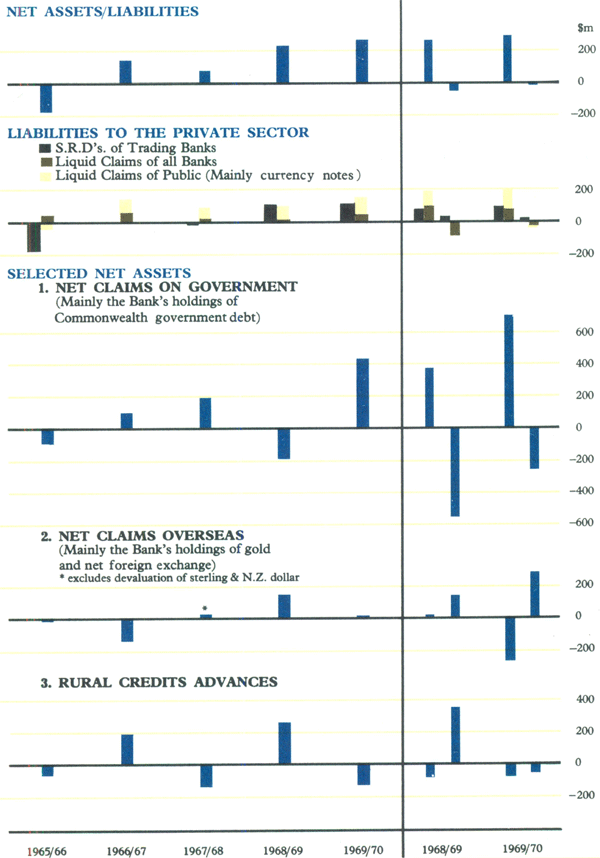
Among the Reserve Bank's liabilities, the Statutory Reserve Deposits of the major trading banks comprise assets of the banks which are not readily available to them. Broadly, if changes in the Bank's assets are affecting liquidity in the private sector, the Bank can vary the impact of these changes by altering the Statutory Reserve Deposit ratio and hence the availability of funds to the trading banks. The increases in the ratio during August and October 1969, together with the effect of rising trading bank deposits, resulted in an increase in Statutory Reserve Deposits of $110 million during the first eight months of 1969/70. Changes in the liquid claims of the private sector on the Bank comprise movements in a number of items, including currency notes held by the public and various deposits and working balances of the banks with the Reserve Bank. Adjustments in these items are, in the main, determined by changes in the demands of holders and they fluctuate considerably from year to year.
Earlier restraints applied through the banking system had achieved some reduction in the availability of finance and the further increase in bank interest rates in March could be expected to have a reinforcing effect. However, the influence of these measures, if taken alone, would be offset to some extent if demands for finance by the private sector could be met by running down holdings of Government securities or bidding away bank deposits. The increases in rates of interest paid on bank deposits had improved the relative attractiveness of these assets but more widespread increases in yields on financial assets were desirable. The very small rise in private holdings of Government debt, and the clear preference on the part of the public for short as against long-dated issues, indicated that some improvement was needed in the competitiveness of yields on Government securities, and especially the yields on the long issues; such a change would tend to reduce pressure on the Bank to take up Government debt. In the event, the rise in yields on Government securities had an important effect in tightening monetary conditions.
The changes in bank interest rates and bond yields in March and April were rapidly transmitted through the various financial groupings. The speed and extent of this process owed something to the normal seasonal tightness of funds; however, it also owed much to the development of more competitive and interdependent financial markets over recent years, suggesting that there may be more scope for greater flexibility in the use of open market operations.
| Changes — $ million | |||||
|---|---|---|---|---|---|
| 1965/66 | 1966/67 | 1967/68 | 1968/69 | 1969/70† | |
| Reserve Bank—Treasury bills* | −36 | +9 | +51 | −127 | −33 |
| —Treasury notes | — | — | — | +13 | +175‡ |
| —Other | −78 | +113 | +175 | −80 | +182 |
| Trading banks | +171 | +85 | −7 | +173 | −96 |
| Savings banks | +50 | +62 | +72 | +35 | −50 |
| Authorised money market dealers | +38 | +83 | +30 | +30 | +73 |
| Life Offices | +89 | +145 | +115 | +57 | +43 |
| Other non-government holders | +65 | +53 | +65 | +79 | +3 |
| TOTAL | +299 | +549 | +501 | +180 | +297 |
| * Face value. Allows for movement in Commonwealth deposits with Reserve
Bank. † Estimate ‡ Including Treasury notes issued to Reserve Bank by the Commonwealth Government to finance advances to the Wheat Board. |
|||||