
Reserve Bank of Australia Annual Report – 1970 Other Activities of the Bank
Note Issue
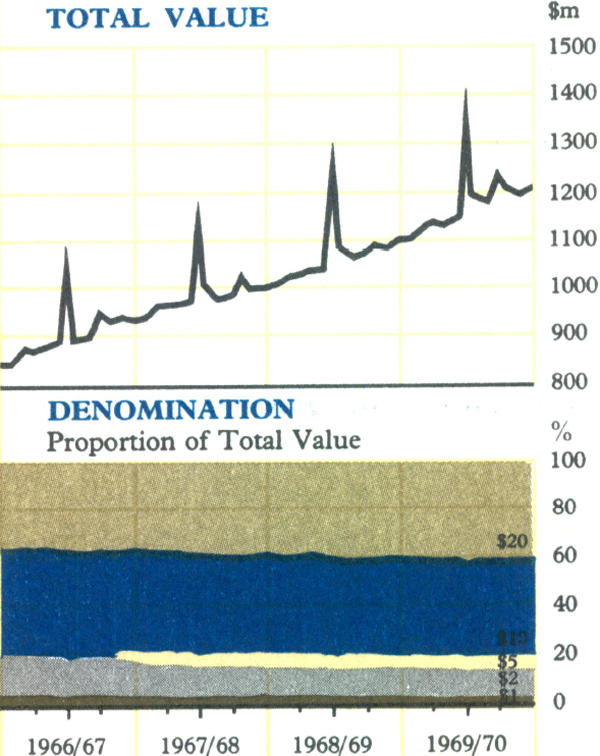
Australian notes on issue rose by $104 million during the year, compared with an increase of $93 million in 1968/69 (see graph 18). Total notes in circulation at 30 June 1970 amounted to $1,196 million. Following the trend of recent years, the increase was mainly in the $20 denomination.
The volume of major items of security printing undertaken over the last four years by the Printing Division of the Note Issue Department is shown in the table below.
Graph 18
NOTES IN CIRCULATION
| millions of pieces | |||||
|---|---|---|---|---|---|
| Year Ended June |
Australian Notes |
Postage Stamps |
Postal Orders |
Other Postal Material |
Cheques |
| 1967 | 190 | 1,061 | 12 | 74 | 58 |
| 1968 | 151 | 1,236 | 13 | 80 | 57 |
| 1969 | 257 | 1,148 | 14 | 83 | 49 |
| 1970 | 306 | 1,194 | 15 | 117 | 9 |
| $ million | ||||||
|---|---|---|---|---|---|---|
| AS AT 30 JUNE | $1 | $2 | $5 | $10 | $20 & over | Total $ |
| 1966 | 32 | 138 | — | 370 | 295 | 835 |
| 1967 | 33 | 128 | 43 | 389 | 337 | 930 |
| 1968 | 35 | 118 | 57 | 401 | 387 | 998 |
| 1969 | 37 | 115 | 63 | 435 | 441 | 1,091 |
| 1970 | 40 | 117 | 72 | 466 | 501 | 1,196 |
Centralised Cash Facilities for Banks
Direct cash servicing arrangements continued between offices of the Reserve Bank and branches of participating banks in New South Wales, Victoria and South Australia. The number of branches being serviced was a little higher over the year and, at 30 June 1970, totalled 3,700.
Foreign Exchange Operations and Control
During 1969/70, turnover in foreign exchange through the banking system was about 14 per cent above that of the preceding year. As in 1968/69, about one third of banks' foreign exchange business was in U.S. dollars.
Uncertainty in foreign exchange markets again raised some problems for the Australian banks. When the French franc was devalued in August, banks found it necessary to suspend dealings in francs on one day. Further, when the foreign exchange markets in West Germany were closed for several days in September, the banks had to suspend quotations for deutschemarks on one day; however, over the remainder of the period they were able, despite some difficulties, to handle transactions in this currency. When the deutschemark was officially appreciated in October, banks again had to suspend deutschemark quotations for one day. There was also a brief interruption of Canadian dollar dealings at the beginning of June 1970 when the Canadian authorities introduced a floating rate.
Following the official appreciation of the deutschemark, the position of sterling strengthened and the forward risk covered with the Bank declined significantly; this cover had reached an all time peak during June 1969.
In the field of exchange control, Australian companies have shown a continued interest in contributing capital for direct investment in overseas ventures and generally these investments have been approved. In particular, in line with official policy relating to the promotion of Australian exports, residents have been allowed to participate freely in overseas ventures designed to foster such exports.
Borrowing in Australia by Overseas Interests
Since May 1965, enterprises operating in Australia which are substantially or wholly overseas owned have been requested by the Commonwealth Government to consult the Reserve Bank regarding proposals to borrow in Australia. This policy, known as the “guidelines”, is designed to guard against undue reliance by overseas interests on borrowings in Australia and, consequently, provides support for the Australian balance of payments. At the same time, it provides an incentive for overseas-controlled companies to admit or to increase Australian equity participation.
The policy was revised by the Commonwealth Government in September 1969, with a prime objective of increasing the inducement to overseas-controlled companies to admit or to increase local equity participation. A further aim was to remove certain unsatisfactory features relating to the equitable application of the policy.
In terms of the revised policy, enterprises in which more than 25 per cent of the equity is held directly or indirectly by overseas interests are requested to consult the Reserve Bank in respect of proposals to borrow in Australia. Provision is made for reasonable access to Australian borrowings for working capital and for approval to be readily given to borrowings for the specific purpose of financing export transactions. Local borrowing to finance capital investment is determined in terms of formulae which take into account the share of total equity held by Australians and increases in funds employed.
Rural Credits Department
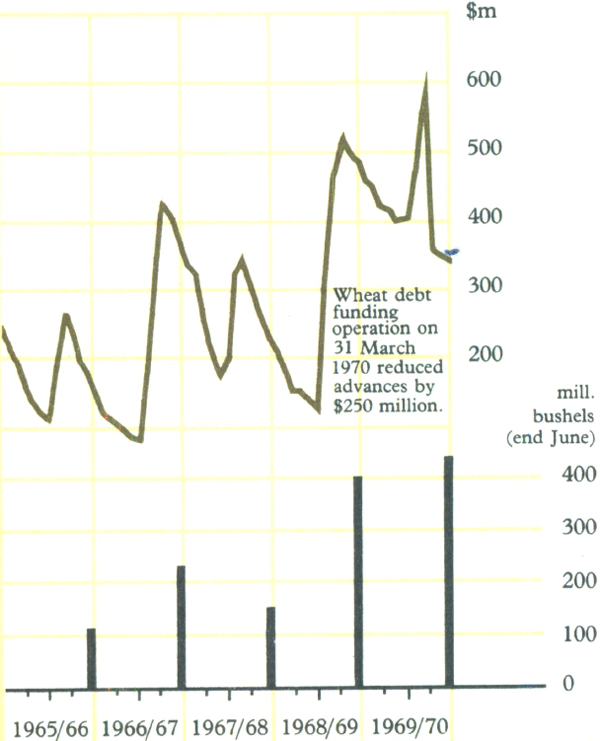
Seasonal finance provided by the Bank's Rural Credits Department to assist marketing, processing or manufacture of primary produce reached a peak of $622 million in March 1970; this was $79 million higher than the previous year's peak in April 1969.
The increase in peak advances was due mainly to the financing of large stocks of wheat on account of the Australian Wheat Board. This has been occasioned by a carryover of 267 million bushels from the 1968/69 Pool and quota receivals of 310 million bushels from the 1969/70 crop.
A sharp fall in outstanding advances occurred at end-March when indebtedness amounting to $250 million in the Australian Wheat Board's 1968/69 Pool accounts was repaid. The repayment was made possible by a Commonwealth Government loan to the Wheat Board. Export proceeds are being used to repay the loan. At 30 June 1970, the Department's outstanding advances were $358 million compared with $480 million a year earlier (see graph 19).
In addition to wheat, the Department provided finance for other commodities including dairy produce, canned fruits, barley, cotton, rice, oats, eggs, super-phosphate and grass seeds.
Following an increase in the maximum overdraft rate, interest rates on Rural Credits advances were increased, as from 8 August 1969, by 0.25 per cent per annum to 5.00 per cent per annum on government guaranteed loans and to 5.25 per cent per annum on other loans. The maximum overdraft rate was increased a further 0.5 per cent per annum from 9 March 1970; in the normal course, an increase would have been made in Rural Credits Department interest rates but, at the request of the Government, the rates were left unchanged for the time being, having regard to the special difficulties and financial problems facing many rural producers.
Graph 19
RESERVE BANK RURAL CREDITS ADVANCES
AND WHEAT STOCKS OF THE AUSTRALIAN WHEAT BOARD
Bonds and Stock
Each of the Bank's Australian branches conducts an Inscribed Stock Registry for Commonwealth Government domestic loan raisings, and a registry at London office handles Commonwealth securities on issue in the United Kingdom. In addition, registries are maintained at Port Moresby for borrowings by the Territory of Papua and New Guinea, at Sydney for Australian issues of the Fiji Government, and at Brisbane for some semi-governmental authorities.
During 1969/70, the Commonwealth Government floated four new cash loans and introduced the first issue of Drought Bonds. Offers to convert four maturing series of Commonwealth Government securities were combined with three of the cash loans. The 12 new series offered in the cash and conversion loans have now brought the total of non-rebate securities on issue to 25, compared with 42 series on which a 10 per cent taxation rebate on interest is allowed.
The first series of Drought Bonds, bearing interest at 3 per cent and with a 10 year maturity, opened for subscription on 3 November 1969 and will close not later than 31 August 1970. This new security was introduced to encourage certain classes of primary producers to accumulate, in good seasons, financial reserves which could be drawn upon in the event of drought, fire or flood. An income tax deduction is allowed to eligible subscribers.
Holders of the two series of Special Bonds which matured during the year were invited to convert to new series issued in conjunction with the July and May loans. Treasury notes with terms of 13 weeks and 26 weeks were on continuous issue.
Liaison
The Bank has paid continuing attention to the need to keep in touch with financial institutions, rural and other industry and commerce. Contacts of this kind provide information valuable in supplementing other data. The special arrangements for a rural information service to banks instituted in 1956 have been found less necessary with the development of banks' own services; consequently, distribution of some of the material provided by the Rural Liaison Service has been discontinued.
Research and Other Grants
During 1969/70, the Rural Credits Development Fund approved grants totalling $745,000. Grants are made to universities and other organisations engaged in research and extension work aimed at improving primary production. The Fund is financed by a transfer each year of half the net profits of the Rural Credits Department.
The Economic and Financial Research Fund continues to provide support for post-graduate research in economic and financial topics with particular reference to Australia. In 1969/70, grants amounting to $44,000 were approved from the Fund.
Publications
Three Occasional Papers published during the year reported results of the project being undertaken in the Bank to construct a quarterly model of the Australian economy. Further papers in the series will deal with other aspects of the model. It is hoped that the model will become an increasingly useful tool for economic analysis.
Additional publications, apart from the regular release of statistical and other information, were RURAL CREDITS DEVELOPMENT FUND (which reviewed the activities of the Fund during the five years to December 1969) and CREDIT FACILITIES FOR RURAL PRODUCERS IN AUSTRALIA.
Premises
Construction of buildings for the Bank in Perth and Brisbane has commenced. Both buildings are scheduled for completion during 1972 and initially will have floors available for letting. Planning is well advanced on the building for the Bank's Hobart branch and tenders should be called early in 1971.