
Reserve Bank of Australia Annual Report – 1970 Papua and New Guinea
The Bank's responsibilities extend to Papua and New Guinea. In particular, the Bank is concerned with the development of the banking and financial system and with increasing participation in it by Papuans and New Guineans during the transition to self-government or independence.
Economic Activity
Growth and diversification in the Papuan and New Guinean economy continued during 1969/70 although production of two of the major crops, copra and cocoa, was lower than in the previous year. Output of coffee, tea and also rubber was higher in 1969/70. Oil palm plantings were extended; commercial production of the oil is planned for 1971/72. There was further strong growth in the cattle industry and increased activity in fishing and seafood processing. The mining industry assumed increased importance during 1969/70. Work on the Bougainville copper project continued; the project will involve an investment of about $350 million and production should commence in 1972. Exploration for oil and other minerals was in progress in many districts. Small scale industrial activity expanded during the year, with a pronounced increase in the number of local companies registered. Manufacturing activities still centre on processing primary products for export, but the range of other manufactures intended for the domestic market has increased. Building activity remained at about the same level as in the previous year.
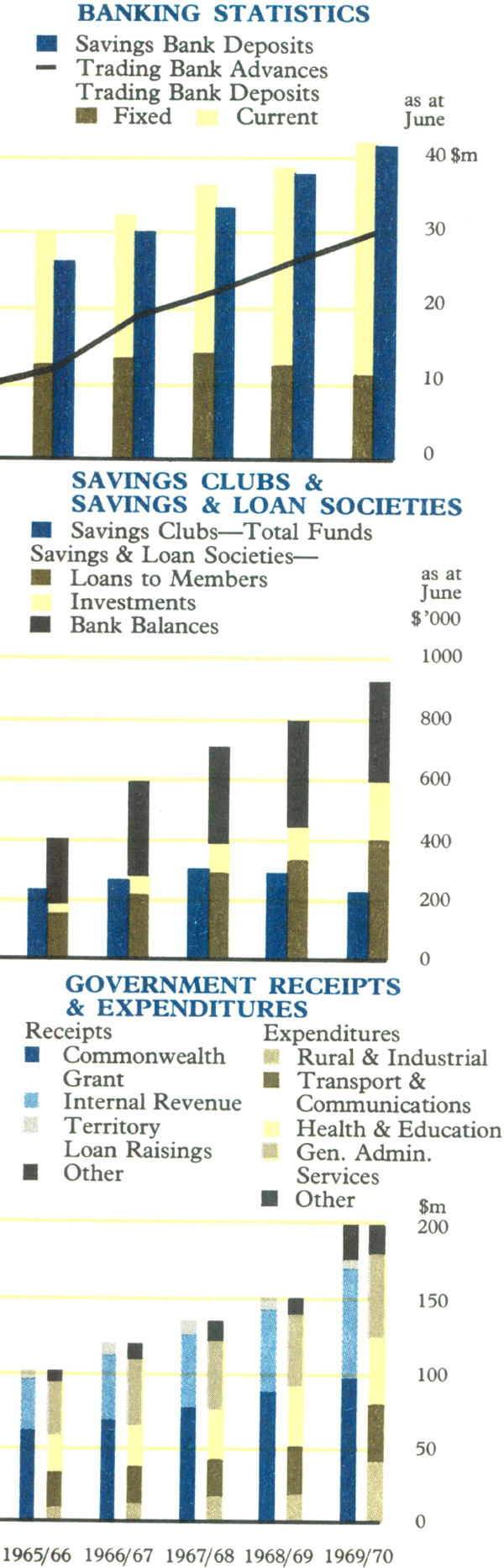
Public expenditures, which account for a substantial part of total spending in the monetised sector of the economy, increased by about 23 per cent, following modest increases in the previous two years. Expenditure by the Administration rose by 28 per cent; expenditure by Commonwealth departments and instrumentalities was much the same as in 1968/69 (see graph 20).
The number of motor vehicle registrations again rose sharply in 1969/70 and there was evidence of strong growth in private investment in plant and equipment. An index of retail prices in the three main towns of Papua and New Guinea rose during 1969/70, having fallen in the previous year; the rise was due largely to an increase in customs and excise duties on tobacco and cigarettes.
Increased output and better prices for some major commodities, most notably coffee, led to a sizeable increase in the value of exports during 1969/70. However, imports rose even more strongly; increased imports of mineral fuels and of machinery and transport equipment, in particular, reflected development in the mining and industrial sectors. Imports exceeded exports by about $100 million, compared with $72 million in 1968/69; despite increased transfers from the Commonwealth Government, there was a larger deficit on current account. Capital account figures are not available but estimates suggest a net inflow of private capital from Australia.
During 1969/70, international institutions provided further funds to assist in the development of Papua and New Guinea. Loans from the World Bank group were used to improve telecommunications and to help develop the palm oil industry. In addition, during 1969/70 one loan of US$5 million ($A4.5 million) for agriculture was approved by the International Development Association and a further US$9 million ($A8 million) for highway development was approved by the World Bank and the International Development Association. The World Bank is also giving consideration to providing assistance for the hydro-electric scheme on the Ramu River.
In April 1970, the Economic Commission for Asia and the Far East (ECAFE) recommended to the Economic and Social Council of the United Nations that Papua and New Guinea be admitted as an Associate Member of ECAFE. Approval of the recommendation would make Papua and New Guinea eligible for membership of the Asian Development Bank.
Graph 20
PAPUA AND NEW GUINEA
Finance
In 1969/70, 41 per cent of the Administration's expenditure was met from local sources, 37 per cent from revenue and 4 per cent from loan raisings; in the previous year, 42 per cent of expenditure was met from local sources. To cover a shortfall in local borrowing in 1969/70, the Commonwealth Government provided the Administration with standby finance of up to $3 million. Most of the increase in Administration securities on issue was taken up by banks and life offices.
The Administration has committed $70.9 million up to June 1972 for the Bougainville copper mining project; $25.0 million for a 20 per cent equity in the operating company, $27.5 million towards a new town at Arawa and $18.4 million for associated capital works and services. To assist the Administration to meet its outlay on Arawa township, the Commonwealth Government has agreed to make available $20 million in the form of a loan, free of capital repayment and payment of interest for four years. During 1969/70, the Administration paid $12.5 million in application money for equity in the operating company; this advance was financed temporarily by the Reserve Bank under Commonwealth Government guarantee.
Development of the financial system proceeded throughout 1969/70. At June 1970, trading bank deposits at $42.3 million were 10 per cent higher than a year earlier; in the preceding annual period, deposits rose by 7 per cent. As in the previous year, the increase was in current deposits. New and increased lending commitments by trading banks were about 16 per cent above the level of the previous year; limits outstanding had risen by $3.8 million to $36.4 million at the end of the year. Advances outstanding increased by 15 per cent to $29.9 million at June 1970, compared with a rise of about 17 per cent in 1968/69. The classification of trading bank advances at January 1970 showed a decline over the previous twelve months in advances to agriculture; there was strong growth in loans to persons and in the residual classification which includes mining.
The Rural Credits Department of the Reserve Bank again provided seasonal finance during the year to assist marketing of part of the coffee crop.
Savings bank deposits rose during the year by about 12 per cent to $41.5 million at June 1970, a slightly slower growth than in 1968/69 (see graph 20). The number of operative accounts totalled 403,000 at June 1970, compared with 365,000 at June 1969; of these, about 90 per cent belonged to Papuans and New Guineans.
In 1969/70, there was a considerable expansion in the activities of the Papua and New Guinea Development Bank. Advances outstanding at June 1970 amounted to $14.1 million, 41 per cent above the level at June 1969. Loans to Papuans and New Guineans in 1969/70, in terms of both number and amount, represented a higher proportion of total approvals than in the previous year.
The spread of banking facilities in Papua and New Guinea improved over the year; the number of trading and savings bank branches increased by 6 to 34. Four of the new branches were in the Bougainville copper mining area.
The Savings and Loan Society movement expanded more slowly, largely as the result of a lower level of activity in the East New Britain district. The number of societies increased by 20 to 241 in the year to June 1970; total funds increased by $131,000 to $912,000. In addition, there were 192 savings clubs with funds of $218,000 at June 1970.
Deposits with dealers in the short term money market were at higher levels in 1969/70 than in the previous year. There was a further expansion in hire purchase activity.
The Reserve Bank's Advisory Committee on Central Banking in Papua and New Guinea met three times during the year, twice in Port Moresby and once in Kundiawa, to discuss the Bank's activities in Papua and New Guinea and other economic and financial matters. Further efforts were made by the Bank to improve the coverage and effectiveness of the programme of financial education, particularly in schools.
Staff in Papua and New Guinea
It is the Bank's policy that its Papuan and New Guinean staff should occupy more positions of responsibility. For part of the year, the Bank's senior New Guinean officer acted as Manager in Port Moresby. A Papuan officer has been appointed Deputy Registrar of Stock for Papua and New Guinea; two additional local officers have assumed senior positions as Assistant Registrars in the Registry of Savings and Loan Societies.
The Bank maintained its programme of local staff training and some officers completed the first stage of the Elementary Banking Certificate course conducted through the Papua and New Guinea Bankers' College. Three officers visited Australia for further training. Eleven indigenous staff members were on fulltime scholarships provided by the Bank at the University of Papua and New Guinea and one was at the Administrative College. Further scholarships were provided for one student at the University of Sydney, four at the Institute of Technology, Lae, one at Vudal Agricultural College and eight at secondary schools.
Banks in the Territory again provided valuable assistance to the Savings and Loan Society movement by seconding four staff members for service with the Registry of Savings and Loan Societies.