
Reserve Bank of Australia Annual Report – 1970 Balance of Payments
The high levels of output and spending in 1969/70 were associated with a sharp rise in imports. However, exports rose at an even faster pace and a significant trade surplus was recorded. Although net payments on invisibles rose strongly, the current account was in considerably smaller deficit than in 1968/69. Throughout much of the year, capital inflow was considerably less than in 1968/69 but it increased very sharply in the quarter ended June 1970; overall, there was a small favourable net monetary movement over the year.
Economic Developments Abroad
Economic growth in several of Australia's chief trading partners slackened during 1969/70; however, while not repeating the unusually high growth rate of 1968/69, overseas trade of major industrial countries rose strongly in 1969/70. Prices generally moved favourably across a wide range of Australian exports, particularly minerals and metals. Prices of some rural commodities showed favourable trends although the average returns on wool and wheat fell.
Some specific developments abroad improved the prospects for world trade and eased the speculative pressures in the international monetary system. Adjustments in the parities of the French and German currencies not only relaxed speculative pressures but, more fundamentally, provided a more stable environment for the expansion of world trade. Uneasiness about the franc had persisted since the French economic difficulties of late 1967/68. Speculation was further encouraged by the strength of the deutschemark and a widely held belief that that currency would be appreciated. The depreciation of the franc in August 1969 by about 11 per cent, together with a French programme of fiscal and monetary restraint, allayed one major uncertainty in the international monetary system. In late September 1969, the German authorities withdrew official support of the parity rate for the deutschemark and the exchange rate was temporarily allowed to float; at the end of October 1969, an appreciation of about 9 per cent was announced. Although this change was followed by substantial international flows of funds, speculative positions were unwound and markets were more stable after the adjustments had been made. Towards the end of the year, the Canadian authorities decided that, for the time being, they would not maintain the exchange rate of the Canadian dollar. At the close of 1969/70, the Canadian dollar had appreciated by about 3 per cent from its previous level.
The strengthening of the United Kingdom's balance of payments was a further important development; Britain's balance of trade in 1969/70 was in a substantially more favourable position than in 1968/69, having benefited from the earlier devaluation of sterling and the adoption of various deflationary measures. With this improvement and with greater stability in European money and capital markets, the United Kingdom's capital account strengthened considerably. Official restraints were continued in effect on certain capital outflows. The Sterling Guarantee Agreements between the United Kingdom and other sterling area countries, including Australia, continued in force over the year; details of the arrangements were outlined in the Bank's Annual Report of 1968/69.
There was a slowdown in economic activity in the United States during the year. Production declined, unemployment rose steadily to the highest level for several years and prices continued to increase rapidly. Although a trade surplus was recorded, there was a substantial deficit, on a liquidity basis, in the balance of payments. Monetary policy was generally tight over the year although there was some relaxation during the second half. Stock market prices followed a downward trend over 1969/70 with substantial fluctuations towards the close of the year.
An event of major significance, particularly for its longer run implications, was the activation, on 1 January 1970, of Special Drawing Rights with the International Monetary Fund. The Bank's Annual Report for 1968/69 referred to the circumstances leading to the creation of these facilities. The amendment to the Articles of Agreement of the Fund authorising introduction of the new arrangements was ratified in July 1969. On 1 January 1970, an initial allocation, equivalent to US$3,414 million, was made to 104 member countries choosing to participate; the allocation was distributed among participants according to their Fund quotas. Additional distributions are to be made at the beginning of 1971 and 1972 for amounts of about US$3,000 million each. The introduction of Special Drawing Rights was a significant development in a world monetary system hitherto dependent on new supplies of gold and the external deficits of reserve currency countries as a means of increasing international liquidity. The facilities are a first step in placing the creation of international reserves on a more orderly basis.
Pressures in the private gold market relaxed considerably over the year. After reaching a peak in London of almost US$44 per fine ounce in March 1969, the price had eased to about US$41 by September and then fell markedly. By mid December, the price was only slightly above US$35, the official price. In later months, the price rose a little and stood at US$35.5 at the end of the year. A factor contributing to the relaxation in the gold market was the agreement reached in December 1969 between South Africa and the International Monetary Fund about arrangements for the marketing of gold.
Higher interest rates over most of the year and the generally tighter financial conditions abroad reflected, in most cases, official measures to combat inflationary pressures. Interest rates were also raised in some countries to maintain positions competitive with other major capital markets. The United Kingdom Bank Rate remained at 8 per cent until early March 1970 but was subsequently reduced in two equal stages to 7 per cent. In the United States, yields on three-month Treasury bills were at an historically high level during the first half of the year but were lower over the second half as deflationary measures were relaxed a little. Conditions tightened during the year in several European capital markets; the West German discount rate was raised to a record level of 7.5 per cent in March. In the Eurodollar market, interest rates reached record levels towards the end of 1969. Rates were somewhat lower between January and April 1970, partly because of easier credit conditions in the United States and substantial capital outflows from Germany; in the closing weeks of 1969/70, rates began to rise again, mainly in response to heavy German borrowing.
Imports
Australia's imports increased by about 12 per cent in 1969/70, after only a modest rise in the previous year. Purchases from abroad of government equipment and civil aircraft were about the same as in 1968/69 and considerably less than in 1967/68. However, private imports (excluding civil aircraft) were about 14 per cent higher and their ratio to gross national expenditure was the highest for several years.
All major components of imports rose over the year. Imports of finished consumer goods increased by 22 per cent; this was even sharper than the 1960/61 increase associated with the boom conditions early in that year. Imports of motor vehicles and parts rose by 20 per cent over the year—a considerably larger rise than in 1968/69. The rise in imports of producers' equipment was the most rapid for several years and was associated with increased spending on plant and equipment. Imports of producers' materials (excluding those for the rural industry) also responded to the high levels of economic activity. Petroleum imports were higher during the first three quarters of the year; however, they slackened considerably during the final quarter as a greater volume of locally produced crude oil came onto the domestic market.
Graph 5
EXPORTS OF COMMODITIES
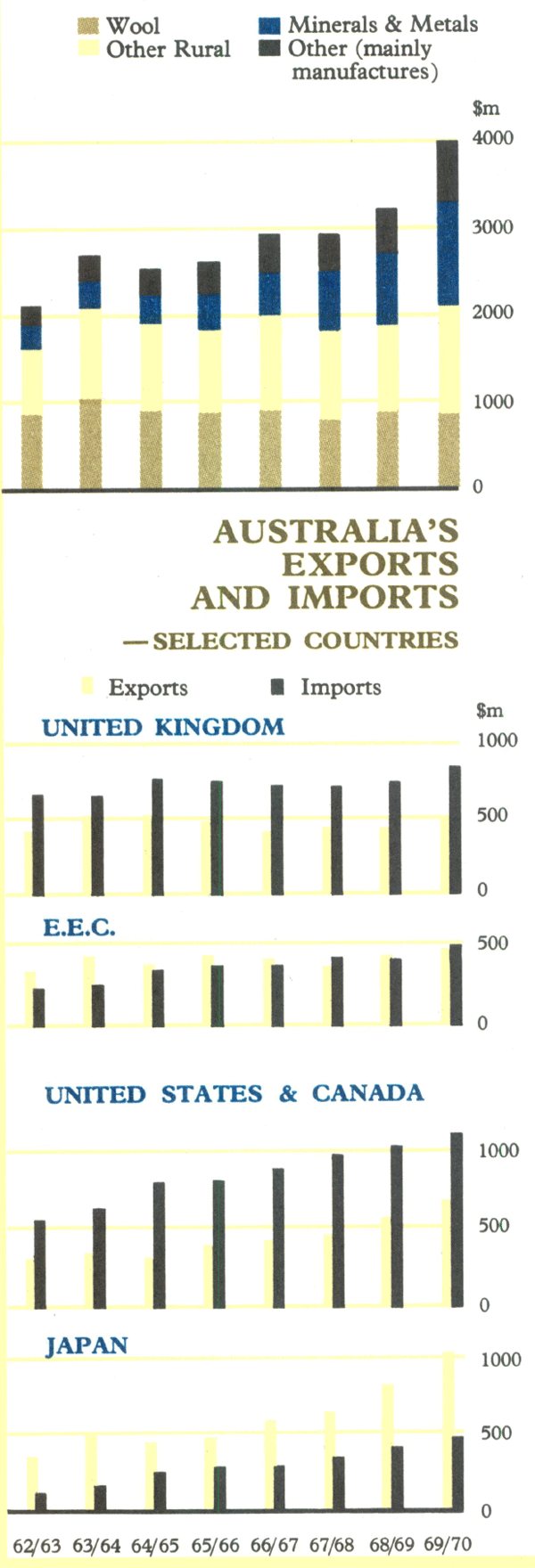
The expansion in imports occurred across a wide range of countries but supplies from the United Kingdom, United States, Japan and Germany rose particularly sharply (see graph 5).
Exports
With a slightly slower rate of increase in world trade, some easing in the growth of Australia's exports could have been expected. Nevertheless, exports of minerals and metals expanded rapidly, particularly to Japan, and markets for manufactured goods were opened up and extended. Rural exports rose considerably over the year. In 1969/70, total exports rose by 24 per cent, more than double the rise in 1968/69.
Exports of minerals and metals, the major growth items, increased by about 45 per cent. Sales abroad of iron ore earned about $275 million, approximately 55 per cent above proceeds in 1968/69. Tonnage increased substantially and prices rose although, with increased shipment of lower grade ores, there was some fall in average value per ton. Exports of coal again rose sharply and, at $175 million, were about 45 per cent higher than in 1968/69 and about double the 1967/68 level; average prices rose very strongly, encour-raged by heavy demands from the Japanese iron and steel industry. Sales abroad of non-ferrous metals and alloys were substantially higher, with pronounced rises in both quantity and price of many commodities. Exports of mineral sands also rose strongly. Iron and steel exports were about 23 per cent higher, due partly to price increases associated with supply shortages in world markets.
For rural goods, the sharpest rise was in meat exports which increased by over 45 per cent. Quotas in the United States for beef, veal and mutton were increased and prices in that market rose significantly; in addition, sales in other markets expanded sharply. Wheat and flour exports were about 30 per cent higher than in 1968/69, but were still below the levels of 1966/67 and 1967/68. A record volume was available for export but average returns were somewhat lower; sales to China accounted for about one third of total wheat exports. The value of wool and sheepskins exported was slightly less than in the previous year; exports of greasy wool were up about 7 per cent in volume but this was offset by a fall in the average export price. The substantial fall in the volume of sugar exported reflected drought conditions in Queensland in the previous year and quota arrangements under the International Sugar Agreement; however, this fall was largely compensated by an increase in average export returns. In 1969/70, the total value of rural exports rose by about 12 per cent to the highest level since 1963/64.
Exports of manufactured goods rose by about 30 per cent over the year. The rise occurred across all major components; sales of motor vehicles and machinery rose particularly strongly, with considerably increased buying by South Africa and New Zealand.
Exports to most countries rose strongly over the year. Shares of various countries as export customers and the changing composition of Australia's exports are shown in graph 5.
Invisibles
The growth in Australia's overseas trade in 1969/70 resulted in substantial increases in both transportation receipts and payments; overall, net transportation payments continued to rise over the year.
Graph 6
BALANCE OF PAYMENTS
Seasonally Adjusted Quarterly
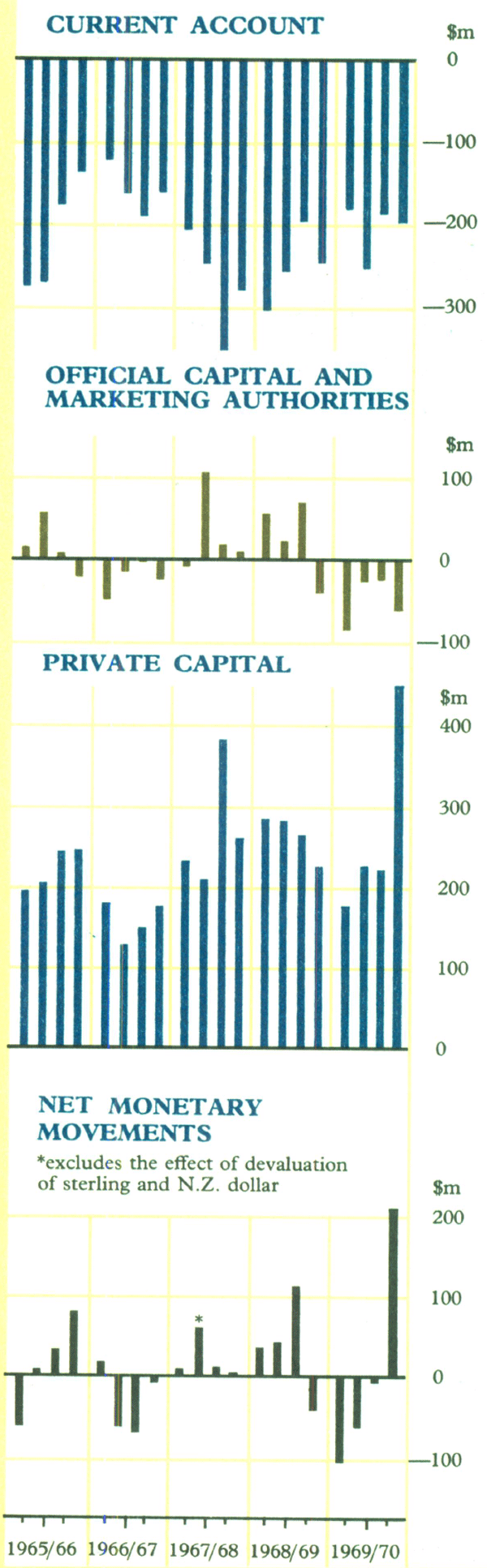
Property income payable abroad increased strongly. Income payable on direct investment grew particularly sharply, partly because of high returns on mineral exports. Much of the rise was attributable to higher undistributed income. Income payable abroad on portfolio investment also rose over the year. In these circumstances, the rise in the net deficit on invisibles of 20 per cent in 1969/70 partially offset the increased trade surplus. As a result, the deficit on current account amounted to $830 million in 1969/70, compared with $1,006 million in 1968/69.
Capital Movements
Capital inflow into Australia was influenced by the various developments in the world economy mentioned above. In the earlier part of the year, higher interest rates abroad widened the margin between domestic and overseas rates and tended to present opportunities to place funds in Australia in a less attractive light. Domestic borrowers who might otherwise have sought funds in overseas markets had an added incentive to borrow in Australia. Official restraints on capital outflow, particularly in the United States and United Kingdom, were maintained and no doubt affected capital outflows to Australia, although to an uncertain extent. The improved stability of the international monetary system apparently led to a repatriation from Australia of some speculative funds, particularly to the United Kingdom. However, during the latter part of the year, the margin between interest rates in Australian and overseas financial markets narrowed; interest rates were lower in some overseas markets and financial conditions tightened in Australia. In this situation, investment opportunities in Australia became relatively more attractive and domestic borrowers had added incentive to seek funds overseas rather than in Australia.
Total capital inflow in 1969/70 at about $867 million was somewhat lower than the very high levels of the previous two years (see graph 6) but was still above that in most years prior to 1967/68. On official borrowings, only two loans were floated in overseas markets during the year, one each in Germany and Switzerland; total public loan proceeds from abroad of $48 million were about $121 million below raisings' in 1968/69. Redemptions and repurchases amounted to $160 million or about $92 million higher than in 1968/69. In total, official overseas loan transactions resulted in a net outflow of $112 million against a net inflow of $100 million in the previous year. Transactions related to civil aviation and U.S. defence credits resulted in net outflows of $16 million and $3 million respectively over the year. After allowing for other items, net outflow on official capital account totalled $159 million compared with an inflow of $71 million in 1968/69. Marketing authority transactions resulted in a net capital outflow of $48 million, largely because exports of wheat on credit to China exceeded receipts from previous credit sales; the comparable figure in 1968/69 was a net inflow of $27 million.
In 1969/70, private capital inflow (including the balancing item) amounted to about $1,074 million which was about the same as in 1967/68 and 1968/69. In the September quarter, private investment from abroad fell to an annual rate of about $600 million. Net inflow rose to some extent over the following two quarters; however, in the June quarter, inflow amounted to a little more than $500 million or about half of total private capital inflow over the full year. A number of factors could have led to this especially large rise; the monetary policy action taken towards the end of the year, including the rise in interest rates, was a contributing factor.
Details of the components of private overseas investment in Australia are not yet available for 1969/70. However, it appears that portfolio investment (including institutional loans) was below the record levels of the previous two years. Portfolio investment was lower in the first three quarters of 1969/70, compared with the same period in 1968/69; however, statistics of remittances through the banking system suggest that there was a strong resurgence in the final quarter of the year. Direct investment was higher in 1969/70; undistributed income was much higher than in 1968/69 but it did not appear that there was much overall change in other direct investment. Banking system figures suggest that, as with portfolio investment, direct investment was substantially greater in the June quarter than in the earlier periods of the year.
Monetary Movements
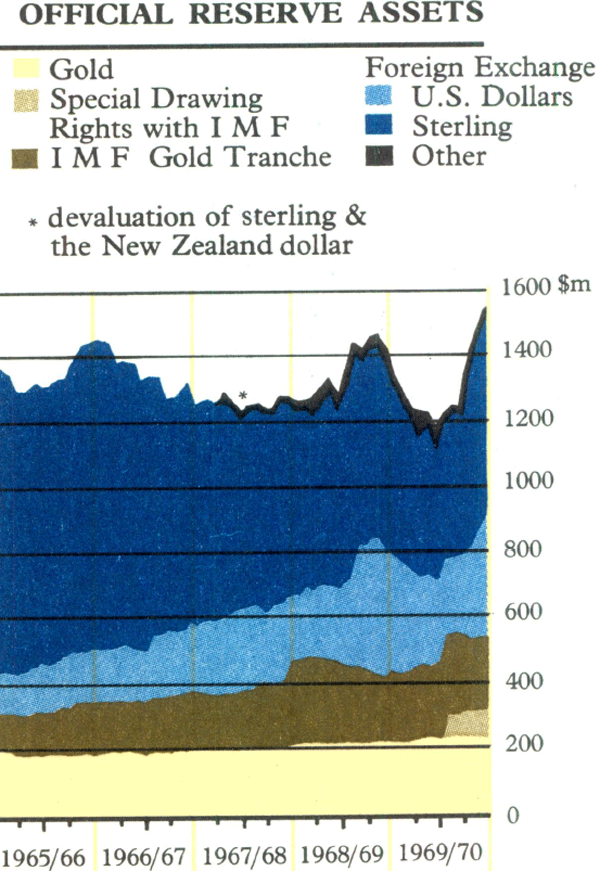
During 1969/70, total capital inflow slightly exceeded the deficit on current account, resulting in a net favourable monetary movement of $37 million; this compared with a favourable movement of $148 million in 1968/69. Official reserve assets (described below) rose by $118 million over the year but would have risen by $43 million had it not been for the allocation of Special Drawing Rights with the International Monetary Fund (see graph 7). Other monetary movements, including changes in net foreign exchange holdings of the trading banks, accounted for the balance of the net monetary movement.
Australia's initial allocation of Special Drawing Rights with the International Monetary Fund in January 1970 was US$84 million ($A75 million). In the March quarter, Australia was designated to provide foreign currency up to US$12 million to participants using Special Drawing Rights; the amount provided by Australia over this period was US$4 million ($A3.6 million) and Australia's initial holding of Special Drawing Rights was supplemented to this extent. In the June quarter, Australia was not designated to provide currency.
A new series, official reserve assets, was introduced during the year as the major measure of Australia's international liquidity; it includes official holdings of gold and net foreign exchange, Australia's gold tranche position with the International Monetary Fund and the new Special Drawing Rights, but excludes certain government balances and the foreign exchange holdings of the trading banks other than amounts pending settlement with the Reserve Bank. This series has been used as the indicator of Australia's international liquidity throughout the Report. These changes have brought the series into line with practice now being adopted by some major central banks abroad and with the recommendations of the International Monetary Fund. The following table shows changes in the disposition of Australia's official reserve assets over the past two decades.
Graph 7
AUSTRALIA'S INTERNATIONAL LIQUIDITY
OFFICIAL RESERVE ASSETS
| end June | 1950 | 1955 | 1960 | 1965 | 1969 | 1970 |
|---|---|---|---|---|---|---|
| Gold | 78.7 | 124.6 | 133.0 | 205.0 | 230.5 | 240.9 |
| Special Drawing Rights with I.M.F. | — | — | — | — | — | 78.6 |
| I.M.F. Gold Tranche | — | 7.5 | 64.8 | 111.6 | 203.5 | 216.8 |
| US$ | 6.3 | 30.2 | 73.3 | 120.2 | 368.2 | 370.9 |
| Sterling | 1,167.0 | 621.9 | 737.3 | 965.1 | 586.0 | 617.1 |
| Other Foreign Exchange | 1.4 | 0.9 | 1.1 | 1.5 | 31.5 | 13.8 |
| TOTAL | 1,253.4 | 785.2 | 1,009.5 | 1,403.3 | 1,419.7 | 1,538.1 |