
Reserve Bank of Australia Annual Report – 1968 The Year in Brief
International events dominated the year. One, the devaluation of sterling, involved Australia in an immediate loss in the international purchasing power of its reserves and also required Australia to make a decision about the value of its currency in relation to the currencies of other countries. The other major events—controls over capital outflows by the United States, changes in gold markets and progress towards the creation of a new reserve asset —had less direct impact on Australia in 1967/68 but will have lasting significance for the future prospects of the Australian economy and, indeed, the world economy.
Within the Australian economy, new major discoveries of oil, nickel and other minerals gave a further boost to our medium-term potential while Australia's ability to cope with problems arising from drought was again demonstrated. On the other hand, the build-up in defence expenditure continued and made strong demands on both domestic and external resources.
At the beginning of the year the domestic economy was in a broad state of equilibrium although there were elements of uncertainty. The pace of expansion of activity had slowed down a little in the final quarter of 1966/67 and there had been some increase in unemployment. However, the prospect was for a modest acceleration in aggregate spending. On the supply side, there appeared to be scope for an expansion of domestic output commensurate with the likely growth of expenditure. Externally, some further fall in international reserves was likely but it was not expected to be so large as to cause serious concern. Financial conditions were relatively easy but the demand for finance was expected to increase.
In this setting, the objectives of policy in 1967/68 were to maintain a rate of growth which would keep resources fully employed and to contain within acceptable limits any pressures which might emerge in the balance of payments. The Commonwealth Government budget for 1967/68 was formulated to provide some stimulus to activity and monetary policy was expected to play a complementary role in making adjustments which might become necessary as the year progressed. Early in the year some doubts developed about whether private expenditure, particularly private capital spending, would grow at an acceptable rate and in October 1967 the Reserve Bank eased the modest restraints which it had imposed on bank lending some six months earlier. However, over the year as a whole, bank liquidity tightened significantly and no Statutory Reserve Deposit action was taken to offset this. Interest rates on bank deposits were raised slightly near the end of the year so as to maintain their attractiveness relative to other forms of investment of funds. Increases in some lending rates of savings banks were expected to follow.
Graph 1
ECONOMIC ACTIVITY
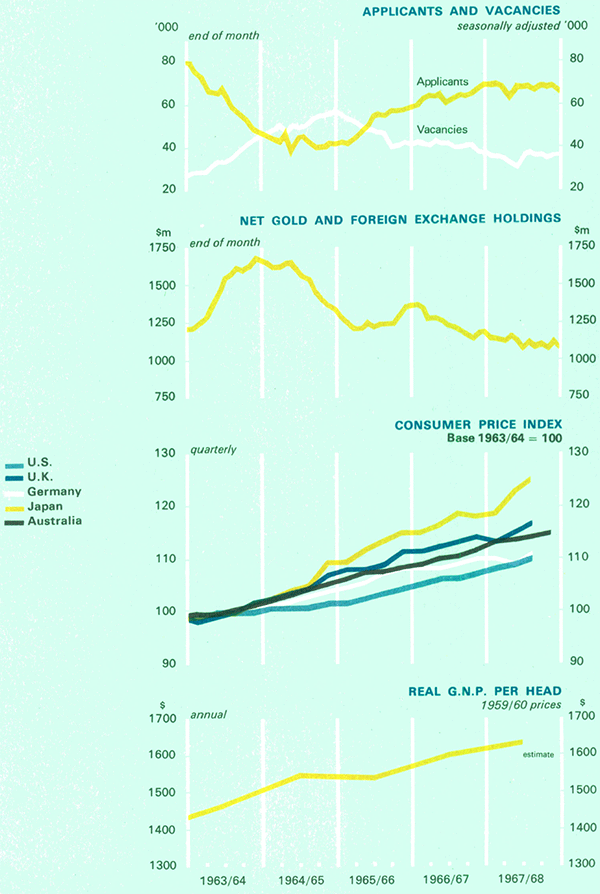
In general, the domestic economy performed very much in line with expectations. All major categories of expenditure grew at a faster rate than in 1966/67; in particular, a revival in private capital expenditure emerged in the course of the year. The economy was in a position of balance throughout the year and, after allowing for the effects of drought, growth continued at a good rate. Few signs of pressure were evident. Although employment rose quite rapidly over the year, the labour market was remarkably stable. Prices rose moderately but there were some fairly large increases in award wages in the second half of the year.
Contrary to earlier expectations, there was a favourable monetary movement in the balance of payments in 1967/68. Drought, weak commodity prices and, to a lesser extent, the devaluation of sterling, combined to make 1967/68 a disappointing year for exports. Imports grew quite strongly, partly because of a substantial increase in imports of defence equipment. For most of the year the deficit on current account widened but was financed by a spectacular increase in the inflow of capital from abroad. When inflow eased in the final quarter of the year, the overall balance of payments deteriorated.
When sterling was devalued in November 1967, the Commonwealth Government decided not to change the existing par value, in terms of gold, of the Australian dollar. This had the effect of appreciating the Australian dollar against sterling and a number of other currencies which had also devalued. Considerations involved in this decision are discussed later in the Report.
Although both the public and private sectors increased their demands for finance in 1967/68, financial conditions generally were easy throughout the year. The higher demands for funds by the private sector were met by a substantial increase in the inflow of capital from abroad and by increased lending by domestic financial institutions. Interest rates in the private sector were generally steady in the first half of the year but subsequently there was a tendency for some rates to move upwards a little. Increases in interest rates on bank deposits were announced around the end of the year. Trading bank advances rose strongly throughout the year and the increase over the twelve months was greater than in 1966/67. However, there was a reduction in the liquidity of the trading banks over the year which meant that, as they entered 1968/69, the base from which the banks could expand credit was appreciably smaller than that at the beginning of 1967/68.
In Government securities markets, overseas developments at times created uncertainty about the likely course of interest rates in Australia. In the event, there were small increases in short-and medium-term yields but long-term yields remained unchanged. Generally, investors showed a marked preference for short-term securities, as evidenced particularly by a sharp increase in holdings of Treasury notes during the year.
At the end of the year all major categories of expenditure were following an upward trend and the indications were that total spending would continue to grow fairly quickly. The strength of this upward movement was expected to depend largely upon three factors—the rate of growth of public spending, the impact of higher real incomes on personal consumption and the extent of the recovery in private investment. The scope for an increase in domestic non-farm output appeared to be much the same as in 1967/68. Thus, a continuation of recent rates of growth in aggregate expenditure would be unlikely to cause pressures in the domestic economy but the margin for a faster rate of growth was not great.
The external outlook was quite uncertain. With the advent of more favourable seasonal conditions, exports could be expected to grow quite strongly in 1968/69. The growth in expenditure and a high level of imports of defence equipment would produce an increase in imports also but it seemed that there could be some improvement in the balance on current account in 1968/69. However, we could not count on capital inflow continuing at the levels of 1967/68 and the prospect seemed to be for a small deficit in the balance of payments in 1968/69. The current level of reserves could finance such a deficit without embarrassment. In addition, of course, Australia has substantial drawing rights on the International Monetary Fund, of which $249 million is available virtually automatically. However, in view of the considerable uncertainty about international flows of capital, an early improvement in the current account of the balance of payments would be welcome.
The new mineral discoveries in 1967/68 have further transformed the medium-term outlook for the Australian economy. The development of these vast mineral resources gives Australia an opportunity to strengthen its balance of payments and to grow at a faster rate than was envisaged several years ago. Full advantage of this opportunity will only be taken if we are able to marshal and co-ordinate effectively our other resources in the form of labour, technical skills and capital. Considerable progress has been made in recent years by the Australian financial system in adapting itself to meet the changing needs of the Australian economy. The new growth industries will, however, make further demands on its flexibility. Tightening restrictions on international capital movements have reinforced the desirability of raising the level of domestic savings and increasing the capacity of the local capital market to provide developmental capital. The establishment of the Australian Resources Development Bank, which commenced operations during 1967/68, was a significant step in mobilising savings to meet some of the new demands upon the Australian financial system.
The bright prospects for the Australian economy in the medium term do not mean, however, that the path will be smooth in the intervening period. The development of our mineral resources will require substantial capital expenditure which will be reflected in a strong demand for imports as well as local resources. Defence spending may add further to this demand. Moreover, maturities of overseas debt will be high in coming years. If capital inflow were to fall off significantly, the balance of payments could come under strain in the period before the mineral developments come to full fruition, particularly if overseas expenditure on defence continues to grow. The strain could be large enough to become a significant factor in the determination of domestic policies.
This prospect for the balance of payments in the short term underlines the significance for Australia of the international economic and financial events of 1967/68. It is of great importance for Australia's economic development that the problems of the international monetary system should be resolved without resort to measures which would further hinder the free flow of trade and capital.