
Reserve Bank of Australia Annual Report – 1968 Some Specific Activities
Note Issue
The value of notes in circulation increased by $68 million in the year ended 30 June 1968, compared with an increase of $95 million in the previous year. £.s.d. notes were withdrawn from circulation as they were received by banks and at the end of the year they represented only about 3 per cent of total notes on issue.
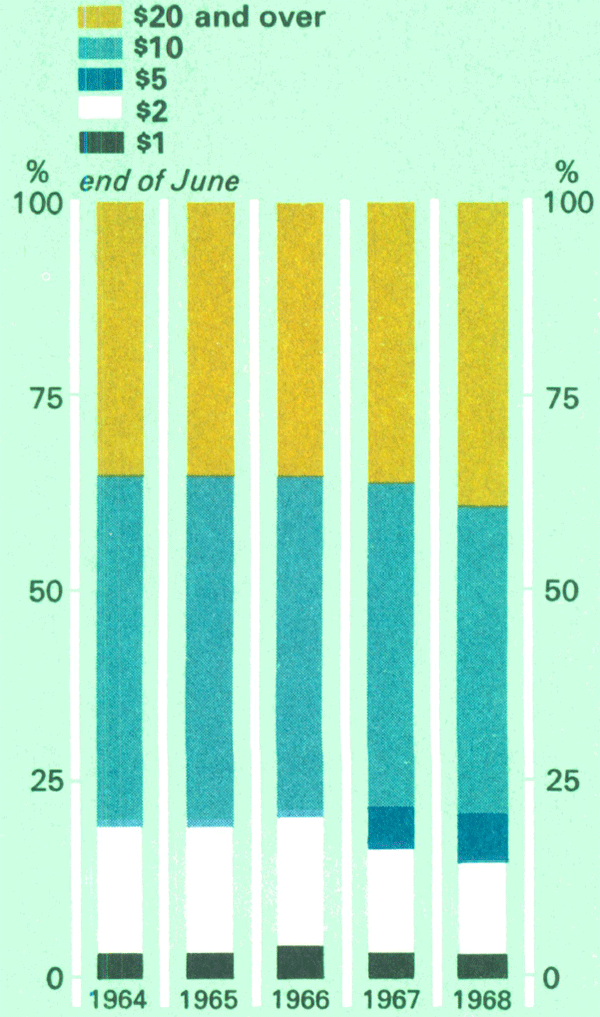
The introduction of the $5 note in May 1967 brought changes in the use of notes of various denominations. As graph 20 shows, $5 notes represented approximately 6 per cent of the total value of notes on issue at 30 June 1968. The use of the $5 note has been at the expense of the $2 note and the $10 note, both of which now constitute a smaller proportion of the total value of notes in circulation than was the case prior to the introduction of the $5 note.
Graph 20
VALUE OF NOTES IN CIRCULATION
Persontage of Total
| $ million | ||||||
|---|---|---|---|---|---|---|
| End of June | $1 |
$2 |
$5 |
$10 |
$20 and over |
TOTAL |
| 1966 | 32 | 138 | — | 370 | 295 | 835 |
| 1967 | 33 | 128 | 43 | 389 | 337 | 930 |
| 1968 | 35 | 118 | 57 | 401 | 387 | 998 |
Counterfeit $10 notes continued to be detected in 1967/68. During the year the Bank gave wide publicity to the characteristics of these forgeries through the press and other news media and the distribution of leaflets to the public. The Bank also offered rewards of up to $10,000 for information leading to the apprehension and conviction of persons responsible for the forging of Australian notes and related offences. Rewards totalling $3,100 were paid early in 1968 to eight persons who had volunteered information regarding the counterfeit $10 notes which were first circulated in Melbourne in December 1966.
The Note Printing Branch of the Bank again produced a considerable volume of security printing in 1967/68. Details of the major items produced during the last three years are set out below.
Centralised Cash Facilities for Banks
The centralised system for the distribution of cash between the Reserve Bank and branches of banks was extended to South Australia late in 1967.
At 30 June 1968, some 1,800 bank branches in New South Wales and South Australia were included in the direct servicing arrangements and the total value of cash handled during the year was about $2,300 million. It is proposed to extend the arrangements to branches of banks in other states as premises and facilities become available.
Foreign Exchange Operations and Control
The policy of permitting overseas residents to withdraw capital and current account funds freely from Australia was continued. So, too, was the practice of permitting outward transfers by Australian residents to make direct investments overseas where it appeared such investments would benefit Australia's balance of payments or have other advantages from the national viewpoint.
When traders agree to receive or pay overseas currencies they expose themselves to the possibility of losses arising from a change in the relationship between Australian currency and the overseas currency which they have contracted to receive or pay at some future date. They may avoid this risk by entering into forward exchange contracts with their bankers. These are contracts to sell or buy a fixed amount of foreign currency against a fixed amount of Australian currency for delivery on or by a nominated future date, regardless of the rate of exchange on that date. Broadly speaking, banks may write forward exchange contracts with their customers for a normal maximum period of six months in respect of all genuine exchange risks related to trade or invisible transactions. They are not permitted to cover capital or speculative transactions.
| millions of pieces | |||||
|---|---|---|---|---|---|
| YEAR ENDED JUNE |
Australian Notes |
Postage Stamps |
Postal Orders |
Other Postal Material |
Cheques |
| 1966 | 283 | 1,275 | 27 | 90 | 60 |
| 1967 | 190 | 1,061 | 12 | 74 | 58 |
| 1968 | 151 | 1,236 | 13 | 80 | 57 |
The Reserve Bank has arrangements with the Australian banks whereby it accepts the exchange risk on forward exchange contracts in sterling. In addition, the Reserve Bank accepts the Australia/London component of the risk on contracts in other currencies (except United States and Canadian dollars for which special covering facilities are provided).
The pressures on sterling early in 1967/68 which preceded its devaluation in November made Australian traders aware of the possibility of a change in the exchange rates between Australian and overseas currencies and there was a significant increase in the volume of their forward covering, both in sterling and in other currencies. As a result, the Bank's risk in sterling in respect of forward exchange contracts was particularly high at the time of sterling's devaluation in mid-November 1967. The devaluation involved the Bank in a loss of about $33 million in respect of liabilities under sterling forward exchange contracts. Of this amount, about $26 million was met in 1967/68 and the remainder will fall due from time to time as transactions covered by forward exchange contracts are completed.
Australian traders are continuing to make considerable use of the facilities available for covering their exchange risks in foreign currencies and, at the same time, there has been an increasing tendency for trade transactions to be denominated in Australian currency, thus eliminating the exchange risk of Australian traders.
The only significant variation in exchange control policy took place in March 1968 when the Government decided that Commonwealth and state commodity marketing boards and pools, which previously had been ineligible for forward exchange cover, would be able to obtain the same facilities as are available to other traders.
The gold crisis of March 1968, when the London foreign exchange market was closed at short notice and dealings in other overseas centres were difficult, created many problems for the banks. On this occasion the Reserve Bank intervened and took the unusual course of fixing the United States dollar rate for banks' transactions with their customers and at the same time requested banks to do only essential and non-postponable transactions.
Gold Transactions
Commonwealth legislation requires that all gold, with certain minor exceptions, must be delivered to the Reserve Bank and provides that the Bank may release gold to persons in Australia for use in connection with their profession or trade.
Newly mined gold is delivered to the Reserve Bank through four prescribed refiners and payment is made to the producer at the Bank's current buying price of $31.25 per fine ounce, which is the par value of Australian currency as agreed with the International Monetary Fund. Since late 1951 Australian gold producers have been permitted to sell their output on overseas markets. Gold which producers have delivered to the Reserve Bank is then made available by the Bank, at the price at which it was bought, to the Gold Producers' Association Limited, membership of which is open to all gold producers in Australia and the Territory of Papua and New Guinea. The Association arranges for the sale of the gold on overseas markets.
Until March 1968 the Bank retained from deliveries made by producers sufficient gold to meet the requirements of local industrial users. This gold was sold by the Bank at a small margin above its official price to a number of refiners and other companies authorised to sell gold to industry. On 17 March 1968 the governors of the central banks contributing to the operation of the London gold pool invited other central banks to co-operate in the policies which they had agreed upon in respect of gold (see page 7). Following this request, the Reserve Bank terminated its existing procedure for the sale of gold for industrial use in Australia and arrangements were made for authorised sellers to obtain their requirements either directly from the Gold Producers' Association Limited at market prices or by importing gold. In addition, the Association was authorised to sell gold direct to industrial users.
In summary, gold produced in Australia is delivered to the Reserve Bank which makes it available immediately to the Gold Producers' Association Limited for sale to local industrial users or on overseas markets. The Bank's price as a buyer and seller in these transactions is $31.25 per fine ounce.
Rural Credits Department
The Rural Credits Department of the Bank continued to provide seasonal finance to statutory marketing boards and similar authorities and to co-operative associations to assist in the marketing, processing or manufacture of primary produce. Finance was provided for a wide range of commodities, including wheat, dairy produce, canned fruits, sugar, rice, barley, eggs and cotton.
The production of many of the commodities financed by the Rural Credits Department, particularly wheat, barley and oats, was reduced by drought in 1967/68. As a result, the peak total of advances, which was $367 million in January 1968, was lower than the peak of $437 million in March 1967. However, because of the higher level of wheat stocks carried through the first half of 1967/68 and increased calls for finance for dairy produce and canned fruits, the average level of advances during the year was higher than in 1966/67.
Outstanding advances at 30 June 1968 totalled $230 million, compared with $361 million a year earlier. The fall of $131 million reflected the lower level of wheat stocks, lower outstandings in respect of term sales of wheat overseas and repayment of special assistance granted to the sugar industry in 1966/67. Interest rates on Rural Credits advances were unchanged during the year at 4.50 per cent on government guaranteed loans and 4.75 per cent on other loans.
Bonds and Stock
The Bank conducts an Inscribed Stock Registry for the Commonwealth Government at each of its Australian branches. In addition, the Brisbane branch maintains registries for some semi-government bodies and the Port Moresby branch operates an Inscribed Stock Registry for the Territory of Papua and New Guinea Administration. During the year the Bank also established a Registry in Sydney for the first loan flotation in Australian currency by the Fiji Government.
On behalf of the Commonwealth Government, the Inscribed Stock Registries handled the flotation of four cash loans during 1967/68 and continued the tap issues of Special Bonds and Treasury notes. The four cash loans raised a total of $492 million from 9,100 subscribers, compared with $554 million from 10,900 subscribers in 1966/67 and $465 million from 14,600 subscribers in 1965/66. Three of the cash loans were combined with conversion offers to holders of four maturing series. Two series of Special Bonds also matured and holders were offered conversion to the current series of Special Bonds.
In July 1967 the Commonwealth Government commenced the issue of a new Treasury note with a currency of 26 weeks to supplement the usual daily issue of 13 week notes. Since their introduction in July 1962 the 13 week Treasury notes have proved a useful investment for institutions with substantial funds available for relatively short periods, particularly during the seasonal build-up in liquidity. The 26 week Treasury note is designed to cater for investors who prefer a security with a maturity which covers a longer period. The Bank continued to offer redis-counting facilities for Treasury notes.
Research Funds
The Bank provides financial assistance for research into rural and economic and financial matters.
The Rural Credits Development Fund, which is financed by the transfer each year of half the net profits of the Rural Credits Department, has approved grants totalling more than $3.3 million since 1960. During the year grants amounting to $666,000 were made to universities and other organisations engaged in research and extension work aimed at the promotion of primary production.
The Economic and Financial Research Fund provides support for post-graduate research in economic and financial fields related to the Australian economy. Since its inception in 1952 grants approved from the Fund have totalled more than $426,000 and for 1967/68 amounted to over $57,000. During the year finance was granted to assist research into various topics including the Australian motor industry, a policy oriented econometric model of the Australian economy and a survey of consumer finances.
Publications
A report by the Bank's Rural Liaison Service on “Physical and Financial Effects of Drought” was issued in February 1968. A paper entitled “The Nature and Role of Finance” was published in June 1968 and this will be followed by other occasional papers on economic and financial topics. A pamphlet called “Reserve Bank of Australia — What it is … What it does”, which gives a brief account of the Bank's main activities and responsibilities, was also published during the year.
The Bank continued to publish the monthly Statistical Bulletin which was broadened to include, for the first time, selected seasonally adjusted statistics. Supplements to the Bulletin—on Statistics of the Territory of Papua and New Guinea, Company Statistics and Flow-of-Funds—were again published, and an Economic Supplement, which provided historical figures for most of the non-financial tables published in the Statistical Bulletin, was also issued.
A weekly balance sheet, a weekly statement covering transactions by authorised dealers in the short term money market and a monthly statement of Australia's international reserves continued to be issued. In addition, a daily note on bond transactions in the short term money market was introduced during the year.
Liaison Activities
The Bank maintains regular contact with businessmen in industry, commerce and finance and with members of the academic community. The assistance received in the form of information on current and prospective trends in economic conditions is greatly appreciated. The Rural Liaison Service continued to carry out its function of providing information on rural matters to banks.
During the year the Governor, Deputy Governor and several senior officers of the Bank visited central banks and international financial institutions in Europe, North America, South America, Africa and Asia to enquire into latest financial and economic developments.
Premises
The Bank's building at 6 Bennett Street, Darwin has been completed and a new branch was opened there on 28 March 1968.
Work on the construction of a new branch building in Port Moresby is progressing satisfactorily and completion is expected about the middle of 1969. Planning on new buildings for the Brisbane and Perth branches of the Bank is well advanced and tenders for both buildings should be called in the second half of 1969.