
Reserve Bank of Australia Annual Report – 1968 The Australian Economy
Domestic Activity
Domestic Demand
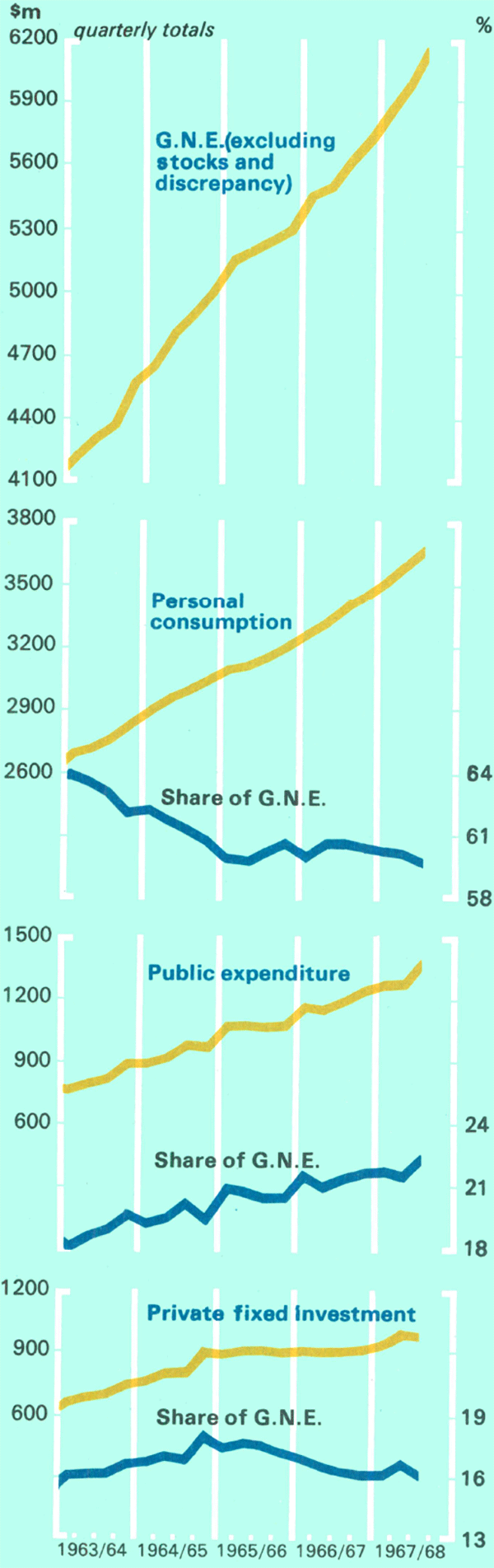
All major categories of expenditure rose more quickly in 1967/68 than in the previous year. Gross national expenditure, excluding stocks and statistical discrepancy, rose by about 9 per cent, compared with an increase of 6.7 per cent in 1966/67.
After moderating towards the end of 1966/67, aggregate expenditure, excluding stocks and statistical discrepancy, accelerated in the first half of 1967/68, led by an improvement in private capital expenditure and by a quickening in personal consumption. This higher rate of growth was maintained in the second half of the year.
The composition of domestic expenditure has been changing for some years and the same trends were evident in 1967/68. Graph 5 shows that the share of public expenditure in gross national expenditure, excluding stocks and statistical discrepancy, rose from less than 19 per cent in 1962/63 to over 22 per cent in 1967/68. This increase was matched by a reduction in the share of personal consumption which fell from 64 per cent to about 60 per cent. The share of private fixed investment fluctuated cyclically but showed no significant change over this period.
Graph 5
Gross National
Expenditure
and Components
seasonally adjusted
Public Expenditure
For the fifth successive year, public expenditure grew more rapidly than private spending. Expenditure on defence continued to play a dominant role in this expansion. In 1967/68 defence accounted for about 19 per cent of total public spending compared with about 13.5 per cent in 1962/63. Other Commonwealth expenditure and state and local government expenditure also increased at a rate faster than the growth in private spending.
Personal Consumption
Drought reduced farm income by about $500 million in 1967/68 but nonfarm personal income grew at much the same rate as in 1966/67. However, personal consumption rose more quickly than in 1966/67; in particular, the demand for motor vehicles was very strong and spending on other consumer durables also rose at a faster pace.
The growth in consumption had eased towards the end of 1966/67 but accelerated in the first quarter of 1967/68; thereafter consumption continued to follow a firmly rising trend.
Private Fixed Investment
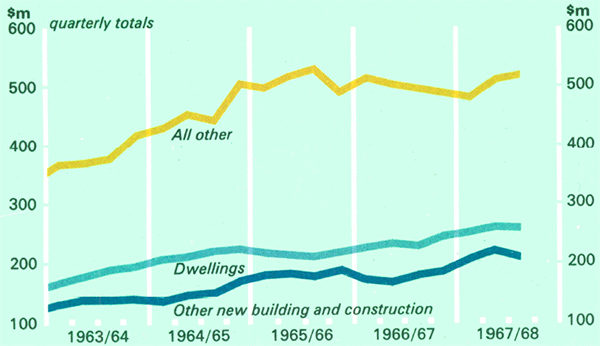
Gross private fixed capital expenditure provided little stimulus to the growth of economic activity in the eighteen months preceding 1967/68 (see graph 5). A recovery began in the last quarter of 1966/67 and this accelerated in the first half of 1967/68 when there was a sharp increase in expenditure on non-residential building and a reversal of the downward trend in expenditure on other capital equipment. However, the rate of growth of private fixed investment appeared to be less rapid in the second half of the year.
Expenditure on dwelling construction had been the only component of private fixed investment to show strength in 1966/67 and it continued to grow quite strongly during 1967/68 (see graph 6). Private dwelling commencements rose steadily and totalled about 108,000 for the year, compared with 98,000 in 1966/67. With local government approvals rising less rapidly towards the end of 1967/68 and with the prospect of some tightening in the availability of finance, it seemed that the rate of growth in expenditure on dwellings could moderate a little in 1968/69.
Graph 6
Private Fixed Investment
seasonally adjusted
The steady advance in dwelling construction in 1967/68 was supported by the ready availability of housing finance. The table on page 11 shows that the value of loans approved for new housing by major lending institutions (other than permanent building societies) was about 9 per cent above that in 1966/67. Savings banks were mainly responsible for the increase but lending by trading banks, life offices and terminating building societies also rose. Finance provided by the War Service Homes Division fell, as in each year since 1962/63. There was a particularly strong demand for finance for the purchase of existing dwellings. The value of loans approved for this purpose was about 11 per cent higher than in 1966/67.
| Loans Approved by Major Lending Institutions* | ||||
|---|---|---|---|---|
| 1964/65 | 1965/66 | 1966/67 | 1967/68¶ | |
| For New Housing | ||||
| Number of Loans (′000) | 49.4 | 49.0 | 51.2 | 53.7 |
| Amount of Finance ($m) | 327.6 | 333.5 | 358.1 | 391.3 |
| For Used Housing | ||||
| Amount of Finance ($m) | 289.4 | 308.2 | 361.2 | 401.5 |
|
* Includes trading banks, savings banks, major life offices, the War Service Homes
Division and terminating building societies (including some of those receiving
finance under the Commonwealth and State Housing Agreement). ¶ Preliminary. |
||||
Although official statistics are not available, preliminary information suggests that housing loan approvals by permanent building societies again grew rapidly in 1967/68.
Non-dwelling private fixed investment, which had been weak since the middle of 1965/66, resumed an upward trend early in 1967/68. This continued over the rest of the year but the rate of growth in the second half was lower than during the initial recovery period. Capital expenditure increased over a wide range of industries. Investment by the non-manufacturing sector, led by the mining industry, rose very strongly in the first half of the year and continued to increase in the second half. Capital expenditure by the manufacturing sector increased substantially in the first half but appeared to rise less rapidly in the latter part of the year.
The upturn in expenditure on nonresidential building preceded the improvement in other forms of business capital expenditure by several months (see graph 6). It had commenced an upward trend in the second half of 1966/67 and accelerated sharply in the following six months. The rate of growth eased subsequently but building approvals remained buoyant indicating that high levels of expenditure could be expected well into 1968/69. After declining for most of 1966/67, private expenditure on other capital equipment reached a trough in the September quarter of 1967. Spending rose in the December quarter, despite a possible weakening in rural investment, and continued to increase thereafter.
STOCKS
Non-farm stocks increased sharply towards the end of 1966/67 and continued to rise strongly in the first half of 1967/68. The rate of accumulation may have moderated during the second half but, over the year as a whole, the increase in non-farm stocks was quite large. Drought reduced rural output substantially in 1967/68 and, with wheat exports maintained at a high level, farm stocks fell sharply over the year. In 1966/67 they had risen by almost $200 million.
Domestic Supplies
Because of the effects of drought, real gross national product in 1967/68 rose by less than the increase of 5.8 per cent in 1966/67. Non-farm gross national product, however, rose at a faster rate, mainly reflecting a stronger increase in employment.
Production
In two of the last three years farm production has been seriously affected by drought (see graph 7). Rural output in 1967/68 was about 11 per cent below that of 1966/67 but was some 3 per cent higher than in the earlier drought year of 1965/66. Cereal growing areas in south-eastern Australia were most affected by the dry conditions and the wheat crop amounted to only 277 million bushels, compared with 467 million bushels in 1966/67. Crops of barley and oats were also substantially lower. The output of wholemilk was down but meat production rose as lack of feed forced higher slaughterings. Wool production was a little higher; the recovery in flocks since the previous drought allowed an increase in the number of sheep shorn but dry conditions reduced the average clip per head.
Graph 7
PRODUCTION
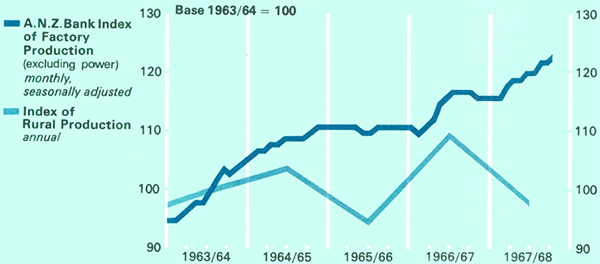
The development of new projects and extensions of existing capacities were responsible for further rapid growth in the production of minerals, especially iron ore, bauxite and crude petroleum. Coal output increased at the same rate as in recent years but the production of Australia's other traditional minerals, such as copper, lead and zinc, recorded only modest gains or declined.
Industrial production rose more strongly in 1967/68 than in the previous year (see graph 7). Production had levelled out towards the end of 1966/67 when the growth in expenditure had slackened. The improvement in expenditure in the opening months of 1967/68 brought a similar response in manufacturing output which continued to grow over the rest of the year.
Employment
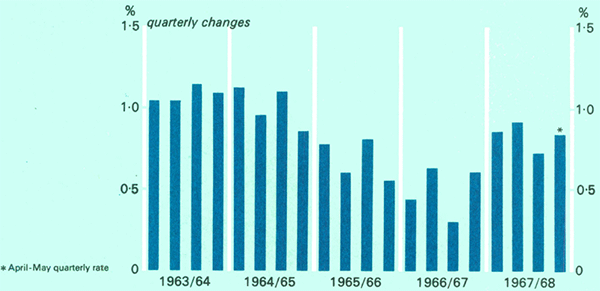
The growth in activity in 1967/68 absorbed the increase in the work force and there was little change in unemployment over the year. The work force rose more than in 1966/67; the intake of young people, which had been affected by changes in school leaving requirements in some states in 1966/67, was larger and there was also some increase in net immigration.
Civilian employment rose by about 3.3 per cent in the year ending June 1968, compared with an increase of 1.9 per cent in the previous year. As graph 8 shows, employment rose fairly rapidly in the first half of 1967/68. Employment in building and construction, which had fallen since early in the previous year, rose strongly during this period. The improvement in industrial production was reflected in a faster growth in manufacturing employment; employment in community and business services also rose more quickly. The growth in employment was slightly less rapid in the second half of 1967/68, largely because of a slackening in the expansion of manufacturing employment, but at the end of the year employment in all major industrial sectors was following an upward trend.
Graph 8
CIVILIAN EMPLOYMENT
seasonally adjusted
The labour market was remarkably stable in 1967/68; after allowing for seasonal movements, persons registered for employment and registered vacancies fluctuated within a narrow range throughout the year. Between June 1967 and June 1968 applicants fell by 3,200 to 65,300 and vacancies fell by 600 to 28,700. The strength of the labour market varied between the states, with demand being strongest in Western Australia. Although the demand for labour improved during the year in Queensland and South Australia, it remained weaker in those states than elsewhere. Within the year there was a deterioration in the labour markets in Victoria and Tasmania, both of which were affected seriously by the drought.
The faster growth in expenditure and production was accompanied by an increase in overtime working in the first half of 1967/68. Over the rest of the year average hours of overtime worked did not change significantly.
The reduction in rural production in 1967/68 was reflected in a slower rate of increase in real output per worker. However, non-farm output per worker appeared to rise at much the same rate as in 1966/67.
Prices and Wages
During 1967/68 the consumer price index rose by 2.8 per cent, a little less than the increase in the previous twelve months (see graph 9). The index increased unevenly during the year, largely due to changes in meat prices. Higher slaughterings because of the drought caused prices of meat to fall in the middle months of the year but prices increased again in the June quarter as restocking followed the improvement in seasonal conditions.
Graph 9
PRICE AND WAGE INDEXES
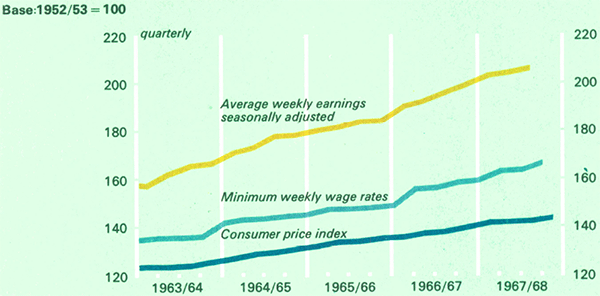
Average weekly earnings rose at an annual rate of about 4.6 per cent over the first nine months of 1967/68; during 1966/67 they had risen by 8.1 per cent (see graph 9). Because of changes in award wages, however, the rate of increase in the June quarter of 1968 was probably greater than in earlier months of 1967/68.
The wages of all adult employees under federal awards were increased by $1 a week in July 1967 in accordance with an earlier decision by the Commonwealth Conciliation and Arbitration Commission. In December 1967, following an enquiry into the value of work performed by workers employed under the Federal Metal Trades Award, the Commission announced increases ranging from $7.40 to $10.05 per week in award rates for tradesmen and smaller increases in rates for most other classifications covered by that Award. This decision was followed by considerable industrial unrest which centred mainly on the issue of whether the increases should be absorbed into existing over-award payments. In February 1968, the Commission rejected an application by employers that a specific provision permitting absorption should be inserted in the Metal Trades Award. However, it decided that only 70 per cent of the award increases should become effective immediately and that the date of payment of the remaining 30 per cent would be determined by the Commission during its annual review of the total wage, beginning in August 1968. Following the decision by the Commission, various wage-fixing authorities granted applications for increases in award wages in a number of other trades and industries.
The Balance of Payments
Exports
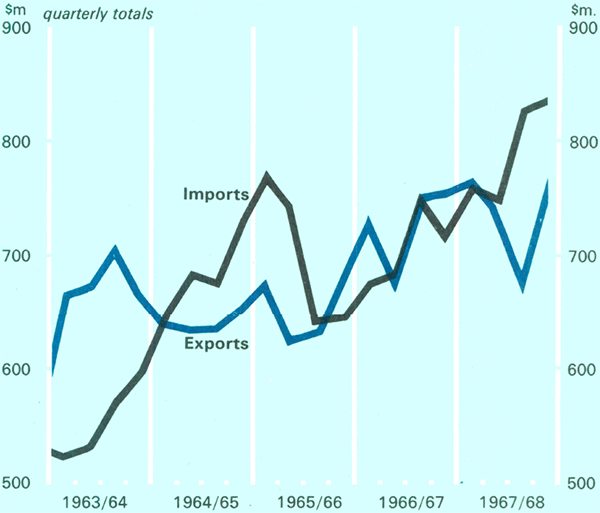
Drought, lower prices and the devaluation of sterling made 1967/68 a disappointing year for exports. They had risen during most of 1966/67 and in the early months of 1967/68. Weakening prices and lower rural production caused exports to fall in the December and March quarters but they rose again in the final quarter (see graph 10). For 1967/68 as a whole, exports amounted to $2,944 million, only $18 million more than in 1966/67.
Graph 10
OVERSEAS TRADE
seasonally adjusted
Export prices were weak in 1967/68; the average level of the export price index was about 5 per cent lower than in 1966/67. However, there was some improvement in prices in the second half. The prices of wool and wheat fell in the first half of the year; wool prices strengthened in the last six months and wheat prices levelled out. Following the devaluation of sterling, the export prices of dairy produce and canned fruits fell and remained at the lower levels.
A feature of the year was the strong growth in exports of the mining industry, which rose from about $340 million in 1966/67 to over $450 million in 1967/68. This brought their share of total exports to about 15 per cent, compared with less than 12 per cent in 1966/67 and only 7 per cent in 1963/64. About half of the increase was in exports of iron ore which rose from $46 million in 1966/67 to $100 million in 1967/68. Shipments of coal rose by $17 million to $90 million and exports of most other minerals also increased.
The growth in exports of manufactured goods slackened in 1967/68. There was a strong increase in exports of alumina, reflecting the recent expansion in refinery capacity, but increased domestic activity was largely responsible for a fall in shipments of iron and steel. Economic problems in New Zealand contributed to a slower rate of growth in exports of other manufactures.
The value of exports of rural products fell in 1967/68. The volume of wool exported was about 3 per cent higher than in 1966/67 but lower average prices reduced the value of wool exports by $107 million. Despite the drought, the volume of wheat exports was maintained at around the 1966/67 level because of the substantial carryover of stocks from the previous crop. However, the value of wheat exports was down by $17 million because of weaker prices. Exports of other cereals were $26 million lower than in 1966/67. Drought reduced the quantity of butter available for export and, with lower prices, exports of dairy products fell by about $21 million. The value of exports of the other major primary products, meats and sugar, was much the same as in 1966/67.
Imports
Largely because of the high import content of expenditure on defence, imports grew at a faster rate than domestic expenditure in 1967/68. After rising strongly during most of 1966/67, they had fallen towards the end of that year. Imports rose again early in 1967/68 and, although dock strikes in the United Kingdom and the bunching of arrivals of defence equipment caused fluctuations, they followed an upward trend over the rest of the year (see graph 10). Imports amounted to $3,182 million in 1967/68 which was $345 million more than in 1966/67.
The increase in imports of defence equipment contributed about one-third of the increase in total imports in 1967/68. Imports of civil aircraft were also significantly higher. Most other categories of imports rose broadly in line with changes in domestic expenditure, with particularly large increases in imports of motor vehicles and components and imports of materials for use in building and construction. With the improvement in expenditure on plant and equipment, imports of capital equipment increased in the second half of the year.
It is too early to determine whether the devaluation of sterling will have a lasting effect on prices of Australia's imports and our sources of supply. So far there is little evidence of any significant change in the sources of Australia's imports. The import price index fell in December 1967 and January 1968 but rose slightly in subsequent months. By May 1968 the index was 3.7 per cent lower than in October 1967. However, because the weights used in the index overstate the United Kingdom's current share of Australia's imports, the change in the index probably overstated the true fall in import prices.
Current Account
Net invisible payments rose strongly in the first half of 1967/68 but fell somewhat in the second half. For the year as a whole, they totalled $843 million, compared with $743 million in 1966/67. There were large increases in freight payments, reflecting higher imports and the re-routing of shipping after the closure of the Suez Canal, and in income payable overseas.
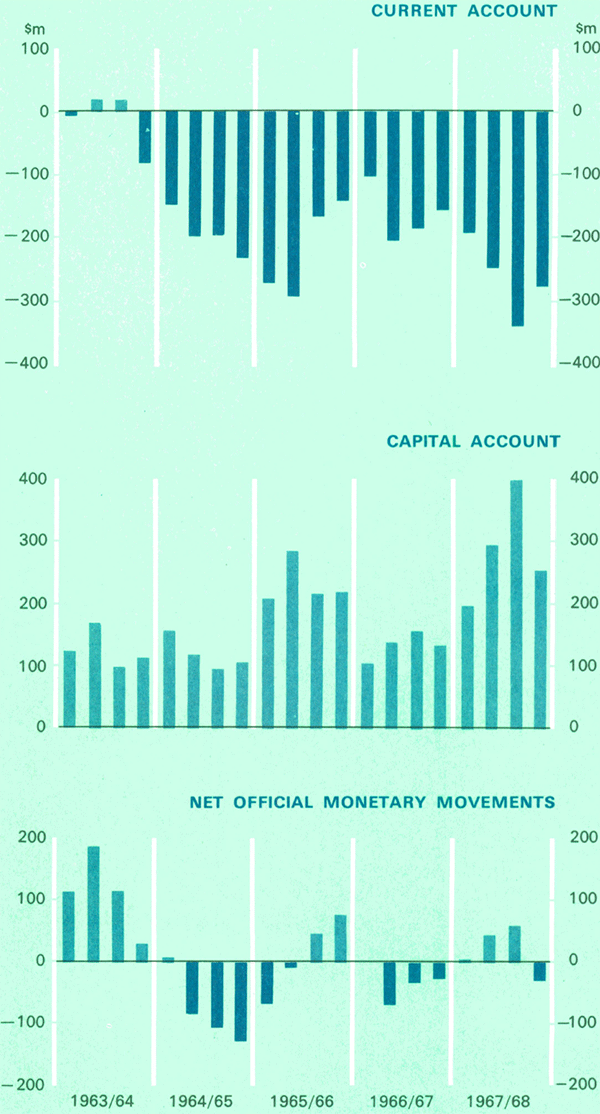
With imports and net invisible payments rising and exports falling, the current account balance deteriorated sharply in the first three quarters of 1967/68 (see graph 11). There was some improvement in the June quarter but the deficit was still running at an annual rate of over $1,100 million. For 1967/68 as a whole, the current account deficit amounted to $1,081 million, which was $427 million more than in 1966/67.
Graph 11
BALANCE OF PAYMENTS
seasonally adjusted
CAPITAL ACCOUNT
The inflow of capital reached unprecedented heights during 1967/68 (see graph 11). Total inflow over the year amounted to $1,159 million which was $625 million higher than in 1966/67. At $1,035 million, private capital inflow (including the balancing item) was $392 million higher than in 1966/67 while official and marketing authority transactions produced an inflow of $124 million, compared with an outflow of $109 million in the previous year.
The inflow of private capital, which had been fairly steady during 1966/67, rose strongly in the first half of 1967/68. Early in 1968 there was a spectacular surge in capital inflow associated with the succession of mineral discoveries in Australia; in the March quarter, private capital flowed in at an annual rate of about $1,500 million. Subsequently, the inflow slackened but it was still running at an annual rate of around $1,000 million in the June quarter.
Official statistics concerning the type and origin of private capital inflow in 1967/68 will not be available for some time. However, statistics of remittances through the banking system suggest that a significant part of the increase in 1967/68 was in the form of portfolio investment, much of which came from or through the United Kingdom. It is possible also that changes in the pattern of trade payments may have contributed to the increased inflow. Direct investment from abroad may have been lower than in 1966/67, reflecting particularly the restrictions on capital transfers from the United Kingdom.
Official transactions made a substantial contribution to the increase in total capital inflow in 1967/68, especially in the December quarter when official loan raisings were largely responsible for a sharp increase in inflow ( see graph 11). Over the year as a whole, official transactions produced a net capital inflow of $90 million; in 1966/67 they had resulted in an outflow of $33 million. The Government raised three loans abroad totalling $79 million in 1967/68, compared with three loans for a total of $53 million in 1966/67. In September 1967 a loan of $35 million was floated in London, Australia's first issue on the London market since 1963. A loan of $22 million was raised in the Federal Republic of Germany in October 1967; this was Australia's first issue in that country. The third loan, for $22 million, was granted by the United States Export-Import Bank in November 1967. Net drawings under credit arrangements for defence purchases in the United States amounted to $118 million in 1967/68, compared with $90 million in 1966/67; net drawings under loans for the purchase of civil aircraft were also higher. Redemptions and repurchases of overseas loans were some $25 million lower than in 1966/67.
There was an inflow of $34 million from marketing authority transactions in 1967/68, reflecting repayments on the large credit sales of wheat to China in the previous year. In 1966/67 transactions by marketing authorities had produced a capital outflow of $76 million.
Net Official Monetary Movements
As graph 11 shows, the growing deficits on current account in the first three quarters of 1967/68 were more than offset by capital inflow and there was a favourable monetary movement during this period. Although the current account improved in the June quarter, capital inflow eased and the overall balance of payments deteriorated. For 1967/68 as a whole, there was a favourable monetary movement of $78 million, compared with an adverse movement of $120 million in 1966/67.
The favourable monetary movement in 1967/68 was reflected in an improvement of $71 million in our net position with the International Monetary Fund, resulting from net drawings of Australian currency by other countries, and an increase of $7 million in net holdings of gold and foreign exchange by official and banking institutions. However, the devaluation of sterling reduced the Australian dollar value of Australia's international reserves by $113 million, and at 30 June 1968 Australia's net holdings of gold and foreign exchange totalled $1,092 million. In addition, Australia held drawing rights on the International Monetary Fund totalling $695 million; of this amount, the gold tranche of $249 million may be drawn virtually automatically and the credit tranche of $446 million may be drawn subject to certain conditions.
| $ million | ||||||||
|---|---|---|---|---|---|---|---|---|
| NET GOLD AND FOREIGN EXCHANGE HOLDINGS OFFICIAL AND BANKING INSTITUTIONS |
GROSS POSITION AT THE IMF |
|||||||
| at end of | Gold | US Dollars | Sterling | Other Foreign Exchange | TOTAL | Gold Tranche | Credit Tranche | TOTAL |
| 1963 June | 179 | 108 | 936 | 2 | 1,225 | 89 | 357 | 446 |
| 1964 June | 195 | 128 | 1,346 | 3 | 1,672 | 89 | 357 | 446 |
| 1965 June | 205 | 154 | 995 | 1 | 1,354 | 112 | 357 | 469 |
| 1966 June | 198 | 194 | 981 | 2 | 1,375 | 152 | 446 | 598 |
| 1967 June | 204 | 251 | 742 | 1 | 1,198 | 178 | 446 | 624 |
| 1967/68 | ||||||||
| Sept. | 204 | 256 | 682 | 1 | 1,143 | 176 | 446 | 622 |
| Dec. | 206 | 279 | 602 | 6 | 1,092 | 183 | 446 | 630 |
| Mar. | 208 | 261 | 635 | 13 | 1,117 | 195 | 446 | 642 |
| June | 230 | 222 | 629 | 11 | 1,092 | 249 | 446 | 695 |
Financial Conditions
Borrowers and Lenders
Australia usually runs a deficit in its transactions in goods and services with the rest of the world. As already described, the deficit on current account with the rest of the world rose by some $425 million in 1967/68. However, investment opportunities in Australia were attractive to overseas investors and the higher deficit was financed without major changes in interest rates and without running down international reserves. Within Australia, both the public and private sectors increased their demands for finance in 1967/68. The financial deficit of the public sector rose by around $100 million while the private sector, whose income and expenditure had been broadly in balance in 1966/67, incurred a deficit of about $300 million.
Public Finance
An increase in the Commonwealth Government's excess of expenditures over receipts and a higher deficit of Commonwealth authorities operating outside the budget were important factors in producing the larger financial deficit of the public sector in 1967/68. On a budgetary basis, Commonwealth Government expenditures grew at a rate which was slightly faster than in 1966/67. There were further substantial increases in expenditure on defence and in payments to state governments. No changes in taxation rates were made but increased economic activity and higher postal charges contributed to a faster growth in revenues. However, the absolute increase in receipts was smaller than the increase in expenditures and the Commonwealth Government's excess of expenditures over receipts rose from $535 million in 1966/67 to $595 million in 1967/68. This excess was almost the same as was envisaged in the budget; both revenues and expenditures were higher than expected.
Net overseas loan raisings and credits under arrangements for defence purchases in the United States amounted to $82 million in 1967/68, which was about $73 million higher than in 1966/67. The higher level of net borrowing abroad meant that, although the excess of expenditures over receipts in 1967/68 was $61 million more than in the previous year, recourse to domestic borrowing was some $12 million less. However, the pattern of domestic borrowing was significantly different. At $279 million, net domestic loan proceeds were $109 million lower than in 1966/67. There was, however, an increase of $184 million in Treasury notes outstanding, which had fallen by $26 million in 1966/67, with the result that residual borrowing from the Reserve Bank was lower. This amounted to $51 million in 1967/68, compared with $164 million in 1966/67.
Private Finance
In 1966/67 the income of the private sector had broadly matched its expenditure. During 1967/68 the increase in expenditure by the private sector was greater than the increase in its income and the sector as a whole incurred a financial deficit.
All major groups within the private non-finance sector probably increased their net indebtedness in 1967/68. The drought in south-eastern Australia substantially reduced farm income and, although investment outlays may have fallen also, it is likely that the net indebtedness of the rural sector increased significantly. Company profits rose more quickly than in 1966/67 but the recovery in expenditure on non-residential building and on plant and equipment increased demands from the corporate sector for finance. It also seems that households and non-farm unincorporated enterprises increased their net indebtedness in 1967/68. The growth in non-farm personal disposable income was about the same as in 1966/67 but personal consumption, particularly on motor vehicles and durable consumer goods, rose at a faster pace. Expenditure on private housing rose quite strongly.
Adequate information is not available to fully identify the way in which individual groups financed their deficits. Some deficits, particularly in the corporate sector, were met by the inflow of capital from abroad and others were met by transfers from financial institutions which have a certain amount of unspent income each year, mainly consisting of the undistributed earnings of life offices and pension funds. These financial intermediaries also play an important role in facilitating transfers between surplus and deficit units in the private non-finance sector. The borrowing and lending activities of some of these intermediaries are described in the next section of the Report.
The liabilities of financial intermediaries constitute a major part of the financial assets of the private sector. The liquidity of these assets varies but some of the claims issued by banks are regarded as being the most liquid. In 1967/68 the private sector's holdings of cash and bank deposits rose by about $982 million compared with an increase of $886 million in 1966/67. The larger increase was reflected in deposits with trading banks. Deposits with savings banks and holdings of notes and coin rose less than in 1966/67.
The larger deficit of the private non-finance sector in 1967/68 was financed mainly by an increase in its liabilities which was greater than in 1966/67. Borrowing overseas rose from about $565 million in 1966/67 to around $1,070 million in 1967/68 and was the major factor in accommodating increased demands for funds. The extension of credit by financial intermediaries to the private non-finance sector was a little higher than in 1966/67; a substantial reduction in Rural Credits advances by the Reserve Bank, mainly because of the rundown in wheat stocks, was more than offset by increased lending by banks and other financial institutions.
The private non-finance sector's holdings of financial assets appeared to rise by much the same amount as in 1966/67. As already noted, the increase in bank deposits was larger and the sector probably took up a greater volume of new issues of shares and debentures of listed companies than in 1966/67. However, there appeared to have been little change in the sector's holdings of Commonwealth Government securities over the year whereas in 1966/67 it had increased its holdings by about $50 million.
Financial Intermediaries
Trading Banks
DEPOSITS. Trading bank deposits rose by more in 1967/68 than in either of the two preceding years. The upward trend in deposits was most pronounced in the first half of the year when both current and fixed deposits rose strongly. In the second half of the year, however, fixed deposits levelled out.
For the second successive year, current deposits rose by more than fixed deposits. In earlier years a feature of the growth in deposits had been the rapidly increasing share of fixed deposits; the proportion of fixed deposits in total deposits had risen from 20.6 per cent in June 1960 to 40.2 per cent in June 1966. This was largely in response to sharp increases in interest rates on fixed deposits in 1960/61 and further increases in 1964/65. The movement into fixed deposits has slackened considerably in the last two years; during this period, the proportion of fixed deposits in total deposits rose only slightly to 40.6 per cent in June 1968. There has also been a shift in the maturity structure of fixed deposits following the reduction in August 1966, of 0.25 per cent in interest rates on fixed deposits up to 18 months. Between June 1966 and January 1968 the proportion of fixed deposits for periods from 12 to 18 months fell from almost 50 per cent to about 30 per cent of total fixed deposits; over the same period the share of deposits for periods from over 18 months to 24 months increased from 24 per cent to about 41 per cent.
In June 1968 maximum rates of interest payable by trading banks on fixed deposits were increased by 0.25 per cent per annum.
LENDING. The growth of deposits in 1967/68 was associated with a further substantial increase in bank credit and trading banks again increased their share of total lending by financial institutions.
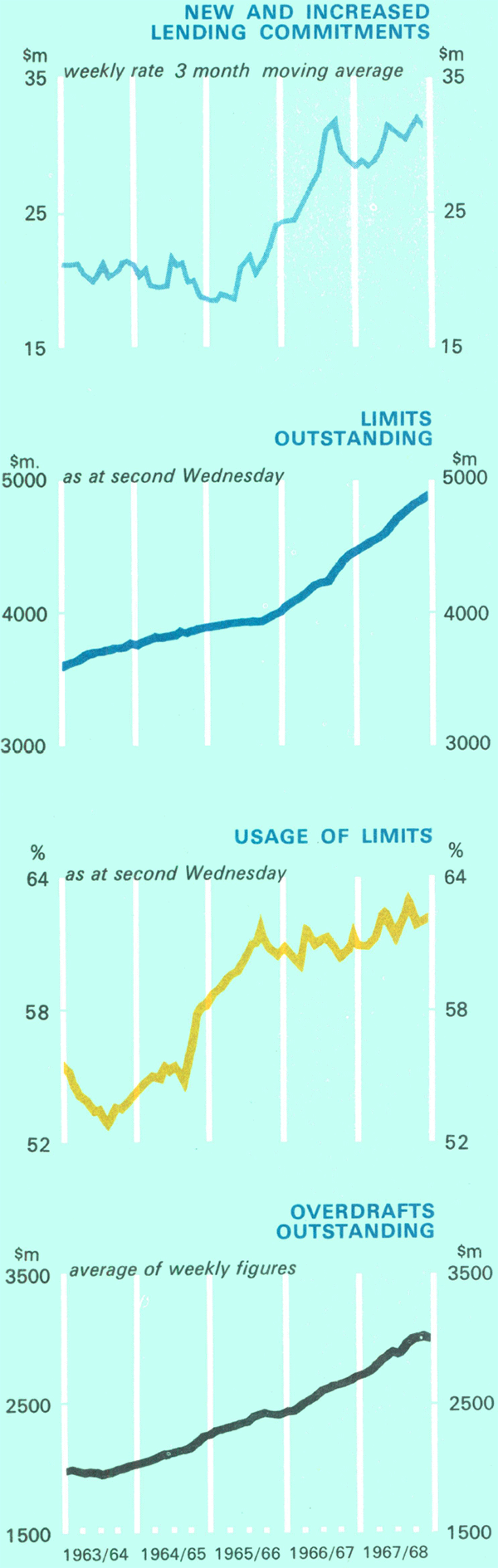
The demand for bank finance was strong throughout the year. Following a request by the Reserve Bank to moderate their new lending, the major trading banks had reduced their rate of aggregate new lending approvals in the final quarter of 1966/67 and this downward trend continued into 1967/68. In October 1967 the Reserve Bank eased the restraints on bank lending and over the next six months new lending approvals followed an upward trend. In the closing months of the year, however, aggregate new approvals levelled out. For 1967/68 as a whole, total new lending approvals by the major trading banks averaged $33.1 million a week, compared with $31.2 million a week in 1966/67. The increase in approvals during the year was almost entirely in overdraft lending (see graph 12). In total, new term and farm development loan approvals fell in the early part of the year but rose in the second half.
Graph 12
MAJOR TRADING BANKS
OVERDRAFT LENDING
seasonally adjusted
New loans approved for rural industry, including approvals attributable to drought, rose strongly in 1967/68. Housing loan approvals, which had risen rapidly in 1966/67, were well maintained in 1967/68. Lending to persons for purposes other than housing rose strongly throughout the year. New approvals to manufacturing industry, which had declined in the early part of the year, regained earlier levels in the last three quarters. Lending to commerce fell for most of the year but was rising in the closing months.
Throughout 1967/68 the Bank maintained a close interest in financial developments in the drought-affected areas of Australia and, in order to add to its understanding of the impact of drought on the demand for finance, the Bank asked trading banks to provide statistics of new lending commitments approved for purposes attributable to drought, including post-drought rehabilitation. Approvals for these purposes averaged about $5 million a month over the second half of the year. The Bank also sponsored a conference, which was attended by senior staff members from banks, pastoral companies, government departments and universities, to discuss problems of drought.
Although the major trading banks maintained a high level of cancellations and reductions of limits, the increase in new approvals resulted in a continued strong growth in overdraft limits. There was also an increase in the usage of these limits and overdraft advances (including personal instalment loans) of the major trading banks rose strongly throughout the year (see graph 12). The increase in these advances in 1967/68 amounted to $350 million, compared with an increase of $279 million in 1966/67. The maximum interest rate on overdraft advances was unchanged during the year.
Term loans outstanding rose steadily in 1967/68 but the increase of $41 million was $8 million less than the increase in the previous twelve months. Approvals were lower than in 1966/67 and repayments and cancellations were higher. In February 1968, transfers totalling $40 million were made to the Term Loan Fund Accounts bringing aggregate transfers to these Accounts since their inception to about $327 million. As with earlier replenishments, about two-thirds of the transfers came from the Statutory Reserve Deposits of the major trading banks and one-third from their other assets.
1967/68 was the second full year of operation of the Farm Development Loan Fund Accounts. Outstanding loans rose by $24 million to total $43 million at the end of the year. The Farm Development Loan Fund Accounts were established in April 1966 with resources of $50 million provided on the basis of approximately two parts from the Statutory Reserve Deposits of the major trading banks and one part from their other assets. By March 1968 the balances of the Accounts had fallen to $13 million and in April 1968 transfers to the Accounts of $37 million were announced, to be made on the same basis upon which the initial resources had been provided.
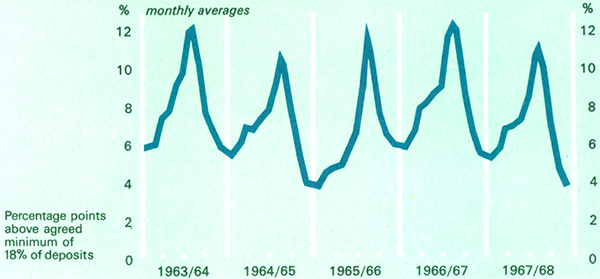
LIQUIDITY. The relative movements in deposits and advances brought about a decline in the liquidity of the major trading banks in 1967/68. There was little change in their L.G.S. assets (liquid assets and Government securities) over the year but the margin of “free” L.G.S. assets (i.e. holdings above the agreed minimum of 18 per cent of deposits) declined (see graph 13). In aggregate, the major trading banks' loans to authorised money market dealers and holdings of overseas funds rose over the year, as did the balances of their Term and Farm Development Loan Fund Accounts. Overall, however, the base from which banks could expand credit at the end of 1967/68 was appreciably smaller than at the beginning of the year.
Graph 13
MAJOR TRADING BANKS
MARGIN OF FREE L.G.S. ASSETS
Total L.G.S. assets of the private sector rose by about $361 million in 1967/68 compared with an increase of $571 million in 1966/67. The factors which led to this smaller addition to L.G.S. assets in 1967/68 are shown in the table on page 20. The major factor was the reduction of $142 million in Rural Credits advances because of the rundown in stocks of wheat and the receipt of proceeds of term sales of wheat made in earlier years; in 1966/67 these advances had risen by $184 million. Government financial transactions contributed less to the private sector's holdings of L.G.S. assets in 1967/68 than in 1966/67; they added about $500 million compared with $550 million in the previous year. On the other hand, international transactions increased L.G.S. assets by $9 million in 1967/68 whereas they had reduced them by $170 million in 1966/67. The reduction in the Australian dollar value of the Reserve Bank's holdings of foreign exchange as a result of the devaluation of sterling did not directly affect the L.G.S. assets of the private sector since the counterpart was absorbed in the Bank's balance sheet. Both bank and non-bank holdings of L.G.S. assets rose by smaller amounts than in 1966/67. Private non-bank holdings increased by about $261 million in 1967/68, compared with a rise of $385 million in 1966/67. Holdings of L.G.S. assets by savings and trading banks increased by about $100 million whereas they had risen by $186 million in 1966/67.
| $ million | |||||||||
|---|---|---|---|---|---|---|---|---|---|
| 1965/66 | 1966/67 | 1967/68 | |||||||
| 1st Half | 2nd Half | YEAR | 1st Half | 2nd Half | YEAR | 1st Half | 2nd Half | YEAR | |
| Government Domestic Financial Position† | +696 | −397 | +299 | +972 | −422 | +550 | +957 | −457¶ | +500¶ |
| Reserve Bank Transactions | |||||||||
| Gold and Foreign Exchange | −136 | +118 | −18 | −100 | −70 | −170 | +25‡ | −16 | +9‡ |
| Rural Credits Advances | −135 | +66 | −69 | −95 | +279 | +184 | −161 | +19 | −142 |
| Statutory Reserve Deposits | −(−24) | −(−160) | −(−184) | −(−11) | −(+13) | −(+2) | −(+19) | −(−36) | −(−17) |
| Term Loan Fund Accounts | −(−7) | −(+10) | −(+3) | −(+5) | −(−13) | −(−8) | −(−11) | −(+22) | −(+11) |
| Farm Development Loan Fund Accounts | — | −(+50) | −(+50) | −(−7) | −(−10) | −(−17) | −(−13) | −(+26) | −(+13) |
| Miscellaneous | −3 | +48 | +45 | −67 | +51 | −16 | −106‡ | +107 | +1‡ |
| Total | +453 | −65 | +388 | +723 | −152 | +571 | +720 | −359¶ | +361¶ |
| Less private non-bank holdings of L.G.S. assets | −(+192) | −(−31) | −(+161) | −(+373) | −(+12) | −(+385) | −(+303) | −(−42)¶ | −(+261)¶ |
| L.G.S. assets of banks | +261 | −34 | +227 | +350 | −164 | +186 | +417 | −317 | +100 |
| of which: Savings Banks | +71 | −21 | +50 | +106 | +15 | +121 | +145 | −39 | +106 |
| Trading Banks | +190 | −13 | +177 | +244 | −179 | +65 | +272 | −278 | −6 |
|
* Figures other than Government Domestic Financial Position and private non-bank
holdings of Government securities are movements in June averages or interpolated
June averages. † Allows for movements in Commonwealth Government deposits with Reserve Bank. ‡ Both items exclude the effect of the writing down of the Australian currency value of the Reserve Bank's foreign exchange holdings as a result of the devaluation of sterling. ¶ Preliminary. |
|||||||||
In June 1967, the average ratio of L.G.S. assets of the major trading banks to deposits was 23.7 per cent, leaving them a margin of “free” L.G.S. assets of 5.7 percentage points. In addition, the major trading banks' loans to authorised dealers in the short term money market amounted to 1.4 per cent of deposits. The seasonal upswing in L.G.S. assets was slower in the first few months of the year than in 1966/67 but accelerated between October 1967 and January 1968 to reach a peak near the beginning of February. At this point, the L.G.S. assets of the major trading banks were $521 million higher than at the beginning of the year, which was almost the same as the seasonal increase of $527 million in 1966/67. The seasonal rundown in L.G.S. assets was, however, some $53 million greater than in 1966/67 and in June 1968, the average L.G.S. ratio was 21.9 per cent. This gave the major trading banks a margin of “free” L.G.S. assets which was 1.8 percentage points narrower than at the beginning of the year. Their loans to short term money market dealers, as a proportion of deposits, were slightly lower.
The only changes in the Statutory Reserve Deposit ratio in 1967/68 were two reductions associated with term and farm development lending. The ratio was reduced from 8.9 per cent to 8.4 per cent in February 1968 and to 8.0 per cent in April 1968 to provide part of the replenishments of the Term Loan Fund Accounts and Farm Development Loan Fund Accounts, respectively.
SAVINGS BANKS
DEPOSITS. Deposits with savings banks rose by $460 million in 1967/68, compared with an increase of $515 million in the previous year. The increase from $6,000 to $10,000 in the interest bearing limit for accounts of individuals, which took effect in March 1967, seems to have contributed to the rapid growth in deposits in subsequent months. The rate of growth slackened during the December 1967 quarter and the slower growth continued during the rest of the year. Early in July 1968 an increase of 0.25 per cent per annum in the maximum rate of interest payable on savings bank deposits was announced, to become effective on 1 August 1968.
LENDING. The growth in deposits was reflected in increases in most major categories of savings bank investments. Holdings of L.G.S. assets rose by about $92 million, which was $42 million less than the increase in 1966/67. Loans to local and semi-government authorities increased by $158 million in 1967/68, compared with a rise of $130 million in the previous year. The larger increase in 1967/68 reflected lending to newly established authorities as well as continued strong support for existing borrowers.
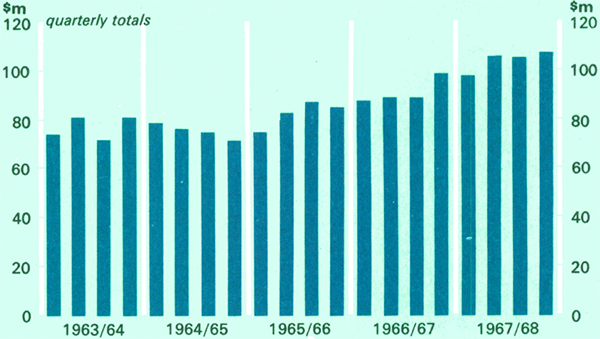
The demand for finance for housing was strong throughout the year. Housing loan approvals by savings banks had risen appreciably to $99 million in the last quarter of 1966/67 and were maintained around that level in the first quarter of 1967/68. With the continuing strong demand for finance and no signs of pressure on resources in homebuilding, the Reserve Bank informed savings banks in October 1967 that it was appropriate for savings bank lending for housing to continue at least at the levels of the previous six months. Graph 14 shows that approvals rose in the December 1967 quarter and continued at this higher level during the second half of the year. Housing loan approvals totalled $417 million, about $53 million more than in 1966/67. Continuing the trend of recent years, the demand for loans to finance the purchase of existing dwellings was greater than the demand for loans for new housing. Loan approvals for used housing accounted for about 52 per cent of total loan approvals to individuals in 1967/68, compared with less than 43 per cent in 1963/64. Although net repayments of housing loans rose in 1967/68, loans outstanding increased by $202 million over the year; in the previous twelve months they had risen by $190 million.
Graph 14
HOUSING LOANS
APPROVED BY SAVINGS BANKS
Following the announcement in July 1968 of an increase in the maximum rate of interest payable on savings bank deposits, savings banks were reviewing their lending rates and increases of up to 0.5 per cent per annum in some rates were expected.
AUSTRALIAN RESOURCES DEVELOPMENT BANK
Last year's Report foreshadowed the establishment by the major trading banks, with the support of the Reserve Bank, of a new corporation to provide finance for projects of national importance. This new institution, named Australian Resources Development Bank Limited, was given bank status under Commonwealth legislation enacted on 8 November 1967 and opened for business on 29 March 1968. By 30 June 1968 it had raised funds totalling over $26 million from capital subscriptions and issues in the local capital market and had given firm approvals for loans amounting to nearly $33 million, of which about $11 million had been disbursed.
The main objective of the new bank is to assist Australian enterprises to participate more fully in the development of Australia's natural resources. It can provide finance to enterprises engaged in major developmental projects by direct loans and equity investment or by refinancing loans made by trading banks, either individually or in consortium. The Resources Bank's lending and interest rate policies are formulated in consultation with the Reserve Bank.
The capital of the Australian Resources Development Bank comprises $5.25 million, of which $3 million was subscribed as share capital by the eight major trading banks. The remaining $2.25 million is in loan capital, of which $2.1 million was subscribed by the Reserve Bank, $100,000 by the Rural Bank of New South Wales and $50,000 by The Rural and Industries Bank of Western Australia. In the early years of the bank's operations these capital funds will be supplemented by loans, called subordinated bank loans, from the trading banks and the Reserve Bank. During this period the trading banks will provide 60 per cent of any subordinated bank loans and the Reserve Bank will provide the remaining 40 per cent; however, the Reserve Bank's participation in subordinated bank loans is limited to $18.9 million. Along with the trading banks, the Reserve Bank is also prepared to provide the Resources Bank with short-term bridging loans. The Reserve Bank's financial support to the new bank has been given to assist it to begin operations and the Reserve Bank's financial participation will be reduced progressively and eventually eliminated.
The Resources Bank is raising the bulk of its funds by accepting deposits and borrowing funds from the local capital market. The bank has stated that it has been actively exploring the possibility of raising funds abroad but that conditions in overseas capital markets have not been favourable for such operations.
Two forms of investment are currently being offered by the Resources Bank. Term deposits are being accepted for four years and five years, bearing interest at 5.25 per cent and 5.50 per cent per annum, respectively. The minimum term deposit being accepted by the bank is $10,000. By 30 June 1968, the bank had received term deposits of about $1 million. Issues of Transferable Certificates of Deposit, which are marketable registered securities, will be made periodically. The first issue was made in April 1968 with maturities of six, eight and ten years and bearing interest at 6 per cent, 6.25 per cent and 6.50 per cent per annum, respectively. Subscriptions accepted totalled $20 million, including over-subscriptions of $10 million.
The establishment of the Australian Resources Development Bank represented a further broadening of the activities of the Australian banking system. It should improve the ability of the Australian capital market to provide large-scale finance to Australian enterprises for major developmental projects. As a bank jointly owned by the eight major Australian trading banks it is also well placed to attract funds from overseas investors, particularly financial and other institutions which already have connections with Australian banks.
NON-BANK FINANCIAL INSTITUTIONS
Lending by finance companies followed a strong upward trend throughout the year and all major classes of lending increased. The strengthening in demand for motor vehicles and other durable consumer goods was reflected in a sharp increase in amounts financed by instalment credit. Wholesale hire purchase lending rose throughout the year and mortgage and personal loans also increased. Leasing transactions by finance companies continued the strong growth of recent years.
Net lending by pastoral finance companies to the rural sector rose by about the same as in 1966/67. Rural advances by these companies rose less than seasonally in the first half of 1967/68. However, there was a strong growth, on a seasonally adjusted basis, in the second half of the year as conditions improved in drought-affected areas. Over the year as a whole, rural advances by pastoral finance companies rose by about $29 million, compared with an increase of $36 million in 1966/67. Clients' credit balances declined during the year and by the end of June 1968 they were about $7 million less than a year earlier. In 1966/67 they had risen by $3 million.
New loans paid over by life offices had been relatively steady during 1966/67 but increased strongly in the first quarter of 1967/68 and continued to rise during the next six months. As a result, the increase in life offices' loans outstanding over the year was probably greater than in 1966/67.
New capital raisings by listed companies in the first nine months of 1967/68 were substantially more than in the same period of 1966/67. The increase was mainly in debentures, notes, loans and deposits but issues of share capital also rose. Raisings by finance companies increased sharply in the first half of 1967/68 and subsequent issues appeared to be well supported. Manufacturing industries raised a relatively small amount in the first half of the year but there was a significant increase in their raisings in later months. Raisings by commerce in the first six months of the year were a little lower than in the same period of 1966/67 but raisings by “other” industries, which includes mining, were higher.
An increasing number of submissions is being received by the Reserve Bank to ascertain whether particular borrowing proposals are in conformity with the Government's policy, as outlined by the then Treasurer in May 1965, on borrowings in Australia by overseas interests. The general aim of the policy is to avoid overseas interests making too great use of Australian borrowings in substitution of funds that would otherwise be provided from overseas sources.
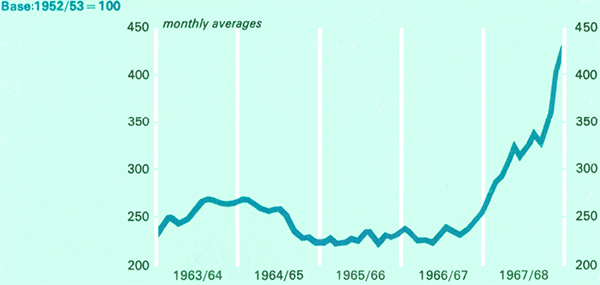
Stimulated by mineral discoveries and by a heavy inflow of portfolio investment from abroad, activity in share markets reached unprecedented levels in 1967/68 and share prices rose very sharply (see graph 15). A strong upward movement in prices began in the final quarter of 1966/67 and continued until November 1967 when the devaluation of sterling set the market back. International events and speculation in mining shares caused prices to fluctuate in the next few months with a peak being reached in February. A new surge in prices began in April, partly in response to heavy demand for mining stocks from abroad, and they continued to increase over the rest of the year. The largest increases during the year were in prices of stocks with mining interests but prices of all other categories of shares also rose.
Graph 15
SYDNEY STOCK EXCHANGE
SHARE PRICE INDEX All Ordinary Shares
The short term money market grew moderately in 1967/68. Funds lodged with the market rose from an average weekly level of $456 million in June 1967 to a seasonal peak of over $540 million early in March 1968 but then fell back to about $495 million in June 1968. The heavy inflow of capital from abroad contributed to the peak level in funds but the amount of overseas money lodged directly with dealers appeared to be small. A feature was the increase in funds lodged with the market by companies. Dealers' liabilities to companies rose by over $100 million during the upswing in liquidity and by $50 million over the year as a whole. On the other hand funds placed with the market by banks fell during the year. In general, dealers had less recourse than in 1966/67 to last resort loans from the Reserve Bank. The average interest rate paid by dealers fell from about 4.5 per cent in June 1967 to 3.7 per cent in November. Thereafter rates tended to move upwards and in June 1968 they averaged about 4.3 per cent.
Uncertainty during 1967/68 about the future course of interest rates was reflected in a significant shortening in the maturity structure of dealers' portfolios. This preference for short-term investments was expressed in a sharp increase in dealers' holdings of Treasury notes which rose from $14 million in June 1967 to $116 million in June 1968 but reached a peak of $272 million during the year. Correspondingly, dealers' holdings of other Commonwealth Government securities fell by $79 million over the year.
Since early 1965 the Bank has allowed authorised money market dealers to hold and deal in commercial bills provided they have been accepted or endorsed by a trading bank. This aspect of dealers' operations has grown steadily with dealers playing a significant part in the development of an active bill market. During 1967/68 they acquired bills at an average rate of around $18 million a month; nearly all were sold on to banks and other parties before maturity. Dealers' holdings of bills in 1967/68 were significantly higher than in the previous year and averaged $25 million, or about 5 per cent of dealers' total portfolios.
During 1967/68 the Bank commenced a review of the way in which the commercial bill market had developed. Discussions were held both with financial intermediaries and non-finance companies and consideration of their views was still in progress at the end of the year. From the discussions and other material available to the Bank, it seems that commercial bill activity has increased steadily since 1965. Banks have accepted an increasing volume of bills each year. Although most of the bills they accept find their way to money market dealers or other investors, their holdings of bills have also increased. There was also significant growth during 1967/68 in finance provided by means of commercial bills which do not carry a bank acceptance or endorsement. Some of these bills are discounted by the acceptor but most are purchased before maturity by other businesses seeking an outlet for investible funds.
GOVERNMENT SECURITIES MARKETS
The Commonwealth Government floated four cash loans in Australia during 1967/68 and Special Bonds were on issue continuously. The terms of the loans in July and October 1967 were broadly the same as those in the May 1967 loan. After the devaluation of sterling, shortand medium-term yields rose slightly and the new level of yields was reflected in the terms of the loans floated in February and May 1968. At $571 million, gross domestic loan proceeds were $75 million lower than in 1966/67. Trading banks and savings banks made larger subscriptions than in 1966/67 but subscriptions by most other classes of investors were lower. Expectations of a rise in yields may have been partly responsible for the lower proceeds, especially in the October and February loans. Redemptions of maturing securities amounted to $293 million in 1967/68, compared with $258 million in 1966/67.
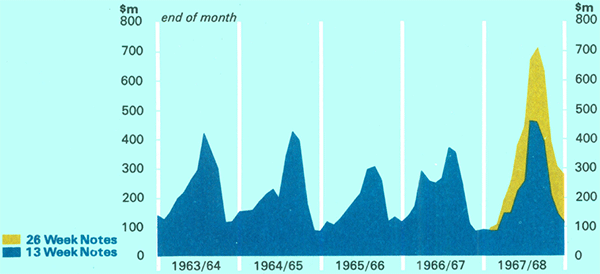
International events in 1967/68 raised expectations that interest rates in Australia would increase and investors in the Government securities market showed a marked preference for short-term securities. This was reflected particularly in a sharp increase in the take-up of Treasury notes, including the new 26 week note (see page 35), during the seasonal build-up in liquidity in lieu of the usual demand for bonds from the Reserve Bank.
Even before the devaluation of sterling there had been uncertainty about the likely course of interest rates. This had manifested itself during the first four months of 1967/68 in a larger increase in Treasury notes on issue and smaller sales of bonds by the Reserve Bank than in the same period of 1966/67. Towards the end of November 1967 activity in the bond market increased as bond holders reacted to the devaluation. After some initial uncertainty, yields on short-dated stocks rose and by the end of November the theoretical yield on a 2 year bond had risen to 4.75 per cent from 4.51 per cent a month earlier. Yields on medium-dated stocks were unaffected at first but rose slightly in December. Long-term yields did not change. In view of the increase in short-term yields, the issue prices of Treasury notes were reduced on 24 November 1967, raising the issue yield on the 13 week note from 4.26 per cent to 4.50 per cent and on the 26 week note from 4.39 per cent to 4.60 per cent.
The announcement in January 1968 of United States measures to restrict the outflow of capital was followed by another small increase in short-term yields. Speculation about further rises in interest rates continued and liquid funds moved more strongly into very short-dated securities, especially Treasury notes (see graph 16). The seasonal peak in Treasury notes on issue was reached early in March 1968 when they totalled $733 million, an increase of $644 million since the beginning of the year. The run-up to the peak in the previous year had been about $270 million.
Graph 16
TREASURY NOTES OUTSTANDING
The desire of holders of liquid funds to stay short by investing in Treasury notes meant that the Reserve Bank was called upon to supply a much smaller share of the securities demanded by the private sector during the upswing in liquidity. Between 30 June 1967 and the end of February 1968, net sales of Commonwealth Government bonds by the Reserve Bank amounted to only $5 million, compared with net sales of about $375 million in the same period of 1966/67.
The rundown in liquidity brought a substantial decline in Treasury notes on issue over the final months of the year. However, at the end of June 1968 Treasury notes outstanding amounted to $274 million, some $185 million more than at the beginning of the year. The rundown also resulted in substantial purchases of bonds by the Reserve Bank but these were considerably less than in 1966/67, reflecting the increased use of Treasury notes during the build-up in liquidity. At the end of June 1968 the Bank's portfolio of marketable securities was about $178 million higher than a year earlier. Its net purchases of bonds over the year were more the result of market initiative than deliberate Bank policy. Economic and financial conditions during the year were such that the Bank did not consider it necessary to use open market operations to influence interest rates and liquidity.
In March 1968 small reductions were made to the issue yields on Treasury notes. The changes in overseas interest rates and other financial developments abroad in March did not bring any strong reaction in Commonwealth Government securities markets although yields on short-dated bonds rose slightly. During the remainder of the seasonal rundown in liquidity, bond yields fluctuated but did not change significantly. At the end of June 1968, the theoretical yield on a 2 year bond was 4.84 per cent, compared with 4.52 per cent a year earlier. The yield on a 10 year bond rose from 5.03 per cent to 5.11 per cent over the same period but yields on longer dated bonds remained generally unchanged throughout the year.
The table on page 25 shows that nongovernment holdings of Commonwealth Government securities redeemable in Australia (including Treasury notes and Treasury bills) rose by about $500 million in 1967/68, compared with an increase of $550 million in 1966/67. Non-official holdings of Commonwealth Government securities rose by about $274 million in 1967/68, some $155 million less than in 1966/67. Savings banks increased their holdings by more than in 1966/67. However, trading banks and authorised money market dealers increased their holdings by only small amounts in 1967/68, whereas these groups had added considerably to their holdings in the previous year. Holdings of other nongovernment groups also rose by less than in 1966/67. The smaller take-up by the private sector meant that the Reserve Bank increased its holdings by about $226 million, compared with an increase of $122 million in 1966/67.
Local and semi-governmental bodies had little difficulty in raising their loan allocations in 1967/68. The Loan Council had approved an initial borrowing programme for major public and larger local governmental bodies of $314 million; this was $46 million larger than in 1966/67. In February 1968, the programme was increased by $20 million. No limit was placed on raisings by bodies with borrowing programmes of $300,000 or less; previously this applied to bodies with borrowing programmes of $200,000 or less.
| Changes—$ million | |||||
|---|---|---|---|---|---|
| 1963/64 | 1964/65 | 1965/66 | 1966/67 | 1967/68¶ | |
| Reserve Bank—Treasury bills* | −69 | −66 | −36 | +9 | +51 |
| —Other | −45 | +192 | −78 | +113 | +175 |
| Trading Banks | +128 | −19 | +170 | +81 | +4 |
| Savings Banks | +165 | +68 | +50 | +62 | +93 |
| Authorised Money Market Dealers | +59 | −12 | +35 | +85 | +23 |
| Other non-government holders | +168 | +74 | +158 | +201 | +154 |
| TOTAL | +406 | +236 | +299 | +550 | +500 |
|
* Face value. Allows for movement in Commonwealth Government deposits with Reserve
Bank. ¶Preliminary. |
|||||
With strong support from institutions, progress in raising allocations was faster than in earlier years. By the end of December, the major public and larger local governmental bodies had completed almost 80 per cent of their initial borrowing programme. For the year as a whole, total new raisings of local and semi-governmental bodies amounted to $424 million, compared with $341 million in 1966/67. Private loans accounted for $384 million, which was $95 million more than in the previous year. Most major groups of institutions increased their support; the largest increases were in loans from savings banks, superannuation funds and life offices. Public issues raised $40 million, which was about $12 million less than in 1966/67, but the response varied widely between individual issues.
Interest rates on new issues by local and semi-governmental bodies were unchanged over the year. The maximum permitted rates are 5.625 per cent per annum on public issues and 5.875 per cent on long-term private issues. Average market yields on existing semi-governmental securities were around 6.0 per cent for most of the year.