
Reserve Bank of Australia Annual Report – 1968 Economic Policies and Problems
Australia entered 1967/68 in a position of near equilibrium in the domestic economy but with a persisting tendency towards deficit in the balance of payments. The outlook was for some acceleration in expenditure matched by an increase in domestic supplies larger than that in 1966/67. The external prospects were fairly satisfactory although a further loss in international reserves was expected.
Economic policy in 1967/68 was directed, therefore, at maintaining the position of domestic balance and at keeping within reasonable limits any pressures that might develop in the external situation. The Commonwealth Government budget provided some stimulus to the economy and monetary policy was expected to play its part by making adjustments which might prove necessary in the light of developments during the year.
The domestic economy moved forward in much the same way as had been expected but unforeseen developments occasioned concern about the external situation. Drought and weak commodity prices reduced exports and international events created other uncertainties in the balance of payments. However, with the substantial inflow of capital from abroad, the need for major changes in monetary policy did not arise.
Monetary Policy
Bank Lending
Trading bank lending, which had been virtually freed of restraint in the first half of 1966/67, followed a strong upward trend early in the second half of that year. Economic activity also moved ahead quite firmly in that period and the outlook was for further acceleration. In April 1967 banks were asked to moderate their new lending and the rate of new approvals fell over the next few months.
Contrary to expectations, the pace of economic expansion slackened a little towards the end of 1966/67 and early in 1967/68 some doubts arose as to whether private spending, particularly capital expenditure, would grow at an acceptable rate. It seemed that the need to slow down bank lending had diminished and in October 1967 the Bank informed trading banks that new lending could continue at around the levels prevailing over preceding months. At the same time, banks were asked to maintain a high level of cancellations and reductions of overdraft limits to avoid an excessive increase in unused limits. In the event, undrawn limits of the major trading banks increased by less than 7 per cent in 1967/68, compared with a rise of about 10 per cent in 1966/67.
No changes were made in policies relating to the direction of bank lending. Banks were asked to continue to treat sympathetically lending for purposes arising from drought. In addition, they were asked to maintain lending for housing and to continue their long standing favourable treatment of rural production and exports.
In order to meet the strong demand for housing finance and to employ available resources in the building industry, the Reserve Bank, also in October 1967, suggested to savings banks that it would be appropriate for them to continue their aggregate housing loan approvals at least at the level of the preceding six months.
Towards the end of 1967, drought and, to a lesser extent, devaluation produced a deterioration in the outlook for the balance of payments and, although the subsequent heavy inflow of capital from abroad more than offset the deficit on current account, uncertainties remained. As the tightening of bank liquidity in the closing months of the year was expected to exercise a restraining influence on the growth of bank lending, the Reserve Bank made no modifications to credit policy during the second half of 1967/68.
Over the year as a whole, the level of new lending by the major trading banks was about 6 per cent higher than in 1966/67 and advances outstanding rose by about 13 per cent, much the same rate of increase as in the previous year. Although the rate of growth of bank credit has been high in the last two years, there have been no developments to suggest that this was inconsistent with the needs of the economy.
Last year's Report commented on the way in which trading banks had extended the range of their lending activities in recent years. Further progress in this direction was made in 1967/68 when approval was given to banks to undertake lease financing on a modest scale. In undertaking such business the banks are limited to a financing role; they are precluded from purchasing commodities for stock and holding them for eventual lease or sale. Interest rates on lease financing transactions are determined in consultation with the Bank but they are not subject to the maximum overdraft interest rate arrangements.
Statutory Reserve Deposits
Apart from reductions associated with the replenishment of the Term Loan Fund and Farm Development Loan Fund Accounts, the Statutory Reserve Deposit ratio was not changed in 1967/68.
During the seasonal upswing in liquidity the margin of “free” L.G.S. assets was narrower than in 1966/67 but was not inconsistent with policy requirements and no Statutory Reserve Deposit action was necessary. The outlook for bank liquidity changed towards the end of the first half when the balance of payments prospects became more pessimistic and it was clear that there would be a substantial rundown in Rural Credits advances. It seemed then that the liquidity position of banks at the end of the year would be significantly tighter than had been envisaged earlier. Because of the uncertainties about the balance of payments, it was considered that some tightening in liquidity would be appropriate and this view was maintained throughout the rest of the year. During the second half the heavy inflow of capital from abroad eased the expected pressure on banks' liquidity. Nevertheless, their position continued to be relatively tight and no change was made in the Statutory Reserve Deposit ratio.
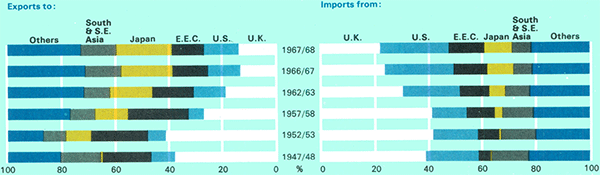
Graph 17
DIRECTION OF AUSTRALIAN TRADE
INTEREST RATES
Interest rates on bank deposits were raised slightly near the end of the year and increases in some lending rates of savings banks were expected to follow. Other interest rates in the private sector were fairly steady in the first half of the year but subsequently tended to edge upwards. In Government securities markets yields on short-and medium-term securities rose slightly over the year but yields on long-term securities generally were unchanged.
The succession of overseas financial crises in 1967/68 created considerable uncertainty in Australian capital markets about the likely course of interest rates. Following the devaluation of sterling these uncertainties produced increases in yields on short-and medium-term Government securities without any active intervention by the authorities. For the remainder of the year the general pattern of market yields did not show any significant change although holdings of liquid funds continued at high levels.
Economic developments during the year did not suggest a need for changes in the general level of interest rates. The domestic economy was in a position of balance throughout the year and changes in interest rates were not needed either to stimulate or restrain activity. The margin between Australian and international interest rates widened appreciably but Australia was able to attract a heavy inflow of capital without action by the authorities to narrow the margin. However, the levelling out in trading bank fixed deposits in the second half of the year and a hesitancy in the growth of savings bank deposits indicated a decline in the attractiveness of these deposits relative to other forms of investment of funds and interest rates on bank deposits were increased near the end of the year.
External Policies and Problems
The Devaluation of Sterling
The devaluation of sterling on 18 November 1967, with its implications for international currency arrangements, required Australia to review the value of the Australian dollar in relation to the currencies of other countries. Because the closure of banks in the United Kingdom on 20 November prevented foreign exchange business being transacted through London, the authority of banks in Australia to deal in foreign exchange was withdrawn for 20 November and 21 November 1967. A decision to change the par value of a country's currency requires the approval of the International Monetary Fund; such approval may be given only if the Fund is satisfied that the change is necessary to correct a fundamental disequilibrium in the balance of payments of the country.
The exchange rate between the currencies of the United Kingdom and Australia had remained unchanged since 1931. When sterling was devalued in September 1949 the Australian pound followed suit. In November 1967, however, the Government decided not to change the existing parity of the Australian dollar; this meant that the Australian dollar appreciated against sterling and a number of other currencies which had also devalued.
On 18 November 1967 Australia's international reserves included sterling holdings of $793 million. The devaluation of sterling, therefore, reduced the value of our reserves, in terms of gold, by about $113 million. On the other hand, there will be savings in the longer term of around $108 million in respect of Commonwealth and state government debt redeemable in sterling. Nevertheless, the devaluation of sterling caused an immediate loss in the international purchasing power of Australia's reserves which no action by Australia could offset.
Australia's international trading position had, of course, to be considered. It was clear that the effects would be much less pronounced than when sterling was devalued in 1949. Since then the pattern of Australia's overseas trade had changed substantially (see graph 17). In 1947/48 the United Kingdom had purchased 38 per cent of our exports but in 1966/67 it had taken only 13 per cent. Japan had replaced the United Kingdom as our major market and the United States was close behind the United Kingdom. Although the share taken by the countries of the European Economic Community had fallen, they still remained substantial buyers of Australia's exports. It was apparent, however, that the devaluation of sterling would affect some exports more than others. Some commodities, e.g. wool, would be relatively unaffected since their prices are set on world markets. In the case of those commodities for which the United Kingdom constitutes a major part of their export market, e.g. dairy produce and fruits, export earnings might be reduced. There could also be reduced exports by some manufacturing industries because of increased competition from the United Kingdom in overseas markets.
The devaluation of sterling was expected to make imports from the United Kingdom cheaper in Australian currency and to lead to an increase in the volume of imports from that country. However, it was expected that much of the increase in imports from the United Kingdom would be at the expense of other suppliers so that there would be no great effect either on domestic industry or on import payments.
A devaluation by Australia would have been of temporary benefit to exporters but might also have led to a considerable boost in domestic prices and costs unless strong measures of restraint were adopted.
The fact that our other major trading partners did not choose to devalue their currencies made it easier for Australia to co-operate in the international effort to avoid a chain of depreciations. It seemed clear that, overall, the devaluation of sterling and its consequences in other countries would have only a limited impact on Australia's balance of payments and domestic activity. Problems would be posed for some industries but the Government decided that these disadvantages were less than those which would have arisen if the Australian dollar had also been devalued.
Following the decision to retain the existing parity of the Australian dollar, the Government took steps to alleviate the effects which the devaluation of sterling had on individual industries, some of which were already in difficulty because of drought and rising costs. A committee was established to receive claims from exporters of primary products for compensation where financial losses were demonstrably and unavoidably incurred because of devaluation. In April 1968 the Government announced that compensation estimated at about $34 million would be paid to statutory marketing authorities for losses, mainly in respect of export contracts which had been invoiced in sterling before devaluation. These authorities had not been eligible to obtain forward exchange cover. The Government also established a committee to investigate problems which arose for exporters of manufactured goods because of the devaluation of sterling.
Domestic and external confidence in the strength of the Australian dollar has been amply illustrated since the November 1967 decision. Immediately after the decision foreign exchange dealings resumed in an atmosphere of calm, and economic and financial conditions were undisturbed. As the year progressed, further evidence of confidence in the Australian economy was provided by the heavy inflow of capital from abroad.
In 1967/68 charges totalling about $146 million were written off the Bank's reserves as a result of the devaluation of sterling. The accounting transactions involved are described on page 44.
DISPOSITION OF INTERNATIONAL RESERVES
International reserves are the resources available to the monetary authorities of a country for use in financing temporary deficits in its balance of payments. An important quality of reserves is that they should be readily and unconditionally available to make international payments. Since external accounts are not balanced bilaterally, this means that reserves should be held in assets which are acceptable as a means of payment or are readily exchangeable into assets which other countries require. One asset which meets these criteria is gold. Convertible currencies also meet the criteria but currencies used as reserve assets have been limited mainly to United States dollars and pounds sterling. Currencies have an advantage over gold in that they may be invested and earn income whereas there is a cost involved in holding gold. However, the values of currencies may be subject to change which could involve losses to holders. These are the major factors which a country must consider when deciding upon the investment of its international reserves. Other factors which are considered are the structure of its overseas debt, international trade and capital flows.
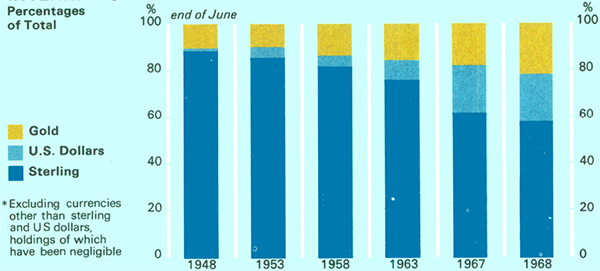
The composition of Australia's international reserves has changed substantially over the last twenty years (see graph 18). The major component has been sterling and fluctuations in reserves have been reflected largely in changes in holdings of sterling. Over these twenty years, however, the proportion of reserves held in sterling has fallen substantially. This reduction has been matched by increases in United States dollars and gold.
Graph 18
DISPOSITION OF AUSTRALIAN INTERNATIONAL RESERVES*
The predominance of sterling in Australia's reserves is a reflection of our close relationships with the United Kingdom over many years. In the 1930's Australia and a number of other countries which had similar links with the United Kingdom became identified as the sterling bloc. When the United Kingdom set up exchange control in 1939, the sterling area was established on a formal basis. Generally, sterling was allowed to move freely within this area but its members contributed their receipts of United States and Canadian dollars to a common “dollar pool” and followed consistent policies of exchange control with the objective of economising in the use of the area's holdings of gold and foreign exchange. This arrangement continued virtually until sterling convertibility in 1958.
Despite the restraints on freedom of action entailed in these arrangements, membership of the area may have allowed Australia to achieve levels of trade and capital inflow higher than would have been possible if we had followed a more independent line of action. Moreover, for a substantial part of the period, higher interest rates were earned on sterling assets than would have been earned on alternative assets.
In recent years, changes have taken place in the pattern of Australia's international transactions, in the fields of both trade and capital (see graphs 17 and 19). Moreover, interest rates obtainable on balances held in United States dollars, the other major reserve currency, have risen. These developments, together with a desire to spread our risks more widely, have been responsible for the diversification which has taken place in Australia's reserves. However, there have been limits, which it seemed wise for Australia to accept, upon the pace and extent to which Australia, as a major holder of sterling, should move to diversify its holdings.
The process of diversification of reserves began in the 1950's and quickened in the 60's. In 1951 the International Monetary Fund relaxed restrictions on the sale of gold in premium markets and since then Australian gold producers have been allowed to sell newly mined gold on overseas markets. These sales were made for United States dollars and, supplemented by the reinvestment of earnings on United States investments, have been the major source of the steady increase in Australia's holdings of that currency. In June 1968, however, these holdings fell by $60 million, largely reflecting the conversion into United States dollars of Australian currency drawn by France and the United Kingdom from the IMF. At the end of June 1968 Australia's holdings of United States dollars amounted to $222 million, representing about 20 per cent of total reserves; ten years earlier they had totalled $51 million or about 5 per cent of reserves.
Over the same period gold production which was not used for local industrial purposes or was not sold overseas was added to Australia's reserves. Despite transfers of $65 million in payment of gold subscriptions to the International Monetary Fund, Australia's gold holdings rose from $132 million to about $230 million during the ten years ended June 1968. The latter figure included gold to the value of $22 million sold to Australia by the IMF in June 1968 to acquire Australian currency for use in drawings by the United Kingdom and France. Nevertheless, with holdings of gold at about 21 per cent of total reserves at 30 June 1968, Australia ranks among the countries with a relatively low proportion of gold in their reserves.
The gold subscriptions to the International Monetary Fund increased Australia's gold tranche position in the Fund. This position represents the amount that a member, experiencing a balance of payments deficit, may draw from the Fund on a virtually automatic basis. The use of Australian currency in drawings from the IMF by other countries has resulted in a further measure of diversification of Australia's reserves. These drawings have reduced Australia's holdings of foreign exchange but have added corresponding amounts to our gold tranche drawing rights. These rights, which are not included in statistics of Australia's holdings of gold and foreign exchange, amounted to $249 million at the end of June 1968, compared with $8 million ten years earlier.
Recent developments in the international monetary system, including progress towards the creation of special drawing rights in the IMF, will have an important influence upon the future disposition of Australia's international reserves.
CAPITAL INFLOW AND THE BALANCE OF PAYMENTS
The inflow of capital from abroad is helping to sustain a rapid rate of growth of the Australian economy. It supplements domestic savings and allows us to use more goods and services than we produce. The volume of capital inflow is, however, uncertain. To a large extent, inflow depends upon prospects in the recipient country and so long as Australia maintains a strong and growing domestic economy we will remain an attractive outlet for foreign investors. But capital flows are also influenced by economic conditions and governmental policies in lending countries and in the last few years economic difficulties in the United States and the United Kingdom have caused those countries to restrict the outflow of capital.
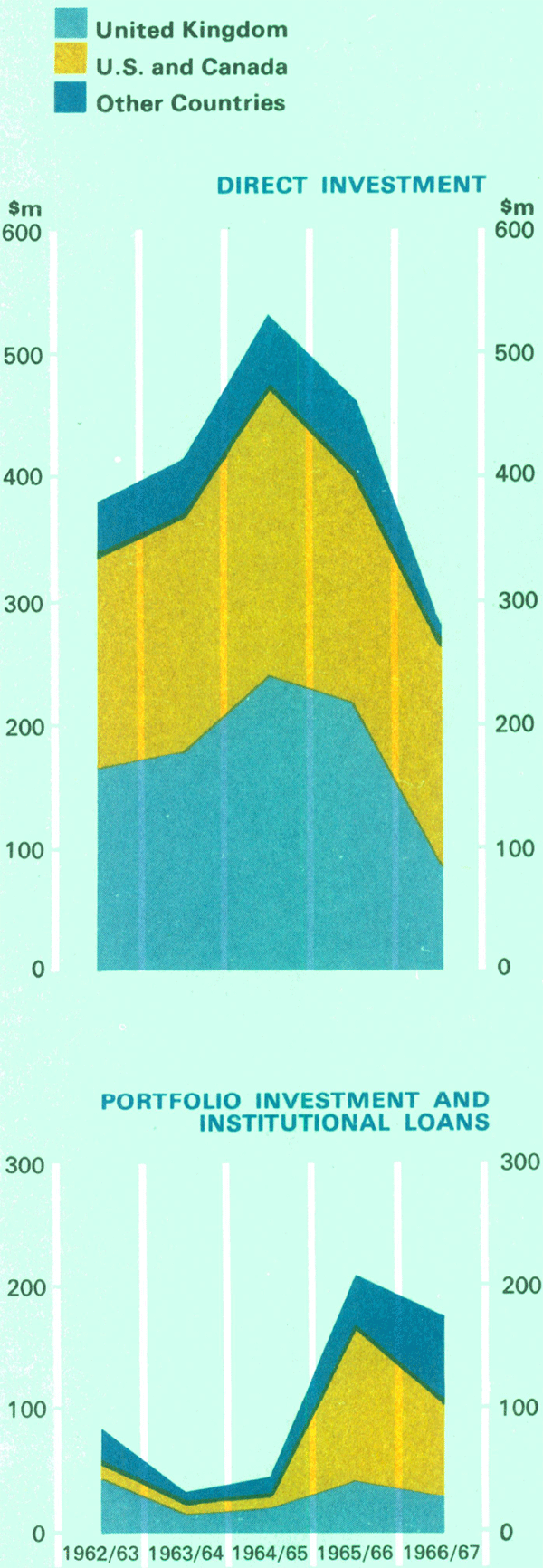
Private overseas investment in companies in Australia can fluctuate widely. In the five years ending 1966/67, the latest year for which statistics are available, the annual inflow ranged from $445 million in 1963/64 to $669 million in 1965/66. Significant changes have taken place in the type and sources of inflow during these five years (see graph 19). Direct investment fell sharply between 1964/65 and 1966/67, partly due to the restrictions by the United Kingdom and the United States. The fall was largest in the case of the United Kingdom and there was a further fall in direct investment from that country in 1967/68. North America is at present Australia's major source of direct investment. The fall in direct investment was offset, to some extent, by an increase in portfolio investment and institutional loans. For this type of investment, funds from countries other than the United Kingdom, especially from North America, grew most in the period between 1964/65 and 1966/67. It seems that there was a significant increase in portfolio investment in 1967/68, much of which came from, or through, the United Kingdom.
Graph 19
OVERSEAS INVESTMENT IN COMPANIES IN AUSTRALIA
The effects of the United States measures of January 1968 on the flow of capital into Australia cannot be predicted with any certainty. Australia is included in a group of countries for which the annual maximum direct investment permitted by the United States is 65 per cent of the average outflow in 1965 and 1966. The limitation applies to investment in the group as a whole rather than to individual countries but we cannot be sure how Australia will fare in competition with other countries in the group. In exceptional cases direct investment in excess of the limit may be authorised. The limitation does not apply to direct investment by United States companies of funds raised by borrowing abroad. One result of the restrictions has been an upsurge of borrowing by United States companies in Europe to provide funds for foreign investment. While there are many competing uses for these funds it is likely that, in addition to the direct investment of United States funds permitted within the restrictions, Australia will receive some direct investment from the United States financed by capital raisings in Europe. On the other hand, the demands by United States companies on European capital markets may reduce direct Australian access to European funds.
The outlook for foreign direct investment in Australia is, therefore, uncertain, especially as the United Kingdom controls on direct investment will continue at least until March 1969. Also doubtful is the outlook for foreign portfolio investment in Australia which was boosted in 1967/68 by the coincidence of international financial events and mineral discoveries in Australia. In these circumstances, it would be unwise to count on a continuation of private capital inflow into Australia at the high levels of 1967/68.
The medium-term prospects for the Australian balance of payments are bright. The growth of exports is likely to accelerate, largely because of mineral developments, while discoveries of oil and natural gas and import replacement in other fields should reduce the demand for imports.
However, there could be problems in the period before the mineral projects are fully reflected in exports. The development of the natural resources upon which the medium-term outlook largely depends will require substantial capital expenditure which in turn will generate a strong demand for imports. Moreover, maturities of official and private debt abroad, including repayments of defence credits, will be high over the next few years.
A continuation of present policies of shifting resources into defence would also have important consequences for the economy. Expenditure on defence not only reduces the volume of resources available for economic development but, because of its high import content, also places an additional burden on the balance of payments.
A reduction in capital inflow in the next few years could, therefore, bring the balance of payments under strain. A higher level of domestic savings would help to finance the capital expenditure required by the new growth industries and, to this extent, would compensate partially for a reduction in the inflow of capital. However, cuts in current spending would need to fall wholly on imports or exportables if there was to be a corresponding fall in the demand for foreign exchange. If defence spending continues to grow and if we are unsuccessful in attracting capital sufficient to cover the deficit on current account in the next few years, we may have to accept a slower rate of economic growth than would otherwise be possible.
Direct investment from abroad can generally be regarded as a long term addition to Australia's resources. Portfolio investment, on the other hand, can be of a less permanent nature. A large part of this type of investment in recent years has been in the form of loans from financial and other institutions abroad which normally have fixed schedules of repayment and therefore are not subject to unexpected withdrawal. There can be little doubt that much of the recent overseas investment in Australian equities is seeking to share in the long-term growth of the economy. However, portfolio investment which is in search of short-term gains could introduce another element of instability into the Australian balance of payments.