
Reserve Bank of Australia Annual Report – 1968 The External Environment
The international monetary system was subjected to severe pressures in 1967/68. As an important trading nation, a major holder of sterling and a large importer of capital, Australia had a substantial interest in the way in which these pressures were met.
The Devaluation of Sterling
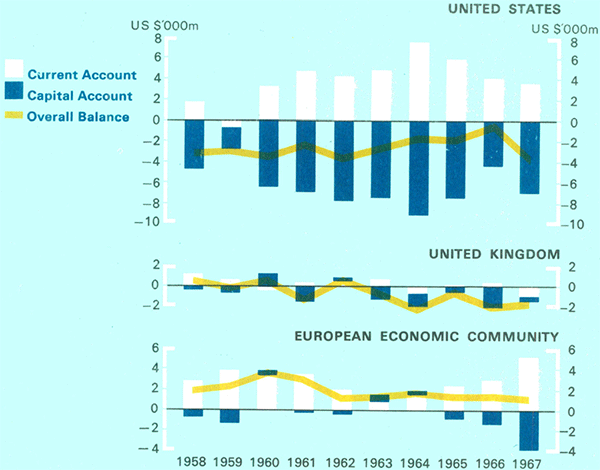
Although the United Kingdom had suffered periods of balance of payments difficulty before 1964, the deterioration which necessitated the devaluation of sterling began in that year (see graph 2). Domestic measures of restraint, which kept economic growth at a very low rate and produced the highest level of unemployment in the post-war period, brought some improvement in the balance of payments in late 1966 and early 1967. However, a slowdown in activity in industrial countries and the closing of the Suez Canal presaged a new period of payments difficulty for the United Kingdom. Confidence in sterling weakened and the withdrawal of funds from the United Kingdom accelerated. On 18 November 1967 the United Kingdom Government devalued the pound sterling by 14.3 per cent from US$2.80 to US$2.40 and reinforced its earlier measures of restraint to make resources available for import replacement and exporting. In addition, the United Kingdom arranged a stand-by credit of US$1,400 million with the International Monetary Fund, bringing total credit facilities available to the United Kingdom to around US $3,000 million.
Graph 2
BALANCE OF PAYMENTS SELECTED INDUSTRIAL COUNTRIES
The devaluation of a currency which plays such an important role in trade and in the international monetary system could have provoked a series of competitive depreciations by other countries. In the event, none of the major industrial countries devalued its currency. Neither did Australia, for reasons which are discussed on page 29. Those countries which devalued their currencies were either very dependent on trade with the United Kingdom or were experiencing severe payments difficulties.
THE UNITED STATES DOLLAR AND GOLD CRISES
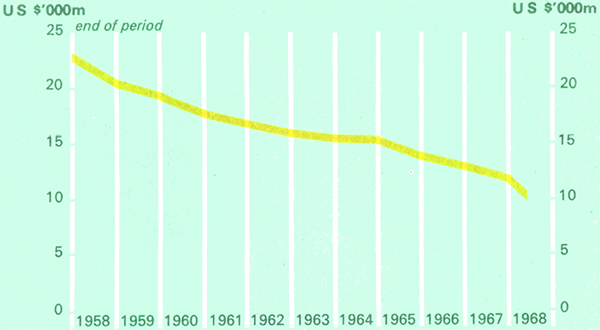
The United States balance of payments has been in continuous deficit during the last ten years (see graph 2). These deficits were financed by running down the country's gold stock (see graph 3) and by a substantial increase in its external liabilities. This deterioration in the relationship between the external assets and liabilities of the United States had rendered the dollar vulnerable. Despite international efforts to isolate the devaluation of sterling, doubts about the stability of the United States dollar and the price of gold increased and were reflected in a substantial increase in the demand for gold in the London gold market. Most of this increased demand had to be met from the gold stocks of monetary authorities participating in the London gold pool. Since the United States supplied about 59 per cent of the pool's requirements, the rate of fall of its gold stock accelerated sharply towards the end of 1967. There was also a pronounced deterioration in the United States balance of payments during this period.
Graph 3
UNITED STATES GOLD STOCK
On 1 January 1968 the President of the United States announced measures directed at the balance of payments position. The previously voluntary programme of restraint on United States direct investment abroad was changed into a mandatory programme with much lower levels of permitted capital outflows. While these controls were designed to reduce the outflow of capital to all areas their major impact was intended to fall on the surplus countries of western Europe. Restrictive guidelines on the extension of loans to foreigners by United States financial institutions were also tightened. In addition, the President announced other measures which were intended to reduce government and net travel expenditure abroad and promote the expansion of exports.
Despite this programme, speculative activity in the gold markets resumed early in 1968 and the flight from currencies to gold reached such a height that the stability of the international monetary system was seriously threatened. The London gold market was closed on 15 March 1968 and the governors of the central banks of countries which were active contributors to the gold pool met in Washington to examine its operations. On 17 March 1968 they stated their belief that henceforth officially-held gold should be used only to effect transfers among monetary authorities and, therefore, they decided no longer to supply gold to the London gold market or any other gold market. Moreover, they stated that, as the existing stock of monetary gold was sufficient in view of the prospective establishment of the facility for special drawing rights in the International Monetary Fund, they no longer felt it necessary to buy gold from the market. They also agreed that henceforth they would not sell gold to monetary authorities to replace gold sold in private markets. Finally, they invited the cooperation of other central banks in the policies which they had agreed upon. The change which was introduced in Australian policy relating to gold transactions is described on page 34 of this Report. The governors also agreed to provide further facilities which would bring the total of credits immediately available to the United Kingdom authorities, including the IMF stand-by credit, to US$4,000 million.
The effect of these decisions was to create two separate markets for gold—an official market, in which gold could be transferred between monetary authorities at the existing price of US$35 an ounce, and a private market, in which the price of gold would be determined according to fluctuations in supply and demand. The opening price of gold on Continental markets was about US$40 an ounce. By the time the London gold market resumed operations on 1 April 1968 the price had eased to about US$38 an ounce. The price on the London market subsequently rose to a peak of US$42.60 an ounce on 21 May 1968 but by the end of June 1968 it had fallen back to US $40.90 an ounce.
The introduction of the two-tier gold system had the immediate effect of halting the drain on the gold reserves of the world's monetary authorities. However, long-term confidence in the international monetary system will require the adjustment of the external deficits of the reserve currency countries and continued progress towards the establishment of a new reserve asset to supplement gold and foreign exchange.
Through the devaluation of sterling and supporting measures of domestic restraint, which were reinforced by the budget of March 1968, the United Kingdom has taken strong action towards correcting its external deficit. By the end of the year, however, there was still no clear evidence of a marked improvement in the balance of payments and sterling had continued to come under pressure from time to time. In June 1968 the United Kingdom drew US$1,400 million from the IMF under the stand-by credit arranged in November 1967; the proceeds were used to repay outstanding short-term debt to overseas central banks, thus reconstituting the United Kingdom's short-term borrowing facilities by the same amount. The balance of payments deficit of the United States was reduced in the first quarter of 1968 but it was still too large to encourage confidence in the United States dollar. However, the enactment in June 1968 of a bill to raise taxes in the United States and reduce government expenditure was a positive step towards the reduction of the balance of payments deficit and the restoration of international monetary stability.
The substantial improvements which the United States and the United Kingdom are aiming to achieve in their external accounts will involve opposite changes in the payments situations of other countries. If surplus countries are unwilling to follow domestic and international policies which will enable the tendency for them to accumulate surpluses to be reduced, long-term balance of payments equilibrium will be achieved only at reduced levels of international trade and at the cost of unemployment and lower rates of growth in deficit countries. The communique issued by central bank governors in Washington in March 1968 noted that the governments of most European countries intended to pursue monetary and fiscal policies which would “contribute to conditions that will help all countries move towards payments equilibrium”.
SPECIAL DRAWING RIGHTS
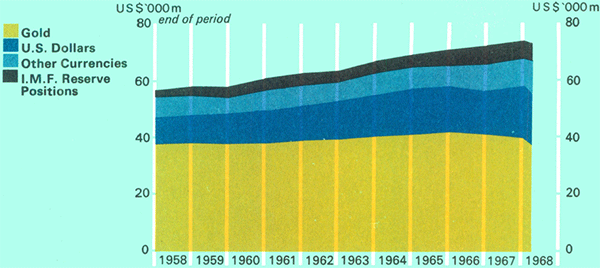
For several years there has been concern about the rate of growth of world monetary reserves (see graph 4). The flow of gold into monetary stocks has slackened and, indeed, reversed as a result of a levelling off in world gold production and a substantial increase in private demand because of rising industrial use and hoarding. Over half the increase in world monetary reserves since 1958 has been in the form of United States dollars. The gold policy adopted in March 1968 and the efforts of the reserve currency countries to eliminate their external deficits underline the need for a scheme which will ensure that the expansion of world activity and trade will not be hindered by a shortage of international liquidity.
Graph 4
WORLD MONETARY RESERVES
At the annual meeting of the International Monetary Fund in September 1967 the Board of Governors approved the outline of a plan to establish a new reserve facility based on special drawing rights in the Fund. An amendment to the Articles of Agreement of the Fund, incorporating this plan and certain other changes in rules and practices, was approved by the Board of Governors on 31 May 1968 and was transmitted subsequently to member governments for formal acceptance. The amendment will become effective after it has been accepted by three-fifths of the members of the Fund having four-fifths of the total voting power.
The amendment provides a means for the periodical creation of special drawing rights in the IMF which participating countries can accept as reserves and can use in making official settlements. Holders of special drawing rights will be able to use them to obtain convertible currencies from other participating countries to finance a balance of payments deficit or to meet other unfavourable developments in their reserves. All members of the IMF are entitled to participate in the scheme and allocations of the special drawing rights will be made to participants in proportion to their IMF quotas. On this basis, Australia would receive special drawing rights equivalent to about US$24 million out of each US$1,000 million created. The rights will have a guaranteed value in terms of gold and participants will be obliged to accept them, up to a certain limit, in exchange for convertible currency. A country's holdings of special drawing rights will earn a moderate rate of interest but a charge at the same rate will be payable on its net cumulative allocation of rights.
WORLD ECONOMIC ACTIVITY AND TRADE
Despite unsettled conditions in the international monetary system, economic activity increased in most industrial countries during 1967/68. There had been a pronounced pause in the growth of output in the second half of 1966/67 as earlier policies of monetary restraint took full effect. Domestic developments had caused governments to revert to expansionary policies during those six months and the tempo of activity began to improve early in 1967/68 and quickened thereafter. By the end of the year, however, four major industrial countries— United States, United Kingdom, Japan and Canada—were following policies of domestic restraint. Expansion was continuing in most European countries although social unrest dislocated economic activity in France in the closing months of the year. In June 1968, France drew US$885 million from the IMF to replace reserves which had been used to support the franc in foreign exchange markets.
The improvement in economic activity was not reflected immediately in international trading conditions. World trade grew only slowly in the early months of 1967/68, partly because of special factors such as the closure of the Suez Canal and dock strikes in the United Kingdom; commodity prices were also fairly weak. With the recovery in production in the industrial countries, world trade began to increase strongly towards the end of 1967 and early in 1968 and there was also some improvement in commodity prices.
Early in the second half of 1966/67, pressures in world financial markets had eased and there were widespread reductions in interest rates. Towards the end of 1966/67, however, rates had begun to move up again in some markets. The devaluation of sterling and the gold and United States dollar crises gave fresh impetus to the upward trend in interest rates which, in the United States and the United Kingdom, rose to historically high levels during 1967/68. At the end of June 1968, interest rates in the major international money markets were still substantially higher than a year earlier.
The future expansion of world economic activity will depend to a large extent upon the existence of stable conditions in the international monetary system. Moves to ease the pressures on the system which arose in 1967/68 included actions by the reserve currency countries to correct their external deficits and the new arrangements for the marketing of gold. However, at the end of the year, long-term confidence in the international monetary system had not yet been restored.