Reserve Bank of Australia Annual Report – 1968 Papua and New Guinea
The Bank's central banking functions extend to the Territory of Papua and New Guinea. It also undertakes some broader responsibilities relating to the growth of banking and financial institutions and the use of money by Papuans and New Guineans.
Economic Activity
The economy of the Territory continued to expand in 1967/68 and the involvement of Papuans and New Guineans increased.
Total government expenditure rose by $12 million in 1967/68 to about $168 million, of which $78 million was financed from a grant by the Commonwealth Government and about $32 million from direct spending in the Territory by Commonwealth Government departments. Internal current revenue amounted to $50 million, a rise of $6 million over the previous year, and domestic loan raisings contributed a further $8 million. Emphasis in government expenditure continued to be placed on economic development, particularly on the expansion of exports. There were higher allocations for capital works and services and for agriculture, and additional funds were provided for the Papua and New Guinea Development Bank, the University of Papua and New Guinea and the Institute of Higher Technical Education.
Dwelling construction continued at a high level but commencements of other buildings were lower than in 1966/67; employment in the building industry also fell. In 1967/68 the Administration established a Housing Commission which will concentrate initially on the provision of low-cost housing. Registrations of new motor vehicles were higher than in 1966/67 and ownership and operation of commercial vehicles by Papuans and New Guineans increased. The Retail Price Index rose by 1.7 per cent over the year, compared with an increase of 2.4 per cent in 1966/67.
Seasonal conditions were generally favourable in 1967/68. The production of copra recovered from the lower level recorded in the previous year. Coffee and cocoa crops were substantially larger and the output of timber and rubber continued to rise steadily. The development of a commercial cattle industry is proceeding and prospects are bright for the tea industry.
There was further expansion in the operations of some existing secondary industries and a number of new factories commenced. As a result, factory employment again rose.
A tourist board was established and tourism was stimulated by the completion of several new hotels and motels and a generally higher standard of accommodation. The flow of tourists was also encouraged by improved air services, both within the Territory and externally.
Further progress was made in two major undertakings in which the Administration is participating. The development of a palm oil industry in New Britain will involve the establishment of smallholder blocks, a plantation estate and a processing factory. Through the Papua and New Guinea Development Bank, the Administration is joining with private enterprise to develop the scheme. Additional exploratory work is proceeding before a final decision will be taken concerning the extraction of copper deposits on Bougainville Island. The Administration has an option to take up 20 per cent of the anticipated share capital requirements.
The search for oil and natural gas continued during the year and one company reached gas at 6,000 feet in an offshore area in the Gulf of Papua.
During the year the International Bank for Reconstruction and Development approved a loan of $6.2 million to the Administration for the improvement of the Territory's telecommunications system. The Commonwealth Government will guarantee the borrowing. Preliminary discussions were also held regarding finance from the International Development Association for a package of agricultural and livestock development projects. A United Nations agency has agreed to finance a basic transport survey in the Territory and is financing part of the development of the Goroka Teachers' College.
World prices for the Territory's export commodities fluctuated but they do not appear to have been affected much by the devaluation of sterling. Lower world supplies of copra and cocoa raised prices for these commodities significantly above levels in the previous year. Coffee prices were down a little and rubber prices were depressed, reflecting the current world over-supply situation.
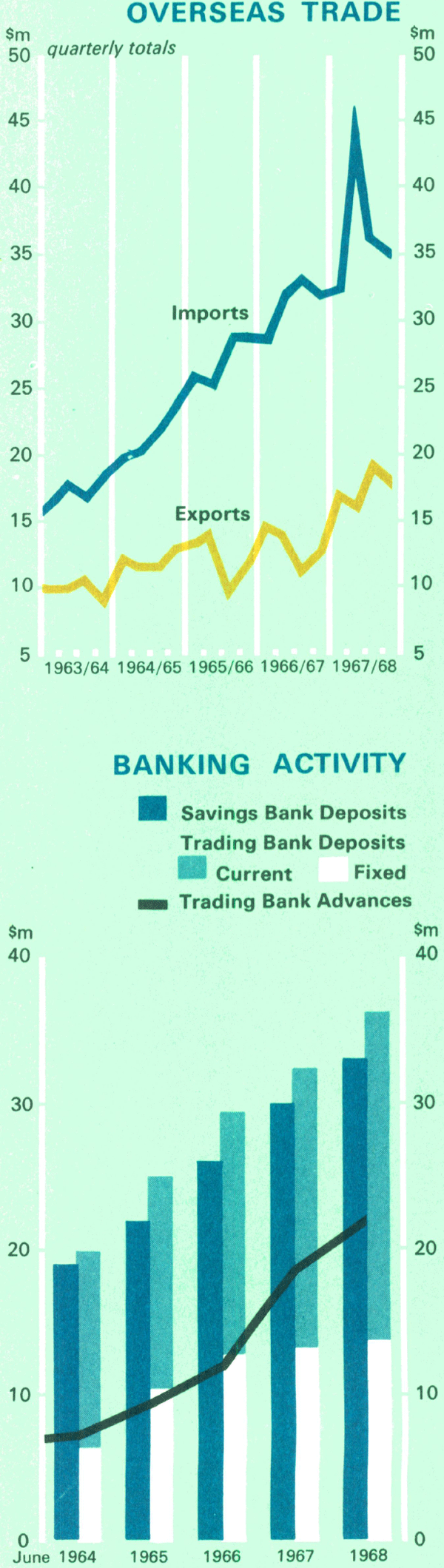
The expansion in primary production and higher prices for cocoa and copra were reflected in a rise in exports in 1967/68. However, the growth in domestic expenditure brought a strong increase in imports, particularly manufactures and machinery, and the trade deficit widened further (see graph 21).
FINANCE
The year saw a continuation of the general broadening of the economy through increased acceptance and use of money by Papuans and New Guineans.
Banking activity continued to expand (see graph 21). Deposits with savings banks increased by $3.1 million in 1967/68 to a total of $32.9 million; in 1966/67 they had risen by $3.9 million. The number of savings bank accounts rose by 39,000 to 325,000, a slightly smaller increase than in 1966/67. Deposits with trading banks rose from $32.2 million to $36.1 million; this increase was a little higher than that in the previous year.
Trading bank advances rose more slowly than in 1966/67 and at June 1968, they totalled $22.2 million, which was $3.4 million more than a year earlier. In 1966/67 they had risen by $6.5 million. Through its Rural Credits Department the Reserve Bank again made seasonal finance available for the marketing of copra and coffee and, for the first time, cocoa.
Savings and loan societies and savings clubs expanded at a slower rate in 1967/68 as greater emphasis was placed on consolidation and on improving standards of existing groups. Total funds at 30 June 1968 amounted to $994,000, compared with $840,000 a year earlier. Lending by societies continued to expand and outstanding loans at the end of June totalled $281,000; this was $73,000 more than in June 1967. Most of these loans were used for income generating projects; a significant amount was also spent on housing improvements. The activities of the Federation of Savings and Loan Societies and the Gazelle League of Savings and Loan Societies strengthened during the year and a new body, the Eastern Highlands League of Savings and Loan Societies, was established.
The Papua and New Guinea Development Bank began operations in July 1967, with capital of $3.5 million provided by the Administration. Its function is to provide longer term development finance with particular attention to the needs of small-scale enterprises. At June 1968, advances outstanding totalled $605,000. In addition to the capital being provided for palm oil development in New Britain, the Development Bank is offering loans to each smallholder in the scheme.
The Reserve Bank's Advisory Committee on Central Banking in the Territory, whose members include Papuans and New Guineans, the Territory Treasurer and other residents, met regularly during the year. The Committee reviewed the activities of the Bank in the Territory and provided opportunities for discussion of local banking and financial matters.
During the year, the Bank continued its programme of financial education. This was carried out mainly through schools by specialist officers using films and booklets to supplement lectures. In order to assist the increasing number of Papuans and New Guineans seeking investments for their savings, a booklet was produced which outlined the main investment opportunities available in the Territory.
The Bank continued to undertake research into various aspects of the Territory economy and maintained close liaison with groups concerned with economic development. Two senior officers of the Bank's Papua and New Guinea Division travelled overseas to study the growth of central banking and the training of staff in banking and financial systems in developing countries.
Territory Staff
At 30 June 1968, the Reserve Bank's staff in the Territory totalled 74, of whom 56 were Papuans and New Guineans. In addition, three officers were on secondment to the Bank from trading banks.
Further progress was made towards the objective of giving greater responsibility in the Bank's service to Papuan and New Guinean officers. In-service training was given to these officers and some of the more promising attended training courses in Australia. One officer attended the Commonwealth Study Conference in Australia and another was selected to attend a course in central banking to be held in Ceylon, beginning in July 1968.
The Papua and New Guinea Bankers' College, which was established by the Reserve Bank and other banks operating in the Territory, continued to conduct residential courses in Port Moresby. It also introduced an elementary banking certificate course for bank officers. Nine members of the Bank's staff are attending the University of Papua and New Guinea on full-time scholarships and eight Papuans and New Guineans are attending secondary schools in Australia under Reserve Bank scholarships.
Graph 21
T.P.N.G.