
The Dual Mandate of Monetary Policy
The RBA has two key objectives:
- to keep inflation low and stable, and at the same time
- ensure as many people in jobs as possible.
These two objectives usually work together – achieving one helps achieve the other.
The Reserve Bank of Australia’s Dual Mandate for Monetary Policy
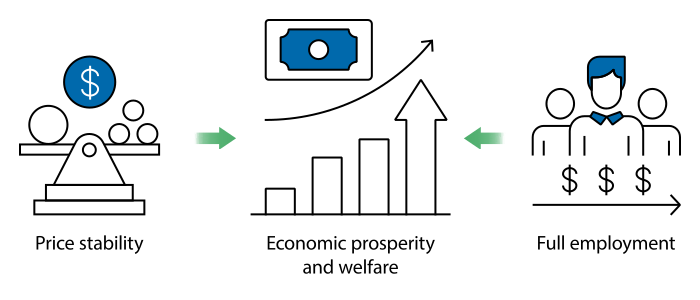
The RBA’s overall goal is to ‘promote the economic prosperity and welfare of the Australian people, both now and into the future’. The Monetary Policy Board (MPB), chaired by the Governor of the RBA, is responsible for making the decisions about monetary policy for Australia to achieve this goal. For the MPB, this means setting monetary policy to achieve both price stability and full employment. These two goals are often referred to as our ‘dual mandate’ and are longstanding objectives of the RBA.
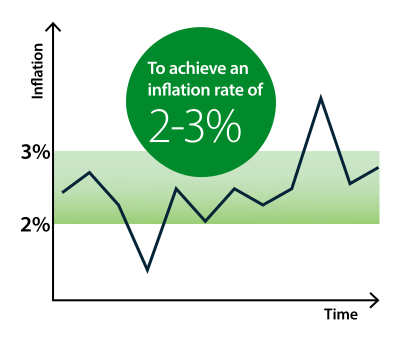
- To achieve price stability, the MPB aims to set monetary policy to keep consumer price inflation between 2 and 3 per cent. Consumer price inflation is a measure of how fast the prices of household goods and services are rising.
- To achieve full employment, the MPB aims to set monetary policy to have as many people in jobs as possible, while at the same time keeping inflation low and stable.
Price Stability
Inflation measures how fast prices are rising. The RBA’s inflation target is an annual rate of consumer price inflation of between 2 and 3 per cent, which is measured using the Consumer Price Index (CPI). Inflation can be influenced by many factors, including changes in supply and demand in the economy, as well as what households and businesses expect inflation to be in the future.
How does the RBA achieve price stability?
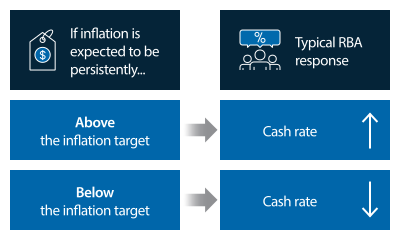
To ensure price stability, the RBA uses a flexible inflation targeting framework. If inflation is expected to be higher than the target range for a prolonged period, this may be a sign that the economy is overheating, and the RBA will typically ‘tighten’ monetary policy by increasing the cash rate. If inflation is expected to be lower than the target for a prolonged period, this may be a sign that the economy is growing too slowly, and the RBA will typically ‘loosen’ or ‘ease’ monetary policy by decreasing the cash rate.
When deciding if monetary policy should respond to inflation, the MPB considers the forecast for inflation. Since monetary policy takes some time to work, the RBA forecasts what inflation is likely to be over the next two years. These forecasts consider both temporary and persistent changes in inflation. For example, temporary changes in inflation may be caused by events like supply disruptions, while persistent changes in inflation arise from things like a sustained imbalance between demand and supply, such as business difficulties finding workers. The Board aims to ‘look through’ temporary changes in inflation when setting monetary policy. This means not every deviation of inflation from the target will warrant a policy response, which is one of the benefits of flexible inflation targeting.
The MPB considers data on current inflationary pressures and other economic variables that affect forecasts of inflation. The Board also considers inflation expectations. If households expect higher inflation in the future, they may bring forward demand to beat future price rises, which can cause inflation to rise even more quickly. A clear inflation target helps keep these expectations stable, in turn making it easier for the RBA to keep actual inflation low and steady.
For more information on price stability, see Explainer: Australia’s Inflation Target.
Full Employment
What is full employment?
Full employment refers to a situation where as many people are in jobs as possible, while at the same time keeping inflation low and stable. It does not mean the unemployment rate is zero, as some unemployment is normal in a healthy economy. But it should mean that most people who are willing and able to work can find a suitable job without having to search for too long.
In the context of the dual mandate, full employment is the point at which labour demand and labour supply are in balance, and inflation remains low and stable. Full employment is much harder to measure than inflation, and it can change over time. The RBA uses a range of indicators to assess labour market conditions including measures of unemployment and underemployment, measures of wage and price growth and measures of how easy it is to find a job. These labour market conditions help the RBA assess the health of the economy. If labour demand is judged to be strong relative to labour supply (the labour market is ‘tight’), this may be a sign that the economy is overheating. If labour demand is judged to be weak relative to labour supply, this suggest that the economy is growing too slowly.
How does the RBA achieve full employment?
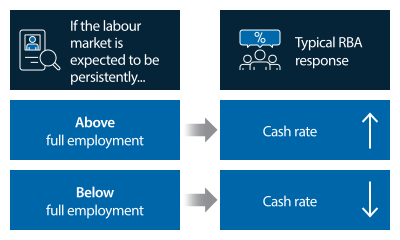
If the labour market is judged to be above the full employment level that is consistent with low and stable inflation, the MPB may need to ‘tighten’ monetary policy by increasing the cash rate. If the labour market is judged to be below the employment level that is consistent with low and stable inflation, the MPB may need to ‘loosen’ or ‘ease’ monetary policy by decreasing the cash rate.
For more information on full employment, see Explainer: Full Employment.
How are Price Stability and Full Employment related?
Over the longer term, price stability and full employment usually go hand-in-hand. Low and stable inflation is needed for strong and sustainable employment in the economy because it creates the right conditions for businesses to plan, invest and create jobs without having to worry about inflation.
Even in the short term, the objectives often align. For example, when there is an increase in demand, employment typically rises and so does inflation. In this situation, an increase in the cash rate that returns inflation to target will, in time, also move the labour market towards full employment.
However, it is not always the case that the price stability and full employment objectives can be met at the same time. For example, a ‘negative supply shock’, such as a sharp increase in energy prices or a natural disaster that disrupts supply chains, can push inflation higher while also bringing down economic activity and employment.
In these situations, how does monetary policy balance these two goals? It depends, but inflation expectations are a key consideration. If the supply shock causes households’ and businesses’ expectations for future inflation to rise, the MPB may need to respond by increasing the cash rate in order to bring those expectations back down. This is because inflation expectations can influence household spending decisions and businesses’ wage- and price-setting decisions, which could increase inflation even further and make it more difficult to bring inflation back to target. In contrast, if inflation expectations remain steady, the MPB may be more likely to ‘look through’ the supply shock and wait for inflation to fall when the supply shock resolves.
A strong track record of low and stable inflation puts monetary policy in the best possible position to support employment. When households and businesses trust that inflation will return to target, they are less likely to build higher inflation into their wage and price decisions. This allows inflation to be brought down by smaller increases in interest rates and in turn, keeps the labour market closer to full employment.