
Full Employment
- Download the complete Explainer 388KB
- Download the Worksheets
Full employment is one of the RBA’s two key objectives. It means that the RBA wants to ensure that, subject to having low and stable inflation, the maximum number of people are in jobs. It’s not zero unemployment – some unemployment is normal in a healthy economy.
What is full employment?
Full employment refers to a situation where there are as many people in jobs as possible, while at the same time keeping inflation low and stable. It does not mean the unemployment rate is zero, as some unemployment is normal in a healthy economy. But it should mean that most people who are willing and able to work can find a suitable job without having to search for too long.
Refresher
There are three main types of unemployment (see Explainer: Unemployment: Its Measurement and Types).

Cyclical unemployment happens when unemployment changes with the ups and downs of the business cycle.

Structural unemployment happens when the jobs available don’t match the skills or location of people looking for work.

Frictional unemployment happens when people are out of work because they are changing jobs or starting to look for work after not looking (i.e. being out of the labour force).
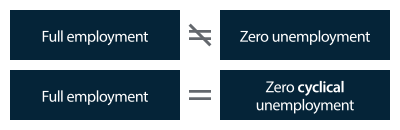
Full employment means there is no cyclical unemployment in the economy. But there will still be some amount of structural and frictional unemployment.
People may be unemployed because their skills don’t match the jobs available, or the available jobs are not located close to where they live (structural unemployment) or because they are changing jobs (frictional unemployment). Monetary policy aims to keep cyclical unemployment as low as possible (without causing inflation to rise above the target range), but structural and frictional unemployment are best addressed by government policies that focus on skills and the supply of labour.
Why is full employment important?
When people can’t find work, or enough hours, it can hurt them financially. But work is about more than just money – it gives people purpose, supports their wellbeing, and more broadly contributes to the economic welfare of Australians. Having more people in jobs also benefits society, it brings new ideas and helps build a more inclusive community.
When the labour market isn’t close to full employment, the effects are often felt most by young people, those on lower incomes, and people with less wealth. These effects can last a long time. For example, someone who is unemployed for a long time might earn less than they did in their previous job even after they find new work, or they might stop looking for work altogether.
How do we measure full employment?
Full employment cannot be directly observed or summarised by a single statistic. It also changes over time as the economy evolves. Therefore, the RBA use a range of indicators to assess how close the labour market is to full employment.
The NAIRU
One way to assess how close the labour market is to full employment is by comparing the unemployment rate (the share of people who want a job but currently don’t have one) to the NAIRU (Non-Accelerating Inflation Rate of Unemployment). The NAIRU represents the lowest unemployment rate that can be sustained without causing inflation to rise. For more information on the NAIRU, see Explainer: The Non-Accelerating Inflation Rate of Unemployment (NAIRU).
While the NAIRU is a helpful guide, it can only be estimated – not directly measured – and is subject to change over time. This is one of the reasons why a broad set of labour market indicators are used to assess how close the labour market is to full employment.
Other labour market indicators
The underemployment rate measures the share of people who have a job but want to work more hours. In other words, they have work, but their skills and time are not being fully used. When the underemployment rate is low (high), this could indicate that labour demand is strong (weak) relative to labour supply.
Other indicators also help to build a picture of the labour market. Some show how strong the demand for workers is – like job advertisements, job vacancies and businesses’ hiring intentions. Others provide insights on the strength of labour supply – such as population growth and participation rates.
Each indicator shows only part of the picture. Looking at a range of indicators helps the Monetary Policy Board (MPB) understand how close the labour market is to full employment.
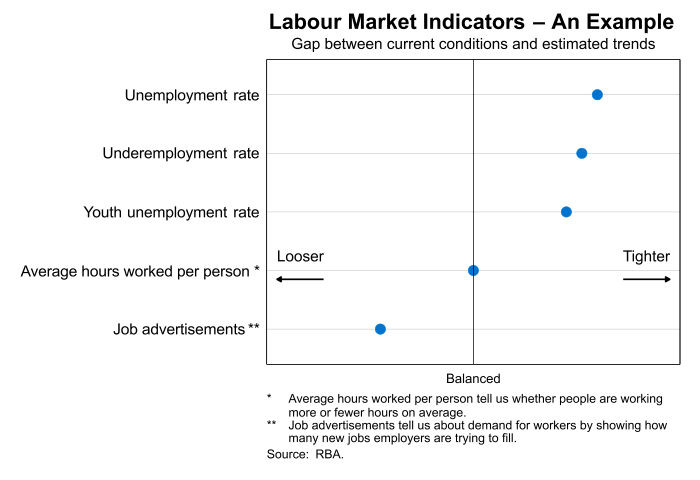
In this graph, each indicator tells us a little bit about the balance of the labour market. If a blue dot is to the right of the vertical ‘balanced’ line, the indicator is suggesting that the labour market is tight. A tight labour market means labour demand is strong compared to labour supply (i.e. the labour market is above full employment). If a blue dot is to the left of the ‘balanced’ line, it suggests the labour market is loose. A loose labour market means labour demand is weak compared to labour supply (i.e. the labour market is below full employment).
Each indicator is one piece of the puzzle. In this hypothetical example:
- The unemployment, underemployment, and youth unemployment rate suggest the labour market is tight.
- Average hours worked per person suggests the labour market is balanced.
- Job advertisements suggest the labour market is loose.
Taken together, an economist might judge this hypothetical labour market to be a little tight, even though all of the indicators are not pointing in the same direction.
How does the RBA support full employment?
The RBA has a dual mandate: to keep prices low and stable and support full employment (see Explainer: The Dual Mandate of Monetary Policy). These two goals are closely connected and can be influenced by monetary policy, which involves changing the cash rate. The cash rate affects the economy in many ways, but one important way is by influencing the demand for goods and services, and in turn, business’ demand for workers.
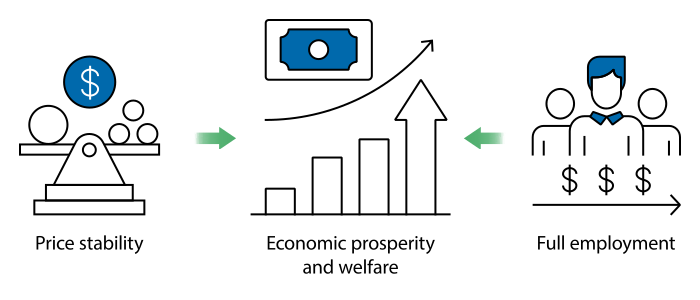
How monetary policy helps to achieve full employment
When the MPB changes the cash rate, the effects flow through the economy over time. This helps the RBA achieve the inflation and employment objectives under its dual mandate.
Scenario: Labour market indicators suggest the labour market is below full employment.
Labour market is expected to be persistently below full employment.
The number of workers that businesses want to employ (labour demand) is less than the number of people who want a job (labour supply).

Lower interest rates
Depending on what else is going on in the economy, the RBA could lower the cash rate.

Demand for goods and services rises
Lower interest rates typically encourage households and businesses to spend more, which boosts consumption, investment and aggregate demand1.

Demand for workers rises
Businesses may want to hire more workers to meet this extra demand for their goods and services.
Labour market returns to full employment
Labour demand increases relative to labour supply and the labour market moves towards balance.
In this example, the labour market returns to balance through changes in the
number of people in jobs. In practice, adjustments can also occur through
changes in the number of hours people work.
The process described above
works the opposite way when the labour market is too tight (above full employment).
Endnote
1 For more details, see The Transmission of Monetary Policy.