
Statement on Monetary Policy – May 20263. Outlook
Summary
- Prior to the onset of the Middle East conflict, domestic capacity and inflationary pressures were elevated. The conflict has caused significant disruption to global trade and production for energy commodities and some other inputs into global supply chains. Elevated prices for these commodities are expected to drive inflation in Australia even higher over the year ahead. The conflict is expected to weigh on growth in economic activity in Australia. Given the current uncertainty around the likely size of the shock, we present both the baseline forecast and a more adverse outcome in which the conflict and related damage to energy production is longer lasting.
- Our baseline forecasts are conditioned on (a) an assumption that a resolution of the conflict allows oil prices to recede somewhat gradually over coming quarters and (b) an increase in interest rates of 60 basis points. We use market pricing to construct the technical assumption for oil prices in the forecasts; current pricing indicates that most market participants anticipate the supply disruptions related to the conflict will be largely resolved before the end of 2026, although oil prices are assumed to remain well above pre-conflict levels at the end of the forecast period. The cash rate assumed in the forecasts – also based on market pricing – increases to 4.70 per cent by the end of 2026.
- In the baseline forecast for Australia’s major trading partners, inflation has been revised higher while the direction and extent of revisions to GDP growth in each region varies. Overall, the disruptions to global energy supply from the conflict are expected to weigh on global activity in the year ahead and largely offset the boost from AI-related investment.
- The baseline forecast is for Australian GDP growth to be a little lower than previously expected. GDP growth is expected to remain below estimates of potential growth over the forecast period. The main effect on GDP growth from the conflict and higher energy prices is expected to be a slowing in household consumption growth in the near term, offset to some extent by lower imports growth. As the effect on activity from higher energy prices wanes, the assumed higher interest rates over the forecast period are expected to weigh on interest-sensitive components of private demand such as consumption and housing activity.
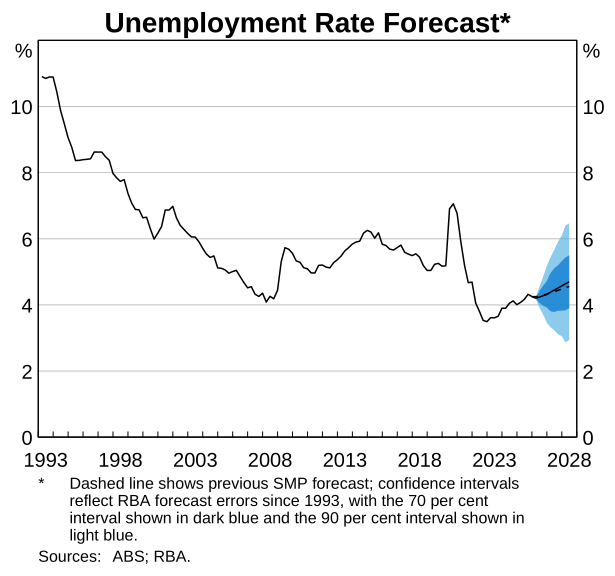
- Labour market conditions are expected to ease by a little more than expected in the February Statement on Monetary Policy. The anticipated weaker growth in economic activity weighs on labour demand, and the unemployment rate is forecast to increase to 4.7 per cent by mid-2028. This is expected to leave the labour market operating with a little spare capacity towards the end of the forecast period.
- Domestic inflation was already elevated prior to the conflict. The recent increases in fuel and raw material costs are expected to push inflation higher over the next year or so. In the baseline forecast, headline inflation is expected to peak at 4.8 per cent in the June quarter 2026. Underlying (trimmed mean) inflation is expected to remain above 3 per cent until mid-2027, as fuel-related cost increases are passed through to consumer prices; we judge that this pass-through occurs a little faster than usual given existing capacity pressures in the economy. Underlying inflation is then expected to ease towards the middle of the 2–3 per cent range as capacity pressures ease from the tighter monetary policy, and as fuel-related cost pressures abate.
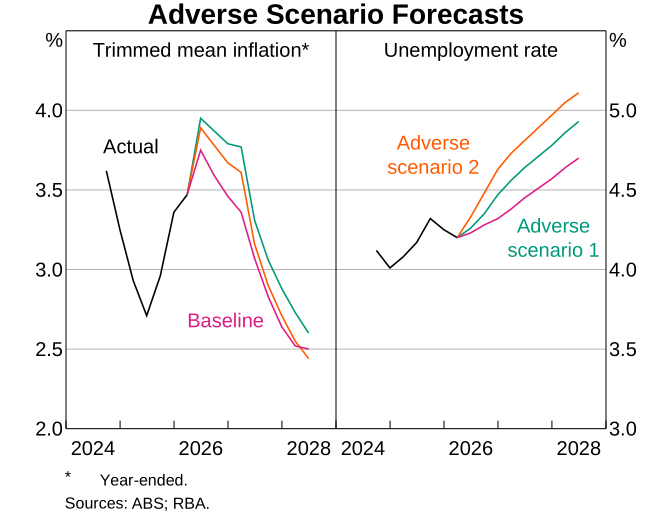
- We also present two adverse scenarios in which a longer lasting conflict in the Middle East results in a more significant disruption to global energy supply. In these scenarios, the increase in energy prices is considerably higher and longer lasting than in the baseline forecast. To aid comparison, the scenarios assume the same path for the cash rate as in the baseline forecast. In both scenarios, inflation would be much higher over the year ahead, with the extent of the increase depending on the speed of pass-through from higher fuel and related costs into consumer prices, the degree to which higher shorter-run inflation expectations feed into wage- and price-setting outcomes, and the impact of heightened uncertainty on asset prices and spending decisions in the economy. However, the two scenarios differ by the extent to which demand is affected by the conflict; a much larger pullback in spending by households and businesses in response to heightened uncertainty (alongside the assumed cash rate increases) would be expected to create more spare capacity in the economy and result in inflation returning to target sooner than otherwise.
3.1 Key conditioning assumptions across the baseline forecast and adverse scenarios
The RBA, like many other central banks, typically presents its economic outlook in the form of a central or baseline forecast. Given the heightened uncertainty around the international environment, this Statement also considers the possible implications of a more protracted disruption to global energy supply.
All the forecasts and scenarios presented in this chapter are based on current market pricing for the cash rate, which is for the cash rate to be 60 basis points higher by the end of the year. Most of the recent rise in the market-implied cash rate path occurred after the start of the Middle East conflict (see Chapter 1: Financial Conditions). Global policy rate expectations have also increased across advanced economies, alongside the higher outlook for inflation stemming from the conflict.
The baseline forecast assumes that the worst of the disruptions to global energy supply are resolved in the coming quarters, consistent with market pricing. The baseline forecast is conditioned on a technical assumption that the global prices of oil and other energy commodities evolve broadly in line with current market expectations (based on market pricing for Brent crude oil). Consistent with the current ceasefire and steps to establish negotiations, market pricing currently suggests that oil prices will soon start to decline from elevated levels, though they remain well above pre-conflict levels through 2026 and beyond (Graph 3.1). Liquefied natural gas (LNG) spot prices, which have risen sharply because of the disruption to supply from the closure of the Strait of Hormuz as well as damage to LNG production in Qatar, are also assumed to decline gradually over the forecast period. The expected path for energy prices is consistent with a relatively prompt resolution to the conflict and limited additional damage to oil and LNG infrastructure over and above that already incurred (see Table 3.1 for detailed assumptions and Key judgement #1).
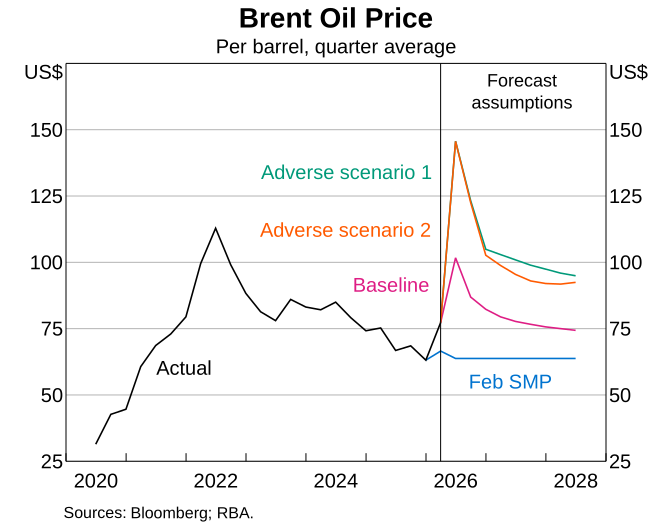
It is possible there is a much more protracted disruption to global energy supply than we have assumed in the baseline forecast. To consider how such a shock could propagate through the economy, in section 3.5 we model two adverse scenarios that both incorporate a longer closure of the Strait of Hormuz, a halt to energy production in the Middle East, and significantly more damage to energy infrastructure. This would cause oil and LNG prices to rise very sharply in the near term and unwind gradually, but remain well above energy prices in the baseline forecast. Current market pricing suggests our assumptions for energy prices in these adverse scenarios would be consistent with a range of plausible tail risk events, so it is useful to consider the extent to which this larger shock could affect growth and inflation (relative to the baseline forecast). The two adverse scenarios we consider are differentiated by the degree to which demand is affected by the energy shock.
| Baseline | Adverse Scenario 1 | Adverse Scenario 2 | |
|---|---|---|---|
| Disruption to energy supply | There is some resolution to the Middle East conflict shortly, with no further damage to energy infrastructure. The Strait of Hormuz is reopened soon and shipping flows return to pre-conflict levels in Q4 2026. |
The Middle East conflict is protracted, with further damage to energy infrastructure. The Strait of Hormuz remains closed in the near term. Shipping flows resume from Q1 2027, but normalisation takes much longer than baseline. Shipping flows do not return to pre-conflict levels by end of forecast period. |
Same as Adverse Scenario 1. |
| Commodity prices(a) | Brent oil price peaks at around US$100/bbl in Q2 2026 and gradually declines to around US$75/bbl by the end of the forecast period. LNG price is assumed to be US$12.1 MMBtu in Q3 2026 before declining to US$10.7 MMBtu at the end of the forecast period. |
Brent oil price peaks at around US$145/bbl in Q2 2026 and gradually declines to around US$95/bbl by the end of the forecast period. LNG price is assumed to reach US$30 MMBtu in Q3 2026 before declining to US$17 MMBtu at the end of the forecast period. |
Brent oil price peaks at around US$145/bbl in Q2 2026 and gradually declines to around US$90/bbl by the end of the forecast period. This is lower than in Adverse Scenario 1 due to weaker global demand. LNG price is assumed to reach US$30 MMBtu in Q3 2026 before declining to US$16 MMBtu at the end of the forecast period. |
| Domestic financial conditions | Cash rate follows current market path.(b) The trade-weighted index of the Australian dollar (TWI) remains unchanged at 66.6 |
Cash rate follows current market path.(b) The TWI appreciates relative to baseline, due to higher terms of trade. |
Cash rate follows current market path.(b) The TWI appreciates relative to baseline, but less than in Adverse Scenario 1 due to safe haven flows. Large fall in global and domestic equity prices. |
| Additional domestic assumptions | The spread between refined fuel prices and Brent oil is assumed to return to historical average levels by Q1 2027. Margins on domestic fuel prices are assumed to gradually return to historical average levels by late 2026. |
The spread between refined fuel prices and Brent oil is assumed to return to historical average levels by Q3 2027. Margins on domestic fuel prices are assumed to gradually return to historical average levels by late 2026. |
Same as Adverse Scenario 1. |
|
(a) The international standard unit of measurement for crude oil is barrels (bbl). The
unit of measurement for natural gas is millions of British thermal units (MMBtu). The
LNG price refers to the spot price of LNG in Asian markets. Source: RBA. |
|||
3.2 Key judgements in the baseline forecast
The baseline forecast incorporates many judgements, such as the choice of models used and whether to deviate from the models given the signal from recent data or qualitative information from liaison. These judgements are considered and debated throughout the forecast process. The three most important judgements for our current assessment of the economic outlook are discussed below.
Key judgement #1 – There is a near term de-escalation in the Middle East conflict, consistent with market pricing for Brent crude oil.
Underpinning our baseline forecast is the assumption that, given the current ceasefire and steps to establish negotiations, the conflict de-escalates and trade activity through the Strait of Hormuz normalises over the coming quarters. This is consistent with current market pricing for Brent crude oil and the latest Consensus forecasts. The cost of insurance against further large increases in oil prices, as measured by options-implied volatilities, has declined considerably since the onset of the conflict, suggesting that market participants increasingly view some form of resolution in the near term as the most likely path forward. However, the situation continues to be characterised by a high degree of uncertainty and we explore the implications of a more protracted conflict in section 3.5.
Key judgement #2 – The spike in fuel prices has relatively contained and short-lived effects on overall economic growth and on the labour market.
In the baseline forecast, the Middle East conflict and the large increase in energy prices is judged to have a modest negative effect on GDP growth and labour market conditions. There are a number of reasons why we judge that the effects are not more negative. First, the baseline assumes that most of the increase in fuel prices is relatively short-lived, such that households and businesses do not respond to higher fuel prices and heightened international uncertainty by materially reducing consumption or increasing layoffs, instead using other margins of adjustment (such as drawing on savings) to smooth through the temporary shock. Second, while fuel and oil remain key inputs to domestic production, GDP is now less oil-intensive than it was during previous global energy price shocks (see Chapter 4: In Depth – The Impact of Higher Global Energy Prices on the Australian Economy). Third, higher export revenue from LNG will also boost national income. And fourth, higher oil prices could raise the relative cost of imports – given that Australia’s imports are more oil intensive than domestic production – and encourage some substitution towards domestically produced goods. That said, it is possible that GDP growth could be weaker than we have judged. While the timely data on spending do not yet show a sharp slowdown, households and businesses could pull back on non-fuel spending more sharply than expected.
It is also possible that the effects on GDP from the energy shock are neutral or even positive for GDP growth. For example, if the exchange rate depreciates and there is more substitution from imports to domestically produced goods and services than expected, or if the positive impact on the economy from higher LNG export revenue is higher than we have estimated. The empirical literature on the effect of oil price shocks on economic output for net energy exporters like Australia is mixed and sensitive to the nature of the shock, with some papers finding positive effects and others negative effects (although smaller negative effects than for net energy importers). We will continue to monitor timely indicators of spending and information from liaison around this judgement.
Key judgement #3 – The rise in fuel prices flows through to underlying inflation relatively quickly given existing capacity pressures.
The temporary increase in oil and fuel prices boosts underlying inflation over the next year as these additional costs are passed through the supply chain to consumer prices. Empirical modelling suggests that the effect of a supply-driven increase in fuel prices has historically flowed through to higher underlying inflation over one to two years. In the current episode, we judge that the pass-through of cost increases occurs relatively quickly – at the faster end of these empirical estimates – given that inflation and shorter term inflation expectations are already high and that the labour market is a little tight. The recent post-pandemic experience, in which costs rose sharply, may also prompt firms to raise prices more quickly than otherwise. The baseline wages forecast also incorporates a small additional effect from higher shorter term inflation expectations, reflecting an assumption that the starting point of some tightness in the labour market allows some workers to push for higher wages growth than expected prior to the conflict.
3.3 Baseline global outlook
Consensus forecasters have started to revise GDP growth downwards across Australia’s major trading partners (MTP); however, the extent of revision varies by region and the impact on MTP growth has been limited to date.
The disruptions to global energy supply from the conflict are expected to weigh on global activity in the year ahead and largely offset the boost from AI-related investment. In terms of Australia’s trading partners, the negative effects from the conflict are expected to be most acute for middle-income Asian economies (excluding China); this reflects the region’s reliance on Middle Eastern commodities for production and the high share of energy and food in some economies’ consumption baskets. By contrast, the outlook for high-income east Asia has been upgraded, reflecting expectations for continued growth in global demand for AI-enabling products (Graph 3.2; see Chapter 2: Economic Conditions). If the conflict is not resolved shortly, Consensus forecasters are likely to make further downward revisions to their outlook for GDP growth across Asia.
Outside of Asia, the direction and extent of the revisions to Consensus forecasters for advanced economies has largely reflected each economy’s degree of exposure to affected commodities in the Middle East and whether it is a net energy importer or exporter. For example, the GDP outlook has been revised lower in the euro area and the United Kingdom but is largely unchanged in net energy exporters such as Canada and the United States. The outlook for growth in Australia’s MTPs is broadly in line with the International Monetary Fund’s projections from the April 2026 World Economic Outlook, although there are some slight differences for individual countries and regions.
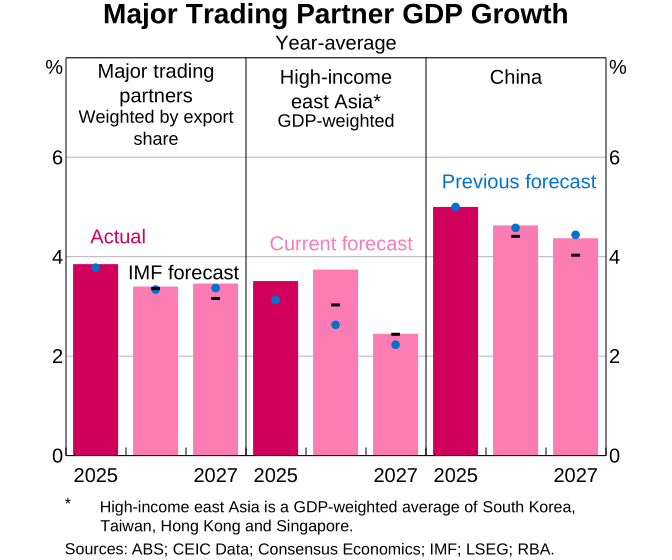
Year-average MTP GDP growth in 2027 is expected to be broadly unchanged from the February Statement. Growth across east Asia is expected to recover quite quickly once the supply of commodities from the Middle East resumes. Similarly, for most advanced economies, Consensus forecasters have not materially changed their assessment of growth in 2027, with the exception of the euro area and the United Kingdom, where the negative effects of higher energy prices are expected to linger.
In China, our forecast for GDP growth is broadly unchanged from the February Statement as we judge China will be relatively resilient to the global energy disruption. Growth in 2026 is expected to be 4.6 per cent, which is at the lower end of the 4.5–5.0 per cent growth target announced by authorities in March but in the middle of the range of external estimates. Under the baseline assumptions, we judge that any direct effects from the conflict-related disruptions on China will be relatively small and short-lived, given that the Chinese economy is less reliant on oil and gas for its domestic energy needs and has high levels of reserves of oil and refined products. While Chinese domestic demand showed some tentative signs of improvement in the March quarter, under the baseline forecast assumptions we do not expect a more material rebalancing toward domestic activity in the near term.
Exports are expected to be a key source of growth in China over the year ahead. The ongoing AI investment boom, the structural rise in China’s manufacturing capacity (particularly in higher value-added products like vehicles, ships and semiconductors), and the recent substantive decline in the US tariff rate are all expected to support continued strength in exports. These factors are judged to more than offset the modestly weaker outlook for global demand factored in under the baseline assumptions. However, a deterioriation in external demand, which may arise if the conflict and global supply disruptions persist for longer than expected, is the key risk for the outlook for China.
Consensus forecasts for headline inflation globally have been revised notably higher. Beyond the direct effects on consumer fuel prices, higher energy and transportation costs are also expected to have downstream effects on global supply chains, particularly in east Asian manufacturing industries that rely on energy imports from the Middle East. This would raise inflation for globally traded goods and as such we forecast world export prices to be higher throughout the forecast period relative to the February Statement. Given the slow pace of services disinflation in many advanced economies to date and, in select cases, relatively tight labour markets, indirect effects on core measures of inflation from the increase in energy prices are likely to be larger for economies where services inflation has been stickier or labour markets have been relatively tighter.
3.4 Baseline domestic outlook
Australian GDP growth is expected to be below potential growth over the forecast period.
GDP growth is expected to slow over 2026 in the baseline forecast (Graph 3.3). Private demand grew strongly in 2025 but the pace is expected to ease over the year ahead as the earlier support provided by several domestic and global factors begins to wane and because of the direct effects of the Middle East conflict (see below and Chapter 4: In Depth – The Impact of Higher Global Energy Prices on the Australian Economy). In addition, growth in exports is forecast to slow over 2026, as the level of iron ore exports comes back into line with typical productive capacity after being temporarily boosted by inventory rebuilding in China. The tightening in monetary policy assumed under the market path also weighs on the growth of interest-sensitive components of private demand, such as dwelling investment, household consumption, and non-mining business investment. Investment growth is expected to continue in sectors of the economy with strong structural tailwinds, such as software, data centres and renewable energy.
Public demand is expected to continue supporting growth over the forecast period. This forecast is broadly unchanged from the February Statement and based on spending projections in mid-year budget updates released in late 2025, adjusted for the long-run average difference between budget projections and actual outcomes. This is consistent with our usual approach to forecasting public demand based on information in the latest available federal and state budgets, in addition to new policies legislated in between these updates.
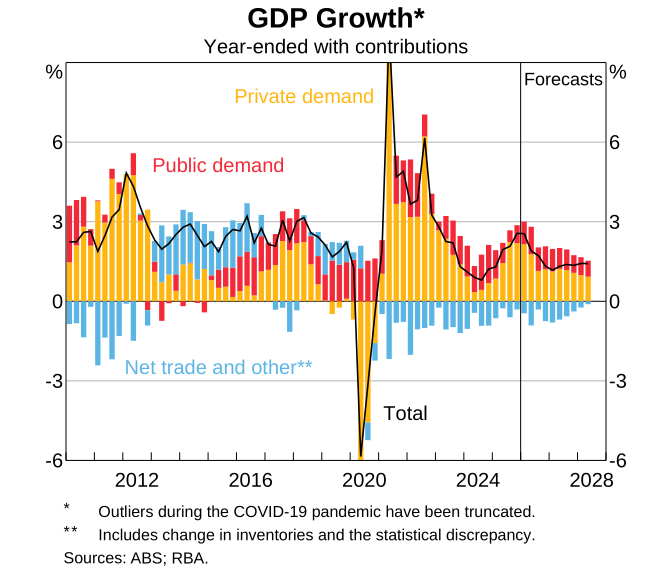
The level of GDP at the end of the forecast period is expected to be lower than in the February Statement, largely reflecting a reassessment of momentum prior to the conflict and the higher assumed path for the cash rate (reflecting market pricing). The much weaker-than-expected growth in household consumption in the December quarter National Accounts, combined with soft growth in timely household spending data in January and February, suggest there was less underlying momentum in household consumption prior to the conflict than previously assessed; some of this is expected to persist over the forecast period (see Chapter 2: Economic Conditions). In addition, there is around 50 basis points of additional tightening in monetary policy embodied in the market path than in February, reflecting market participants’ perceptions of the stance of policy required to bring inflation back to target. This is expected to weigh on growth in household consumption, dwelling investment and non-mining business investment.
The Middle East conflict is also expected to weigh directly on domestic activity, although the effects are expected to be relatively small in the baseline forecasts. The large increase in fuel prices since February is expected to lower real household incomes and consumption. However, these effects are relatively small; for example, because the shock is assumed to be short-lived and fuel accounts for only a small share of household spending (see Key judgement #2). Early indicators of consumer spending also do not necessarily suggest a sharp slowing in non-fuel spending at this stage.
That said, the response of consumption to lower real household incomes is assumed to be faster than the typical historical experience, given the sharp declines we have seen in consumer sentiment. There are no additional effects in the baseline forecast (above and beyond the negative impact of higher energy prices on real incomes) to incorporate weaker sentiment, though additional sentiment effects on spending are incorporated in the adverse scenarios where the conflict is assumed to last longer.
Some of the downgrade in consumption is expected to materialise as weaker imports, which provides some offset to the impact on GDP growth. There is also expected to be some substitution away from imported goods and services to domestic products given movements in relative prices in response to the shock, which will also provide a small boost to GDP growth (see Chapter 4: In Depth – The Impact of Higher Global Energy Prices on the Australian Economy).
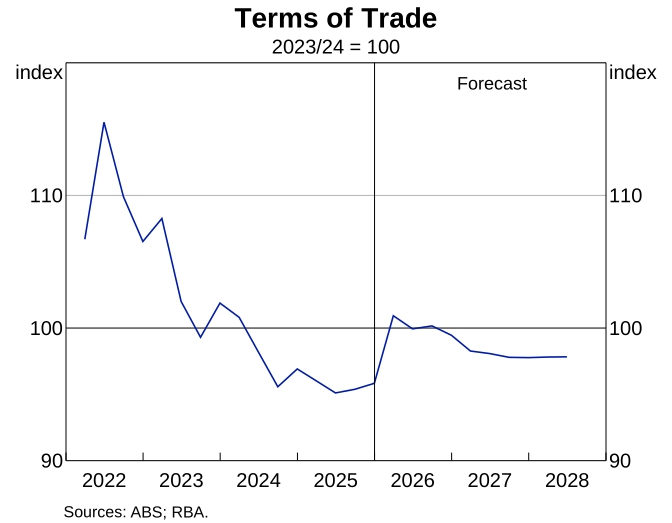
The outlook for Australia’s terms of trade has been revised a little higher in response to the Middle East conflict (Graph 3.4). The outlook for export prices has been upgraded, reflecting a stronger outlook for energy commodity prices, including LNG and thermal coal. This is partially offset by a higher forecast for import prices, largely driven by the increase in fuel prices and related higher world export prices. The boost to national income from the higher terms of trade is judged to have only a modest impact on real activity. This is because the positive shock to commodity prices from the conflict is assumed to be short-lived, with few lasting implications for mining investment and output in Australia.
The tightness in the labour market is expected to ease over the forecast period.
The unemployment rate increases to 4.7 per cent by mid-2028 in the baseline forecast (Graph 3.5). Labour market conditions had largely stabilised prior to the Middle East conflict, and were broadly in line with expectations in the February Statement. Some easing in labour market conditions is expected over 2026 as the conflict and earlier tightening in the cash rate reduce labour demand somewhat. From 2027 onwards, the unemployment rate is expected to increase a little more quickly than expected in the February Statement, given the weaker outlook for domestic activity. Given the expected rise in the unemployment rate, the baseline forecast is for the labour market to be operating with a little spare capacity towards the end of the forecast period, although this judgement is highly uncertain.
The employment-to-population ratio is expected to be higher throughout 2026 compared with the February forecasts (largely reflecting strong recent outcomes) but decreases gradually over the forecast period. Timely indicators of labour demand are mixed. Job ads and surveyed employment intentions from business surveys do not suggest a marked deterioration in labour demand in response to the conflict, though employment intentions from the RBA’s liaison program have decreased in recent weeks. We expect labour demand growth to soften a little as firms adopt a ‘wait and see’ approach to hiring decisions amid heighted uncertainty. Further out in the forecast period, employment growth is expected to remain subdued due to the weaker outlook for domestic activity.
The participation rate is forecast to be little changed over 2026. Cost-of-living pressures continue to persist in the near term, encouraging people to enter or remain in the labour force. From 2027 onwards, the participation rate is projected to ease steadily, as the weaker outlook for domestic activity makes it harder for those without a job to find employment, reducing the incentive to join or remain in the labour force.
Given the expected slowdown in GDP growth in the baseline forecast, aggregate demand is projected to fall below potential supply during the forecast period.
The GDP growth forecasts (which assume the cash rate follows the market path) suggest that capacity pressures in the economy will ease over the next couple of years and there will be some spare capacity in the economy by the end of the forecast period. The labour market is expected to remain a little tight in the near term, with capacity pressures lagging those in the broader economy, consistent with past relationships – but the labour market is projected to be operating with a little spare capacity by mid-2028.
This assessment remains highly uncertain and is conditional on assumptions. The assessment of the economy’s potential output is more uncertain than usual given the disruptions to oil supply. The assessment in the baseline forecast is that disruptions to global oil markets have little effect on potential output because the shock is temporary, and the level of capital and labour available to produce output is unaffected (see Chapter 4: In Depth – The Impact of Higher Global Energy Prices on the Australian Economy).
Wages growth in the baseline forecast is stronger in the near term, reflecting the higher outlook for inflation.
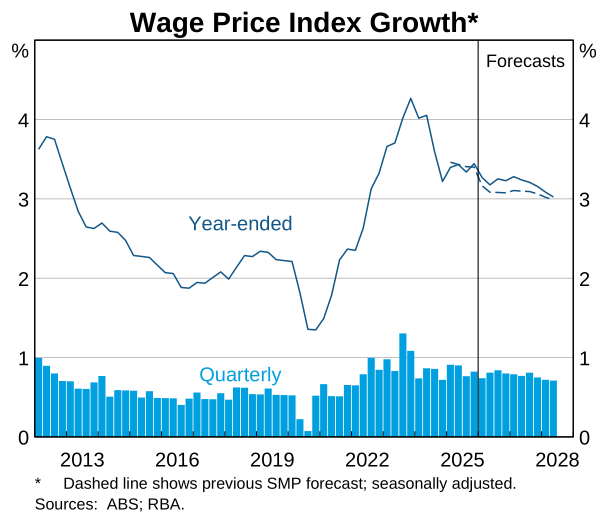
The forecast for year-ended wages growth has been revised higher. In the near term, nominal wages growth is expected to be supported by the higher inflation stemming from energy prices, as well as continued tightness in the labour market. We expect that higher short-term inflation expectations will be a consideration in wage bargaining in the near term as workers seek to preserve real wages. Consistent with this, some firms in the RBA’s liaison program have upgraded their expectations for wages growth over the year ahead. Wages growth is expected to moderate from late 2027 as labour market conditions ease. Wages growth will continue to be supported by announced administered decisions for several large awards (Graph 3.6).
Real average earnings per hour is forecast to temporarily decline in the near term, given the projected increase in inflation. Average earnings, which is a broader measure of labour earnings, are forecast to be at a lower level in real terms at the end of the forecast period relative to February, but higher than their current level.
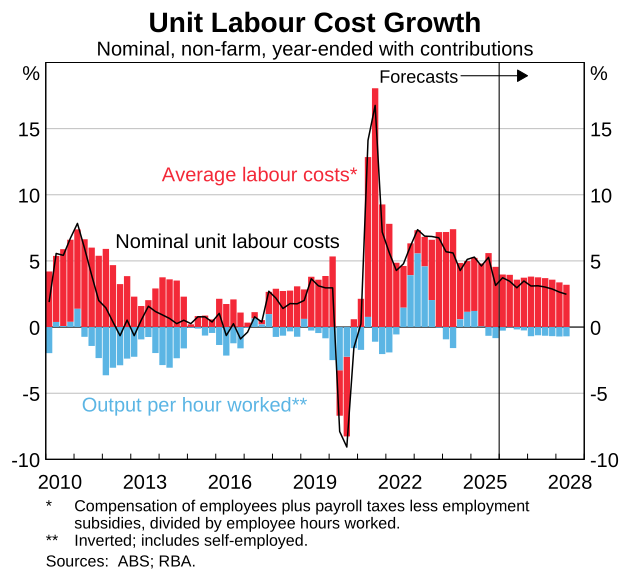
Growth in year-ended unit labour costs (ULCs) is expected to be broadly stable in coming quarters before easing towards the end of the forecast period. Growth in nominal ULCs – the measure of labour costs most relevant for firms’ cost of production and so for inflation outcomes – is likely to remain somewhat elevated in the near term. Year-ended growth in ULCs is then expected to moderate from early 2027 onwards, alongside an easing in labour market conditions and slowing nominal wages growth. Productivity growth is likely to be weak in the near term as firms adjust to slowing demand and higher fuel-related costs, before picking up in 2027 and contributing to the easing in ULCs growth (Graph 3.7).
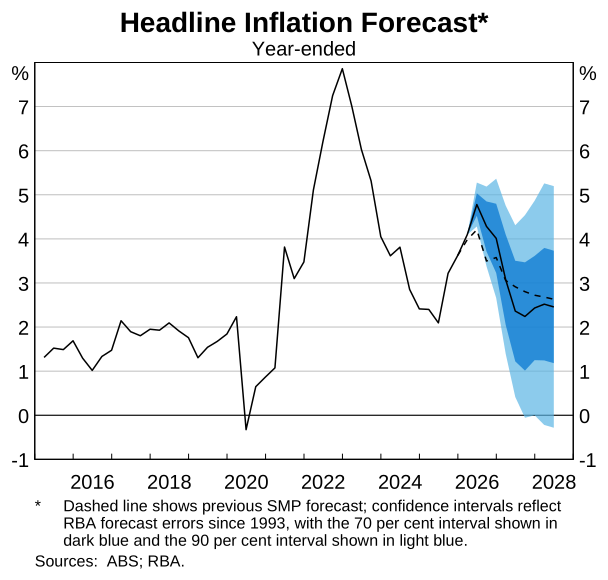
The outlook for headline inflation in the baseline forecast has been revised materially higher in the near term due to higher fuel prices.
Headline inflation is expected to peak at 4.8 per cent in the June quarter. The higher prices for crude oil and refined fuels will lead to significant price increases for motor vehicle fuel and domestic and international travel. We expect this will contribute around 0.5 percentage points to headline inflation in the June quarter 2026. The increase in fuel prices in the June quarter is projected to be reduced by the temporary reduction in fuel excise, which is scheduled to reverse on 1 July. The assumed roll-off of government electricity price rebates also contributes to higher headline inflation in the near term, although this had been factored into our forecasts for some time. The decline in fuel prices over the second half of 2026 – as assumed in the baseline forecasts – leads to downward pressure on headline inflation, particularly as the prices of motor vehicle fuel and travel decline. This downward pressure contributes to headline inflation easing to a low of 2¼ per cent in mid-late 2027. Subsequently, as these prices stabilise, the drag on headline inflation abates, causing it to pick up to 2½ per cent by mid-2028 (Graph 3.8).
The forecast for underlying inflation has been revised higher in the near term, with the spike in fuel prices putting upward pressure on consumer prices, which then eases as fuel-related costs decline and the labour market eases.
Trimmed mean inflation is now expected to remain above 3 per cent until mid-2027, before easing to 2.5 per cent by early 2028, assuming the cash rate follows the market path (Graph 3.9). The quarterly rate of underlying inflation is expected to remain high throughout the remainder of 2026. This reflects our judgement that existing capacity pressures in the labour market and parts of the economy will persist for a time, with additional upward pressure from higher fuel and fuel-related costs arising from the Middle East conflict. Relative to the February Statement, the assumed higher path for the cash rate contributes to a greater easing in capacity pressures over 2027, which is expected to support disinflation. As aggregate demand is expected to fall below potential supply by the end of the forecast period, inflation eases to the midpoint of the target range.
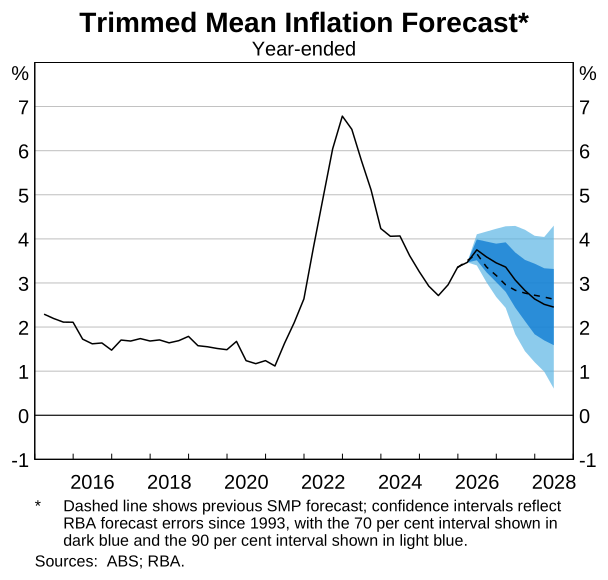
We expect that the pass-through from fuel-related cost pressures to consumer prices will be relatively fast. This reflects the fact that the shock is large (though assumed temporary in the baseline forecast) and affecting many firms, and that inflation and short-term inflation expectations are already elevated given the starting point of the economy prior to the conflict (see Chapter 2: Economic Conditions). Moreover, short-term inflation expectations have increased further since the conflict began, likely owing to the sharp increase in fuel prices. Although short-term inflation expectations are likely to stay elevated for a time or rise further, long-term inflation expectations are assumed to remain consistent with achieving the inflation target over the medium run, conditional on the market path. The effects of higher fuel-related costs on consumer prices are expected to be strongest around the middle of 2026 and contribute around 0.4 percentage points to underlying inflation in the year to the March quarter 2027. From mid-2027 onwards, the expected decline in fuel-related costs puts downward pressure on the quarterly rate of inflation. However, there is a high degree of uncertainty around the intensity and breadth of cost pressures resulting from the conflict and the degree of pass-through to final consumer prices (see Key judgement #3).
New dwelling inflation remains high, and significant price increases for fuel and construction materials are expected to place some upward pressure on inflation in the near term. Businesses in the RBA’s liaison program report significant cost increases for construction materials, particularly oil-based products like polyvinyl chloride (PVC) and high-density polyethylene (HDPE) pipes, as well as concrete, steel and bricks due to higher fuel costs. There are concerns that shortages of key inputs could disrupt project schedules and increase the risk of delays. Later in the forecast period, cost increases stemming from the conflict are expected to unwind, placing some downward pressure on new dwelling inflation.
Significant price increases for fuel and fertilisers, including urea, are also expected to place some upward pressure on groceries inflation in the near term. Agricultural contacts in the RBA’s liaison program have reported that ‘emergency surcharges’ – introduced by some transport providers to manage escalating fuel prices – are increasing fuel costs by as much as 40 per cent. Pass-through to grocery prices is expected to occur more quickly for fast-moving goods (such as fresh produce) than for slower moving items.
3.5 Adverse scenarios
We consider two adverse scenarios, with each assuming that the Middle East conflict is longer lasting, including an extended closure of the Strait of Hormuz, significant damage to infrastructure and disruption to energy production. Energy prices in both scenarios are assumed to rise very sharply in the near term and remain elevated over the forecast period (see Graph 3.1) and the assumptions outlined in section 3.1 and Table 3.1). At this stage, such an outcome for energy prices is considered somewhat of a tail risk but the situation continues to evolve.
The two adverse scenarios are differentiated by the degree to which aggregate demand is affected by a more protracted conflict. The first scenario considers the effects on the economy and inflation from the larger global energy supply shock. The second scenario considers what could also occur if there was a much larger reduction in spending by households and businesses; for example, if the heightened geopolitical uncertainty led to risk averse behaviour. We construct the scenarios using the Global Economic Model from Oxford Economics and MARTIN (the RBA’s macroeconometric model).
Adverse Scenario 1: Significantly higher energy prices drive higher and more persistent inflationary pressures and weaker economic activity.
- In this scenario, global energy prices rise even more sharply (relative to the baseline forecast), as do the prices of other commodities that are key inputs into global supply chains. This increases global inflation directly via higher prices for fuel exports and indirectly through higher production input costs. The shock adds around 3.7 percentage points to MTP-weighted year-ended headline inflation in the June quarter 2026 relative to the baseline.
- To aid comparison with the baseline forecasts, the assumed cash rate for Australia in the scenario is the same as the baseline assumption and implies a cumulative tightening of 60 basis points by mid-2028. The Australian TWI is assumed to appreciate a little relative to the baseline forecast, given that in this scenario the large assumed increase in LNG prices results in a higher terms of trade for Australia.
- The level of domestic GDP is around 0.5 per cent lower by mid-2028 than in the baseline forecast. Household consumption growth slows by more than in the baseline forecast reflecting a sharper decline in real income (as a result of the higher energy prices), while we also assume that persistently weaker consumer confidence reduces spending. Lower global demand reduces Australian export volumes. We assume that there is some offset to GDP growth as the large shift in the relative cost of imports in this scenario encourages some substitution towards domestically produced goods and services. The higher export revenue from higher LNG prices provides an increase in national income, though we assume that the resulting increase in mining investment is not material (in comparison to previous terms of trade booms). We also do not make any assumptions about any changes in fiscal policy in this scenario; any additional public demand could provide a further offset to the fall in GDP.
- The lower level of GDP means that the unemployment rate increases by more than in the baseline, leading to some additional spare capacity in the labour market. It is possible that more of the adjustment could come through a greater fall in hours worked or participation (rather than via the unemployment rate) than we have judged.
- The very large increase in energy prices adds directly to headline inflation through higher prices for retail fuel. In this scenario, headline inflation peaks at 5.2 per cent in June 2026. Trimmed mean inflation remains elevated compared with the baseline – around 0.4 percentage points higher by early 2027 – as the larger and more persistent energy price shock passes through to consumer prices (Graph 3.10). As in the baseline forecast, the effects on underlying inflation depend on the degree of any second-round effects of the shock on foreign and domestic activity, as well as any increase in inflation expectations. We assume that, given the large and longer lasting increase in fuel prices, shorter term inflation expectations move higher. This has the effect of pushing inflation higher than otherwise. As cost and capacity pressures wane because of both the supply disruptions eventually easing and tighter monetary policy, inflation in this scenario is expected to slow but remain above the midpoint of the target range by mid-2028.
- Even with higher fuel prices for longer in this scenario, past experience suggests that oil use will not change much over the forecast period, and so the economy’s productive capacity is judged to be only marginally affected. Given the fall in GDP, the net effect of this scenario is judged to make the output gap more negative by the end of the forecast period.
Adverse Scenario 2: Significantly higher energy prices are associated with a more material decline in aggregate demand.
- In the second adverse scenario, we explore the possibility that elevated uncertainty around the conflict and the associated energy supply disruptions lead to an even sharper decline in global and domestic demand than in the first adverse scenario. We begin by adopting all the assumptions of the first scenario although the oil price gradually responds to the weaker global demand and declines by a little more than in the first scenario. We incorporate a large increase in global risk premia (triggered by the more protracted conflict) which, all else equal, dampens both global and domestic demand. We also assume that the decline in consumer and business confidence is even more pronounced and protracted than in the first scenario, which leads to additional precautionary savings behaviour and a larger delay or cancellation of investment.
- To aid comparisons, the assumed cash rate path in this scenario is the same as in the baseline forecast and the first adverse scenario, implying cumulative tightening of 60 basis points by mid-2028. The decline in global risk appetite weighs on demand for the Australian dollar; as such, the Australian dollar TWI appreciates by less than in the first scenario.
- The level of domestic GDP is more than 0.8 per cent below the baseline forecast and 0.2 per cent below the first adverse scenario. This is driven primarily by weaker consumption and business investment growth following the confidence shock; weaker equity prices also flow through to lower spending via wealth channels.
- Lower economic activity reduces labour demand, and the unemployment rate rises to 5.1 per cent; the labour market moves from being tight at the start of the forecast period to having spare capacity by the end. The increase in the unemployment rate would be less pronounced if we assumed more of a decline in labour force participation given the weaker labour market conditions.
- Trimmed mean inflation peaks at 3.9 per cent in June quarter of 2026. Importantly, the disinflation from the peak is faster in this second scenario (relative to both the baseline and the first scenario) as the additional demand shock leads to weaker GDP growth, a higher unemployment rate and more spare capacity in the economy. Under the current market pricing for the cash rate, inflation is would be below the midpoint of the target range by mid-2028.
The adverse scenarios and baseline forecasts assume that Australia continues to receive enough imported fuel products to meet domestic demand
Australia could face physical supply shortages of oil products. Standard economic frameworks suggest that if shortages affect businesses, they are likely to result in lower output and labour demand, as well as higher prices. If firms cannot get oil products (or other related inputs), there may be a hard cap on their production and so their output will have to decline. Demand will outstrip the new lower productive capacity of the economy, and so prices will rise. Even if firms can replace oil products with other inputs, like labour, doing so is likely to be expensive and inefficient, and so costs and prices are likely to rise and output is likely to fall. Labour demand is likely to fall as activity declines, though this may be offset somewhat if firms do try to substitute towards labour (e.g. using people to replace some machines).
The size of the effects of any fuel shortages on the economy are uncertain and depend on a range of factors. The size, duration and nature of any shortages will matter for the effect on domestic economic conditions, as will the ability of firms to substitute between oil and other inputs in their production processes. The policy response will play an important role too. In addition to directly addressing fuel supply and allocations, governments may consider policies to support households and businesses.
3.6 Detailed baseline forecast information
Table 3.2 provides additional detail on baseline forecasts of key macroeconomic. The forecast table from current and previous Statements can be viewed, and data from these tables downloaded, via the Statement on Monetary Policy – Forecast Archive.
| Dec 2025 | Jun 2026 | Dec 2026 | Jun 2027 | Dec 2027 | Jun 2028 | |
|---|---|---|---|---|---|---|
| Activity | ||||||
| Gross domestic product | 2.6 | 1.9 | 1.3 | 1.3 | 1.4 | 1.4 |
| Household consumption | 2.4 | 1.9 | 1.9 | 1.7 | 1.7 | 1.6 |
| Dwelling investment | 5.5 | 3.8 | 2.0 | 1.0 | −0.3 | −1.1 |
| Business investment | 4.4 | 3.9 | 0.8 | 2.2 | 1.8 | 1.3 |
| Public demand | 2.4 | 3.7 | 3.1 | 2.8 | 2.3 | 2.1 |
| Gross national expenditure | 3.0 | 2.7 | 2.0 | 2.0 | 1.7 | 1.5 |
| Major trading partner (export-weighted) GDP | 3.9 | 3.4 | 3.3 | 3.6 | 3.3 | 3.2 |
| Trade | ||||||
| Imports | 6.7 | 3.8 | 1.9 | 3.8 | 2.9 | 2.3 |
| Exports | 5.2 | 1.3 | −0.9 | 1.0 | 1.3 | 1.8 |
| Terms of trade | −1.1 | 5.1 | 3.8 | −1.9 | −1.7 | −0.3 |
| Labour market | ||||||
| Employment | 1.1 | 1.3 | 1.4 | 1.0 | 1.0 | 0.9 |
| Unemployment rate (quarterly, %) | 4.3 | 4.2 | 4.3 | 4.4 | 4.6 | 4.7 |
| Hours-based underutilisation rate (quarterly, %) | 5.4 | 5.4 | 5.5 | 5.7 | 5.8 | 6.0 |
| Income | ||||||
| Wage Price Index | 3.4 | 3.2 | 3.2 | 3.2 | 3.2 | 3.0 |
| Nominal average earnings per hour (non-farm) | 4.1 | 3.4 | 3.7 | 3.8 | 3.6 | 3.2 |
| Real household disposable income | 3.7 | 1.8 | 1.1 | 1.8 | 1.4 | 1.2 |
| Inflation | ||||||
| Consumer Price Index | 3.6 | 4.8 | 4.0 | 2.4 | 2.4 | 2.5 |
| Trimmed mean inflation | 3.4 | 3.8 | 3.5 | 3.1 | 2.6 | 2.5 |
| Assumptions | ||||||
| Cash rate (%)(c) | 3.6 | 4.2 | 4.7 | 4.6 | 4.7 | 4.7 |
| Trade-weighted index (index)(d) | 61.3 | 66.4 | 66.6 | 66.6 | 66.6 | 66.6 |
| Brent crude oil price (US$/bbl)(e) | 63.1 | 101.7 | 82.3 | 77.7 | 75.7 | 74.4 |
| Estimated resident population(f) | 1.5 | 1.3 | 1.2 | 1.2 | 1.2 | 1.2 |
| Memo items | ||||||
| Labour productivity(g) | 0.8 | 0.0 | 0.2 | 0.6 | 0.7 | 0.7 |
| Household savings rate (%)(h) | 6.9 | 5.8 | 5.8 | 5.7 | 5.5 | 5.4 |
| Real Wage Price Index(i) | −0.2 | −1.5 | −0.6 | 0.9 | 0.7 | 0.6 |
| Real average earnings per hour (non-farm)(i) | 0.4 | −1.2 | −0.1 | 1.4 | 1.1 | 0.7 |
|
(a) Forecasts finalised on 29 April. Sources: ABS; Bloomberg; CEIC Data; Consensus Economics; LSEG; RBA. |
||||||