
Statement on Monetary Policy – May 2026 Box A: Insights From Liaison
This Box highlights key messages collected by the RBA’s liaison teams in Adelaide, Brisbane, Melbourne, Perth and Sydney during discussions with around 270 businesses, industry bodies, government agencies and community organisations from early-February to late-April 2026.
Prior to the start of the Middle East conflict, the themes and sentiment raised in liaison discussions had been little changed over preceding months. Demand conditions remained positive, albeit a little more moderate than last year, and investment intentions were quite strong. Firms were generally not expecting large changes in their headcount or in the pace of prices and wages growth over the year ahead.
However, a dominant issue since mid-March has been the effects of the Middle East conflict and disruptions to oil markets. Immediate impacts reported by firms have related mostly to non-labour input costs, as prices have risen for fuel and oil-derived inputs. Cost increases have been reported as transmitting quickly through many supply chains, and some of this is beginning to flow through to selling prices, although firms note there is considerable uncertainty regarding their pricing decisions. Expectations for forward demand have slowed further, as have employment expectations. That said, the impact of current events on firms varies widely, and a range of businesses continue to report positive demand conditions and above-average investment plans to support longer run growth and to manage business costs.
Global oil market disruptions have quickly affected input costs for many businesses.
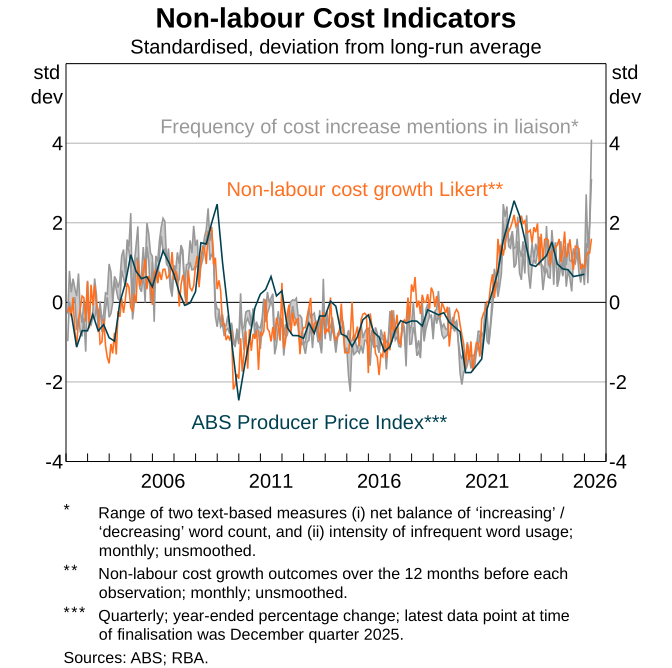
Firms are widely reporting marked increases in input costs over March and April. The frequency with which cost increases are being mentioned in liaison discussions is higher than at any time in recent decades (Graph A.1). The primary driver of these reports has been higher prices for fuel and transport services, which have rapidly passed through supply chains. As these prices spiked higher, firms with existing contractual fuel surcharge rights quickly adjusted customer pricing, and surcharge arrangements were also quickly adopted more broadly by suppliers and contractors. Fuel costs are also being cited by many suppliers as the basis for general increases in their own prices.
In addition to fuel, contacts across the manufacturing, construction and primary production industries have reported large cost increases for various petrochemical-derivative products such as fertiliser, bitumen, resins, PVC and other plastics.
While there had been some fuel shortages in the first few weeks of the conflict – particularly in regional areas – these were mainly driven by a sharp and largely temporary increase in demand, and availability concerns have eased as demand has stabilised. Some agricultural producers have reported actual or contemplated delays, reductions or switches in crop plantings in response to higher costs and uncertain availability for farm inputs such as fuel, fertiliser and packaging. Some manufacturers reliant on petrochemical-derivative inputs have also expressed concerns around availability over the period ahead. Builders are generally not reporting issues around availability of materials, though some have noted concerns around potential disruptions should shortages eventuate. Wholesalers and retailers are not otherwise reporting issues around availability and distribution of imports or domestically produced goods.
Downstream price pressures have been building across supply chains.
Firms have reported that higher costs for fuel and some other inputs started being passed through supply chains as soon as global markets were affected in March. While liaison contacts generally expect indexed fuel surcharges and materials costs to move in line with raw materials prices over time, some contacts expect some other supplier prices might remain higher even if global disruptions are resolved soon. To date many contacts have not increased consumer-facing prices, although firms widely report that they are actively considering what price changes they might make if input cost increases persist or broaden.
Liaison discussions indicate downstream cost impacts have been particularly evident in the construction and property development industries, given transport and oil-derived raw materials are a relatively large share of input costs. Many construction firms therefore are implementing and/or actively considering increases to prices. In existing civil and commercial projects this is typically via fuel surcharging or ‘rise-and-fall’ contract provisions. Firms also note that new projects are being costed on the basis of higher prices. Residential builders which have sold fixed price contracts are pushing back on supplier cost increases where they can. Pricing for new contracts is being reviewed, although reported actual increases have been fairly modest to date. In regions where demand conditions have been solid for a sustained period of time – such as South East Queensland, South Australia and Western Australia – firms are noting that higher prices are being implemented fairly quickly. Where conditions have been more subdued, firms have reported being somewhat wary about the potential effect of higher prices on demand, but some upward movement is still likely.
Energy market contacts do not expect higher international energy prices to have material effects on domestic electricity and gas prices. A risk to this outlook would be if the conflict were to be prolonged and result in domestic shortages of fuel necessary for generator operations. In the retail electricity market, draft price determinations suggest retail prices will generally be lower for the year ahead. In the east coast gas market, contacts report the market is currently well supplied, against a backdrop of gradually softening demand.
For other businesses, the outlook for selling prices is more mixed. Prior to the conflict, liaison contacts had generally expected selling price inflation to ease a little over the year ahead, but that is now less clear.
Macquarie University’s March 2026 Business Outlook Scenarios Survey (BOSS) included a special module, designed in collaboration with the RBA, to explore the effects of current events (most respondents are small- and medium-sized businesses).1 Survey respondents reported that average input cost increases of around 10–15 per cent are expected over the coming 12 months, of which a large share had already occurred. Respondents also reported that they expected only partial (around 30 per cent) pass-through of higher costs to selling prices. Many firms noted competitive pressure as a key constraint to fully passing on upstream cost increases, but this would be less so if price increases became more generalised across other firms and industries.
Discussions with liaison contacts over recent weeks have been consistent with these survey results. Where costs have increased markedly (such as fuel), these have been passed through quickly to commercial customers. But while the magnitude of some individual input cost increases is large, in many (though not all) cases these are a relatively small share of firms’ total cost base. To date, only a few firms have reported actual increases in their consumer prices, although many contacts note that increases are under active consideration.
Contacts have been reporting positive demand conditions to date, but the outlook for activity has slowed over recent months.
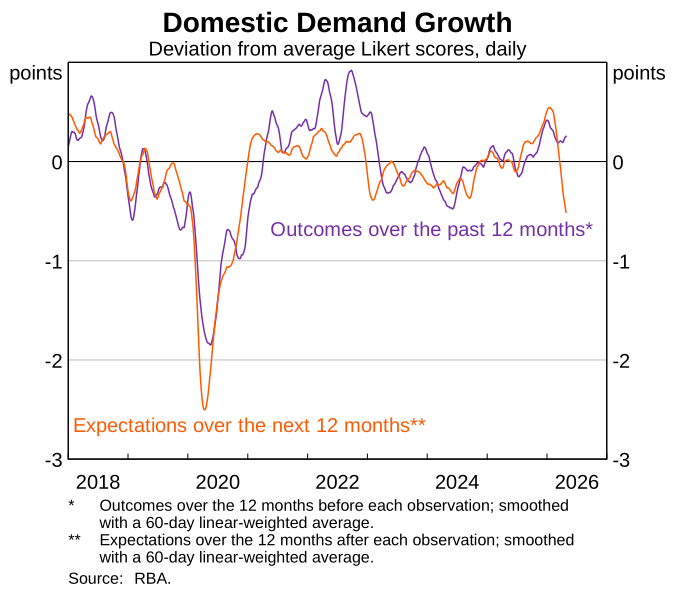
Contacts in general had been reporting that positive demand conditions had been sustained into the first few months of the year (Graph A.2). However, even prior to the Middle East conflict, firms had been downgrading their outlook for demand given signs of moderating consumer spending and an increase in interest rate expectations. Expectations for forward demand have since slowed further.
Over the first few months of 2026, retailers were generally reporting solid sales, although possibly a bit softer than seen over the peak promotional periods in late 2025. One factor cited as maybe weighing on spending has been households responding to higher expected interest rates since the start of the year. A consistent theme across retailers for the past year has been that generating sales growth requires more effort than a few years ago, but demand is generally evident when consumers perceive value. In response, some retailers have been adjusting their product mix to attract more value-conscious shoppers.
As recent events unfolded, some food retailing businesses reported seeing some limited precautionary purchasing by consumers, but this has since stabilised. Retailers otherwise are not reporting significant shifts in sales volumes, although some are observing a switch to lower priced goods as households look to manage budget pressures from higher transport costs. Some businesses that are more exposed to discretionary spending – such as in hospitality and tourism – have seen evidence of a pullback in spending over recent weeks. Airlines are also reducing some capacity in light of higher fuel costs. Consistent with the impact of higher transport costs, community services organisations are reporting some pick-up in enquiries and demand from more vulnerable households.
Prior to the conflict, builders and developers were seeing solid home building demand over early 2026, although the pace appears to have moderated compared with 2025, which some contacts attributed to higher interest rates. Some residential industry contacts are reporting further slowing in sales enquiries and deposits in some markets in recent weeks, which they attribute to economic uncertainty and the effect of higher fuel prices on household budgets. Selling conditions have been more resilient in more supply-constrained markets. Given earlier strength in sales, the volume of work under construction remains elevated for many homebuilders. Cancellation rates remain low; however, if they were to increase sharply over the next few months, the pipeline of work could fall significantly from current levels.
Investment spending and intentions had remained solid through the first few months of the year. Prior to recent events, businesses in aggregate had expected investment spending to ease from its recent strength as some larger projects near completion, but still remain above average. More recently, the outlook for higher construction costs has been noted by some contacts as likely to see some private and public sector clients review forward spending plans. Some mining industry contacts have noted deferred investment expenditure due to global economic uncertainty. In other cases, though, contacts are planning for above-average spending to support business growth. Construction and fit-out of data centres has remained strong, and businesses more generally continue to explore ways to reduce operating costs through investment in enterprise systems and other IT programs.
Lifting productivity continues to be a key motivation for firms exploring artificial intelligence (AI) tools, although adoption varies widely and many are still in early stages of experimentation.2 A growing number of firms report plans to leverage AI to use staff resources more effectively, noting that the likelihood and timing of any future employment changes remain uncertain. Few firms have reported making actual adjustments to their headcount to date.
Firms have been reporting that the labour market remains a bit tight but hiring intentions have recently moved lower.
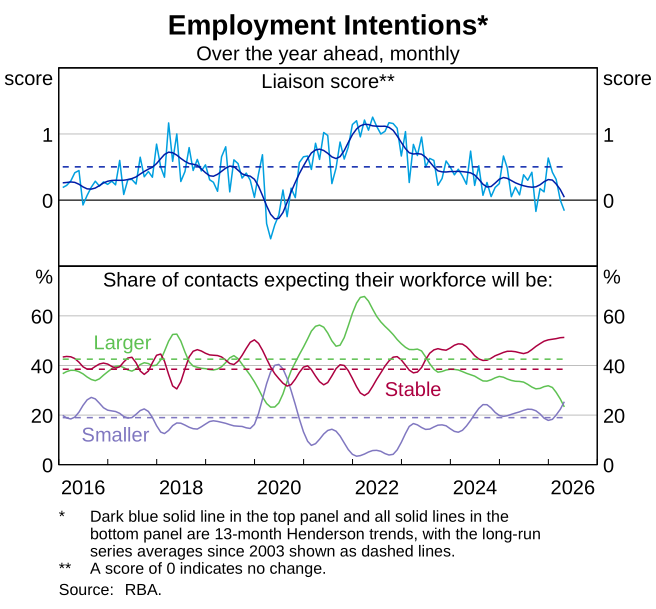
Headcount growth picked up a little at the beginning of 2026, with hiring underpinned by investment and project work as well as continued growth in sales and demand. Liaison measures of hiring intentions for the year ahead have moved lower since the start of the year. The share of firms now reporting plans to keep headcount stable in the year ahead is well above its long-run average, and the share of firms expecting lower headcount has lifted (Graph A.3). Labour availability is still reported as being a bit tight overall, though with some variation across regions.
Consistent with a fairly tight labour market, a number of universities have flagged an ongoing shift in domestic student enrolments towards part-time study as students engage in more paid employment. International student enrolments remain generally positive but are expected to soften in the year ahead. Factors cited for this softening include increased competition from other countries, high fees and charges, and tighter student visa policy settings. A range of contacts in industries such as retail and hospitality have noted that restrictions on international students have affected labour availability.
Firms’ messages on current labour costs have been little changed recently, and wages growth had been gradually moderating over the past year. However, a growing share of firms are expecting wages growth to pick up over the year ahead. Reasons cited for this include the pick-up in headline inflation over recent quarters flowing through to wage demands, as well as recently elevated fuel prices and the risk of a further increase in inflation.
Endnotes
1 For more information, see Macquarie University (2026), ‘Business Outlook Scenarios Survey (BOSS)’.
2 For a recent discussion of Australian firms’ current and planned adoption of AI, see Fernando J, K McLoughlin and R Ratnayake (2025), ‘Technology Investment and AI: What Are Firms Telling Us?’, RBA Bulletin, November.