
Statement on Monetary Policy – February 20263. Outlook
Summary
- Recent outcomes for economic activity, the labour market and inflation have been stronger than expected and market expectations for the cash rate – a key technical assumption to the forecasts – have shifted higher in response. Based on financial market pricing, the forecasts assume the cash rate will increase by around 60 basis points by the end of the forecast period; by contrast, the November forecasts assumed the cash rate would decline by a further 30 basis points. The increase in market expectations for the cash rate has contributed to the 5 per cent appreciation of the exchange rate since the November Statement (see Chapter 1: Financial Conditions).
- The economy is judged to be further from balance than we assessed last year, particularly in the near term. The path for monetary policy assumed in the forecasts – with cash rate rises this year – is expected to restore balance between aggregate demand and potential supply. The assumed higher cash rate path contributes to a slowing in GDP growth to below its potential growth rate from late 2026 and a modest rise in the unemployment rate. Aggregate demand and potential supply are expected to have returned to balance by mid-2028, which is later than expected in the November Statement. Inflation is projected to be slightly above the midpoint of the target range by this time. However, this assessment is very uncertain and there is a risk that we have misjudged the extent of excess demand in the economy.
- The near-term outlook for GDP growth has been revised higher, with growth now expected to be a little above its potential rate over most of 2026. The near-term upward revision is driven by private demand, which looks to have been stronger than expected in the second half of 2025 due to both fundamental factors supporting growth as well as some temporary factors (see Chapter 2: Economic Conditions). We expect that some of this unanticipated strength in private demand will continue into 2026. From late 2026 onwards, GDP growth is expected to ease to below potential, reflecting the higher cash rate path and the waning boost from the factors that have supported growth recently.
- The unemployment rate is expected to be broadly stable in the near term, before rising gradually to 4.6 per cent by mid-2028 because of a period of GDP growing below its potential rate. Our assessment is that labour market conditions will be broadly stable in the near term; while some leading indicators of labour demand suggest that conditions could ease a little in coming quarters, this is balanced by the stronger near-term outlook for economic activity. From late 2026, the unemployment rate is forecast to edge higher as GDP growth slows. Wages growth is forecast to be a little higher than in the November Statement, but to ease slightly from late 2027 as the labour market moves closer to balance.
- The outlook for inflation has been revised materially higher over the forecast period. Inflation is now expected to peak in mid-2026 – with underlying inflation at 3.7 per cent and headline inflation at 4.2 per cent – before moderating to a little above the midpoint of the 2–3 per cent range by mid-2028. Strong inflation outturns in the second half of 2025 indicate that there is greater breadth and strength to current inflationary pressures than previously assessed. While much of this unexpected strength is judged to reflect sector-specific demand and price pressures that are expected to wane over the coming year, it also reflects greater capacity pressures in the economy than were assumed in the November Statement. The tightening in monetary policy assumed in the forecasts is expected to help ease these capacity pressures over the forecast period, with the economy returning to balance and inflation approaching the midpoint of the target range in mid-2028. We could have misjudged the role of temporary factors in driving recent inflation outcomes, and we will continue to monitor this risk closely.
- Expectations for global growth have been revised upwards due to resilient trade flows and robust domestic demand in some key trading partners, but Consensus forecasts for global inflation remain broadly unchanged from the November Statement. Risks to global activity remain to the downside over the medium term, but risks to the near-term global inflation outlook may have tilted somewhat to the upside due to bottlenecks in AI-related supply chains, recent developments in geopolitics and increased political pressure for more expansionary monetary policy in the United States. In China, uncertainty remains about the authorities’ economic targets for 2026 and the composition and degree of support they are expected to provide this year in response to weakness in investment and the property market.
3.1 Key judgements
Key judgement #1 – There is more strength in private demand than previously assessed.
Growth in private demand in the second half of 2025 looks to have picked up by more than previously expected. Partial data for the December quarter suggest that growth in household consumption will be significantly stronger than expected in the November Statement. Part of this is judged to have been a ‘bring forward’ of expenditure in response to sales and promotional activity in late 2025. Household spending in categories where promotional activity is prevalent grew very strongly in the December quarter, and we expect some of this to unwind in the March quarter. But the broad-based nature of the pick-up suggests that part of it will be more persistent, and the forecasts therefore assume somewhat greater near-term strength in household spending. Similarly, while some of the unexpectedly strong increase in business investment in the September quarter is judged to reflect temporary or one-off factors, the upward revision to firms’ investment intentions for the year ahead suggests a somewhat stronger expenditure path. Consistent with these points, the outlook for private demand has been revised up over 2026.
However, there is considerable uncertainty around the extent to which the recent strength in private spending reflects stronger underlying momentum, or a bring forward of demand that may not persist. The implications of this are explored in Key risk #2.
Key judgement #2 – The unexpected strength in inflation in the second half of 2025 largely reflects sector-specific demand and price pressures that are assumed to abate over 2026, but is also indicative of more persistent economy-wide capacity pressures than previously assessed.
We judge that sector-specific factors account for much of the recent unexpected strength in inflation. The unexpectedly strong pick-up in private demand in the second half of 2025, particularly for consumption goods and housing, is judged to have allowed firms to pass input cost increases through to prices to a greater extent than in late 2024 and the first half of 2025; during this earlier period, firms in some sectors indicated that subdued demand constrained their ability to pass on cost increases. We assume that the recent contribution to the unexpected strength in inflation from these dynamics’ wanes over 2026, in part because some of the unexpected increase in demand is assumed to represent a bring forward of expenditure. Further, a portion of the pick-up in inflation is judged to have reflected one-off price level increases, for example for fuel, with no persistent implications for inflation.
However, some of the unexpected strength in inflation is judged to be indicative of greater capacity pressures in the economy than previously expected. The lift in price pressures in the second half of 2025 has been seen in a broad range of categories, resulting in both headline and underlying inflation increasing. Consistent with this, there has been ongoing strength in other measures of inflationary pressures in the economy, such as unit labour costs and output prices, while survey measures of capacity utilisation have tightened. Together, these observations indicate that the economy remains capacity constrained, resulting in a persistent increase in inflationary pressures, particularly for components such as services inflation.
Key judgement #3 – Financial conditions are expected to become modestly restrictive under the assumed market path for interest rates.
The easing in monetary policy over the past year has coincided with a broader easing in wider financial conditions; taken together, it is uncertain whether conditions remain restrictive (see Chapter 1: Financial Conditions).
Notwithstanding this uncertainty, the higher market path for the cash rate (relative to the November forecasts) is assumed to lead to financial conditions becoming modestly restrictive in the forecast period. Conditional on this policy path, a period of below-potential growth in activity brings the economy back into balance by mid-2028. In turn, this is judged to return underlying inflation close to the midpoint of the target band by the end of the forecast period.
3.2 The global outlook
The outlook for major trading partner (MTP) growth has been revised up in 2026, amid continued resilience to trade policy developments and stronger growth in AI-related spending, while the assumed outlook for global inflation is little changed.
Growth in Australia’s MTPs has been stronger than expected, supported by resilient trade flows and robust domestic demand in some economies. Year-average MTP GDP growth is expected to have been 3.8 per cent last year (Graph 3.1). This is higher than was expected at the time of the November 2025 Statement, reflecting higher growth in the United States and for several east Asian economies in particular. Global growth is no longer expected to decelerate as sharply in 2026, as the rapid reconfiguration of trade flows and supply chains last year is judged to have helped mitigate the negative impacts of higher US tariffs, together with the range of product-specific exemptions that have also lowered the effective US tariff rate (see Chapter 2: Economic Conditions).
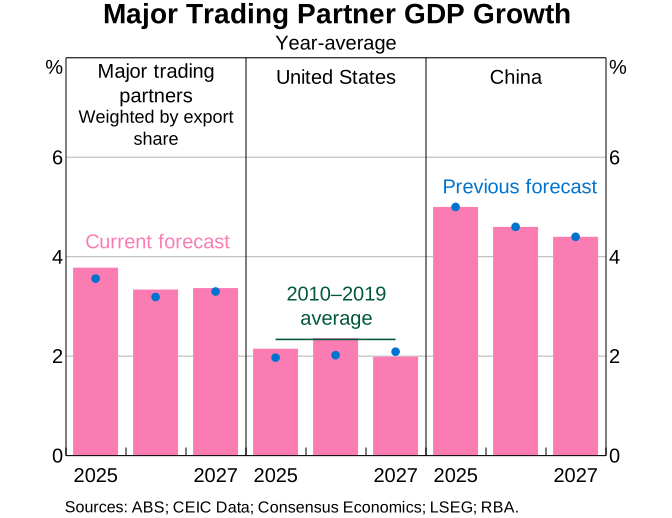
The boom in global AI- and broader technology-related spending is expected to drive continued strength in exports from east Asia, particularly for Taiwan, South Korea and Singapore. Consensus forecasters expect the level of GDP in these countries to be higher over the next two years than was expected at the time of the November Statement, although growth is still expected to moderate from the rapid rates observed in 2025. More expansionary fiscal policy in Japan has also driven a modest upward revision to the outlook for activity in 2026.
Consensus forecasts for US growth have been revised upwards given the strong momentum in US private fixed capital investment and consumption. AI-related investment is expected to remain particularly strong, although its contribution to GDP growth will continue to be partially offset by imports of intermediate inputs from east Asia. Easing monetary policy and expansionary fiscal measures are also expected to support US growth over the next two years. By contrast, Consensus forecasts for US inflation have been revised down in the near term following lower-than-expected CPI inflation in the December quarter. Part of this near-term revision reflects ongoing measurement issues related to the US federal government shutdown last year; however, lower-than-expected core goods inflation may also suggest that firms’ pass-through of higher tariff costs to consumer prices may be smaller, or happening at a slower pace, than was previously anticipated.
Consensus forecasts for other advanced economies are broadly unchanged, with growth expected to be modest and inflation stable or declining. The effects of earlier monetary policy easing continue to support demand in most advanced economies. In Europe, higher fiscal spending in Germany is also expected to spill over to nearby countries and support growth in the region. Headline CPI inflation has returned to central bank targets in some economies and is expected to remain there (e.g. in the euro area and Sweden). For other advanced economies (e.g. the United States and the United Kingdom), inflation remains elevated but is expected to decline over 2026, in line with gradually easing labour market conditions. We also expect price growth for MTP goods exports to remain subdued, consistent with weaker-than-expected growth in Chinese export prices in the second half of 2025.
Growth in China is expected to moderate a little in 2026 and 2027. Year-average GDP growth is forecast to be 4.6 per cent in 2026, and 4.4 per cent in 2027. These growth forecasts are unchanged compared with the November Statement, but our judgement around the composition of growth over the forecast horizon has changed in light of continued soft domestic demand outcomes and strong exports growth. The outlook for investment has been revised down further, reflecting weaker-than-expected nominal investment growth in the December quarter and a continued deterioration in real estate market conditions. However, we continue to anticipate that announced policy stimulus will limit any further weakness in infrastructure investment. We expect net exports to contribute a little more to growth than previously assessed. We judge continued strong growth in export volumes to reflect in part an ongoing structural rise in China’s manufacturing capacity, with growth particularly driven by exports of higher value-added products like vehicles, ships and semiconductors. The Chinese authorities’ 2026 growth target, which will be published in March, may pose an upside risk to the degree of policy support currently embodied in our forecasts and therefore our MTP growth forecast if it is set in line with the 2025 target of ‘around 5 per cent’ (see Key risk #3).
3.3 The domestic outlook
On the assumption that the cash rate follows the market path, Australian GDP growth is projected to pick up further in the near term, before declining to below estimates of potential growth.
Year-ended GDP growth over most of 2026 is expected to be above our estimate of potential growth and our previous forecast (Graph 3.2). Private demand growth has been stronger than expected recently, reflecting the impact of several underlying (as well as some more transitory) forces in the domestic and global economies (see Chapter 2: Economic Conditions). Some of these have been at play for some time, like the cyclical recovery in the domestic economy as household incomes have risen. More recently, the early effects of monetary policy easing, more accommodative broader financial conditions domestically and internationally, stronger-than-expected global growth and an acceleration of business spending on new technologies have all contributed to an additional pick-up in spending growth. While none of these developments individually represents a significant surprise, at least directionally, our assessment is that collectively they have driven materially stronger-than-expected spending as they coalesced in the second half of last year. The upgrade to the near-term outlook for GDP growth recognises this stronger momentum and the judgement that many of these forces are likely to continue into 2026.
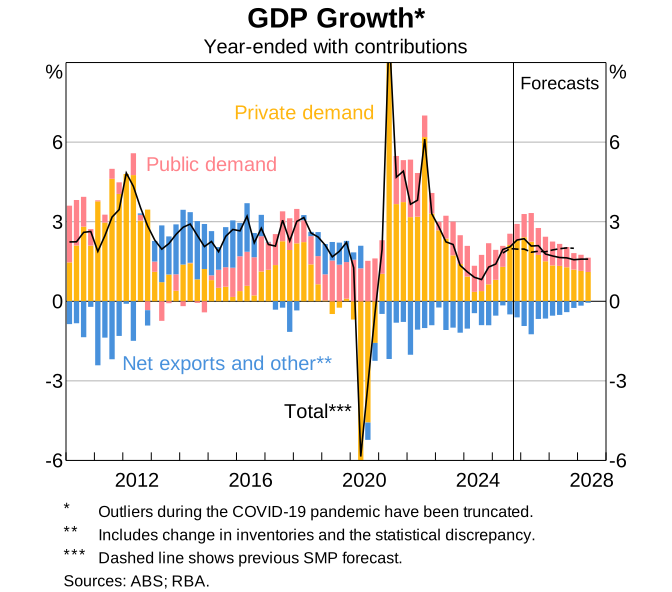
From late 2026 onwards, GDP growth is expected to be lower than in the November Statement and below our estimate of potential growth, with the higher assumed cash rate path beginning to weigh on private demand and GDP. The forecasts are conditioned on the market path for interest rates, with market participants expecting the cash rate to increase by around 60 basis points; by contrast, the November forecasts assumed the cash rate would decline by a further 30 basis points. The outlook for dwelling investment growth has been revised lower in response, due to both the direct effects of higher interest rates and because of slower housing price growth over the forecast period. The outlook for household consumption growth and non-mining business investment in 2027 have also been revised down. The appreciation of the exchange rate is also expected to weigh on GDP growth, by supporting growth in imports and weighing on growth in some categories of exports (see Chapter 1: Financial Conditions). Exports growth is also expected to slow over the forecast period as the level of resources exports comes back into line with productive capacity, having been boosted recently by a drawdown in inventories.
The labour market is expected to remain a little tight in the near term.
The unemployment rate is forecast to be little changed in the near term, before gradually increasing to reach 4.6 per cent by mid-2028 (Graph 3.3). Leading indicators such as job ads, vacancies and employment intentions suggest labour market conditions could ease a little in the near term, although this is balanced by the stronger near-term outlook for activity. Taking these points together, we expect labour market conditions to remain stable over the next few quarters. From late 2026, the unemployment rate is forecast to rise gradually, reflecting the slowing in GDP growth over 2026. The underemployment rate is also expected to edge a little higher.
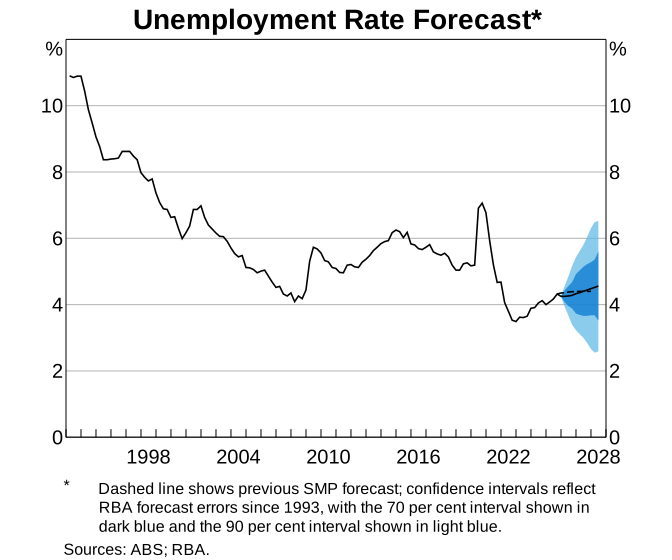
The outlook for the employment-to-population ratio and participation rate have been revised down a little since the November Statement, taking signal from recent data. Population growth is assumed to continue to ease from the very strong growth rates over recent years (Table 3.1). The employment-to-population ratio is expected to decline gradually as activity slows. Growth in non-market sector employment is expected to be below the very strong rates of the past few years.
The participation rate is forecast to be broadly stable. We expect that the participation rate will continue to be supported by long-run trends – such as increasing female participation – but will decrease a little in the near term, as we expect there to be less incentive to enter or remain in the labour force than in previous years. This reduced incentive reflects a possible lessening in cost-of-living pressures, as evidenced by the decrease in the multiple jobholding rate over 2025. The decline in job-finding rates observed in recent years for both the unemployed and new labour force entrants is also expected to reduce the incentive to seek work.
In the central projection, aggregate demand remains above potential supply for most of the forecast period, with the economy only returning to balance in mid-2028; however, there is considerable uncertainty around this assessment, in both directions.
We assess that there will be a little more excess demand in parts of the economy and the labour market than previously expected (see Chapter 2: Economic Conditions). The staff’s assumption for potential output growth is broadly unchanged from the November Statement, with potential output expected to grow at an annual rate of around 2 per cent over most of the forecast period. However, the small downward revision to the assessment of current supply capacity flows through the entire forecast period. Under the GDP growth forecasts, which assume the cash rate follows the market path, capacity pressures in parts of the economy – particularly the housing sector – are expected to increase in the near term before starting to ease from late 2026. The labour market is expected to remain a little tight in the near term and will ease only a little over the forecast period. Both the labour market and the broader economy are forecast to return to balance by the end of the forecast period.
This assessment remains highly uncertain. We have sought to account for some of the risk identified in the August and November Statements that there is a little more excess demand for output and labour, especially in the near term. However, there is considerable uncertainty in assessing potential output, full employment and the outlook for capacity pressures. The possibility that we are misjudging the degree of spare capacity is covered in Key risk #2.
We expect slightly less moderation in wages growth than in November; this is consistent with our assessment that capacity pressures in the labour market will be a little more pronounced within the forecast period.
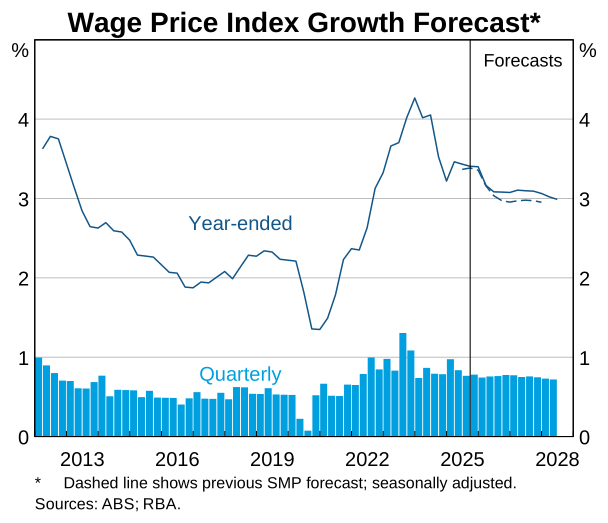
The forecast for year-ended nominal wages growth has been revised slightly higher from mid-2026 onwards (Graph 3.4). In the near term, underlying momentum in quarterly wages growth is expected to remain broadly stable, although changes in the timing of pay increases for some significant agreements and announced administered decisions may contribute to volatility in quarterly outcomes, particularly for the public sector. Beyond the near term, the higher outlook for wages growth relative to November reflects our assessment that there is slightly more capacity pressure in the economy than previously thought (see Chapter 2: Economic Conditions). Quarterly wages growth is expected to moderate gradually from late 2027 onwards as the labour market moves closer to balance.
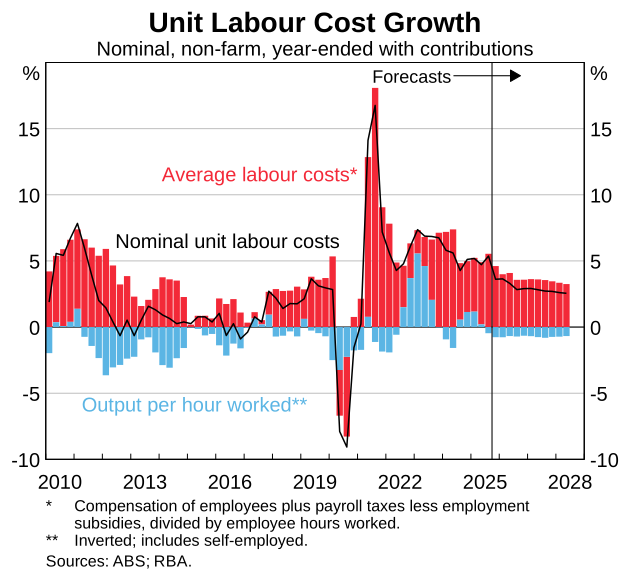
Growth in unit labour costs (ULCs) is expected to ease over the forecast period, on the assumption that the cash rate follows the market path. Growth in nominal ULCs – the measure of labour costs most relevant for firms’ cost of production and so for inflation outcomes – has been elevated in recent years, due to both weak productivity growth and strong average labour cost growth. Growth in ULCs has also been stronger than forecast in recent quarters, largely due to stronger-than-expected growth in average labour costs. Year-ended growth in ULCs is expected to moderate over the forecast period, in line with easing growth in nominal wages and a projected pick-up in productivity growth (Graph 3.5).
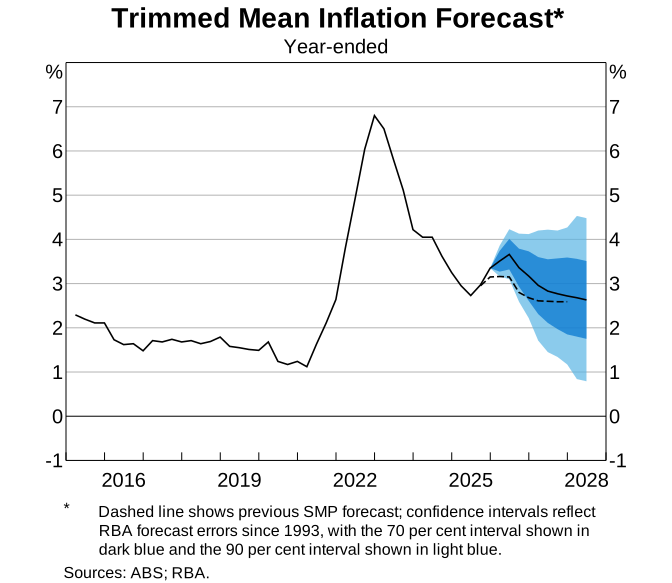
The forecast for underlying inflation has been revised higher relative to the November Statement.
On the assumption that the cash rate follows the market path, the central projection is for year-ended trimmed mean inflation to peak in mid-2026 before easing gradually, remaining above 3 per cent until early 2027 and approaching the midpoint of the target range by mid-2028.1
The central projection assumes the quarterly rate of underlying inflation in the first quarter of 2026 is roughly unchanged. This reflects the upward revision to our assessment of capacity pressures, and that the December quarter outcome for CPI indicated greater strength across a broader range of goods and services than we had expected in November.
Inflation is expected to moderate over the forecast period to reach 2.6 per cent by mid-2028 (Graph 3.6). In quarterly terms, underlying inflation is forecast to start slowing from the June quarter of 2026, including because consumption growth and housing demand slows and places less upward pressure on new dwelling and consumer durables inflation. An easing in economy-wide capacity pressures over 2027, driven by slower growth in economic activity and a gradual easing in the labour market, is also expected to support disinflation. The anticipated moderation in ULC growth is expected to ease some pressures on firms’ costs. The outlook for inflation is subject to considerable uncertainty in both directions: on the upside, capacity pressures may prove stronger than assumed in the central case; on the downside, the recent strength in CPI may prove to be more transitory. Inflation expectations are assumed to remain consistent with achieving the inflation target over the long term.
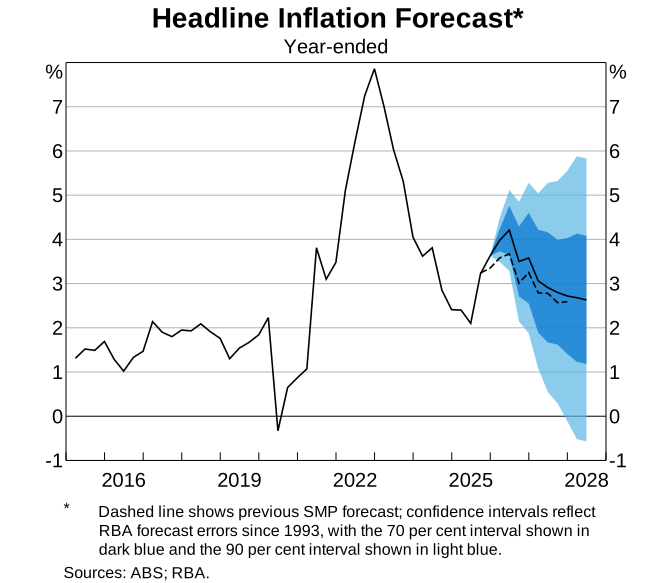
The forecast for headline inflation has also been revised higher relative to the November Statement, primarily reflecting the stronger outlook for underlying inflation. Headline inflation is forecast to reach 4.2 per cent by mid-2026, then ease to around 2.6 per cent by the end of the forecast period (Graph 3.7). The roll-off of government electricity price rebates contributes to higher inflation in the near term and adds some volatility to the forecasts. Because headline inflation can be affected by large swings in the prices of individual items, we will continue to pay close attention to underlying measures as an indicator of momentum in consumer price inflation.2
Housing inflation – measured in the CPI as the cost of constructing a new dwelling and rents currently being paid by households – is expected be higher in the near term relative to the November Statement. The outlook for new dwellings inflation has been revised higher in the near term, which reflects the stronger-than-expected momentum in recent data. New dwellings inflation is expected to remain elevated in coming quarters, before easing in line with a weaker outlook for housing market activity. CPI rents are also expected to be a little higher over the forecast period. Near-term indicators of advertised rents suggest more strength in the rental market than assumed in November, which gradually passes through to the stock of rents as measured in the CPI.
Market services inflation is forecast to remain higher in the near term than in the November Statement. A stronger profile for market services inflation reflects our assessment that there will be more capacity pressure in the economy than previously thought. Market services inflation is expected to increase in the first half of the year, before slowing only gradually as capacity and labour cost pressures ease.
3.4 Key risks to the outlook
Key risk #1 – The central projection may place too much weight on the role of temporary factors in driving recent inflation outcomes.
A key judgement in the central projection is that much of the unexpected strength in inflation in the second half of 2025 reflects some temporary and sector-specific factors that should abate over coming quarters (see Key judgement #2). This assumption accounts for most of the disinflation expected to occur over 2026.
The central projection may have ascribed too much weight to these temporary factors and therefore underestimated the degree of signal that recent inflation outcomes are providing about capacity pressures in the economy. Model-based estimates of spare capacity continue to point to a tighter labour market and economy than suggested by some other indicators. The breadth of the pick-up in inflation across components suggests there is a risk that inflation may remain higher for longer, particularly if it is being driven by broader strength in demand or capacity constraints affecting multiple sectors. At the same time, it is possible that some of the sectoral drivers may be less temporary than assumed – for example, if strength in demand for consumer goods is longer lasting. If we have overestimated the importance of these temporary factors, then the pace of disinflation over coming years is likely to be slower than expected.
Key risk #2 – The balance of demand and supply in the economy and the labour market may evolve in a way that differs from that assumed in the central projection.
There are a range of risks to the demand outlook, the assessment of supply capacity, and the outlook for labour market conditions that could all materialise and have implications for the outlook for inflation.
Demand growth could be stronger or weaker than forecast. This could occur because factors supporting the recent strength in private demand are more, or less, persistent than assumed. For example, if household consumption indicators in October and November have been boosted by promotional periods by more (less) than assumed, it would suggest there would be less (more) underlying momentum to support household consumption in early 2026. The contribution of monetary policy to recent economic outcomes is also a source of uncertainty. The earlier monetary policy easing may have had a larger or earlier effect on private demand than implied by historical relationships because of the easing in broader financial conditions. If that is the case, then the withdrawal of that policy support may also have larger-than-anticipated effects.
The labour market may also adjust to future activity in a way that is different to that assumed in the central projection. The near-term strength in economic activity is not expected to translate into significantly stronger employment growth, consistent with leading indicators of labour demand having been stable or eased slightly in recent months, and feedback from liaison. However, the strength in private demand could translate into a stronger-than-expected increase in market sector employment growth and place downward pressure on the unemployment rate, particularly over the next year. Further out, there is a risk that employment growth is stronger or weaker than forecast, given uncertainty about how the labour market will adjust to the ongoing shift from public to private demand.
A particular source of uncertainty is the judgement about the economy’s supply capacity over the forecast period. The central projection is based on an assumption that the starting point for supply capacity in the economy is a little less than in the November Statement, which flows through the entire forecast period, but that the outlook for growth in supply capacity is broadly unchanged. It is possible that we should be taking more signal from the recent strength in inflation and ongoing weakness in productivity growth to inform our outlook for supply capacity. The labour supply response to the gradual easing in conditions could result in individuals exiting the labour force due to increased difficulty finding work, with this decline in participation putting downward pressure on unemployment.
Key risk #3 – Risks to global activity remain tilted to the downside over the medium term, but the risks to the global inflation outlook may be shifting to the upside, particularly in the near term, because of increased geopolitical tensions and emerging bottlenecks in some supply chains.
Trade policy risks continue to evolve and remain to the downside, with uncertainty still somewhat elevated. While most bilateral US tariff rates have remained broadly stable since the November Statement, the recent increase in geopolitical tensions has seen some jurisdictions contemplate further increases to trade barriers as a retaliatory response to events. Ongoing and expected legal reviews, investigations and negotiations in several countries could raise or lower global trade barriers, and are also contributing to near-term policy uncertainty. There remains a risk that tariffs have a larger but more gradual impact on global supply capacity, taking years rather than months to fully materialise.
Global risks related to geopolitics and political interference in economic institutions have increased, but the impacts for Australia and most of its trading partners have so far been limited. Geopolitical tensions have increased in several regions but have not yet led to significant disruptions to global trade flows or financial markets. However, an escalation in tensions in the Middle East could raise oil prices, which would increase inflation and weigh on activity globally. Sustained political pressure for more expansionary monetary policy in the United States could also lead to higher inflation expectations, but financial market measures remain broadly stable. If these geopolitical and institutional pressures continue to build, downside risks to global growth could materialise, with a wide range of possible outcomes for global prices.
The surge in AI-related investment poses asymmetric risks to the outlook for global activity and prices. In the near term, emerging supply chain bottlenecks may limit the strong growth of global AI-related investment and manufacturing, and raise input costs for other industries. Elevated asset price valuations tied to AI are also supporting household wealth in the United States and in parts of east Asia. A sudden decline in these valuations could weigh on both investment and consumption and create negative spillovers to global activity and inflation.
In China, risks to the growth outlook are balanced. Weakness in investment, persisting for longer than expected due to structural factors, remains a key downside risk. On the other hand, Chinese authorities could provide more policy support than expected, including if they choose to support a growth target in line with 2025 of ‘around 5 per cent’. There are also uncertainties about the composition of growth. If policies to achieve the Chinese authorities’ stated goal of significantly increasing the consumption share of GDP materialise, the composition of Chinese growth could become less resource intensive. By contrast, policy support in recent years has tended to tilt towards infrastructure and manufacturing investment, contributing to demand for Australian resources.
3.5 Detailed forecast information
Table 3.1 provides additional detail on forecasts of key macroeconomic. The forecast table from current and previous Statements can be viewed, and data from these tables downloaded, via the Statement on Monetary Policy – Forecast Archive.
| Dec 2025 | Jun 2026 | Dec 2026 | Jun 2027 | Dec 2027 | Jun 2028 | |
|---|---|---|---|---|---|---|
| Activity | ||||||
| Gross domestic product | 2.3 | 2.1 | 1.8 | 1.6 | 1.6 | 1.6 |
| Household consumption | 3.1 | 2.8 | 2.1 | 1.9 | 1.7 | 1.7 |
| Dwelling investment | 5.5 | 3.7 | 1.8 | 1.1 | 0.3 | −0.4 |
| Business investment | 2.5 | 3.7 | 2.4 | 2.4 | 2.2 | 2.0 |
| Public demand | 2.2 | 3.8 | 3.2 | 2.9 | 2.2 | 1.9 |
| Gross national expenditure | 2.9 | 3.1 | 2.6 | 2.2 | 1.8 | 1.6 |
| Major trading partner (export-weighted) GDP | 3.5 | 3.3 | 3.4 | 3.4 | 3.2 | 3.2 |
| Trade | ||||||
| Imports | 6.3 | 4.6 | 3.0 | 3.7 | 2.6 | 2.2 |
| Exports | 3.9 | 0.7 | −0.4 | 1.5 | 1.5 | 2.0 |
| Terms of trade | 4.7 | 6.8 | −0.4 | −0.9 | 0.1 | 0.4 |
| Labour market | ||||||
| Employment | 1.2 | 1.1 | 1.3 | 1.2 | 1.2 | 1.2 |
| Unemployment rate (quarterly, %) | 4.2 | 4.3 | 4.3 | 4.4 | 4.5 | 4.6 |
| Hours-based underutilisation rate (quarterly, %) | 5.4 | 5.3 | 5.4 | 5.5 | 5.6 | 5.7 |
| Income | ||||||
| Wage Price Index | 3.4 | 3.1 | 3.1 | 3.1 | 3.1 | 3.0 |
| Nominal average earnings per hour (non-farm) | 4.4 | 3.9 | 3.6 | 3.6 | 3.5 | 3.3 |
| Real household disposable income | 3.3 | 2.5 | 1.8 | 1.5 | 1.4 | 1.3 |
| Inflation | ||||||
| Consumer Price Index | 3.6 | 4.2 | 3.6 | 2.9 | 2.7 | 2.6 |
| Trimmed mean inflation | 3.4 | 3.7 | 3.2 | 2.8 | 2.7 | 2.6 |
| Assumptions | ||||||
| Cash rate (%)(c) | 3.6 | 3.9 | 4.2 | 4.2 | 4.3 | 4.2 |
| Trade-weighted index (index)(d) | 61.3 | 64.3 | 64.3 | 64.3 | 64.3 | 64.3 |
| Brent crude oil price (US$/bbl)(e) | 63.1 | 63.8 | 63.8 | 63.8 | 63.8 | 63.8 |
| Estimated resident population(f) | 1.5 | 1.3 | 1.2 | 1.2 | 1.2 | 1.2 |
| Memo items | ||||||
| Labour productivity(g) | 0.7 | 0.6 | 0.6 | 0.6 | 0.7 | 0.7 |
| Household savings rate (%)(h) | 6.0 | 5.9 | 5.5 | 5.4 | 5.2 | 5.1 |
| Real Wage Price Index(i) | −0.3 | −0.9 | −0.4 | 0.3 | 0.5 | 0.3 |
| Real average earnings per hour (non-farm)(i) | 0.7 | 0.0 | 0.1 | 0.8 | 0.8 | 0.6 |
|
(a) Forecasts finalised on 28 January. Sources: ABS; Bloomberg; CEIC Data; Consensus Economics; LSEG; RBA. |
||||||
Endnotes
1 The Australian Bureau of Statistics started publishing a complete monthly CPI in November 2025; it will continue to publish some data from the seasonally adjusted quarterly CPI series (based on the pre-October 2025 collection frequency), including quarterly trimmed mean, for at least 18 months. As noted in the November 2025 Statement, for headline CPI inflation, we will forecast year-ended headline inflation based on the quarter-average of the monthly CPI. This is consistent with the approach taken by many other central banks that have access to monthly inflation data. For underlying inflation, initially we will continue to forecast quarterly trimmed mean inflation from the quarterly CPI, although our forecast will be informed by the monthly CPI data. See RBA (2025), ‘Box C: Transition to a Complete Monthly CPI’, Statement on Monetary Policy, November; RBA (2025), ‘Transition to a Complete Monthly CPI’, Technical Note, November.
2 See RBA (2024), ‘Box C: Headline and Underlying Inflation’, Statement on Monetary Policy, August.