
Statement on Monetary Policy – February 2026Box B: Insights from Liaison
This Box highlights key messages collected by the RBA’s liaison teams in Adelaide, Brisbane, Melbourne, Perth and Sydney during discussions with around 160 businesses, industry bodies, government agencies and community organisations from early-November 2025 to late-January 2026.
Liaison contacts report that demand has picked up over recent months, and it is expected to remain steady over the year ahead. Firms’ investment intentions have also risen, reflecting planned projects across a broad range of industries. Despite the recent pick-up in demand growth, most firms are maintaining a focus on cost control, and say they plan to keep headcount stable, either by adopting a ‘wait and see’ approach or doing ‘more with the same’. Recently, some contacts have noted tentative signs of a modest easing in cost pressures (including wages growth), although they remain above average. Selling price growth picked up slightly towards the end of last year, and while it is expected to ease over the year ahead, it is likely to remain above average (Graph B.1).
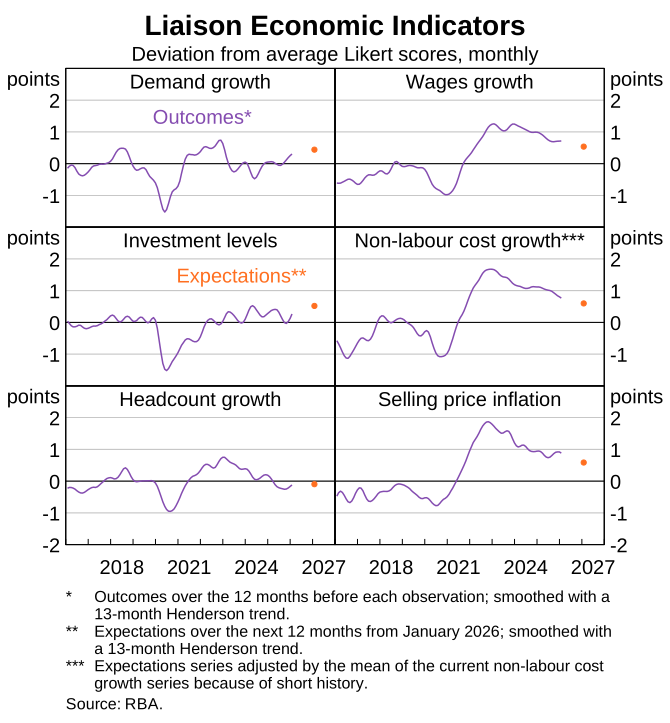
Retailers generally expect solid sales growth to continue.
Retailers reported that sales growth over the December quarter was solid, supported by strong demand throughout promotional periods, although outcomes were marginally below their expectations. Many retailers ran their Black Friday promotions for longer than in previous years and, in some cases, offered deeper discounts to attract deal-focused shoppers. Most retailers reported that the Black Friday period pulled forward sales from early December; however, demand has generally returned since the week before Christmas.
Retailers generally expect steady underlying growth in consumer demand over coming months. Most have noted an improvement in consumer sentiment relative to six months ago and generally expect current conditions to persist. Lower priced retailers continue to report better conditions than more discretionary firms. More generally, liaison contacts note that consumers remain value conscious and are increasingly ‘mission shopping’ (i.e. purchasing only specific planned items). This has contributed to somewhat inconsistent demand outside of promotional periods or new product launches. Some contacts have noted that, since late October, the change in the outlook for the cash rate has slightly tempered sales momentum.
Investment intentions have increased over the past few months.
Investment intentions for the year ahead have increased and are above their long-run average. Around one-third of firms spoken to in recent months (across a broad range of sectors) plan to increase investment, focusing on digital transformation projects (including automation and AI) and site expansions. Firms involved in data centre construction and fit-outs continue to see very strong demand with many projects in the pipeline.
Detached housing demand remains robust and high-density building conditions are improving, though capacity varies by state.
New home sales have picked up in New South Wales and Victoria, while demand in Western Australia, Queensland and South Australia remains robust. Contacts generally expect new detached home sales to continue rising over the year ahead, consistent with a sustained six-month increase in land sales. Builders in Western Australia are often operating at capacity, with 6–12 months of work in the pipeline, whereas those in New South Wales and Victoria have capacity to take on more projects. Trade labour availability tightened over the September quarter and contacts expect further tightening over the year ahead, alongside expected further increases in new home sales and detached construction activity.
Sentiment in high-density construction has improved gradually and contacts are more optimistic than a year ago. Recent increases in established apartment prices in New South Wales have supported modest improvements in project feasibility, leading to more non-premium projects commencing. Premium projects continue to progress, supported by relatively high selling prices. Contractor and labour capacity in high-density construction has improved in New South Wales and Victoria, primarily due to lower levels of public non-residential building activity. By contrast, capacity in high-density construction remains tight in some other states. Recent state government rezoning and planning reforms (especially in New South Wales) have been viewed favourably by industry contacts and are expected to materially support new medium- and high-density construction in coming years.
Firms expect growth in their headcounts to remain subdued.
Firms are trying to manage their headcount and labour costs more effectively, leading to subdued headcount growth over the past year, and project for this to continue in the year ahead. Most firms say they plan to keep headcount numbers stable (Graph B.2), either by taking a ‘wait and see’ approach or by continuing to reallocate existing headcount towards more productive or revenue-generating areas of the business. Some firms are doing this by replacing staff that joined soon after the COVID-19 pandemic with higher quality or skilled labour.
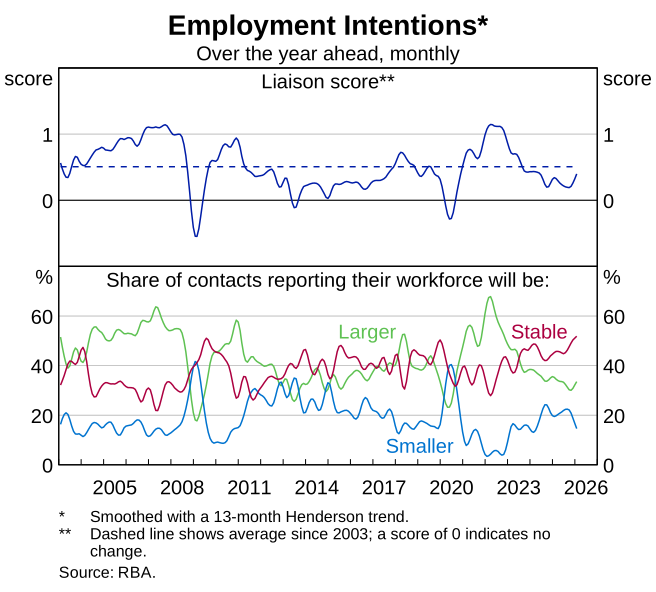
Hiring conditions are reported to be stable or improved, with job application numbers increasing; however, many contacts still struggle to find sufficiently skilled or high-quality candidates. Around half of firms still consider the labour market tight. Where shortages persist, firms are adapting by adjusting hiring practices, offering higher wages, or using non-wage incentives such as flexible hours, permanent roles, or housing.
Average wages growth has been little changed in recent months. Firms were surprised to the upside on their wages growth in early 2025, but the gap between expectations and outcomes has narrowed. Firms expect wages growth to ease marginally over the coming year.
Non-labour cost growth has eased gradually but remains elevated.
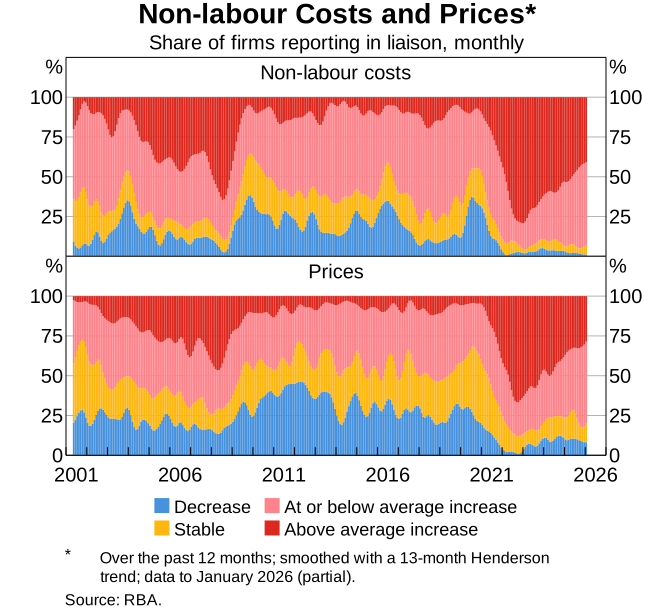
The share of firms reporting above-average non-labour cost increases continues to decline, although very few report stable or decreasing costs (Graph B.3). As a result, non-labour cost growth remains above its long-run average. Firms regularly highlight the elevated level of their overall cost base; most expect non-labour cost growth to either remain at its current rate or to ease slightly over the year ahead.
Selling price growth remains above its long-run average and is expected to ease over the year ahead.
Selling price growth for both goods and services has edged up in recent months, driven by fewer firms holding prices steady or decreasing prices (Graph B.3). A range of consumer-facing firms and builders have suggested that their margins were under less pressure in the second half of 2025 (compared with earlier in the year). In some cases, this is because they were able to pass through some cost increases to their prices. In other cases, firms found ways to reduce their cost base. Overall, contacts expect selling price growth to ease over the year ahead but to remain above average (Graph B.1).