
Statement on Monetary Policy – August 2026 Box A: Insights From Liaison
This Box highlights key messages collected by the RBA’s liaison teams in Adelaide, Brisbane, Melbourne, Perth and Sydney during discussions with around 240 businesses, industry bodies, government agencies and community organisations from early-May to early-August 2026.
Liaison contacts report some moderation in business conditions since the start of the year, with demand growth easing across a range of sectors and regions. Firms continue to note ongoing cost pressures for both labour and non-labour inputs. While input cost and availability concerns stemming from the Middle East conflict are less acute than was the case a few months earlier, the effects on costs and prices are expected to persist for some time. Investment and employment intentions are currently around or a bit below their longer run averages.
Firms continue to report elevated cost inflation, but increasingly note that customer price sensitivity is constraining pass-through to selling prices.
As global and domestic fuel prices declined over late May and June, many of the fuel surcharges introduced at the height of the Middle East conflict began unwinding. This eased direct and indirect fuel cost pressures from their earlier peaks, but a range of contacts report that fuel and logistics costs remain above pre-conflict levels, particularly where suppliers have built higher fuel costs into base prices. Firms also note continued uncertainty around the outlook for these costs given the ongoing conflict.
Availability of oil-derived inputs such as PVC pipes, plastics and fertiliser is not currently being flagged as an immediate challenge, though remains a watchpoint for some businesses. The cost of many of these products remains higher than pre-conflict levels. Firms in the construction sector report that this is adding to new build costs, which is being passed on through rise-and-fall provisions in commercial builds or in sales prices for home building (although less so in markets where demand has been softer). Trade labour costs have also risen, particularly where workers are being attracted to stronger interstate markets or where there is competition for resources across infrastructure and non-residential construction.
More generally, firms across many industries report that growth in business costs has been above average and is expected to remain so in the near term (Graph A.1). This in part reflects some pass-through of recent fuel price costs into upstream supply chains and logistics costs, with some expectation that this will persist for a while longer. Firms also note ongoing inflation in other non-labour operating costs, such as IT (including recurrent software fees as well as other operating expenses) and other professional and support services.
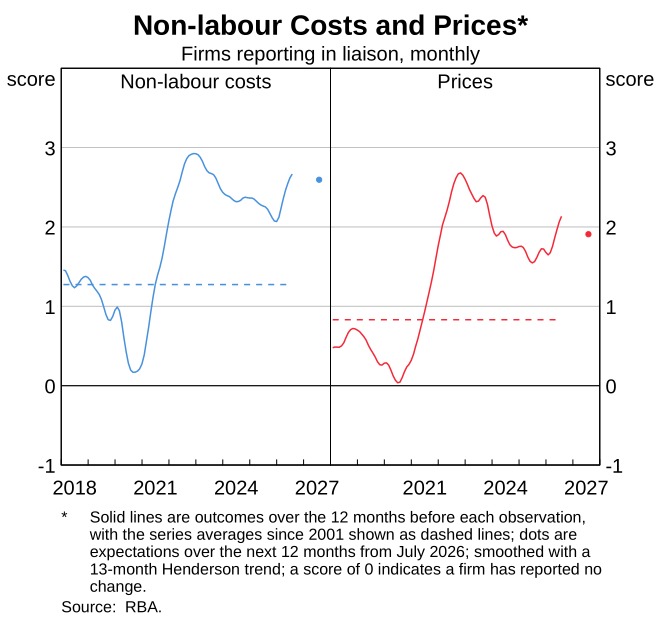
Firms increasingly note that pass-through of these costs is being constrained by customer price sensitivity. While firms reported a pick-up in selling prices growth over recent months, some moderation is expected over the year ahead. Prices are expected to grow by less than costs, consistent with many firms reporting some modest margin compression.
Demand growth has moderated across a range of industries since the start of the year.
Firms are generally noting that demand conditions have eased since early 2026. Consumer-facing liaison contacts – particularly those in consumer durables retailing, accommodation and hospitality – report that demand growth has softened in recent months but remains positive, with households more cautious and price-sensitive than at the start of the year. Community service organisations continue to report elevated demand for their services, underscoring ongoing cost-of-living pressures.
While many housing builders continue to work through their existing pipelines, construction activity is expected to slow over the year ahead given lower sales volumes over recent months. Developers also note that sales momentum is softening, although demand for greenfield land continues to exceed supply in some regions. Contacts cite a range of drivers for this softer sales outlook, including higher interest rates and borrowing costs, elevated construction costs and the uncertain outlook for housing prices (in part due to tax and other policy changes). Demand conditions for construction and property development remain weaker in Victoria than other states.
Firms’ investment intentions have eased in recent months but remain positive; fewer firms expect to be undertaking above-average capex over the year ahead. A number of contacts have indicated a cautious outlook, noting the potential for project delays and increases in input costs (including further fuel price increases) and that uncertainty about the economic outlook is still elevated. Some firms have already reported increased input costs and minor delays in project timelines, but are still going ahead with planned investments.
Data centre investment is strong at present, and developers and builders continue to see a strong near-term pipeline of this activity, although there is uncertainty about how long buoyant demand conditions will last. Domestic availability of materials and contractors is generally not a significant constraint; most activity in this sector is occurring in New South Wales and Victoria where capacity constraints are less binding than in other regions.
Contacts in Queensland continue to flag concerns around construction industry capacity in that state given the large pipeline of planned residential, non-residential and infrastructure projects.
Wages growth expectations have lifted, while firms’ employment intentions have steadied over recent months.
Firms regularly note that wages remain a key source of upward cost pressure, with many firms reporting above-average wages growth expectations for the year ahead (Graph A.2). Firms note a factor in this is employee expectations, which remain elevated in light of persistent cost-of-living pressures. The Fair Work Commission’s decision in June 2026 to increase award wages by 4.75 per cent was higher than most business contacts had expected. Consistent with this, there has been a marked lift in the share of firms expecting wages growth to pick up over the year ahead.
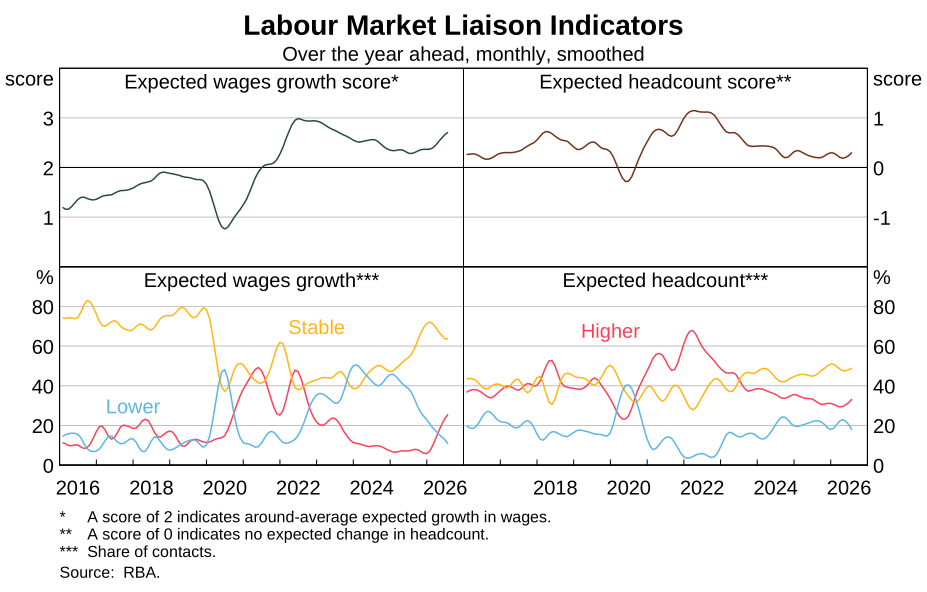
Employment intentions remain a bit below their longer run average. Partly to manage labour cost growth, close to half of firms in liaison are reporting they plan to hold headcount stable over the year ahead. The share of firms expecting to increase headcount remains below average though has ticked up a little recently; such firms typically cite expected good demand conditions as well as business expansions or project work as driving these planned headcount increases. As concerns around the effects of the Middle East conflict became less acute over recent months, the share of firms expecting to reduce headcount unwound a little.
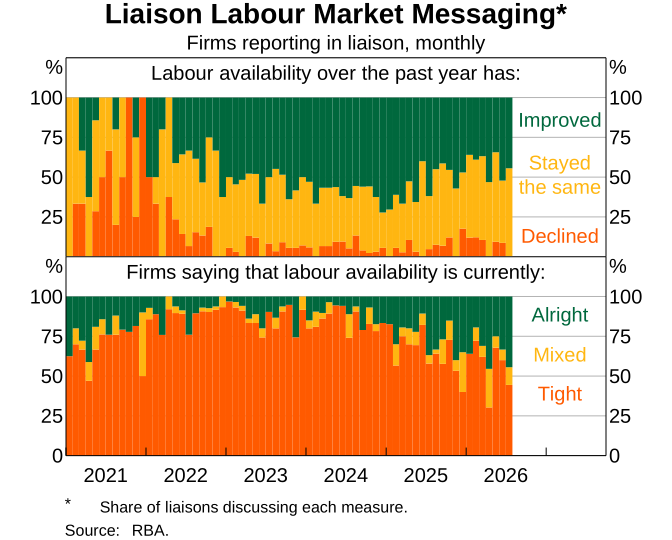
Contacts generally report labour availability has stabilised or improved compared with a year earlier (Graph A.3). Even so, many contacts still note some labour market tightness and are actively competing for labour, and sourcing staff with appropriate skills and experience remains challenging in many industries.
Adoption of AI is not widely being reported as a factor behind headcount reductions – instead, most firms see AI as a tool for supporting revenue growth without a commensurate increase in their cost base. While the majority of firms in liaison report they are investigating AI usage in some form, most are in the early stages of adoption and AI has not yet materially changed how tasks are being performed. There are, though, a small minority of firms making substantially larger investments and related business changes.