
Financial Stability Review – October 2026Financial Stability Assessment
Overall assessment
The Australian financial system has a good degree of resilience. Most borrowers – households and businesses – are well positioned to manage through a period of slowing economic growth and declining housing prices. Bank lending standards have remained prudent in recent years and Australian banks have established large capital buffers to absorb significant loan losses if they were to arise under extreme-but-plausible scenarios. Non-bank lending activity in Australia has supported favourable business credit conditions over recent years; as the rapid growth in the domestic private credit market has been from a low base, concerns over credit quality in segments of this market raise more issues for investor protection than financial stability. In sum, while cyclical domestic risks continue to be closely monitored, they are not assessed as posing systemic financial stability risks at present.
At the same time, threats to global financial stability continue to mount. Geopolitical risks are underscored by two ongoing conflicts and, over the medium term, intensifying strategic competition among major powers. Sovereign debt in some large overseas economies continues to trend higher from already elevated levels, and the increased participation in these markets by leveraged and price-sensitive investors is being closely monitored. Low risk premia in major equity and credit markets have contributed to buoyant financial conditions for businesses, but these risk premia could move sharply higher in response to an adverse shock potentially in a disorderly manner. One possible trigger could be a shift in sentiment towards the AI investment boom, which is increasingly fuelled by expectations of sustained rapid earnings growth and a debt-financing cycle that is becoming more opaque and circular. Alongside growing operational vulnerabilities – which are attracting significant attention from regulators domestically and abroad – these external factors are the most prominent threats to financial stability in Australia.
Key messages for industry
Overall, the Australian financial system is well positioned to absorb shocks but continued focus and action is required from industry to ensure this remains the case.
- In an environment of rapid technological change, increased concentration and connectedness, strengthening operational resilience requires ongoing action across the financial system. There is a varying level of preparedness across the system and it is essential that operational resilience is given due focus including by critical service providers such as operators of financial market infrastructure.
- To maintain financial resilience, it is important that lending standards remain sound in the face of ongoing strong competition in lending. It is also important that as the superannuation sector grows, its liquidity risk management practices continue to strengthen.
- Overall risk management and recoverability planning must continue to evolve to meet new challenges. The growing risk that financial and non-financial risks crystallise together suggests industry needs to prepare for scenarios that are more multifaceted than in the past. This includes the ability to respond and recover quickly from a wide range of eventualities. Consideration of more extreme scenarios and stress tests, and more rigorous crisis simulations and other crisis preparedness activities – including at the industry-wide level and across regulators and government – are particularly pertinent in this environment. CFR agencies will continue to work with industry on preparedness initiatives.
The international economy and financial system have weathered several shocks in recent years with limited lasting disruption, but threats to international financial stability continue to mount.
The apparent resilience in the international financial system over recent years has been encouraging, but longer-term threats to financial stability are intensifying, including from those originating outside the system. The global macro-financial environment is vulnerable to external shocks.1 Conflicts in the Middle East and, to a lesser extent, Ukraine continue to disrupt global supply chains, and near-term resolutions to both conflicts are difficult to foresee. More broadly, geopolitical tensions beyond these regions appear likely to remain elevated for the foreseeable future. The pace of technological development is also intensifying. This brings with it not only opportunities for productivity-enhancing investment, but also the risk of significant operational disruptions, including from the complexity of integrating new technologies into existing systems and from the use of new technologies by malicious actors. AI is a current example and quantum decryption will become an increasing threat if post-quantum cryptography is not implemented early enough.2 Meanwhile, longer-term shifts in climate patterns, and an increased frequency and severity of extreme weather, also contribute to a more challenging environment.
These external factors, combined with the increasing complexity and interconnectivity of the domestic and international financial systems, could be making a system-wide shock more likely and its potential consequences more severe. In particular, the potential for financial and non-financial risks to interact in complex and novel ways is a growing focus of financial system regulators in Australia and internationally. One area of related attention is the growing concentration of common service providers within and to the financial sector, which means that the effects of a major operational disruption at one service provider could cascade across a wide range of entities. The evolution in the geopolitical and cyber risk landscapes also raises the prospect that opportunistic cyber-attacks on key institutions occur at a moment of generalised financial stress, potentially interacting in a way that undermines confidence in the financial system and results in system-wide consequences that are complex to manage.
Recent developments related to global sovereign bond markets, the AI investment boom, low market risk premia and operational resilience are also reinforcing risks to international financial system stability.
Sovereign debt in some large overseas economies is trending higher from already elevated levels, and the recent increase in government bond yields will increase debt-servicing costs. The rise in government bond yields over recent months has been driven by a number of factors, including a rise in expected policy rate paths as well as competition for debt funding from AI-related corporate bond issuance. While the absence of credible medium-term fiscal frameworks in several large advanced economies has yet to elicit a major focus from financial market participants, it is possible that debt sustainability concerns begin to mount if bond yields continue to rise without a commensurate increase in long-term growth expectations. Price-sensitive investors are once again accounting for a large share of activity in government bond markets (as central bank purchases have abated), and these participants are requiring higher compensation for risk. Some, including hedge funds, are using significant amounts of leverage in these markets to profit from small arbitrage opportunities. This raises the prospect of increased volatility – and potentially a disruptive sell-off – in core bond markets that are central to the operation of the global financial system. While the upward move in sovereign bond yields has generally been orderly to date, a disorderly repricing in government bond markets could have adverse spillover effects into other asset classes. Elevated sovereign debt burdens also mean that the capacity of some governments to respond to economic shocks with fiscal support is more limited.
The rapid pace of developments in AI are boosting expectations for earnings growth and productivity, but may also be increasing risks to financial stability via operational and financial risk channels. Over the medium term, AI has the potential to support productivity growth and strengthen operational resilience by improving the cyber defence capabilities of banks, financial market infrastructures (FMIs) and other financial institutions. But rapid advancements in AI could also worsen the cyber threat landscape before these defensive capabilities are fully developed, increasing the likelihood that underlying operational vulnerabilities could be exposed. This includes how AI capabilities interact with the development of other emerging technologies, such as quantum computing. The net impact of AI on cybersecurity will depend on a number of factors, including how quickly and thoroughly firms respond. Even prior to the emergence of frontier AI models this year, the threat of system-wide operational disruptions had already been rising over recent years due to worsening geopolitical conflicts and the growing prevalence of common service providers – including from outside the financial sector (see 4.1 Focus Topic: Operational Risk and Financial Stability).3
The exposure of financial market participants to the AI investment boom is increasing at a time when risk premia in global equity and credit markets are low by historical standards. Compressed risk premia in major markets have supported financing conditions for businesses, but also leave them vulnerable to sharp repricing if there were to be a sudden shift in global risk appetite. One trigger could be a shift in sentiment about the outlook for AI-related profitability of ‘hyperscalers’ (large AI-related companies) with the effect amplified by rising concentration and leverage in equity markets, particularly in the United States. To fund the surge in AI-related investment, a number of large firms have increasingly turned to both on and off-balance sheet leverage, which could create hidden and opaque interlinkages. Some arrangements now involve circular financing models where hyperscalers provide vendor financing for key customers (see Box: Funding the AI investment boom). Over time, this could lead to a further build-up of vulnerabilities in the financial system.
Stability risks arising from activity in global private credit markets have also grown, although spillovers to the core banking system have been limited. Investor concerns over asset quality in several international private credit funds have remained elevated following the high-profile defaults of some private credit borrowers in late 2025 and early 2026. For some private credit funds, the concerns centre around their exposure to sectors perceived as negatively affected by AI and some funds in the sector more broadly have had to enforce limits on investors redeeming their capital. These developments have drawn attention to vulnerabilities in segments of the private credit market, though stress has been largely idiosyncratic so far. In major advanced economies, linkages between private credit funds and the core of the financial system are estimated by authorities to be growing from a low base, though limited data availability make it challenging for authorities to monitor the sector.
External shocks to the Australian financial system could transmit through various channels, depending on the context.
In the event of a period of severe global market stress, financial conditions in Australia are likely to tighten. A further escalation in geopolitical tensions or adverse policy or macro-financial developments – including in relation to sovereign debt sustainability or a deterioration in expectations for AI profitability – could trigger disorderly asset price corrections, particularly where investors have been using leverage to boost returns. This could impair market functioning and elicit a sustained increase in risk aversion across global financial markets. Australia is unlikely to be immune should international funding conditions abruptly tighten, given that equity risk premia, corporate bond spreads and sovereign bond term premia in Australia tend to move closely with those in other advanced economies. While large Australian corporations have taken steps over recent years to mitigate offshore refinancing risk and banks have similarly reduced their exposure to offshore funding risk, such a shock would likely affect access to financing by businesses and financial institutions.4
A major operational disruption – originating in Australia or overseas – has the potential to interact with traditional financial risks in complex ways. Depending on the circumstances, the event could undermine public confidence in the Australian financial system and could quickly translate to financial stress and economic disruption if payments were to stop flowing for a time and people temporarily lost access to their funds. If an outage occurs at a common service provider – such as an FMI or key technology provider – the effects could be widespread. Unlike financial risks, whose emergence is likely to be largely confined to the regulated financial sector, operational risks to financial stability can originate from a much broader range of entities including common utility or technology providers, over which supervisors have limited oversight. If an operational outage impaired the provision of liquidity to the financial system, this could severely affect the crisis response (see 4.1 Focus Topic: Operational Risk and Financial Stability). Furthermore, in the event that a major shock severely affected the economy of a key trading partner, the cash flows of Australian exporters would be affected with downstream consequences for employees, creditors and suppliers, although any depreciation of the exchange rate would provide some offsetting support to the economy over time.
Domestic cyclical developments do not pose systemic risks to financial stability in Australia at present, but are being closely monitored.
Most Australian borrowers appear well positioned to manage ongoing cost pressures and declining housing prices. Most households have substantial cash flow and saving buffers, which supports overall resilience in the system. Under adverse-but-plausible scenarios for housing price declines, most borrowers would still have equity buffers in their property given the preceding run-up in prices and prudent lending standards. This provides these borrowers the option of making the decision – though difficult and disruptive – to sell their property to pay off their loan fully if they experience acute financial stress. Most businesses are also expected to remain resilient in the period ahead, although smaller businesses and those in more energy-intensive or cyclical industries with fewer buffers, such as transport, hospitality and construction, are more vulnerable to cost pressures. This is particularly the case if a significant weakening in aggregate demand were to make it harder for them to raise prices to cover their higher costs. In short, while there are pockets of stress in the household and business sectors, both sectors display a good level of resilience overall, as reflected in low loan arrears.
Banks are well positioned to weather a material deterioration in the housing market and a softening in economic conditions more broadly. Banks have maintained prudent lending standards, and the high quantity and quality of capital in the banking system means banks could absorb losses from an adverse macroeconomic shock while continuing to extend credit.
As abroad, regulators in Australia have somewhat less visibility of risks from non-bank lender activity (including private credit), though the financial stability implications of this sector are currently limited by its relatively small size and limited interconnections with Australian banks. Non-bank lenders have provided an alternative source of financing for businesses in Australia, accounting for around 10 per cent of total business debt outstanding. Within this cohort of lenders, private credit funds have expanded over recent years but from a small base and, importantly, banks’ exposures to them remain limited. Relative to the US private credit industry, Australian private credit funds are less exposed to companies disrupted by AI, though are more exposed to real estate, including construction and development. While investors in Australian private credit funds may face heightened risks of lower-than-expected (or negative) returns in a downturn, and this could affect the supply of new financing to real estate construction in particular, the implications for the broader stability of the financial system would be limited. However, there are a number of investor-protection issues relating to opaque valuation practices and uneven standards of governance and risk management that the Australian Securities and Investments Commission is addressing (see Box: Private credit in Australia).
The Australian financial system is well placed to absorb financial shocks, but continued action is required to safeguard overall resilience.
Operational resilience requires ongoing action.
- Improving operational resilience has become a prominent focus of regulators, banks, FMIs, superannuation funds and other financial institutions. This includes the development of robust contingency and recovery plans and crisis response capabilities. There is, however, a varying level of preparedness for operational disruptions across the financial system.
- In an environment of rapid technological change, increased concentration, rising interconnectedness and heightened geopolitical risk, maintaining and building operational resilience will require ongoing vigilance across the financial system. This includes action by highly critical service providers such as FMIs.5 Austraclear is a particular focus for the RBA in its supervision activities at present given Austraclear’s central role in the financial system and the issues identified in relation to its operational resilience, including the ability to maintain critical services during a prolonged outage.6
Capital and liquidity resilience must be maintained.
- It is important that lending standards remain sound in the face of continued strong competition in lending so that resilience is not eroded in an environment more prone to shocks.
- The superannuation sector has been an important source of resilience and stability in the broader financial system over the years, but ongoing work to strengthen liquidity risk management practices is warranted as the sector continues to grow in size and as a larger share of superannuation balances become accessible to members.
A broader strengthening of risk management practices will be an important counterweight to growing financial stability risks, particularly external shocks.
- As structural and cyclical risks to financial stability are mounting, particularly from overseas, the financial sector must position itself to be able to maintain continuity of service across a range of adverse scenarios. It is possible that financial and non-financial (particularly operational) risks crystalise in complex ways in the future. Robust and creative use of scenario analysis, stress testing, crisis simulations and other crisis-preparedness activities are particularly valuable in this environment. The member agencies of the Council of Financial Regulators are increasingly engaging with regulated entities, industry groups and government on a range of crisis scenarios, including scenarios that consider a broader range of possibilities than in the past, with particular focus on geopolitical shocks and multi-day operational outages at critical infrastructures.
Box: Key global and domestic vulnerabilities
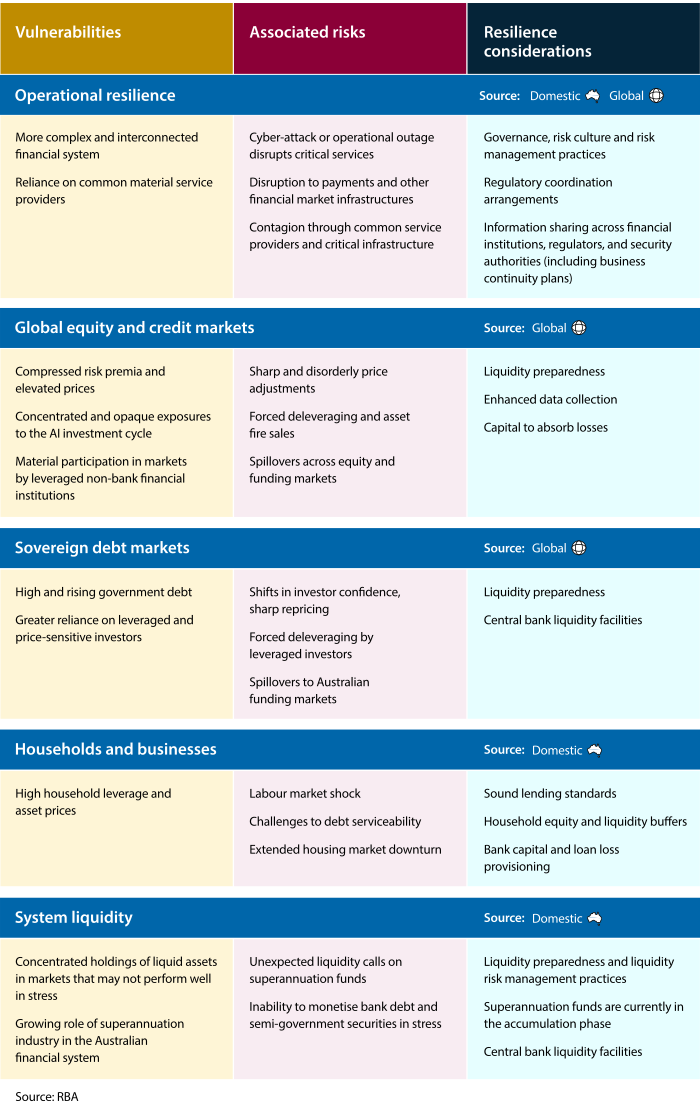
The RBA’s conceptual framework for assessing financial stability focuses on identifying and monitoring vulnerabilities. Vulnerabilities are characteristics of the financial system that increase the likelihood that risks will materialise and/or increase the severity of adverse outcomes. The probability and nature of individual risks7 to financial stability and the transmission of shocks through the financial system are also considered in the assessment. However, having a particular focus on vulnerabilities allows policymakers to better identify actions that can be taken to enhance the financial system’s overall resilience. The framework also considers resilience of the system to vulnerabilities. Resilience involves actions or characteristics of financial institutions, participants in the financial system or the financial system structure that dampen the negative effect of shocks when risks materialise.8
Figure 1 sets out key global and domestic vulnerabilities. It is not an exhaustive list of vulnerabilities.
Endnotes
1 The different characters of these threats were set out in Jones B (2023) ‘Emerging Threats to Financial Stability – New Challenges for the Next Decade’, Speech at the Australian Finance Industry Association Conference, Sydney, 31 October. For an overview of the implications of a more shock-prone environment for Monetary policy, see Bullock M (2026), ‘Monetary Policy in an Era of Shocks’, Speech at the Anika Foundation Fundraising Lunch, Sydney, 28 July.
2 At its June 2026 meeting, the Payments System Board (PSB) discussed the emerging risks from advances in classical and quantum computing, and the approaches to strengthening cryptographic protections in card payments. The PSB also endorsed consulting on strengthening cryptographic practices as part of the Review of Payments System Regulation to further assess risks, uncertainties and regulatory options. The PSB also reaffirmed its expectation that industry maintains strong momentum in its cryptographic uplift efforts. See RBA (2026), ‘Payments System Board Update: June 2026 Meeting’, Media Release No 2026-14, 4 June.
3 Lwin J and G Holland (2026), ‘Geopolitical Risk and Financial Stability’, RBA Bulletin, 9 June.
4 For an overview of how international shocks can transmit to the Australian financial system, see RBA (2025), ‘4.1 Focus Topic: How Overseas Shocks Can Affect Financial Stability in Australia’, Financial Stability Review, October.
5 This includes critical payments systems operated by the RBA, such as the Reserve Bank Information and Transfer System (RITS). The assessment of RITS, published in June 2026, noted that while significant expenditure and effort have been made by the RBA to enhance RITS’s operational risk management, the focus on operational risk must continue given the more challenging external environment. See RBA (2026), ‘Assessment of the Reserve Bank Information and Transfer System’, June.
6 See RBA (2026), ‘Assessment of ASX Clearing and Settlement Facilities’, September.
7 Risks are potential adverse events that result in losses (financial and/or non-financial) to financial system participants or otherwise affect the provision of financial services.
8 See RBA (2025), ‘4.1 Focus Topic: A Conceptual Framework for Assessing Financial Stability’, Financial Stability Review, April.