
Reserve Bank of Australia Annual Report – 1972 Problems and Policies
The year's experience highlighted the problem of selecting and applying appropriate weapons of policy. In the last months of 1970/71, activity was still at a high level but there was evidence of rising unemployment and that spending was no longer accelerating, although the rate of change of prices seemed to be increasing. Prospects for the early months of 1971/72 were for a stronger increase in prices and the possible entrenchment of an inflationary psychology.
Costs and prices were already rising strongly and in this context the 1971/72 Budget sought, by raising rates of customs and excise duty and by increasing the income tax levy, to guard against the potential for demand to grow excessively. In the event, activity eased during subsequent months—due mainly to a fall in the rate of growth of private spending on most items except housing—but prices increased more strongly. The international environment was conducive to relatively strong domestic price and wage increases while external developments, particularly the hiatus in previously stable exchange relationships, contributed to uncertainty within the domestic economy. The level of our international reserves rose sharply, reflecting a marked and progressive reduction in the deficit on current account and a continuing very rapid rate of capital inflow. A consequence of this and the seasonal pattern of government and rural credits transactions was that liquidity of the private sector rose quickly and remained high throughout the year and there was strong private demand for government securities.
In response to the decline in economic activity and the rapid rise in international reserves, the stance of monetary policy was shifted during 1971/72, from one of tightness to one of ease. During October and November the authorities reduced the yields at which they were prepared to deal in and issue government paper and in December bank lending was freed from all official restraints and the Statutory Reserve Deposit ratio was reduced. Early in 1972 yields on government paper fell further and in February bank interest rates were reduced; the opportunity to make them more flexible, so that banks could be more competitive with other financial intermediaries, was also taken. Thus, as well as tending to increase the level of activity and moderate the growth in international reserves, these changes were intended to promote the development of a financial environment in which efficiency in the use of monetary measures to affect financial markets generally would be enhanced.
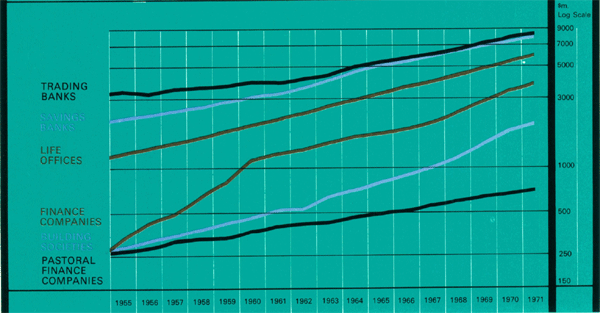
During recent years, the growth of short term financing outside the banking sector has been very rapid (rates of growth of banks and some other major types of financial intermediaries are compared in Graph 17). The most rapid growth, perhaps apart from that of authorized dealers in the short term money market, has occurred in the less formalized markets (such as merchant banking and the inter-company market) for which precise measures of growth are unavailable. The recent extension of greater flexibility to banks reflects the view that it is important, both on grounds of equity and for implementing policy, that intermediaries which are subject to direct controls should be freed whenever possible of restraint applied through those controls to preserve to the extent practicable their market share as financial intermediaries. Experience has shown that direct controls, although perhaps useful tools of policy over short periods, can diminish in effectiveness when applied continuously over long periods. Although a broadening of the range of financial intermediaries is no doubt largely a consequence of natural developments, the exercise of direct control over some part of the financial system obviously encourages, after a time, a shift towards areas not subject to direct control. A widening of the area subject to controls might not substantially reduce this problem because markets develop means for by-passing restraints even if elaborate administrative machinery is established. In the process, there is some diversion of business away from the more efficient means for channelling savings to potential spenders.
The progressive shift during the year in monetary policy was accompanied and reinforced by a series of fiscal measures designed to raise the level of activity. In December, these measures included grants to the states for the relief of non-metropolitan unemployment and for additional assistance to schools. In February, at the Premiers' Conference increases were announced in several categories of government expenditure including grants to the states and action was taken to restore the investment allowance on manufacturing plant and equipment. In April, the Government reduced the personal income tax levy and announced further increases in public spending. These measures not only added to demand but, in reducing the Commonwealth Government's domestic surplus, contributed to the easing in financial conditions that was also being encouraged by monetary policy. In this way, fiscal and monetary policies were complementary in seeking to raise the level of activity and in working towards moderating the growth in international reserves.
The choice of complementary fiscal and monetary policies involves judgments about the relative effectiveness of these policies in influencing the level of activity and the balance of payments. Monetary policy can influence spending and therefore the level of activity by changing the attractiveness of financial assets such as bonds, deposits and debentures relative to physical assets and equities. It can also influence the surplus on the balance of payments through effects on both the level of activity and the relative attractiveness of Australian and overseas liabilities and assets. An increase in interest rates will tend to raise capital inflow and also, through effects on activity, to reduce a deficit on current account, while a fall in interest rates will tend to favour the opposite effects.
In the post-war world in which many countries have retained fixed exchange rates for long periods, the increasing mobility of capital in response to differences in yields seems to have increased the relative effectiveness of monetary policy in influencing the balance of payments but reduced its influence on the level of domestic activity. Inconvertibility of the U.S. dollar, coupled with its position as the main reserve currency, gives the United States considerable latitude in which to aim its monetary policies at domestic activity. This could leave other countries to face considerable movements in their international reserves, or to vary their monetary policies more or less in harmony with United States policies or to find other methods of adjusting their balances of payments. The choices made will affect the efficiency with which resources are deployed, will have some influence on the course of prices and may have effects on activity which will require effective co-ordination with fiscal policies.
17 ASSETS OF SELECTED FINANCIAL INTERMEDIARIES
—end June
The events of the past year pointed up the need for more ready use by countries generally of measures for external adjustment—in order that each country might establish conditions conducive to efficiency, price stability and a high level of activity. Evolution of closer and more sophisticated links between Australia and other countries and financial markets makes conditions in this country, as in others, increasingly subject to external influences. At present, the deficit in our balance of payments on current account is declining and the level of our international reserves is high and growing. Some easing of controls over outflows of capital and further reduction of the stimulus to inflow resulting from the borrowing guidelines could mitigate the growth in reserves; alternatively or in addition, controls over inward transfers of capital could be tightened, although the costs of this measure, both direct and indirect, would not be inconsiderable. Tariff policy could also help to moderate the growth in domestic prices and in external reserves by exposing domestic production to greater competition from external sources, by raising the volume of imports, by encouraging efficiency in the allocation of resources and perhaps by affecting inducements to invest in Australia. An exchange rate policy which is geared to maintaining generally an overall equilibrium in the balance of payments might be expected to create a climate more conducive to price stability than practices which permitted frequent surpluses. If such a policy wished to avoid rather short-term fluctuations in exchange rates, monetary policy would be required to pay more attention to securing the capital movements necessary to finance a fluctuating balance on current account. Hence, more of the responsibility for domestic stabilization would fall on fiscal policy.
It became quite apparent during 1971/72 that neither domestic activity nor the state of Australia's reserves required monetary restraint. Initially, differences in interest rates between Australia and other countries and markets may have been an influence, together with the uncertainty about currency relationships, on the high rate of capital inflow. There was however little abatement of inflow, or reflux of earlier inflow, after the marked reductions in domestic interest rates even though some immediate uncertainties about exchange rates had been lessened by the general realignments in December.
Generally, in external as well as domestic policy, it is important to find measures which not only promote stability but also help to foster efficiency. Measures of adjustment which use pricing or market mechanisms often create the least enduring distortions and help to promote efficiency; even though direct controls and other non-commercial influences already bear on most markets there is evidence that important quantities, including external trade and capital flows, are quite responsive to changes in relative prices. Some controls must probably be accepted; where there is an option, measures which work through their influence on commercial judgments will usually do less further damage to efficiency than any feasible set of direct controls. In the financial field, developments have made funds increasingly mobile and in recent years greater reliance has come to be placed on techniques such as open-market operations whose influence on the cost and availability of funds tends to be transmitted generally through the financial system while less use has been made of direct controls which create arbitrary blockages and consequent innovation to by-pass controls.
For the present, economic activity in Australia seems likely to increase gradually but the scope for some growth in demand to be met by increases in productivity, additions to the work force or increased overtime could work against a rapid reduction in the number of registered applicants for employment. There is the added problem that an inflationary psychology could re-emerge; this influence can create expectations which tend to be self-fulfilling. In the absence of some measure of external adjustment which varies the relationship between domestic and overseas prices, and with the latter rising strongly, there is not the discipline of highly competitive import prices, for example, to impose restraints on domestic price inflation. While prices overseas continue to rise strongly, the problem of achieving appropriate external adjustment seems to require solution before Australia can hope to revert to a rate of increase in prices as moderate as that achieved on average in the nineteen sixties.