
Reserve Bank of Australia Annual Report – 1972 The International Environment
Most of the major Western countries experienced both inflation and unemployment during the past financial year although some moderation of these problems was achieved by several of them as the year progressed. In the United States some economic growth had resumed early in 1971 but the recovery was slow and hesitant and unemployment remained high, the balance of payments was continuing in heavy deficit and domestic prices were rising strongly. A number of measures was introduced in August, aimed at restoring internal and external balance. On the external front, convertibility of the U.S. dollar into gold or other reserve assets was formally suspended and a surcharge imposed on approximately half of U.S. imports. Domestic measures included a 90 day mandatory freeze of wages and prices (later replaced by a system of controls over major wage and price increases) administered by the Cost of Living Council, investment incentives, reductions in excise taxes and continuation of an expansionary monetary policy. Although unemployment remained high, output and most components of domestic demand were expanding strongly by the end of the financial year. Nevertheless, while the increase in prices over the whole of the year was below that recorded in the previous year, the rate of inflation in the second half was still almost double the annual rate of 2 to 3 per cent set by the Cost of Living Council as an interim goal to be reached by the end of 1972.
A further substantial external surplus in the first half of the year enabled the reserves of the United Kingdom to reach their highest level in two decades, even after repayment of the balance of its debts to the International Monetary Fund. However production in that country again grew only slowly, unemployment rose to a post-war peak and strong inflationary pressures continued. Substantial tax concessions and increases in welfare payments announced in the 1972 Budget led to an increase in demand in the June quarter and there was some easing of unemployment, although it was still at a very high level. Interest rates rose sharply in June. Towards the end of that month a sudden weakening of sterling in foreign exchange markets was followed by a decision to allow sterling to float temporarily and this created, for a second time in the year under review, widespread uncertainty about currency relationships. Exchange control was extended at the same time to capital transactions with residents of overseas sterling area countries. Internally, after rising from about 7 per cent per annum in 1970 to almost 9 per cent per annum in 1971, the rate of increase of prices was slower in the first quarter of 1972, but may have accelerated again in the second quarter.
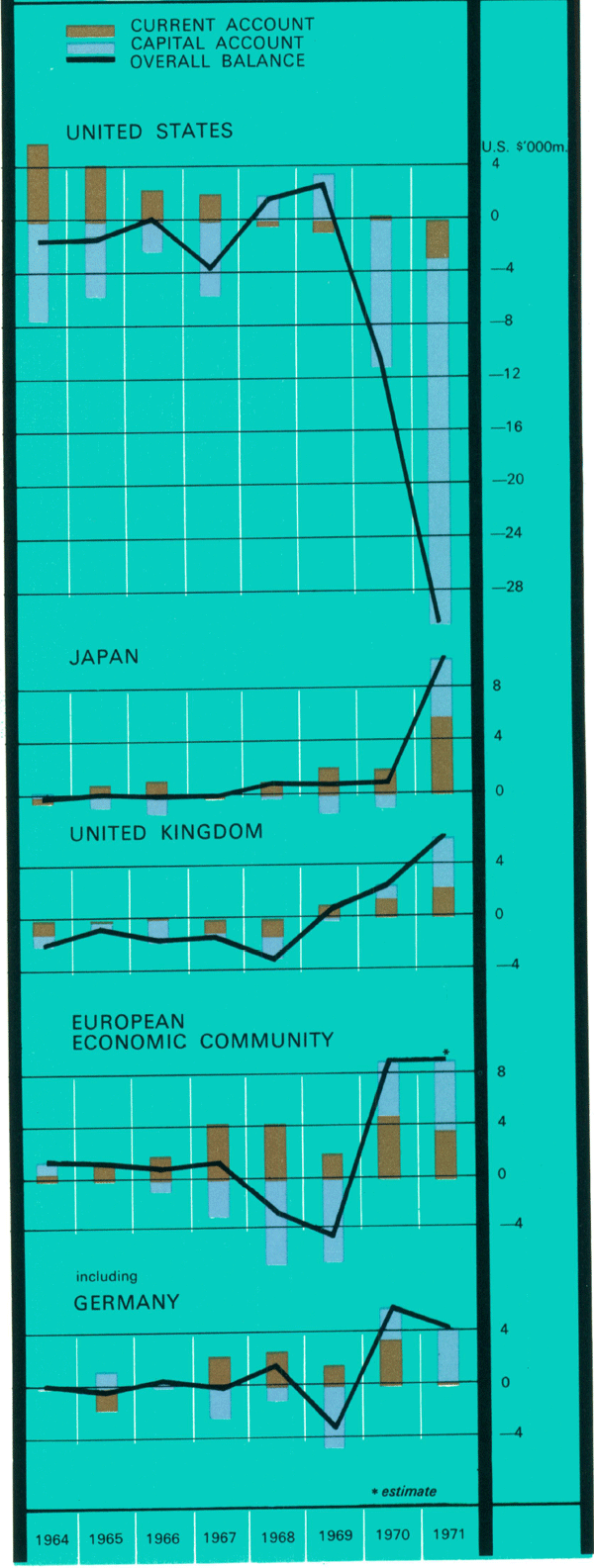
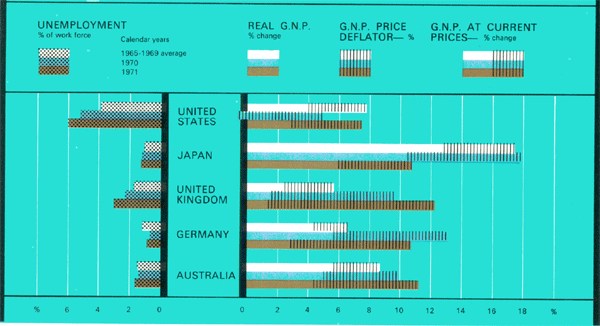
A number of other major countries—Canada, France, Japan, and Italy—achieved some reduction in rates of price increase in 1971 but most had a significant margin of unused capacity, including slack labour markets. Most had adopted expansionary policies including moves to ease monetary conditions. Canada probably had the most moderate rate of increase in prices—a little over 3 per cent—but had relatively high unemployment. Of the rates of inflation experienced by other major countries, that of almost 8 per cent in Germany was apparently the highest. Activity in that country eased during 1971 from a very high level but improved in early 1972. Its exports and foreign exchange reserves grew strongly to record levels despite the appreciation of the deutschemark, but the rate of price inflation was easing. Output in Japan expanded by about 6 per cent during the past year but this was the lowest rate of growth for about six years and as the year closed the margin of slack in the economy was wide. Its currency appreciation during the latter part of 1971 probably added to the effects on activity in Japan of cyclical factors and earlier domestic measures, but seemed to have little immediate effect on the large trade and balance of payments surpluses; the possibility of a further appreciation of the yen was one element in the uncertainties which developed in foreign exchange markets following the floating of sterling in the last week of June 1972. Graphs 3 and 4 depict indicators of the performances of some countries.
3 BALANCE OF PAYMENTS SELECTED COUNTRIES
4 PRODUCTION, PRICES & UNEMPLOYMENT-SELECTED COUNTRIES
Substantial movements in exchange values including the formal realignment of currency relationships in December clouded interpretation of trends in prices in international commodity markets. Moreover, the dampening of growth of international trade which resulted from a downturn in demand in some countries, uncertainties about exchange rates and the barriers restraining imports to the United States, affected the actual course of commodity prices. Demand for a number of agricultural commodities strengthened during the year and there was some increase in prices. Wool prices declined to a very low point in mid-October but, following a recovery which quickened in February, reached a level at the end of the year about 50 per cent above the average for 1970/71. Sugar prices rose steeply in response to an excess of world consumption over current production. Prices for dairy produce also rose strongly. Meat prices in markets other than the United States were high, largely because of reduced supplies from Argentina; during the first half of the year meat prices in the United States, Australia's major market, declined from their previous high level but rose in the second half by an amount which, even after the United States devaluation, raised the Australian dollar price received for our exports. In the last week of June the United States announced the suspension of import quotas for meat for the remainder of 1972. Prices for wheat and other cereals were at high levels early in the financial year but declined as it became evident that harvests in parts of the Northern Hemisphere were much larger than in the previous year. Prices of non-ferrous metals declined early in the year in response to a downturn in activity in Japan and other major economies but in some cases they improved towards the end of the financial year. Demand for iron ore and coal grew much less strongly than in other recent years.
The increasing balance of payments difficulties of the United States continued to reflect in foreign exchange markets as 1971/72 opened. During recent years its external position had weakened both through a substantial decline of the balance of trade and through an increasing outflow of capital; in 1971 its balance of payments deficit reached almost US $30,000 million. The increasing outflow of capital occurred partly in response to interest rate differentials between the United States and elsewhere, including the Euro-currency market. These differentials against the United States had become pronounced in late 1970 and early 1971, as it moved to a more expansionary monetary policy while the major European countries generally maintained tight monetary conditions in order to restrain spending. But speculative motives were also at work as investors adjusted portfolios in attempts to benefit from any appreciation of currencies against the U.S. dollar; borrowers attempted to incur (or substitute for other liabilities) obligations denominated in U.S. dollars while holders of assets sought to switch to stronger currencies.
Because of the reserve status of the U.S. dollar, the continuing balance of payments deficit of the United States added greatly to foreign official holdings of dollars in 1971/72. International liquidity was further augmented in January by a third allocation, of about 3,000 million units, of Special Drawing Rights by the International Monetary Fund. The total increment (approximately SDR25,000 million or US $35,000 million) to international liquidity during 1971/72 was even greater than the previous record total of a little over SDR20,000 million or US $20,000 million during the preceding year.
Given the continuing external deficits of the United States, its dominance in world trade and finance and the system of generally fixed exchange rates, inflation in the United States is, inevitably, an international problem. The inflationary consequences of the balance of payments surpluses which other countries experienced as the counterpart of the United States deficits intensified their concern about the external position of the United States. The transmission of price increases between countries is complex; there is not only the direct effect of increases in import prices but also, and very importantly, the pressures on domestic prices which arise from ability to raise profits or wages in those industries which sell abroad and those which are in actual or potential competition with goods and services produced abroad. In addition, there can be monetary expansion in countries experiencing external surpluses.
The U.S. dollar remained the basic international reserve currency and unit of account and the currency against which most other countries intervened to support their own currencies. But increasing doubts about its stability and convertibility brought about decisions to change its exchange value in relation to other currencies and to vary other aspects of international monetary arrangements. The formal suspension in August by the United States of the convertibility of the dollar into gold or other reserve assets and the imposition of a 10 per cent surcharge on about half of its imports were aimed at producing a substantial turnaround in the balance of its international payments. As well as pressing for some reduction in tariffs and other barriers against its exports, and some greater sharing of defence burdens, the United States made clear its view that there was a need for surplus countries to appreciate their currencies substantially against the dollar; because of the pivotal role of the dollar in the international monetary system it was claimed that the United States could not unilaterally depreciate the dollar.
This created a dilemma for many countries, particularly European countries and Japan; for in determining their responses to the United States measures, individual countries had to consider likely moves by other countries, as well as the subsequent policy of the United States towards the official price of gold and the surcharge on imports. A number of countries reported fairly widespread pessimism among businessmen about the economic outlook, in part because the United States measures had provoked fears about further governmental interference with and restrictions on capital flows and international trade. Essentially, however, each country had to decide whether to remain in external surplus and, if a reduction in surplus was thought necessary for domestic or international reasons, how this might be best achieved. There are various ways by which a country can seek to reduce an external surplus. Exchange appreciation is one. Less general but similar effects can be obtained by reductions in tariffs or in export subsidies. Expansion of domestic demand will also tend to reduce an external surplus. The level of net capital inflow may be dampened by reducing domestic interest rates in relation to external rates, by specific regulation, by discriminatory taxation or interest arrangements, by special deposit requirements, or by intervention in forward exchange markets.
The continuing weakness of the U.S. dollar over recent years and the existence of inflationary forces led most of the major industrial countries to consider appreciation of their currencies against the dollar as part of their adjustment to the United States measures. Most accepted, at the least, some need to reduce their external surpluses. For, although variations in a country's reserves can usefully absorb short term fluctuations, it is difficult for a country to continue to accumulate reserves without experiencing the strains of speculative shifts into its currency and of domestic inflation. Moreover, a country which does not establish the conditions to prevent an excessive accumulation of reserves forgoes some potential consumption or capital formation. Particularly when there is inflation abroad or a decline in the exchange value of the reserve currency, the marginal real rate of return on international reserves is likely to fall short of the return which might for example accrue to an increase in domestic investment. Then again, the accumulation of reserves as an alternative to additional imports will tend to go with some increase in, or introduction of, inflationary forces in the domestic economy. These inflationary forces can tend to erode any immediate advantage offered the export and import-competing sectors by the particular exchange rate and other conditions which underlay the excessive accumulation of reserves; in the process, increased supplies of goods and services may be made available on domestic markets but achieving this by way of inflation is not an ideal method of adjustment.
Appreciation contributes to solving these difficulties by encouraging a reduction in trade surplus or an increase in trade deficit, with some diminution of pressures on domestic prices. If this leads to some slackening in the domestic employment situation, expansionary domestic policies could then be appropriate. Appreciation can also point up the need for reallocation of resources in some sectors of the economy. However these changes take time and may therefore be of only limited impact if other countries continue to inflate.
Responses to the United States measures also had to take account of the international mobility of capital. The existence of a number of currencies which appeared to be undervalued in relation to the U.S. dollar—that is in the context of the existing trade regulations, rates of inflation and capital controls—suggested that fixed interest assets in those currencies were an attractive form of investment and that borrowing in U.S. dollars was good business. Equity in the respective countries' domestic assets would also have seemed cheap, in terms of weaker currencies, for a time—while domestic market valuations were adjusting to take account of the effects of the undervaluation. In general, investors seem likely to direct capital into fixed interest assets in countries whose exchange rates they think are likely to appreciate and, initially, into equity investments in countries which they think less likely to appreciate undervalued currencies. Of course these judgments can vary between investors and individual investors may choose to diversify their investments because of the inherent uncertainties. In some circumstances, countries can achieve the objectives of external and internal balance under a system of fixed exchange rates through appropriate use of monetary and fiscal policies; a country in disequilibrium can for example influence the cost and availability of domestic finance to encourage capital inflow or stimulate outflow. Such policies can militate against efficient international allocation of capital. Moreover, if the disequilibrium in the balance of payments is sizeable, it may be impracticable to implement monetary and fiscal measures to the extent needed to restore external and internal balance. The options for a country in these circumstances are to adjust exchange rates, to attempt to control trade or capital flows directly, or to sacrifice pursuit of one or more objectives of policy.
It took some time for countries to weigh these matters and decide their policies; uncertainties about exchange rates continued for four months after the announcement of the United States measures in August. During this period, most major industrial countries allowed their exchange rates to float, subject to official intervention in foreign exchange markets to control the extent of appreciation of their currencies against the U.S. dollar. There was more intensive use of exchange controls, two-tier exchange markets and interest embargoes. At the Annual Meeting in September of the International Monetary Fund, the Board of Governors adopted a resolution which had been submitted following meetings between Ministers of the Group of Ten countries and other major international bodies. The resolution called on Fund members to collaborate with each other and with the Fund in order to establish, as promptly as possible, a satisfactory structure of exchange rates maintained within appropriate margins. It also called on the Executive Directors of the Fund to report without delay on measures necessary or desirable for the improvement or reform of the international monetary system, with special reference to the role of reserve currencies, gold and Special Drawing Rights, convertibility, the provisions of the Articles with respect to exchange rates and problems caused by destabilising capital movements.
In December the Group of Ten countries agreed to currency realignments which reduced the value of the U.S. dollar against other major currencies. Japan, Germany and the Benelux countries appreciated their currencies against gold. The United Kingdom and France retained their existing gold parities and Italy and Sweden depreciated their currencies by 1 per cent. The Canadian dollar continued to float, Canada having adopted a floating rate in 1970. The United States agreed, subject to satisfactory progress being made in trade negotiations with the European Economic Community, Canada and Japan, to depreciate the U.S. dollar against gold by 7.9 per cent and to eliminate the surcharge on imports which had been imposed in August. The International Monetary Fund agreed to the temporary use of central rates, or provisional par values, by countries which considered they could not determine their par values until the United States parity had changed and exchange markets were less unsettled. At the same time the margins for permissible exchange rate fluctuations on either side of parity (or central) rates were widened temporarily (pending longer term reform) from 1 per cent to 2.25 per cent, to permit some greater flexibility in the movement of market rates. Use of wider margins could enable countries to reduce the risk of destabilising flows of capital and thus provides greater scope for independent monetary policies; or it could enable them to achieve some correction in their current account positions. Subsequently, as a step towards closer monetary unity, the member countries of the European Economic Community agreed to contain fluctuations between each other's currencies within half the margin permitted by the Fund. The United Kingdom, Denmark and Norway entered this arrangement shortly afterwards.
During the months of uncertainty and instability in foreign exchange markets until the formal realignments in December, the Australian dollar retained its link with sterling and for a time therefore floated with sterling against the U.S. dollar. We continued to add substantially to our holdings of foreign exchange; exports rose more strongly than imports but the increase in reserves owed a good deal to the inflow of private capital which continued at the high level attained towards the end of 1970/71.
In the light of the decisions on realignment of the major currencies the gold parity of the Australian dollar was retained. This amounted to an appreciation of approximately 8.6 per cent against the U.S. dollar. The Government, however, took advantage of the wider margins now permitted by the International Monetary Fund and established a market rate for the Australian dollar at the lower end of the band—an appreciation against the U.S. dollar of about 6.3 per cent on the previous parity relationship and a small depreciation against sterling. The Government also decided that exchange rates for the Australian dollar would be fixed on the U.S. dollar rather than, as previously, on sterling. Subsequently, the U.S. dollar was mostly weak with the result that there was actually a greater degree of depreciation of the Australian dollar against sterling and other major currencies in terms of market rates than that indicated by comparison with parity or central rates.
Late in June the United Kingdom, which had experienced a run-up in its external liabilities and reserve assets, was the target of a sudden and very sharp outflow of capital. This reversal was apparently mainly speculative in origin, but may in part have been based on a possible further deterioration in the United Kingdom's external trade position following its poor relative price performance and stronger domestic demand. The U.K. authorities reacted promptly and firmly by freeing their exchange rate to float and by making supporting changes in their exchange control arrangements.
This decision took sterling outside the arrangement with EEC and certain other European countries to contain fluctuations between each other's currencies within half the margin permitted by the International Monetary Fund; Denmark also withdrew from that arrangement from 27 June. By 30 June sterling had depreciated in foreign exchange markets to about 6 per cent below its parity. A number of other currencies strengthened against the U.S. dollar, perhaps because of some apprehension in the markets that the United Kingdom's action could possibly serve as a catalyst for a somewhat wider revision of existing currency relationships during the early part of 1972/73.
5 EXCHANGE RATES
AUSTRALIAN DOLLAR
AGAINST SELECTED
OTHER CURRENCIES
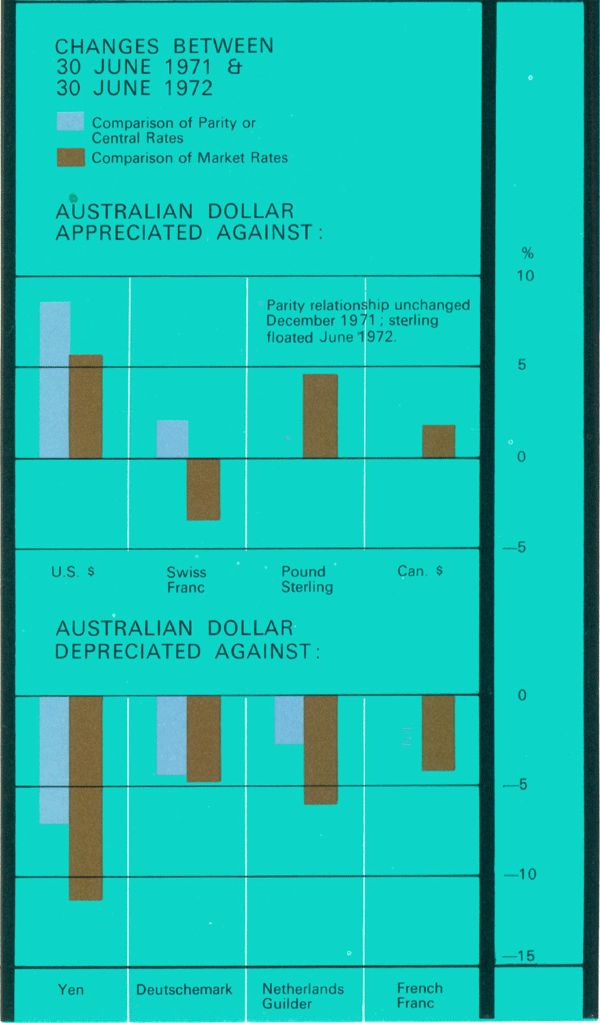
Graph 5 depicts changes over 1971/72 in exchange relationships between the Australian dollar and certain other currencies based on official parities (or central rates) and on market rates. The realignments in December resulted on average in a slight overall depreciation of the Australian dollar against the major world currencies and in terms of market rates the depreciation has, during most of the period since the realignments, been greater. At least until relative prices adjust, this should tend to produce further increases in Australia's international reserves. The consequences, especially in the short run, will also depend on the impact which the realignments have on levels of economic activity in the economies of the major importers of Australian goods. As has already been noted, there has for example been a reduced rate of economic growth in Japan during the past year and this may have been attributable to some extent to currency uncertainties.
During the year, the Sterling Guarantee Agreements between the United Kingdom and other members of the sterling area including Australia were renewed until September 1973. The new agreement provided in Australia's case for a reduction from 40 per cent to 36 per cent in the proportion of reserves required to be held in sterling. The disposition of Australia's reserves during 1971/72 is outlined in a later section.