
Reserve Bank of Australia Annual Report – 1972 The Australian Economy
Affected particularly by uncertainty on the part of both producers and consumers about economic trends, aggregate real spending grew only slowly during 1971/72; it was insufficient to sustain expansion of activity at the rate achieved in immediately preceding years. Exports grew very strongly, public spending and outlays on housing rose fairly strongly but consumption grew only modestly and there was a decline in private business investment. As the year closed however, it appeared that there was some strengthening in consumption, that the decline in business investment had almost run its course and that some acceleration in aggregate spending was in prospect.
The trend in spending during 1971/72 was reflected in almost static industrial production and the rate of growth in civilian employment declined sharply. Registered unemployment rose from 1.2 per cent to 1.9 per cent of the work force between June 1971 and June 1972. Prices continued to rise strongly. The lags between rises in costs and subsequent adjustment of profit margins meant that prices were still being influenced by earlier increases in costs. However earnings also continued to increase strongly. Although at the end of the year the rate of increase in prices had eased a little, an early return to the lower rates of inflation experienced a few years ago seemed unlikely.
With a much reduced current account deficit and a very high level of capital inflow there was a rise over the year of almost $1,500 million, or 65 per cent, in Australia's international liquidity.
Financial conditions were generally very easy, influenced by the external surplus and the Government's fiscal operations and facilitated by a shift to an easy monetary policy. With heavy demand for government paper and a decline in domestic private capital raisings there was a general reduction in interest rates. Financing by some intermediaries grew only moderately. Share markets were depressed during the early months of 1971/72 but recovered strongly from about the end of November until the end of June when there was a sharp reaction to the floating of sterling and the extension of the United Kingdom's exchange controls to capital transactions with residents of overseas sterling area countries.
SPENDING
In current prices, gross domestic expenditure expanded by about 8 per cent in 1971/72. This was a little less than the increases in the previous two years and, when deflated for the change in price levels, represented a rise of only about 1 per cent, the lowest increase for ten years; the growth in real spending in 1970/71 had been over 3 per cent and there had been an average annual increase of approximately 5 per cent during the past ten years. Strong export sales added to the call on domestic resources but, in the face of reduced pressure of domestic spending, imports did not increase and the excess of exports over imports of goods and services rose very sharply.
As a result of reduced public expenditure and private business investment, aggregate domestic spending had declined in real terms during the concluding quarter of 1970/71. In the early months of 1971/72 public expenditure resumed an upward trend but private business investment remained depressed and, apart from a short-lived upsurge in purchases of motor vehicles, consumer spending showed little strength. A fall in investment in the mining sector was associated with the completion of some major projects and, apparently, a downward revision of expectations about demand for ores and concentrates, especially from Japan. Apart from this, the increasing caution of both producers and consumers because of uncertainties about trends in the domestic economy and in overseas markets appears to have resulted in some trimming of expenditure. However, in the face of a number of policy initiatives and other developments, some of the uncertainties and pessimism began to dissipate later in the year and, at the close, a gradual acceleration in demand seemed in prospect.
Personal Consumption
In real terms, the increase in consumption during 1971/72 appears to have been a little less than the 3 per cent recorded in 1970/71 and an average of almost 5 per cent during the previous four years. Few components of consumer spending grew strongly. Retail sales were sluggish, particularly around Christmas. Purchases of new motor vehicles continued to be subdued, except for a short time just prior to the 1971/72 Budget.
Personal consumption grew less in 1971/72 than personal disposable income and the savings ratio was historically high. There are commonly lags before increases in incomes are followed by changes in spending, but worries about unemployment and economic prospects generally could also have influenced the level of savings. The earlier reduction in the value of assets following rises in interest rates during 1970 and a general reduction in share prices might also have continued to dampen consumption for a time in 1971/72. The restrictive impact of these factors appears, however, to have diminished during the second half of the year. In addition, fiscal measures announced in April added to personal disposable incomes although these were still not rising as fast as in 1970/71. The strengthening in personal consumption, evident in figures for the March quarter, seemed to be continuing as the year ended.
PRIVATE FIXED CAPITAL EXPENDITURE
During 1970/71 only the dwellings component of private investment had failed to grow strongly; in the past year this item recovered quite strongly but business investment was weak.
The strong growth of private non-dwelling investment in 1970/71 had, in particular, included increased expenditure on office construction and in the mining industry and associated smelting and refining industries in the manufacturing sector. The latter groups experienced a marked reversal in 1971/72; this was especially significant as they had come to represent an important component of the total following substantial expansion over the previous three years. At the same time the rate of growth in office construction began to slacken and investment by other groups was being affected by the weakness in domestic demand.
The need for projected exports of ores to be renegotiated to below specified contract minima, together with the downturn in the growth of demand for concentrates and coal, offer indications of a less rapid than expected rate of growth of mineral exports, and in turn of the mining sector, perhaps for at least the next few years. It remains to be seen whether development of other resources, for example natural gas, will assume a pace-setting role.
An early return to brisk growth in office construction does not seem in prospect. So far as other business investment is concerned, the decline in interest rates during the year and the restoration in February of the investment allowance could be expected to offer some stimulus—but these measures take time to work. In addition, excess capacity in many fields suggests that recovery of investment will depend heavily on revisions of expectations about sales.
Private investment in dwellings grew in 1971/72 by about 12 per cent—or by approximately 4 per cent in real terms as against a fall of 2 per cent in 1970/71. The growth in this element of private investment was aided by ready availability of finance from the major lenders. Local government approvals for and commencements of private cottages both rose during 1971/72 to new peak levels. Early in the year the overall growth of private investment in dwellings was dampened by continued sluggishness in construction of flats and home units. However, here also there were signs of re-surging confidence in the second half. Overall, there was a rise of almost 10 per cent in aggregate private commencements of dwellings during 1971/72.
Public Expenditure
Spending by the public sector, which had been curtailed late in 1970/71, increased in the September quarter and was then maintained at a high level over the remainder of the year. In current prices, Commonwealth spending rose over the previous year by about 12 per cent and that of state and local authorities by about 15 per cent; the increase in the aggregate was about 14 per cent. In real terms, the aggregate rose by about 4 per cent compared with 3 per cent in 1970/71.
Within the year, public spending in the first half was boosted by purchases of civil aircraft from overseas but in the second half domestic spending increased markedly; for the year as a whole there appears to have been little change in the proportions of the public sector's spending in Australia and overseas.
Commonwealth cash benefits to persons rose during 1971/72 by about 16 per cent. The impact of these transfer payments on expenditure depends of course on their effects on the spending of recipients; as already indicated, they presumably were a factor in the strengthening of consumer demand late in the year.
EXPORTS
Despite reduced rates of growth in several of Australia's major trading partners, exports of goods and services increased during 1971/72 by a little over 12 per cent. In constant prices the increase during the latest year was between 9 and 10 per cent; this was above the 8 per cent achieved in 1970/71 although well below the 19 per cent recorded in 1969/70. Export prices declined a little during the early months of the year but rose in the second half to a level in May about 7 per cent higher than 12 months earlier (Graph 8). The rise would have been influenced to some extent by the effects of exchange rate changes between the Australian dollar and the currencies of trading partners, as well as by fluctuations in commodity prices; there was an increase of about 10 per cent between December, when exchange rates were realigned, and May.
The rise in total proceeds of exports of goods and services comprised an increase of 8 per cent in receipts for services and a rise of 13 per cent in exports of goods. The increase in receipts for services was due mainly to transportation earnings. Within the aggregate of exports of goods, non-rural exports rose at almost the same rate as in 1970/71 while exports of rural origin, which had been almost stationary in that year, grew more strongly than non-rural exports. Exports of manufactured goods and foodstuffs rose strongly while the value of wool and sheepskins shipped increased a little after having fallen by 28 per cent in 1970/71. Proceeds from ores and concentrates grew by 6 per cent, markedly less than the 22 per cent increase in 1970/71. Much of the recent growth in ores and concentrates was accounted for by alumina; exports of iron ore were almost unchanged, as against a rise of 35 per cent in the previous year.
The growth in exports of wool was largely accounted for by an expansion in volume; production of shorn wool declined slightly but the quantity exported was boosted by a net reduction of stocks of the Australian Wool Commission; early in the year prices declined and the Commission bought heavily, but a sharp improvement in the second half enabled it to sell in substantial volume. The proportion which wool contributed to total proceeds of exports declined a little further during 1971/72, to a new low of 13 per cent; two years ago it was 21 per cent.
Exports of other rural commodities were generally buoyant. World consumption of sugar, which was boosted by large purchases by the U.S.S.R., exceeded current production by 5 per cent and its price in the international market rose steeply; Australia's exports rose from the previous year by about 30 per cent in volume and 40 per cent in value. The U.S.S.R. also made heavy purchases of grains and these halted a decline in world cereal prices which was developing in response to large harvests in parts of the Northern Hemisphere. Exports of wheat slipped a little from the sharply increased level of the previous year but with greater exports of barley and grain sorghum, cereals exceeded the high level of 1970/71. Exports of beef and mutton increased sharply. The United States remained the main buyer—despite dock strikes—but an expanding market in Japan was an important factor in the increase.
STOCKS
Following large increases in 1969/70 and 1970/71 there were much smaller additions to stocks of non-farm products during the latest year. This apparently reflected attempts, in the face of sluggish spending, to moderate expansion of inventories and, in some cases, to reduce excess holdings which built up during 1970/71; the smaller expansion of inventories was, in turn, a significant factor in the slowdown in growth of aggregate demand. The Australian Wool Commission, whose holding of wool is included in non-farm stocks, achieved a substantial net reduction over the year.
The level of farm stocks declined for the second year in succession. Despite the increase of about 10 per cent in wheat harvest, stocks held by the Wheat Board declined by about 35 per cent over the year. However, delivery quotas for the 1971/72 season have been expanded by 20 per cent; should these quotas be fully met, a further increase in sales overseas would be required if stocks are not to revert to high levels.
SUPPLIES
Dampened by the slower growth in spending, there was a less rapid increase during 1971/72 in domestic production and employment and there was no growth in imports. Graph 6 shows percentage movements in national turnover of goods and services and the contributions of major items to those movements.
PRODUCTION
The rate of growth of real gross national product is estimated to have declined from just over 4 per cent in 1970/71 to about 3 per cent in 1971/72; the increase in real non-farm product seems to have been about 3 per cent against about 4.5 per cent in 1970/71 and 6 to 7 per cent in each of the previous three years. Real farm product expanded somewhat faster than in 1970/71.
Rural production in 1971/72 benefited from generally favourable weather, and pastures and stock were mostly in good condition. It is estimated that, overall, the volume of rural output rose by about 5 per cent. The wool clip was down by about 2 per cent largely because of a reduction in numbers shorn. Slaughtering rates for sheep rose dramatically and mutton production increased by about 25 per cent. Beef production increased by about 10 per cent, even though cattle numbers were increased substantially over the year (by about 15 per cent). The wheat harvest rose by about 10 per cent despite reduced yields in New South Wales. There was also an increase of about 10 per cent in output of sugar and production of barley again rose sharply. Dairy production declined a little.
Output of the mining sector was higher in 1971/72 but the rate of growth of output of many minerals slackened markedly as local and overseas demand grew less rapidly. Production of iron ore, bauxite, oil, and natural gas was much higher than in 1970/71 but showed little tendency to rise further during the year. Output of nickel and lead ores declined whilst production of other non-ferrous metal ores rose moderately. Output of coal was only a little higher than in the previous year.
During most of 1971/72 industrial production was no higher than the levels achieved in the middle of the previous financial year and in some months, notably in the early part of 1972, was somewhat lower. This was in no small way due to weakness in private business investment and it seems that aggregate output of items such as machinery, transport equipment and building and construction materials was little if any greater than in 1970/71. Among the categories of durable items only furniture and household goods seem to have risen above 1970/71 levels. Overall, output of non-durables was also sluggish although chemicals rose fairly strongly and output of food, drink and tobacco seems to have shown a moderate rise. Output of fuel and power continued to increase fairly rapidly.
EMPLOYMENT
The rate of growth of the labour force declined to about 2 per cent in 1971/72 compared with about 3 per cent during the previous year and 3.5 per cent during 1969/70. The slower expansion reflected, particularly, a decline in female participation in the labour force; this had previously been growing quite strongly and females had represented an important part of the increase in numbers at work over recent years. There was at the same time a very sharp reduction in net migration, which declined by more than 50 per cent following falls of about 10 per cent in each of the preceding two years; the reduction in net migration may have been a factor in the decline in participation rates for both males and females.
6 CHANGES IN NATIONAL
TURNOVER OF GOODS AND SERVICES
Contribution of components to half-yearly percentage changes
Constant prices; seasonally adjusted
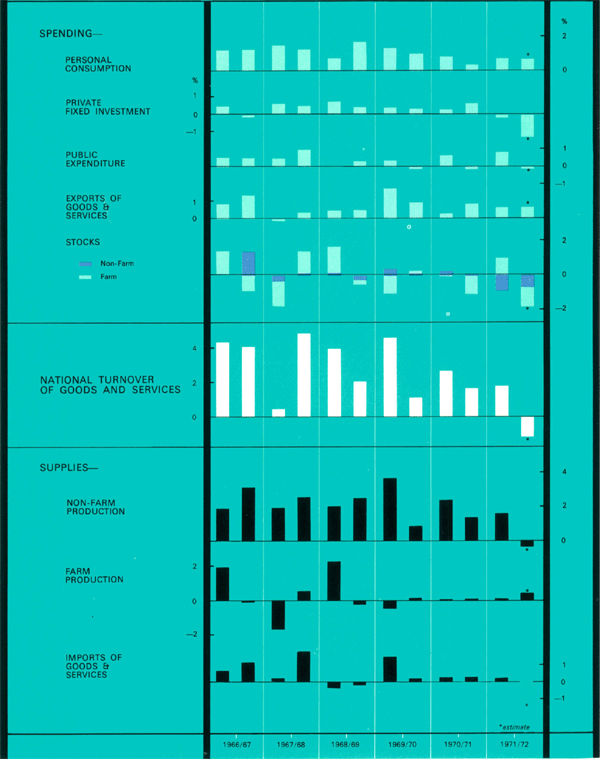
Civilian employment grew by only a little over 1 per cent during 1971/72 in contrast with increases of 3 per cent and 4 per cent in 1970/71 and 1969/70 respectively. Government employment expanded by about 4 per cent, which was somewhat faster than in 1970/71, but private employment showed little net change over the year. Employment in manufacturing turned downwards after November, having fluctuated about its opening level during the earlier part of the financial year, and there was also a reduction at about that time in overtime being worked in factories. Employment in building and construction was also fairly steady in the early months of the year but picked up around the time many were being hired under the Government's scheme for relief of non-metropolitan unemployment. Total employment in tertiary industries continued to grow fairly strongly but at a rate markedly lower than in other recent years.
The reduced rate of growth in employment reflected in an increase in registered unemployed despite the slower growth in the work force. Registered applicants (seasonally adjusted) totalled 104,900 at June 1972, an increase of about 35,000 over the level of June 1971. The number of vacancies declined from 40,700 to about 31,400 over the same period. The number of registered applicants in country areas rose significantly in the early months of 1971/72. There was then little change between December and April, when many were being hired under the Commonwealth's scheme for relief of non-metropolitan unemployment, but there was a further increase during the closing months of the year. The number of applicants in metropolitan areas, on the other hand, rose strongly until about March, after which it appeared to level off.
The number of registered unemployed at June 1972 represented 1.9 per cent of the work force. During 1970/71 the proportion registered as unemployed had risen from 1.0 per cent to 1.3 per cent. The rate of growth of production had already tended to decline during that year. Initially such a decline tends to be reflected to a significant extent in a fall in productivity (including effects of reduced overtime) as employers wait to see if a slackening in demand continues; there are costs involved in training new employees and in dismissals and hiring. If the slowdown in demand persists it then tends to be associated with increased unemployment.
In fact, in the face of continued slackness in demand, the deterioration in the labour market quickened in the early months of 1971/72; the percentage of the work force registered as unemployed rose during the September quarter to about 1.5 per cent and then to a little over 1.6 per cent in December and almost 1.8 per cent by March. In the light of these developments a number of measures was taken in the concluding months of 1971 and the early months of 1972. Measures which would have had the effect of directly reducing the growth in unemployment were, firstly, the postponement of arrival of 3,000 migrants and, secondly, the introduction in December 1971 and expansion in February and June 1972 of the Non-Metropolitan Employment Creating Grants. The number of persons provided with employment as a result of the latter measure reached almost 14,500 in May, before falling to about 12,000 in June. General measures were also taken to boost spending and, ultimately, contribute to reducing unemployment; these were various changes in monetary policy, outlined in a later section, and additional fiscal measures in the form of increased grants to the states and increases in their loan programmes, re-introduction of the taxation allowance on investment in manufacturing plant, increases in social services benefits and a reduction in the personal income tax levy.
Such measures affect spending and output with varying lags. There are usually further lags before effects on employment occur. The initial impact is often on productivity as employers make more intensive use of existing labour (less short-time, more overtime, etc.) and equipment. Only as existing capacity is more fully employed can a substantial rise in the demand for new labour be expected; moreover, some of this is likely to be met from people re-entering the work force. Even so, in the closing months of the year it seemed that there had been at least a check to the rate of growth in unemployment.
IMPORTS
In current prices, imports of goods and services increased by only 2 per cent from the level in 1970/71; this contrasts with increases of about 8 and 12 per cent respectively in domestic spending and exports of goods and services. In constant prices, domestic spending grew by about 1 per cent but imports were lower than in 1970/71, after rising by about 4 per cent in that year. Imports in 1971/72 were affected by such factors as the slackening in growth of domestic demand, dock strikes in the United States and the disruptions in foreign exchange markets in the early part of the year; the separate influence of currency realignments on the level or pattern of our imports was therefore not readily discernible.
Imports of civilian aircraft were appreciably higher than in the previous year, influenced in part by the arrival of four Boeing 747 aircraft. The outlay on petroleum was also greater, because of a sharp increase in prices, but there was a substantial reduction in imports of defence equipment. The remainder of imports also declined, even in current prices; they are more sensitive to short-term fluctuations and during 1971/72 represented a sharply reduced proportion of domestic expenditure. This proportion has ranged in recent years from just over 10 per cent to 12 per cent but during the latest year declined to about 9.5 per cent.
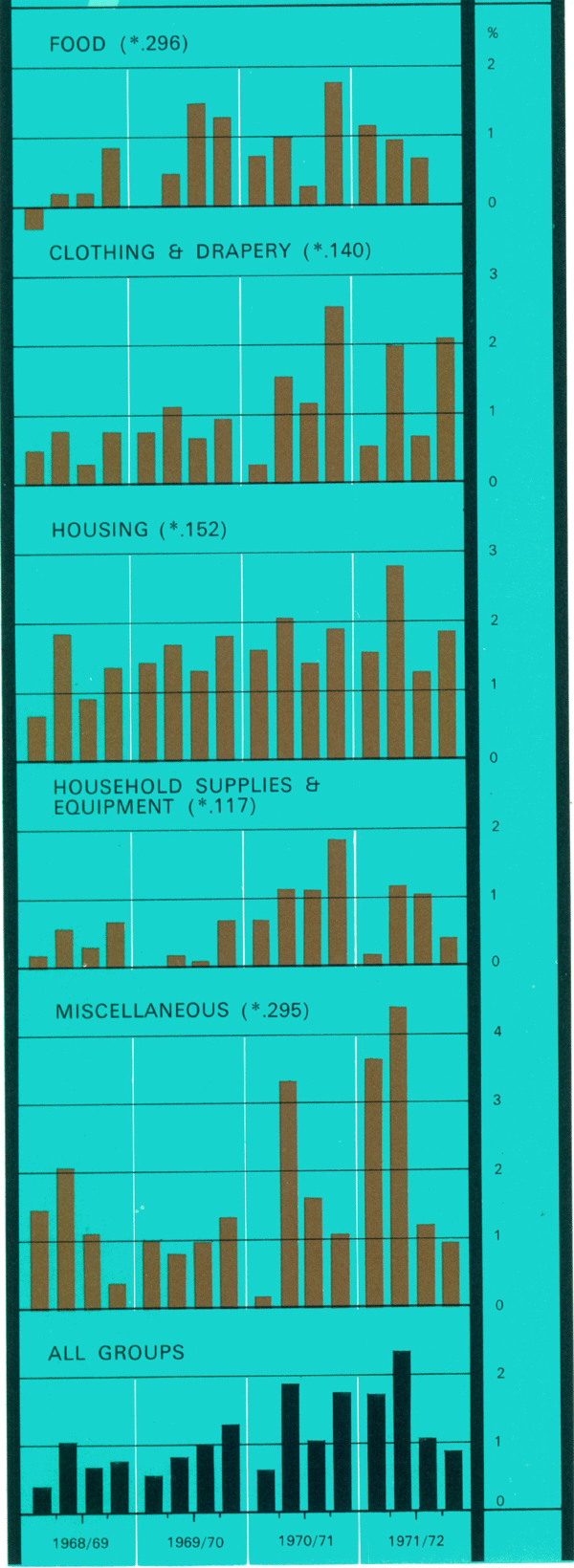
7 CONSUMER PRICE INDEX
Quarterly percentage change in components
current weight in index*
The combined effect of the zero growth in imports and the strong expansion in exports was a marked increase in the trade surplus—from a little over $400 million in each of the previous two years to about $970 million. At the same time, net payments for services increased only modestly and, with a strong rise in earnings on international reserves substantially offsetting a fairly strong rise in other current payments overseas, there was only a moderate rise in net transfer payments. As a result, the deficit on current account declined from approximately $820 million in 1970/71 to $398 million in 1971/72 (Graph 8).
INCOMES AND PRICES
Although minimum weekly wage rates grew strongly during 1971/72, the decline in demand for labour was reflected in a fall in overtime and some moderation in the growth of over-award payments. The rise granted in May in the national wage case was considerably smaller than that in the corresponding judgment in 1970/71 and was also announced much later in the year than is usual. There was, consequently, a small reduction from over 11 per cent to about 10 per cent in the growth of average weekly earnings. With earnings and employment both growing less rapidly, the rise of about 11.5 per cent in wages, salaries and supplements was below the increases of about 14.5 and 12 per cent recorded in 1970/71 and 1969/70 respectively. Nevertheless, wages, salaries and supplements appear to have increased as a proportion of non-farm factor incomes to about 64.5 per cent; this proportion had risen to about 63.5 per cent in 1970/71 after averaging about 62 per cent during the ten years to 1968/69.
During 1971/72 growth in the gross operating surpluses of companies and unincorporated non-farm enterprises appears to have been close to the rates of the previous year—about 3 per cent and 7 per cent respectively. The gross operating surplus of farm unincorporated enterprises, which fluctuates widely, had fallen by about 9 per cent in the previous year but rose again by about 8 per cent in the latest year; the Government's deficiency payments scheme for wool was a factor in this.
Although the rate of growth in average weekly earnings eased slightly in 1971/72, domestic prices rose more strongly. Inflationary pressures were evident in implicit deflators for the major components of gross national expenditure; growth in the cost to governments of current goods and services was particularly rapid. In the year to June 1972, the consumer price index rose by 6.1 per cent, which exceeded the recent peak increases of 5.4 per cent over 1970/71 and 4.0 per cent over 1964/65 and was the highest full-year increase since 1955/56 (6.3 per cent). Prices of non-food items rose by 7.6 per cent while those of food rose by only 2.8 per cent. Within the non-food category, prices of household supplies and equipment grew least strongly, and by rather less than in 1970/71.
Within the year there was considerable variation in quarter to quarter movements in the consumer price index. Much of this was attributable to special factors; for example the movement in the December quarter included increases in a number of governmental charges including excise duty, postal charges, fares, hospital fees and local government rates. Such charges typically are varied infrequently. Apart from these influences, it appears that the rate of increase of prices was accelerating during the first half of the year but may have eased during the second half.
As mentioned earlier, prices rose strongly overseas and this was conducive to inflation in Australia. The import price index (which covers only goods) rose by about 6 per cent but a recovery in export prices moderated the further deterioration of the terms of trade (Graph 8).
FINANCING AND MONETARY POLICY
Financial conditions eased considerably during 1971/72 and most groups added substantially to their holdings of liquid assets. There were large increases in Holdings of public securities and funds lodged with most financial intermediaries also rose rapidly. With private spending growing slowly, there was only moderate demand for loan funds by ultimate borrowers. Monetary and fiscal policies were eased significantly as the year progressed; interest rates fell and other monetary restraints which were tending to add to the cost and limit the availability of finance were relaxed.
The inflow of capital from overseas highlighted the growing integration of financial markets both within the economy and between Australia and overseas countries. It demonstrated also that funds moving from savers to spenders can take any of a number of courses. These range from direct lending between savers and final spenders to complex situations in which funds pass through series of intermediaries who collectively link final spenders with the financial resources of local and international money and capital markets. Increasing mobility of funds has been, and will continue to be, of major importance as background to the formulation of policy.
As 1971/72 opened, monetary policy was being directed to the maintenance of generally tight financial conditions. Rapid rises in award wages a few months earlier had added to pressures on costs and seemed to cause a resurgence in the growth of domestic prices. Policy was therefore seeking to ensure that excessive growth in spending did not add to the influences which were increasing prices. The authorities were selling government securities to meet a continuing firm demand for financial assets, interest rates were historically high and bank lending was under considerable restraint.
The Government had moved in the latter part of 1970/71 to reduce its own spending and had suspended the taxation allowance on investment in manufacturing plant. Early in 1971/72, it provided in its annual budget for a considerable increase in spending by the public sector but introduced revenue measures to guard against the emergence of excessive growth in private spending.
In the event, real private spending grew only slowly in the first few months, unemployment grew and it became apparent that demand pressures were not contributing significantly to the continuing inflation of prices. At the same time, very high capital inflow added to the seasonal impact of the Commonwealth's budgetary transactions to produce an abnormally strong rise in liquidity and there was downward pressure on yields, particularly on government debt. The new circumstances required a change in the mix of policy responses. There was little that restrictive monetary measures could do towards restraining the increase in prices without further dampening growth in activity. Moreover, a tight monetary policy could tend to be self-defeating in a context of fixed exchange rates and where there was some opinion that the Australian dollar was at least not over-valued and might perhaps be appreciated. It became gradually clearer also that the developing conditions called for some action to stimulate spending and activity.
During the remainder of the year a number of changes in the stance of monetary policy was therefore made to encourage growth of spending to levels more consistent with the economy's potential for growth. In October, the trading banks were informed that the Bank would not object to some increase in the level of new lending. Bond yields had already commenced to fall under the weight of continued heavy buying. Then, in December, the remaining official restraints on bank lending were removed. Trading banks were told that the Bank would favour increases in the level of lending and Statutory Reserve Deposit action was taken to give a general measure of support to bank lending. A little later, bond yields moved further downward and bank interest rates were reduced. In addition, fiscal measures were introduced at varying stages up to April, including a reduction in the levy on personal income taxation and increases in social services benefits.
EXTERNAL FINANCING
A general easing of monetary policies in major overseas countries and a tendency for capital to be attracted to stronger currencies created conditions highly favourable for the private sector of the Australian economy to arrange financing transactions overseas. Fears that restraints on inflow might be introduced could also have encouraged some speeding up of planned inflows. The outcome was that the net inflow of private capital during 1971/72 at $1,929 million far exceeded the deficit on current account; holdings of official reserve assets rose by 65 per cent to a new peak of $3,764 million. Aspects of the economy's international transactions can be seen in Graphs 8 and 9.
The net inflow of private capital had risen to very high levels of the order of $500 million (seasonally adjusted) in the June quarter of 1969/70 and the March and June quarters of 1970/71. On those occasions it had seemed partly to be a response to tightening (or prospective tightening) in domestic financial conditions; the growing international contacts of Australian business enterprises and the influx of financial intermediaries with international affiliations would have increased borrowers' awareness of and access to overseas sources of capital. However the inflow continued throughout 1971/72 at levels previously experienced only in periods of tightness. The lower interest cost of finance overseas generally continued to encourage Australian borrowing abroad; so also did the view held by some that the Australian dollar could appreciate against the U.S. dollar. In addition, the inflow during the early part of the financial year may to some extent have been the counterpart of a wish by some to move out of the U.S. dollar and other currencies about which doubts were held. Subsequently, the inflow continued unabated after the realignment of exchange rates, even though financial conditions had eased considerably and investment by the mining sector had declined; in earlier periods much of this investment had been associated with inflow from overseas. The sharp drop in confidence in sterling in the final weeks of the year probably provided some further stimulus.
8 BALANCE OF PAYMENTS
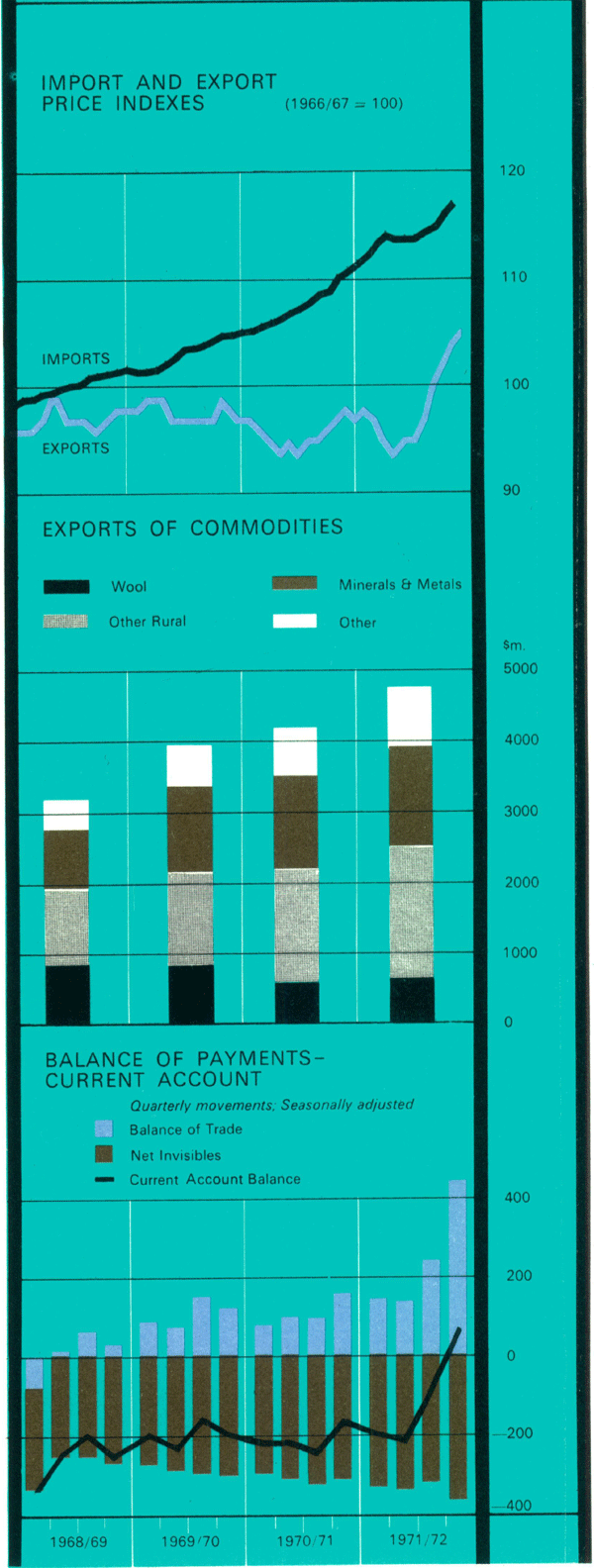
For a short period following the United States measures in mid-August, restrictions which were placed on foreign exchange dealings because of uncertainties about exchange rates affected capital movements into and out of Australia. Since the removal of those restrictions, banks have been required to sight specific Reserve Bank approval before converting inward capital remittances of $250,000 or more; this requirement enables the Bank to watch for possible transfers of large amounts of speculative capital into the country. In the event, a very large part of the increased inflow apparently took the form of borrowings overseas by enterprises in Australia and, while the greater part of the borrowing was by overseas owned or controlled enterprises, much of the growth was accounted for by enterprises which are predominantly Australian owned. Exchange control approvals, for example, were given for borrowings abroad which were about $460 million higher in total than in 1970/71, and of this increase over $280 million may have been accounted for by companies predominantly Australian owned.
The volume of capital inflow and the rapid growth of reserves during 1971/72 raise a number of issues for policy. These include the appropriate assignment of policy instruments and are discussed elsewhere in this report. The recent dramatic growth of reserves does however bring into particular focus several issues, including the guidelines policy relating to access by overseas owned or controlled companies to the Australian capital market and exchange control policy on capital flows. The guidelines policy was introduced in 1965 in response to overseas measures to restrict capital outflow from the United States and the United Kingdom. It was revised in 1969 with the aim of inducing overseas owned or controlled companies to admit or increase Australian equity participation; during 1971/72 it undoubtedly continued to encourage inflow to Australia, although the effect may have been reduced somewhat in the final quarter by a relaxation of the application of the policy to the working capital needs of finance companies. Exchange control policy continued to allow foreign capital to be transferred to and invested in Australia with a minimum of difficulty. At the same time, however, it continued generally to preclude portfolio investment abroad by Australian residents although, in the main, proposals involving direct investment overseas by Australian residents have been authorized. At the end of the year the Government had under review the general question of overseas investment in Australia.
9 BALANCE OF PAYMENTS &
AUSTRALIA'S
INTERNATIONAL LIQUIDITY
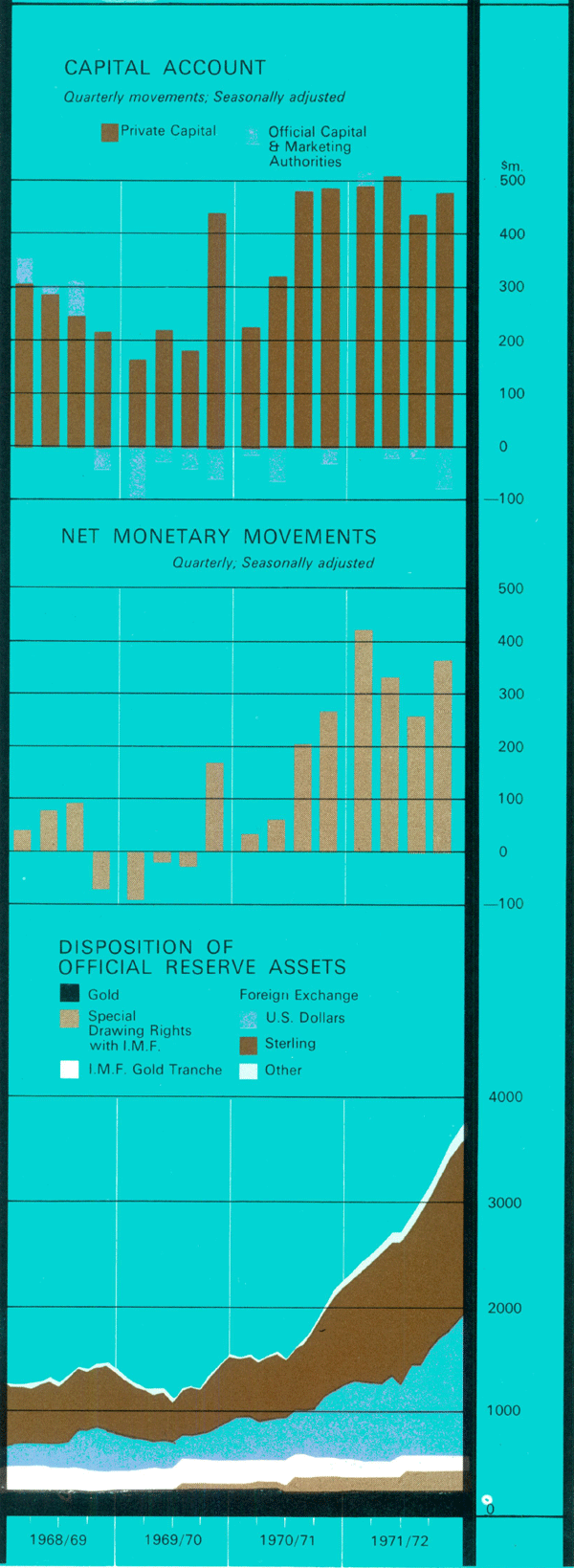
The disposition of a country's international reserves is influenced by several factors, including the unwillingness of many countries to act as hosts to foreign currency reserves of other countries. Most of Australia's foreign currency reserves continue to be held in sterling and U.S. dollars; the proportion in sterling at the end of 1971/72 was about the same as at the start. However there was some further diversification into other foreign currencies. The stock of gold has been virtually unchanged. The holding of Special Drawing Rights increased by $63 million with the addition in January of the last of the initial three allocations but the gold tranche with the International Monetary Fund declined by $37 million early in the financial year as a result of repayments in Australian dollars by other countries of drawings from the Fund. The table below summarizes the disposition of official reserve assets at the end of each of the past five financial years.
PUBLIC FINANCE
With a financial environment in which the private sector was highly receptive to new issues of government debt, even as yields declined more rapidly than rates on non-official paper, the Commonwealth Government achieved very large net domestic loan raisings of $720 million—in a year in which maturing domestic loans were high, at $939 million. The private sector also increased its holdings of government paper through open market transactions with the authorities. Indeed, over the first nine months of 1971/72 the private sector's holdings of bonds had risen by over $1,200 million while those of Treasury notes had risen by over $500 million; this is discussed later in the context of private liquidity.
| $ million | ||||||
|---|---|---|---|---|---|---|
| end June: | 1968 | 1969 | 1970 | 1971 | 1972 | |
| Gold | 230 | 231 | 241 | 227 | 233 | |
| Special Drawing Rights with I.M.F. | — | — | 79 | 146 | 209 | |
| I.M.F. Gold Tranche | 249 | 204 | 217 | 186 | 149 | |
| U.S. Dollars | 189 | 368 | 371 | 696 | 1,345 | |
| Sterling | 605 | 586 | 617 | 947 | 1,657 | |
| Other Foreign Exchange | 5 | 32 | 14 | 77 | 171 | |
| TOTAL | 1,278 | 1,421 | 1,539 | 2,279 | 3,764 | |
| * Holdings of gold and foreign exchange converted on basis of official parity relationships and not at market rates ruling at end June. | ||||||
The large net raising from loan operations far exceeded the Commonwealth Government's deficit of $187 million between revenue and expenditure. After meeting a reduction over the year of $10 million in Treasury notes on issue and including other financing transactions, there was a reduction of $567 million in net use of temporary financing with the Bank. In contrast, the deficit in 1970/71 was some $112 million smaller but net domestic loan raisings were approximately $500 million lower and net use of temporary financing with the Bank was reduced in that year by only $157 million. The contrast is apparent in Graph 10.
The larger deficit in 1971/72 arose from an increase in expenditure of $927 million or 11 per cent and a rise of $815 million or 10 per cent in revenue. The growth in revenue was dampened by the transfer to the states of payroll taxation but Financial Assistance grants to the states were reduced to offset most of the revenue forgone by the Commonwealth. Mainly reflecting the strong growth in earnings and the increased income tax levy, income tax collections from individuals increased by 19 per cent; collections from companies rose by 6 per cent. Collections of indirect taxes rose only a little; strong increases in excise and sales taxes were almost offset by the reduction in payroll tax collected by the Commonwealth.
Within the year, the buoyancy of subscriptions to the Commonwealth Government's loan operations and its tap issues of Treasury notes and special bonds was such that its net use of cash balances with, and recourse to temporary financing by the Reserve Bank grew to an end-of-month peak of only $453 million (at the end of December) despite the very high cumulative deficit of over $1,500 million (Graph 10).
Local and semi-governmental bodies generally had little difficulty during 1971/72 in raising their allocated programmes; private loans attracted particularly strong support. Raisings of new money by these bodies totalled $549 million including $49 million from public issues and $501 million from private loans. The aggregate in the previous year was $497 million. Movements in interest rates offered on public issues by these bodies, which are subject to maxima approved by the Australian Loan Council, corresponded fairly closely with those on Commonwealth Government securities; the top rate for public issues was reduced in November 1971 from 7.25 to 7 per cent and further in February 1972 to 6.3 per cent. The minimum period for which the top rate is payable was increased from 15 to 20 years in November.
PRIVATE SECTOR FINANCING
Spending does not appear to have been inhibited by any shortage of finance during 1971/72. The rapid rise in personal savings and the large surplus on external account have been mentioned. Financial intermediaries had no difficulty attracting funds and the growth in their liabilities outstripped the growth in their claims on the private sector: government paper remained in strong demand despite reductions in yields which enhanced the competitiveness of private paper; many intermediaries and direct borrowers who then faced heavy demand for their own issues reduced rates in sympathy with the reductions on government paper; share prices rose strongly from about the end of November.
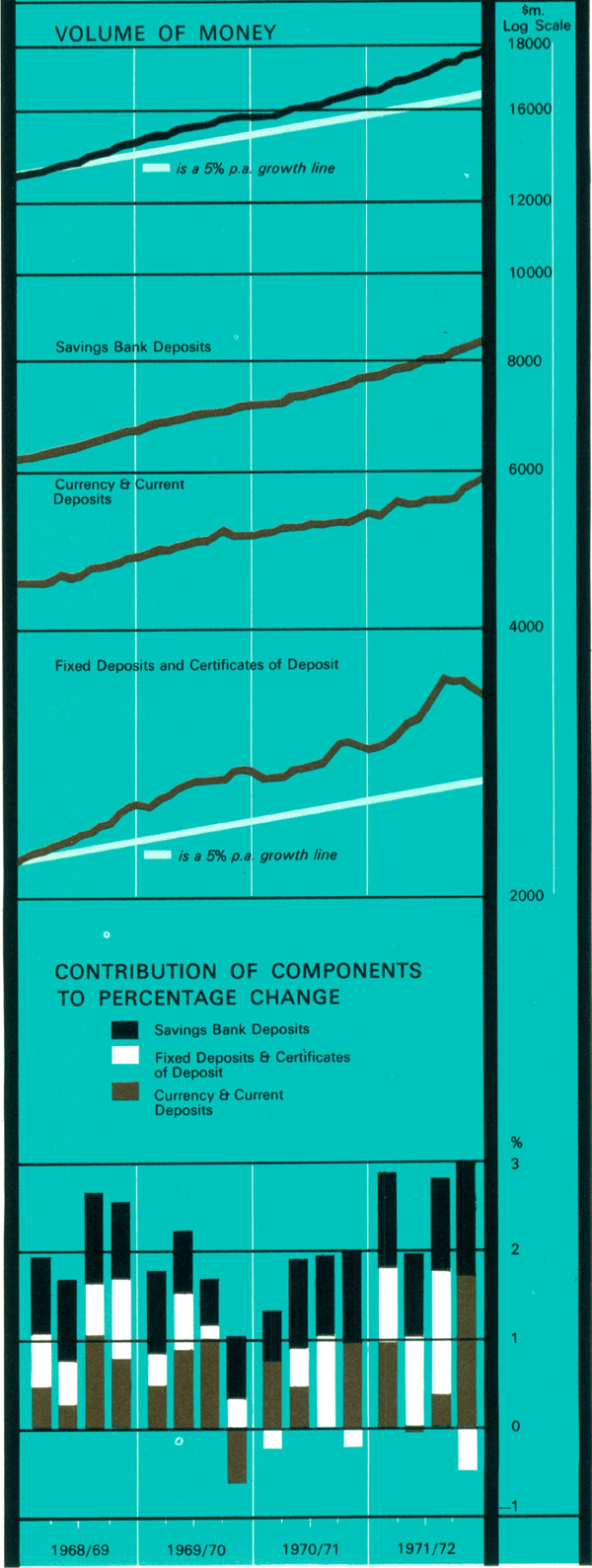
In the event, private non-finance groups may have incurred a deficit not much more than half that ($800 million) recorded in 1970/71. Ready availability of cheaper finance clearly is not necessarily a sufficient condition for an early acceleration of activity. Some of the factors inhibiting a rapid expansion of spending were traversed earlier. The “Minsec crisis” early in 1971 also contributed to caution; in financial markets it had led to some switching into assets offering a high degree of safety, such as government paper, bank deposits and loans to authorized dealers. The demand for these and many other financial assets remained high during 1971/72; the slackness in the economy suggested that the expected rate of return on physical assets may have declined. In addition, there was some strengthening of opinion during the first half of the financial year that fixed interest rates had peaked for a time and would probably soon move lower; this encouraged both demand for government and other fixed interest paper and some lengthening of the maturity structure of holdings of these assets. The private non-bank sector added $700 million to its holdings of government paper, a rise of about 16 per cent. Private non-bank holders also increased substantially their holdings of notes and coin and bank deposits, but the preference for interest bearing deposits was strong; the growth in their holdings of notes and coin and current deposits with trading banks increased from 6.6 per cent in 1970/71 to 9 per cent but they increased from 6 per cent to 16 per cent the growth in their fixed deposits plus certificates of deposit with trading banks. Deposits with savings banks grew by 9.9 per cent compared with 7.5 per cent in 1970/71. The net outcome was an increase of 11 per cent in the volume of money as against an increase of 6.8 per cent in 1970/71 (see Graph 11). As indicated, borrowing from domestic sources grew only moderately. Borrowings from building societies grew most sharply. New lending by finance companies levelled off but there was again a sizeable increase in their outstandings. Liabilities to trading banks on advances grew by 11 per cent as against 8 per cent in the previous year and to savings banks by 11 per cent (almost wholly representing an increase in advances for housing) as in 1970/71. However, Rural Credits advances and borrowings by the Wheat Board from the Government declined over the year as did liabilities to pastoral finance companies. Borrowings from life offices grew only moderately.
10 GOVERNMENT FINANCING
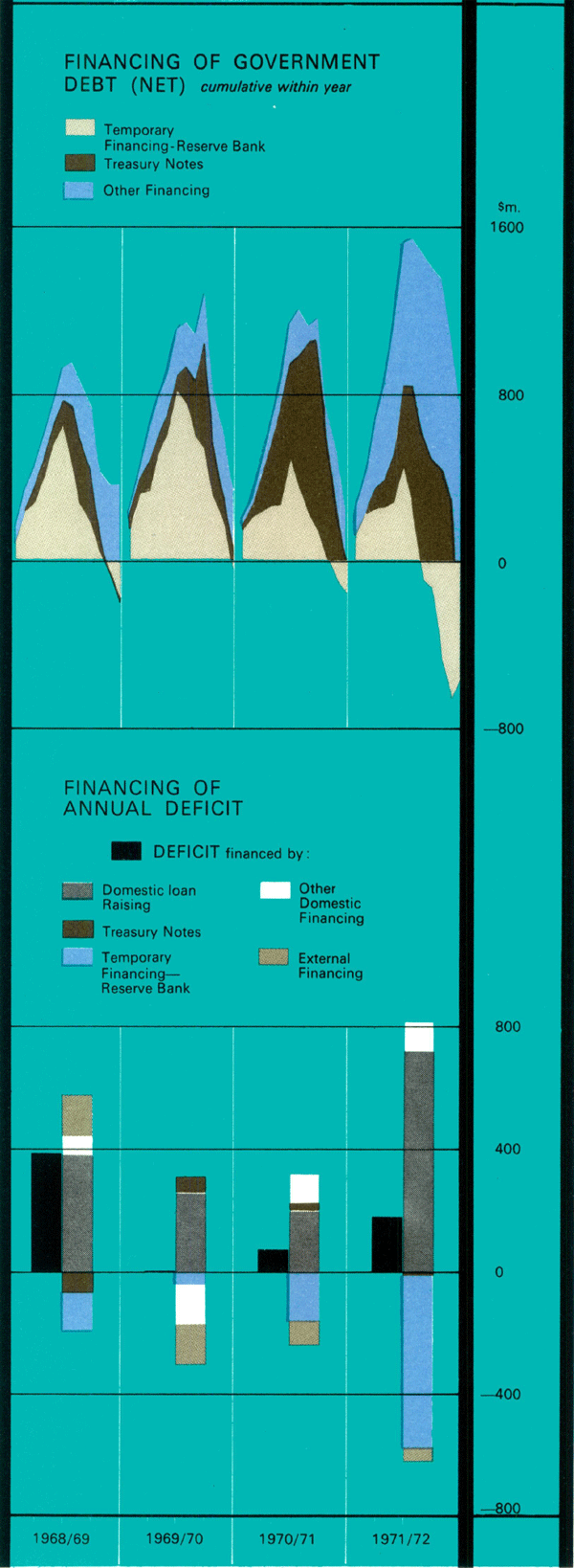
As 1971/72 opened, private liquidity was approaching its seasonal trough. The rise in interest rates in the money markets had been less sharp and bank liquidity was a little higher than a year earlier. There had also been some indication during the latter part of 1970/71 that market yields on industrial debentures might be tending to decline. From about mid-July the up-swing in liquidity was very strong. The net rise of over $700 million during the September quarter in the LGS assets of the private sector was almost $450 million higher than in the corresponding quarter in 1970/71. Indeed, the cumulative rises of more than $1,550 million by the end of December and over $2,000 million by the end of March were larger by almost $800 million and $950 million respectively than those in the previous year. Government transactions and sales of foreign currencies by the private sector to the Bank were the main factors. The net rise of about $1,450 million over the full year in the private sector's holdings of LGS assets was more than double the increase in 1970/71 and more than seven times that in 1969/70. Private non-bank holders absorbed $850 million of the total increase and banks the remaining $600 million. An analysis of changes over the past three years is given in the table below.
11 VOLUME OF MONEY
Seasonally adjusted
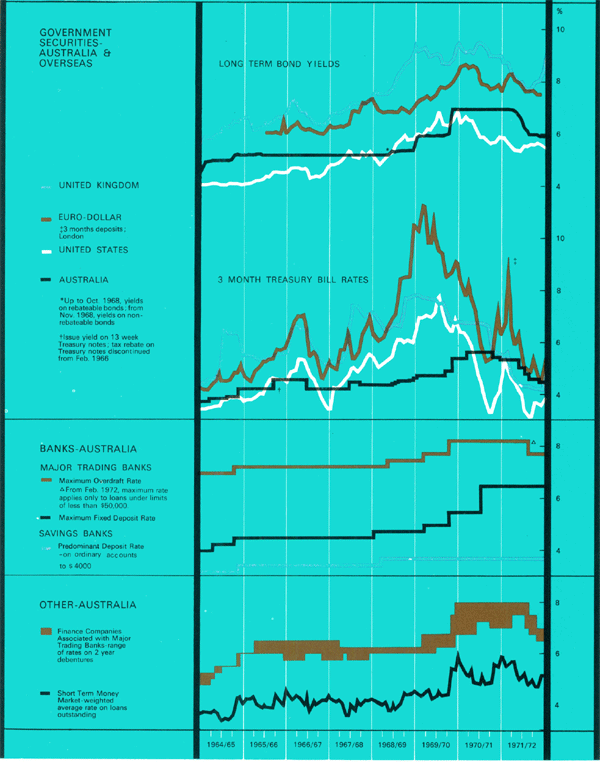
12 SELECTED INTEREST RATES
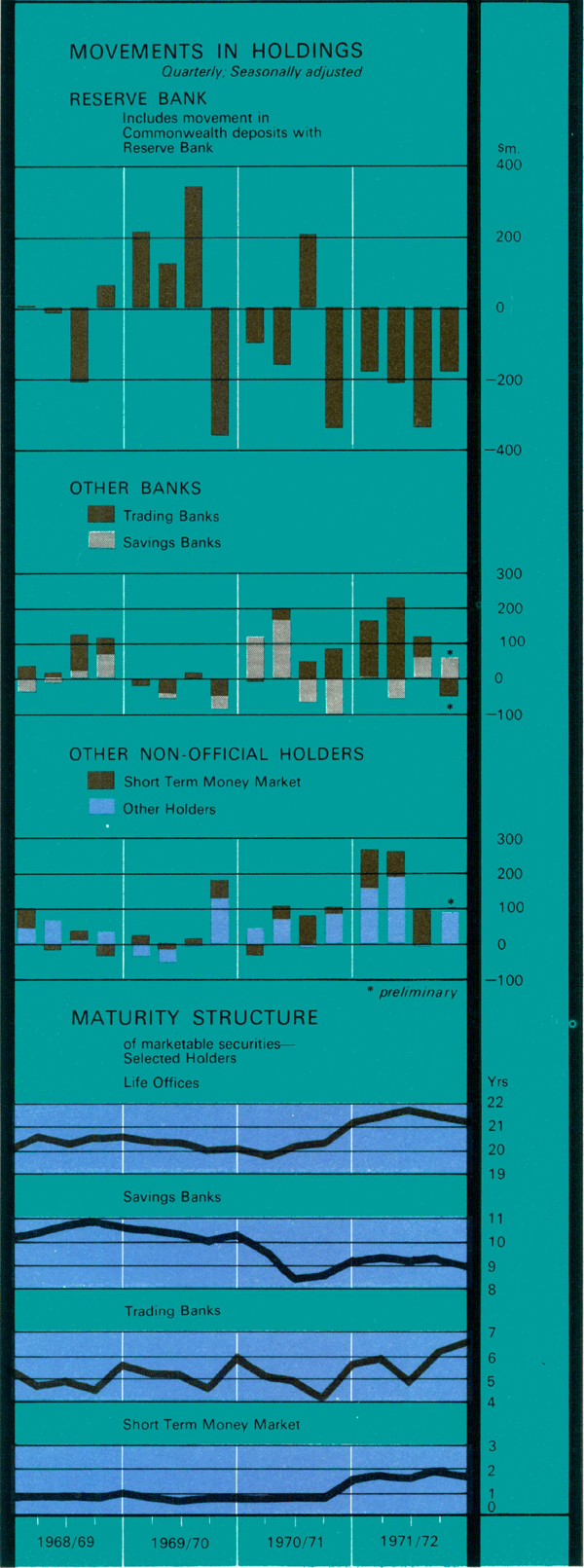
In financial markets, interest rates paid by authorized dealers reflected less clearly than most other rates the highly liquid state of the private sector. As liquidity increased in the early months of 1971/72 the dealers, for whom 1970/71 had been a year of profitable expansion, continued to seek funds energetically to finance very large increases in their portfolios of government securities. Consequently, throughout the period of seasonal growth in liquidity, rates paid to clients were mostly above those paid in corresponding months of the previous year. Dealers' portfolios increased quickly to levels which ranged between 40 and 50 per cent higher than at the corresponding stages in 1970/71; the monthly average was over $1,000 million at the seasonal peak and only a little lower during the final two months of the year. The dealers' market purchases and subscriptions to loans were a significant part of the greatly increased take-up of government debt by the private non-bank sector (Graph 13). At the same time there was further extension of the relatively long maturity structure of their holdings of government securities with which the year began.
In the inter-company market, interest rates seemed to have been more affected by the growth in liquidity; greater selectivity by lenders following the “Minsec crisis” militated against a marked increase in lending in this market, although the demand for loans was presumably not strong, given prevailing economic conditions. From about the time when bond yields commenced to decline, call rates in the inter-company market appear to have been below those ruling during the corresponding stages of the previous financial year; the margin was about 1 to 1.5 percentage points at the seasonal peak of liquidity. Market yields on certificates of deposit issued by trading banks held steady until bank interest rates were reduced in February but rates on short dated bank bills declined steadily as liquidity increased and by the peak in liquidity appear to have been some two percentage points below those at corresponding times in 1970/71.
| $ Million | |||||||
|---|---|---|---|---|---|---|---|
| 1969/70 | 1970/71 | 1971/72 | |||||
| Year | 1st half | 2nd half | Year | 1st half | 2nd half | Year | |
| p | p | ||||||
| Government Debt (net) † | +315 | +1,052 | −955 | +97 | +1,500 | −1,345 | +155 |
| Reserve Bank transactions: | |||||||
| Gold and foreign exchange ‡ | +47 | +23 | +761 | +784 | +570 | +965 | +1,535 |
| Rural Credits advances | −140 | +24 | −63 | −39 | −61 | +17 | −44 |
| Statutory Reserve Deposits | −(+111) | −(−43) | −(−16) | −(−59) | −(−1) | −(−61) | −(−62) |
| Term Loan Fund accounts | −(−10) | −(+10) | −(−5) | −(+5) | −(+16) | −(+11) | −(+27) |
| Farm Development Loan | |||||||
| Fund accounts | −(−15) | −(+19) | −(+3) | −(+22) | −(−1) | −(+7) | −(+6) |
| Miscellaneous | +69 | −337 | +133 | −204 | −437 | +225 | −212 |
| Total L.G.S. assets of private sector | +205 | +776 | −106 | +670 | +1,558 | −95 | +1,463 |
| Less private non-bank holdings of L.G.S. assets | −(+257) | −(+380) | −(+62) | −(+442) | −(+807) | −(+52) | −(+859) |
| L.G.S. assets of banks | −52 | +396 | −168 | +228 | +751 | −147 | +604 |
| of which: Savings banks | +48 | +155 | −58 | +97 | +191 | +36 | +227 |
| Trading banks | −100 | +241 | −110 | +131 | +560 | −183 | +377 |
| * Figures other than Government Debt (net) and private non-bank holdings
of Government securities are movements in June averages or interpolated
June averages. † Allows for movements in Commonwealth Government deposits with Reserve Bank and coin on issue. ‡ Include allocations of Special Drawing Rights of $75 million in 1969/70, $64 million in 1970/71 and $63 million in 1971/72, which have been offset in the miscellaneous item. p Preliminary. |
|||||||
Demand from the private sector for government securities was heavy from the outset. The July and September loans, which offered terms largely consistent with those of loans floated in the latter part of 1970/71—although yields were shaded down a little for short-dated series—raised net amounts of $126 million and $186 million respectively. In addition, sustained buying pressure from both banks and non-bank groups made heavy demands on the Bank's portfolio. For a time the Bank met the demand at largely unchanged yields, being content thus to absorb some of the increment in primary liquidity and slow the easing of financial conditions.
Although substantial subscriptions continued to be made to Treasury notes, the preferences of private investors had shifted strongly, compared with other recent years, from these short-term securities to bonds (Graph 10). Towards the end of September yields on short-dated bonds declined a little. By this time it was apparent also that market yields on private fixed interest paper were tending lower and, while private borrowers in the capital market were not seeming to encounter difficulty in securing funds, there were relatively few private raisings, either by fixed interest or equity issues. At the same time the share market continued to decline; compared with the September quarter of 1970/71, turnovers were lower by almost 60 per cent in value and 45 per cent in volume.
As the pace of economic activity fell away, it became appropriate for private borrowers to have easier and cheaper access to funds. The Bank therefore was not willing to meet the continuing heavy demand for government securities at the previously existing yields; it did not resist a small reduction in market yields, although it continued to sell in some volume to assess the pressure on yields. At the same time, the existing restraints on bank lending were eased; trading banks had for more than two years been subject to relatively firm general restraint in their lending and it was now considered important that they should be permitted to participate in any expansion of financing.
13 COMMONWEALTH
GOVERNMENT SECURITIES
Redeemable in Australian Currency
The cash loan operation undertaken during November offered yields which ranged from 0.30 percentage points (on long-dated series) to 0.60 percentage points (on short stocks) lower than those offered in the September loan. Small reductions were made at the same time in issue yields on Treasury notes and in the Reserve Bank's re-discount rate for these securities. Subscriptions to the loan totalled $191 million; demand for long-dated series was very heavy, as in the previous loan. Rates on local and semi-governmental securities and on private issues were also reduced.
During December and January there were further substantial purchases from the Bank. The sustained demand led to a further reduction in bond yields, to widen the movement throughout the maturity structure of rates to at least one percentage point below the rates offered in the September loan. Policy had also been further eased during December by the removal of the remaining official restraint on bank lending and by a reduction of the Statutory Reserve Deposit ratio. Then, when bank interest rates were reduced in February, a change in interest rate policy, which is outlined in a later section, was introduced with the aim of allowing trading banks somewhat greater flexibility in competing for deposits and in lending.
Following these further reductions in rates on government paper and bank liabilities, demand for non-bank private fixed interest issues strengthened appreciably. There was nevertheless, a further heavy net take-Up ($182 million) of the government debt offered in the February loan although the maturity pattern of demand was noticeably shorter. (By contrast, there had been net redemptions of $113 million in the February loan operation a year earlier.) Following the Government's announcement in mid-February of stimulatory economic measures, share prices rose strongly (Graph 14). The share market was subsequently given added stimulus by the removal in April of the voluntary restraints on the outflow of capital from the United Kingdom and by the introduction in the same month of further expansionary measures in Australia; there was however a marked reaction in the last week of June to the floating of sterling and the changes in exchange control arrangements in the United Kingdom affecting sterling area countries. Demand for government paper eased as the seasonal downturn in liquidity approached but the conversion offer for the large maturity of $401 million in May resulted in redemption of only $19 million. Moreover, the secondary market remained active for a time as private holders switched between themselves large amounts of securities; the emergence of higher market values associated with the lower levels of yields made it opportune for tax rebate and non-rebate securities to be switched between holders to maximise the earning rates of investors according to their respective tax positions.
14 FINANCING—
SOME ASPECTS
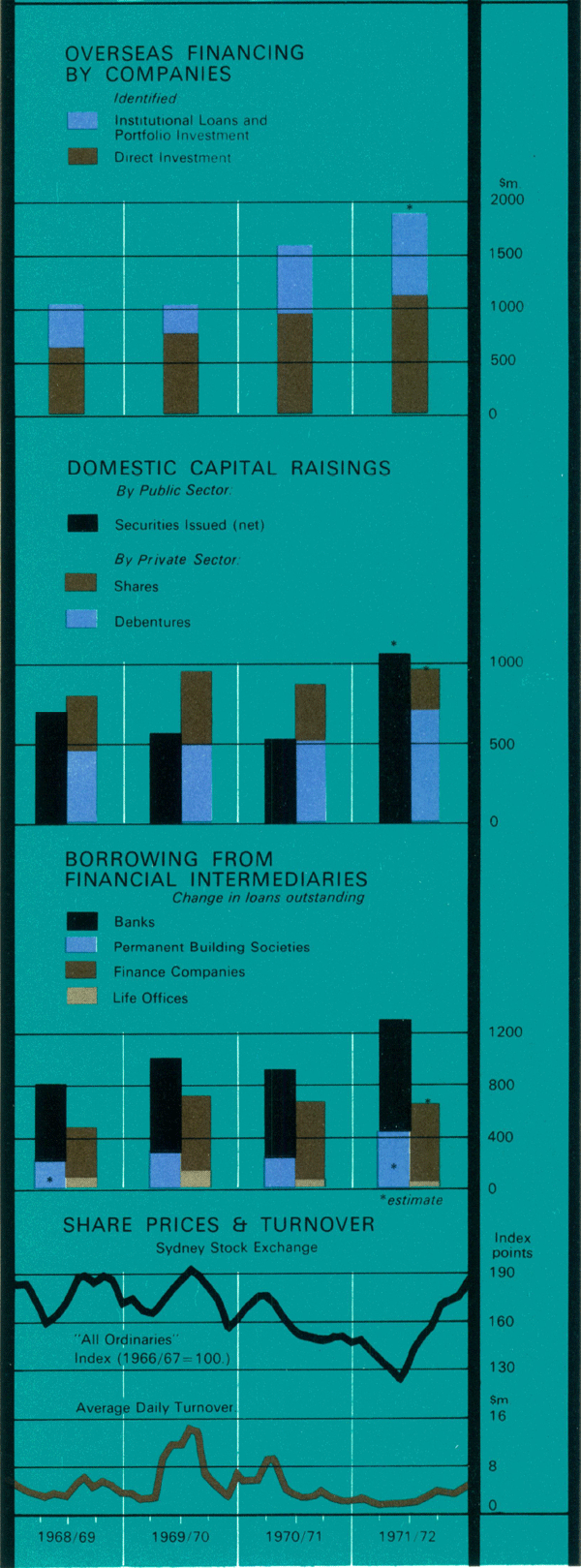
Thus, in the securities markets the Bank's approach during 1971/72 gradually moved from that of meeting demand for government securities in the September quarter to that of reducing their relative attractiveness. This shift made funds more readily available and less costly to the private sector and so tended to encourage spending. Nevertheless, private demand for government securities remained relatively strong throughout. Graph 12 shows movements in interest rates, both in Australia and overseas, and Graphs 13 and 14 show some aspects of market activity.
INSTITUTIONAL ASPECTS
The establishment of another 11 representative offices of overseas banks was authorized by the Treasurer during the year, taking the total to 50. Australian banks opened representative offices in Singapore (two) and Hong Kong (one) and four of the Australian banks opened branches in the New Hebrides. One bank also announced plans to open a representative office in New York.
In May, the Government issued an authority to the Bank of New Zealand Savings Bank Ltd. (a wholly-owned subsidiary of the Bank of New Zealand) to carry on savings banking business in Australia; by the end of the financial year it had not begun to do so.
Legislation to give the Commonwealth power to control the acquisition, by local or overseas interests, of large shareholdings in banks incorporated in Australia and holding authorities under the Banking Act was enacted during the year and commenced in May.
In February, the Bank withdrew the requirement on authorized dealers in the short term money market to hold amounts of government securities as “margins” with the Reserve Bank. This change had been foreshadowed earlier. During the year the Bank also eased the restrictions on the size of authorized dealers' holdings of assets other than government securities, to enable them to hold a higher proportion of bank paper. Other aspects of the relationship between the authorized dealers and the Bank, including access to the Bank as a lender of last resort, continue as before.
During the year the Bank had discussions with a number of companies operating in the field which has become known as. merchant and investment banking to improve its knowledge and understanding of activities in that field.
An important change during the year altered the basis of arrangements between the Reserve Bank and other banks for handling foreign exchange dealings in sterling or based on sterling. A review of foreign exchange practices was mentioned in the previous report. Since August, banks have acted as principals in these transactions with their customers; they have been transacting on that basis in U.S. and Canadian dollars for some 20 years but since 1939 all foreign exchange dealings in sterling or based on sterling had been handled on an agency basis for the Reserve Bank. The introduction of the new arrangements is discussed further on page 35.
TRADING BANKS
Changes in the balance sheets of major trading banks reflected the easing of financial conditions and the removal of official restraints on bank lending. Their liquid assets grew substantially during 1971/72 and their deposits and loans and advances increased fairly strongly. Even though non-bank holdings of government securities increased sharply (Graph 13), deposits grew by 12 per cent and loans and advances by 10 per cent. Holdings of LGS assets, as a proportion of deposits, increased by more than 2 percentage points between June 1971 and June 1972. Deposits and loans and advances of the other trading banks, which include state trading banks, grew even more strongly than those of the major trading banks. Their deposits increased by 16 per cent and their advances by 13 per cent. Current deposits with trading banks rose by 8 per cent, a little more than in 1970/71. A feature of the growth of deposits was the sharp increase of 18 per cent in fixed deposits and certificates of deposit; for major trading banks these accounted for a peak proportion of almost 47 per cent in February and represented 44 per cent of the total at the end of the year, compared with 42.4 per cent twelve months earlier. Certificates of deposit, which had fallen sharply in 1970/71, continued to decline in the early months of the financial year, to a low point of $15 million in October 1971. However, their relative attractiveness was enhanced by several reductions in issue yields for Treasury notes and by June 1972 the total had risen to $89 million.
The basis on which banks can compete for fixed deposits has been made considerably more flexible during the past two financial years. In December 1970 the maximum term for which banks could accept fixed deposits was increased from two to four years. This, together with generally easy liquidity in the private sector, the emergence of increased caution in spending, and the fact that bank interest rates did not immediately reflect the downward trend in competing rates, may have influenced the very strong performance of these deposits during the first seven months of 1971/72. Then in February 1972, banks were given considerably greater flexibility to compete for large deposits. Rates for fixed deposits of less than $50,000 were reduced for all periods in line with market trends in interest rates generally. However, for larger fixed deposits and certificates of deposit banks were given discretion to negotiate rates, for any period within the general ranges permitted, within the existing maximum of 6.5 per cent per annum for fixed deposits. To date, the rates offered for deposits of $50,000 and over have at times varied significantly between banks and have generally been higher than on smaller deposits but well below the maximum rate.
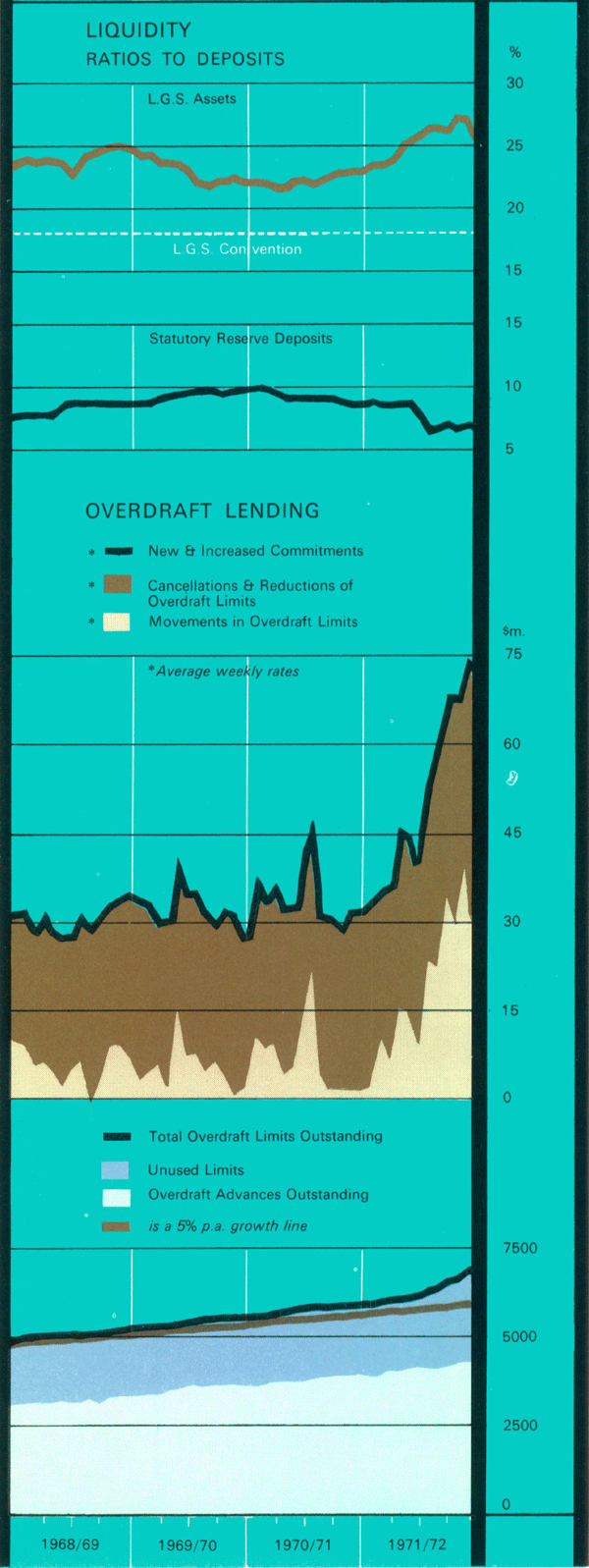
With capital inflow running strongly during the final months of 1970/71, banks did not encounter severe pressure on their liquidity and they ended that year with an LGS ratio almost one percentage point higher than a year earlier. Despite this easier initial position and the very strong rise in liquidity from the latter part of July, lending by major trading banks continued to be fairly constrained during the early months of 1971/72. Total advances showed only modest growth; while new lending approvals rose moderately, cancellations and reductions of limits remained high. Following the easing of lending policy during October there was a relatively sharp increase in new lending approvals, although this was strongly influenced by substantial approvals for wool marketing. The Bank recognized that the willingness of banks actually to lift their lending was determined to some extent by their judgment of the outlook for their individual liquidity and that their enthusiasm to lift their lending sufficiently to encourage a high level of spending could be dampened by the inherent uncertainties in the existing economic climate. Therefore, even though the LGS ratio was at that stage some three or four percentage points higher than a year earlier, the Bank reduced the Statutory Reserve Deposit ratio in December from 8.9 per cent to 7.1 per cent of deposits as a signal of clear support for the message that banks should feel free to increase their lending and that the Bank would favour increases in the level of lending. Part of this reduction in the Statutory Reserve Deposit ratio was applied towards replenishment of Term Loan Fund and Farm Development Loan Fund accounts. The greater margin of “free” liquidity (the excess over the minimum of 18 per cent in terms of the LGS convention) and the impact of the change in SRD policy are demonstrated in Graph 15.
New lending approvals increased sharply and by April reached the high level of $75 million per week as against weekly averages of $41 million in the first quarter of 1971/72 and $39 million throughout 1970/71. Undrawn overdraft limits also rose strongly (see Graph 15). Advances outstanding showed some growth but by the end of the third quarter the rise since the start of the financial year was only comparable with that during the first three quarters of 1970/71, when liquidity was tighter and lending policy required restraint. During the final quarter of the year new lending increased a little further but, although advances outstanding had started to rise more strongly, the usage of limits fell from about 66 per cent in the first half of the financial year to about 63 per cent. All categories of overdraft lending shared in the strong increase in new lending; Farm Development Loan approvals also rose strongly and Term Loan approvals increased moderately.
15 MAJOR TRADING BANKS
Seasonally adjusted
New lending approvals by the Australian Resources Development Bank were lower during 1971/72 than in other recent years; despite a sharp reduction in its undrawn commitments, its loans outstanding grew only by $67 million (to $328 million) compared with $98 million in 1970/71. The bulk of its lending continued to take the form of refinancing of trading bank term loans. In its borrowings, the Resources Bank relied more heavily on domestic sources of funds during the latest year and reduced the amount of its indebtedness overseas.
As with interest rates on trading bank deposits, the opportunity was taken in February to allow greater flexibility and discretion for the banks to determine their own rates on loans. At that time, the maximum rate on overdraft lending was reduced by 0.5 percentage points to 7.75 per cent per annum and the maximum flat rate on personal instalment loans was reduced by 0.25 percentage points to 6.25 per cent per annum. Apart from loans exempted from the general rise in March 1970, rates on most other loans subject to the maximum overdraft rate were to be reduced. However, an innovation was that the maximum overdraft rate would in future apply only to loans drawn under limits of less than $50,000.
SAVINGS BANKS
Deposits with savings banks grew strongly during 1971/72, increasing by 9.9 per cent over the year against 7.5 per cent in 1970/71. As in the previous year, savings banks possibly benefited from the high rate of personal saving and from a cautious approach by depositors in the selection of assets in which to hold wealth. The maximum interest rate payable on ordinary savings accounts was not varied during the year but that on investment accounts was reduced by 0.25 percentage points to 5 per cent per annum. Within these maximum rates, savings banks have discretion to determine their own rates; on ordinary accounts most savings banks have continued to offer rates below the maximum.
16 SAVINGS BANKS
Seasonally adjusted
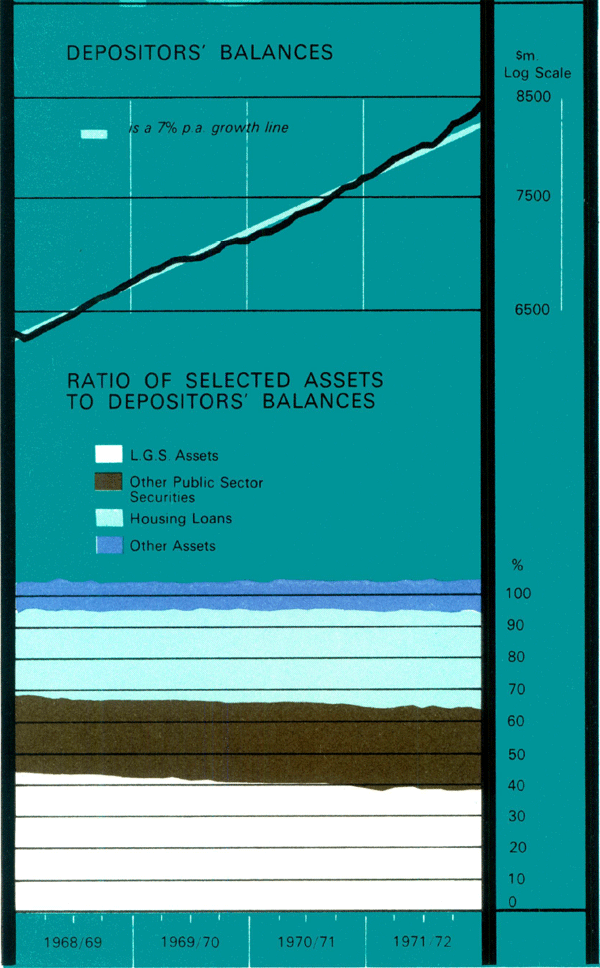
Facilitated by the strong growth in deposits and by the change announced in October 1970 in the regulations governing savings banks' investments, lending for housing grew particularly strongly during 1971/72. New approvals were 18 per cent higher than in 1970/71 and more than 40 per cent higher than in 1969/70. Housing loans outstanding increased by 11 per cent (to $2,616 million) as against 10 per cent in 1970/71. At the same time savings banks' lending to local and semi-governmental authorities increased more rapidly than in 1970/71, and their holdings of securities issued by these bodies rose by 10 per cent over the year. Aggregate holdings of LGS assets and loans to authorized dealers in the short term money market increased by 7.5 per cent. Within these items there was a reversal of the greater emphasis placed in 1970/71 on Treasury notes compared with deposits with the Reserve Bank. The proportions in which savings banks' assets are held are shown in Graph 16.
Where applicable, the reduction in the trading banks' maximum overdraft rate and the flexibility for their loans of $50,000 or more, outlined earlier, were carried over into savings bank interest rates. However, interest rates on the bulk of savings bank loans for housing have not altered.
NON-BANK FINANCIAL INSTITUTIONS
In contrast with the experience of most other non-bank financial intermediaries, permanent building societies achieved a very pronounced expansion of their lending in 1971/72. During the first half their net intake of funds was 51 per cent greater than in the corresponding portion of 1970/71, approvals were about 61 per cent higher and loans paid over were about 86 per cent higher. Their business continued to increase in the second half of the year, influenced to some extent by the maintenance in some states of unchanged rates on shares and deposits despite reductions in interest rates generally. In the 11 months to May, their net intake of funds rose at an annual rate of 57 per cent, approvals by 59 per cent and loans paid over by 66 per cent; their total liabilities to shareholders and on borrowings were then only a little short of $2,000 million and their outstanding loans on mortgage were approximately $1,650 million.
Early in the year there were increases in rates offered by some finance companies for funds but later these were reduced sharply to restore earlier relationships with bond and bank rates. After allowing for seasonal factors the total amount financed by finance companies rose fairly strongly in the first quarter of 1971/72 but then levelled off. The slow growth in consumer spending and the increased availability of funds from trading banks and from abroad probably affected the demand for funds from finance companies. Nevertheless, outstanding balances owed to finance companies rose over the 11 months to May at an annual rate of 17 per cent.
During the first three quarters of 1971/72 the growth in total assets of life offices was close to that of 11 per cent during 1970/71. Fixed assets grew noticeably more strongly than other categories but holdings of local and semi-governmental securities, investments in shares and Commonwealth Government securities also grew a little more strongly than total assets. The rate of increase in total loans outstanding was a little lower than in the previous year, an annual rate of about 3 per cent, and the proportion of total assets accounted for by loans declined by 1.3 percentage points to just under 25 per cent.
Many merchant banking companies appear to have been in a stage of consolidation after earlier strong growth but the sector has continued to grow fairly strongly, to some extent the result of serving as a channel for capital inflow.
The net inflow of cash into unit trusts, land trusts and mutual funds appears to have been at much the same level as in 1970/71 but their net purchases of shares, debentures and other investments grew more strongly. Outstanding rural advances of pastoral finance companies continued to decline steadily after turning down quite sharply in the second half of 1970/71; they had declined by 5 per cent over that year and fell further in the 11 months to May at an annual rate of about 13 per cent.
FOREIGN EXCHANGE OPERATIONS
The temporary closure of the foreign exchange markets in London and other centres, which followed the announcement on 15 August 1971 of measures by the United States, necessitated a brief suspension from 17 August of foreign exchange dealings in Australia. In addition to the considerable uncertainty about exchange rates it was not possible for covering transactions to be arranged in overseas markets. Consequently, the Bank withdrew for a short period the authority of Australian banks to deal in foreign exchange. Limited authority was restored after only one day to enable banks to assist Australian residents to settle amounts contractually due in foreign currency under trade transactions and to meet the reasonable needs of travellers. Within a week, banks' authority was further restored to include all normal trade transactions. At this stage banks were also authorized to provide forward cover for customers at their own discretion; shortly afterwards the Bank's forward covering facilities for banks were restored for cover up to three months forward. A limited range of capital transactions was also included in the list of authorized spot dealings. The remaining limitations on dealings were lifted from 13 September when banks were permitted to resume the handling of all normal exchange transactions including capital movements into and out of Australia. To enable the Bank to watch developments closely, banks were required to sight specific Reserve Bank approval for all inward capital remittances of $250,000 or more before converting the foreign currency into Australian dollars. Finally, from 27 September, the Bank restored its forward covering facilities for banks generally to the position which had existed before the recent disturbances.
Foreign exchange dealings were again suspended briefly from 20 December, after the general realignment of exchange rates of the major currencies and while the particular position of the Australian dollar was being determined. As a consequence of the Government's decision to link the exchange value of the Australian dollar to the U.S. dollar, instead of to sterling as in the past, Australian rates of exchange for sterling now fluctuate from day to day as do rates for all currencies other than the U.S. dollar—reflecting changes in overseas markets in values of these currencies against the U.S. dollar. There was a further suspension of dealings from 26 June in consequence of the closure of overseas foreign exchange markets following the floating of sterling. Limited authority for certain types of transactions was restored to banks two days later, and the remaining restrictions were removed by 13 July.
During the earlier periods of interruption to ordinary dealings, the Bank took the opportunity to introduce changes in procedures for transactions in foreign exchange between itself and the banks, towards which it had been working for some time. The proposed changes had been foreshadowed in the Bank's report for 1970/71 and planning for their introduction was well advanced. The Bank was therefore able to move quickly to introduce the new arrangements; some of the changes applied from 23 August and the remainder from 27 September. The essence of the initial changes was that banks would in future deal as principals in all foreign currencies and the Bank would provide them with daily covering facilities for sterling in place of the previous periodical settlements in that currency. Since 1939 all dealings in sterling or based on sterling had been handled by banks as agents for the Reserve Bank. The Bank also provides the banks with covering facilities in U.S. and Canadian dollars. Hence the new arrangements mean that all foreign exchange transactions undertaken by them are now at their own exchange risk although, in addition to the facilities of the foreign exchange markets in major overseas centres, facilities are extended by the Bank for them to cover their risks. Moreover they are required to restrict their uncovered positions and not to carry excessive balances abroad. The bulk of Australian international reserves will consequently still be held by the Bank.
Initially, the banks were required in their transactions with the public to continue to observe the fixed rates of exchange for sterling laid down by the Bank. However, the second significant aspect of the new arrangements was introduced on 27 September. From that date the Bank fixed only outer limits of the rates for transactions in sterling between banks and the public and quoted separate buying and selling rates at which it stood ready to deal with the banks. The banks were given discretion to deal in that currency with the public at rates inside the limits laid down by the Bank; they were permitted to determine their own charges for forward exchange transactions; and they were given freedom—and encouraged—to adjust their positions by dealing with each other. At the same time the Bank increased its rates for sterling forward cover to banks from 10 cents to 25 cents per £Stg 100 per month; this was a return to the level obtaining before a reduction in March 1964. Subsequently, from 10 July, the linking of the Australian dollar to the U.S. dollar instead of sterling was carried through to forward exchange arrangements. In future the Bank would provide forward cover to banks in U.S. dollars at rates to be advised—initially the rates would be based on a discount of 1 per cent per annum on the spot rates for both buying and selling transactions. The Bank would also provide forward cover to banks in sterling and Canadian dollars, at rates which vary from day to day according to movements in forward exchange rates between those currencies and the U.S. dollar in markets abroad.
Following the Government's decision in December that the Australian dollar would in future be fixed on the U.S. dollar, the Bank set outer rate limits in U.S. dollars, in lieu of in sterling, within which banks' transactions with the public must be arranged. The outer limits set by the Bank reflect the decision by the Government to avail itself of the wider margins for permissible fluctuations in exchange rates and establish a market rate for the Australian dollar at the lower end of the range.
The new arrangements, under which all of the banks' dealings in foreign exchange are done on their own account and (subject to the outer limits for U.S. dollars fixed by the Bank) at their own exchange rates, provide some scope for competition between the banks across the spectrum of foreign currency dealings. Remoteness in time from the major centres of the foreign exchange markets imposes some obvious problems for any embryonic foreign exchange market based in Australia. However, the introduction in September of a spread between the Reserve Bank's inter-bank buying and selling rates has provided an incentive for banks to make a market for dealing among themselves. Similarly, the discretion for banks to determine their own rates provides scope for some competition in their dealings with the public.