
2026 Assessment of the Reserve Bank Information and Transfer System Appendix A: Detailed Self-assessment of RITS
- Download the complete Document 822KB
This Appendix is prepared by Payments Settlements Department and sets out a detailed self-assessment of how RITS observed each relevant Principle of the PFMI as at 31 March 2026.1 Under the PFMI, each Principle is supplemented by a number of Key Considerations. This self-assessment provides detailed information for each Key Consideration. Unless otherwise specified, information in this Appendix applies to both RITS and the RITS FSS.
This self-assessment is used as one input to inform Payments Policy Department’s assessment of RITS, the findings of which have been approved by the Payments System Board.
Principle 1 – Legal basis
A payment system should have a well-founded, clear, transparent and enforceable legal basis for each material aspect of its activities in all relevant jurisdictions.
1.1 The legal basis should provide a high degree of certainty for each material aspect of a payment system’s activities in all relevant jurisdictions.
RITS is owned and operated by the RBA. The legal basis of all key aspects of RITS is set out in the RITS Regulations, which cover the operation of RITS, and the rights and obligations of members and the RBA.2 Standard RITS Membership agreements are executed to bind each member to the RITS Regulations. In addition to the RITS Regulations, the following key aspects of RITS activities are supported by Australian legislation and additional contractual arrangements.
Real-time gross settlement (RTGS) feeder systems
RITS accepts settlement instructions from approved feeder systems (Figure 1). Admission as a feeder system is by specific reference in the RITS Regulations. The RTGS feeder systems are the Swift Payment Delivery System (PDS), Austraclear, Clearing House Electronic Sub-register System (CHESS) RTGS and NPP.3 The Swift PDS, Austraclear and CHESS RTGS are wholesale RTGS feeder systems. NPP feeder system transactions settle via the FSS.
The Swift PDS is administered by Australian Payments Network (AusPayNet) under its High-value Clearing System (HVCS). The RBA and AusPayNet each have contractual arrangements with Swift covering the Swift PDS.
The Austraclear and CHESS RTGS feeder systems are operated by Austraclear and ASX Settlement respectively. Both entities are wholly owned subsidiaries of ASX Limited. The RBA has separate contractual arrangements with Austraclear and ASX Settlement covering these feeder systems.
The NPP feeder system is operated by New Payments Platform Australia Limited, a wholly owned subsidiary of Australian Payments Plus (AP+). The RBA and New Payments Platform Australia Limited have a contractual arrangement covering this feeder system.
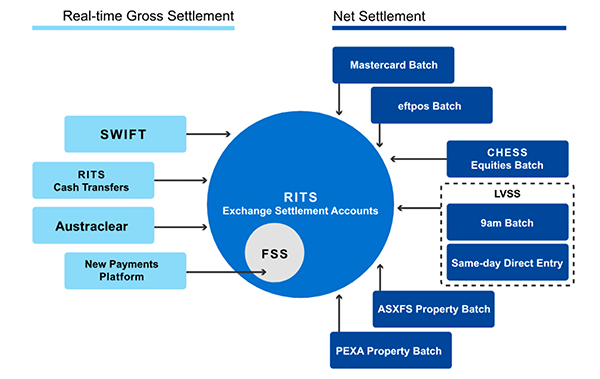
Source: RBA.
Settlement finality
The RITS Regulations state that settlement is final when the Exchange Settlement Accounts (ESAs) of the paying and receiving members in RITS are simultaneously debited and credited, respectively. The irrevocability of payments settled in RITS is protected by RITS’s approval as an RTGS system under Part 2 of the Payment Systems and Netting Act 1998 (PSNA). With this approval, a payment executed in RITS at any time on the day on which a RITS member enters external administration has the same standing as if the member had gone into external administration on the next day (in the case of a winding up) or as if the member had not gone into external administration (in the case of other forms of external administration). Accordingly, in the event of insolvency, all transactions settled on the day of the insolvency are irrevocable and cannot be unwound simply because of the event of external administration (i.e. they are protected from the ‘zero-hour’ rule). The PSNA also, among other things, clarifies that resolution of a financial institution is a form of non-terminal administration, and that a payment executed in RITS when a member has gone into non-terminal administration has the same effect it would have had if the member had not gone into non-terminal administration.
The irrevocability of settled transactions originating from the Austraclear and CHESS RTGS feeder systems is supported by their respective approvals as RTGS systems under Part 2 of the PSNA.
Netting arrangements
In the unlikely event that RITS is unavailable for a significant period of time, payments arising from Austraclear and the Swift PDS can be settled using contingency arrangements. These arrangements involve the multilateral netting and settlement of transactions arising from those systems. The irrevocability of settlement under these contingency arrangements is supported by the approval of Austraclear and HVCS as netting arrangements under Part 3 of the PSNA. The approval of HVCS establishes the legal basis for the netting of Swift PDS payments.
While RITS is primarily an RTGS system, it also provides for the final settlement of net obligations arising in other payment and settlement systems. This is either through the Low Value Settlement Service or the batch feeder functionality.5 RITS’s approval under Part 2 of the PSNA does not ensure the legal certainty of the netting of the underlying obligations. Nevertheless, the majority of the value of obligations settled in these multilaterally netted batches originates from AusPayNet clearing streams and transactions settled in the CHESS, Mastercard and eftpos batches, which are approved netting arrangements under Part 3 of the PSNA.
Enforceability of repurchase agreements
The enforceability of repurchase agreements (repos) in the event of a default also requires a high degree of legal certainty. Repos with the RBA are governed by an international standard agreement – Securities Industry and Financial Markets Association (SIFMA) / International Capital Market Association (ICMA) Global Master Repurchase Agreement (GMRA) (2011 version) – as amended by an annexure to the RITS Regulations. This agreement sets out, among other things, what constitutes default, and the consequential rights and obligations of the parties. In the event of a default, the agreement allows the non-defaulting party to terminate the agreement, calculating the net obligation based on the prevailing market value at the time the contract is closed out. Close-out netting provisions included in repo contracts with RITS members provide for the immediate liquidation of collateral in the event of default. This right is supported by Part 4 of the PSNA.
1.2 A payment system should have rules, procedures, and contracts that are clear, understandable, and consistent with relevant laws and regulations.
To facilitate a clear understanding of RITS rules and procedures, the RITS Regulations are supplemented by user guides and other documentation that explain RITS requirements and functions. This material facilitates existing and prospective members’ understanding of the RITS Regulations and the risks they face by participating in RITS.
The RBA seeks external legal advice on material amendments to the RITS Regulations and associated contractual agreements, including, where relevant, on the interaction of such amendments with Australian and New South Wales laws and regulations.
1.3 A payment system should be able to articulate the legal basis for its activities to relevant authorities, participants, and, where relevant, participants’ customers, in a clear and understandable way.
At a high level, the legal basis for RITS is articulated in a clear and understandable manner on the RBA website6 and the RITS Information Facility.7
1.4 A payment system should have rules, procedures, and contracts that are enforceable in all relevant jurisdictions. There should be a high degree of certainty that actions taken by the payment system under such rules and procedures will not be voided, reversed, or subject to stays.
To ensure that the RITS Regulations and associated contractual agreements are enforceable, the RBA seeks external legal advice on material amendments to these documents.
1.5 A payment system conducting business in multiple jurisdictions should identify and mitigate the risks arising from any potential conflict of laws across jurisdictions.
The RITS Regulations are governed by New South Wales law and require that all members submit to the non-exclusive jurisdiction of the courts of New South Wales. The RBA requires foreign RITS applicants to provide a legal opinion affirming that the RITS membership legal documents constitute valid, legally binding and enforceable obligations.8 This opinion must cover whether the courts in the home jurisdiction of the applicant will give effect to the choice of New South Wales law as the governing law and whether the judgement of an Australian court would be enforceable in the home jurisdiction without retrial or re-examination.
Principle 2 – Governance
A payment system should have governance arrangements that are clear and transparent, promote the safety and efficiency of the payment system, and support the stability of the broader financial system, other relevant public interest considerations, and the objectives of relevant stakeholders.
Note: In line with the CPMI-IOSCO guidance on the Application of the PFMIs to Central Bank FMIs, as RITS is operated as an internal function of the RBA, Key Considerations 2.3 and 2.4 are not intended to constrain the composition of the RBA’s governing body or that body’s roles and responsibilities.
2.1 A payment system should have objectives that place a high priority on the safety and efficiency of the payment system and explicitly support financial stability and other relevant public interest considerations.
RITS is owned and operated by the RBA. The high-level objectives of the RBA are set out in the Reserve Bank Act. The RBA’s overarching objective is to promote the welfare and economic prosperity of the people of Australia, as outlined in section 8A of the Reserve Bank Act. Section 45 of the Reserve Bank Act further provides that the RBA’s functions include contributing to the stability of Australia’s financial system.
The RBA’s Corporate Plan sets an objective to promote a secure, stable and efficient payments system.9
The RBA’s aim in developing and operating RITS is to provide the infrastructure through which settlement obligations arising from the exchange of high-value payments and debt securities settlements can be extinguished in a secure, stable and efficient manner. The design of RITS ensures that there is no build-up of settlement exposures associated with high-value transactions, which in turn promotes the stability of Australia’s financial system. Reflecting the critical importance of RITS to the Australian financial system, the RBA aims to operate RITS at an extremely high standard of availability and resilience, and to ensure that its settlement services continue to evolve to meet the changing needs of the broader payments system.
2.2 A payment system should have documented governance arrangements that provide clear and direct lines of responsibility and accountability. These arrangements should be disclosed to owners, relevant authorities, participants, and, at a more general level, the public.
Since it is not operated as a separate entity, the management and operation of RITS falls under the governance structure of the RBA and is subject to the RBA’s oversight, decision-making and audit processes. Information on the RBA’s governance arrangements for RITS is documented on the RBA website.
Decisions affecting day-to-day operations, RITS member relations and the development of RITS are delegated to the RBA’s Payments Settlements Department. This Department is part of the RBA’s Business Services Group, for which the Assistant Governor (Business Services) is responsible. Procedures are in place to escalate day-to-day operational matters within the Department and other areas of the RBA, as appropriate. The RBA’s Information Technology and Workplace Departments provide technology services and infrastructure services that support the operation of RITS. The Chief Operating Officer has accountability for the provision of these services.
Oversight of RITS is carried out by the RBA’s Payments Policy Department, within the policy framework for which the Payments System Board has ultimate responsibility. This Department is separate from Payments Settlements Department in the RBA’s organisational structure, with separate reporting lines up to and including the level of Assistant Governor. The two departments nevertheless meet regularly to discuss policy issues and operational developments, and the Payments System Board is periodically updated on relevant developments.
The RBA’s current governance arrangements reflect relevant provisions of the Reserve Bank Act and the Public Governance, Performance and Accountability Act 2013 (PGPA Act). In accordance with the Reserve Bank Act, the Governance Board is the accountable authority under the PGPA Act and therefore ultimately responsible for the operation of RITS. The Audit and Risk Committee – a sub-committee of the Governance Board that replaced the previous Audit Committee – supports the Board to fulfill its responsibilities, most relevantly in regard to risk management.
Day-to-day responsibility for managing the RBA rests with the Governor. In fulfilling this responsibility, the Governor is assisted and supported by the Executive Committee, which is comprised of senior executives. The Executive Committee is the key decision-making committee in the RBA at which matters that have a strategic or Bank-wide significance are discussed, including major decisions related to RITS. The role of the Executive Committee is set out in its charter.
Four executive committees of the RBA play a key role in the governance of RITS:
- Executive Committee: as described above.
- Risk Management Committee: chaired by the Deputy Governor, at which matters relating to the RBA’s key risks are discussed.
- Investment Committee: chaired by the Chief Operating Officer, at which matters relating to the RBA’s projects portfolio and funding allocation are discussed.
- Technology Committee: chaired by the Chief Operating Officer, at which matters relating to the RBA’s technology projects, IT business initiatives, cyber security and emerging technology are discussed.
The RBA has established an Executive Accountability Framework, which is publicly available. The framework sets out where accountability lies within the executive team for the RBA’s functions and operations. Under this framework, the Assistant Governor (Business Services) is accountable for the operation of RITS. The Executive Accountability Framework is in the process of being enhanced to further operationalise accountabilities through executive-level accountability statements that are intended to hold executives to account on the discharge of their duties.
In July 2025, the RBA implemented an enhanced 3LoA model. The 3LoA model lays out the foundation for uplifting the RBA’s risk practices and provides clarity on staff roles and responsibilities as it pertains to risk management.
The RITS Operating Model, delivered in September 2025, sets out the operational framework for managing RITS, detailing its governance, processes and controls. It explains the relationship and responsibilities between Information Technology Department and Payments Settlements Department, and how they will engage to operate the RITS ecosystem in a safe, resilient and reliable way.
As an independent central bank and statutory body, the RBA is ultimately accountable to the Parliament of Australia. The Governor and senior officers of the RBA appear twice yearly before the House of Representatives Standing Committee on Economics to report on matters under the responsibility of the RBA. The Governor and senior officers of the RBA also appear before the Senate Economics Legislation Committee. The PGPA Act also requires the Governance Board, as the accountable authority of the RBA, to keep the Treasurer informed of its decisions and the Bank’s activities.10 In addition, to fulfil its obligations under the PGPA Act, the RBA prepares an annual report for presentation to the Treasurer and tabling in the Parliament.11
2.3 A payment system should have documented governance arrangements that provide clear and direct lines of responsibility and accountability. These arrangements should be disclosed to owners, relevant authorities, participants, and, at a more general level, the public.
As noted above, the Governance Board is ultimately accountable for the operation of RITS. The Governor is responsible for the day-to-day management of the RBA, including the operation of RITS. The roles and responsibilities of the Governance Board are set out in the Governance Board Charter. The Governance Board assesses its performance and the fulfilment of its responsibilities under the Charter annually. Governance Board members recognise their role in maintaining the RBA’s reputation for integrity and propriety in all respects and therefore agree to adhere to a Code of Conduct.
The RBA’s three boards have established an MoU to clarify how they will work together effectively and manage any potential conflicts that may arise.12 However, if a conflict were to arise, the Governor has the ultimate authority to resolve the conflict.
In recognition of the Governor’s responsibility for maintaining a reputation for integrity and propriety on the part of the RBA, the Governor and other members of the Executive Committee are subject to the Code of Conduct for Reserve Bank Staff, which places a high priority on integrity for RBA staff, including those supporting the operation of RITS, and has provisions that address potential conflicts of interest.13 Specific RBA policies deal with potential conflicts of interest arising from the RBA’s roles as the principal regulator of the payments system and as provider of banking services to the Australian Government.
2.4 The board should contain suitable members with the appropriate skills and incentives to fulfil its multiple roles. This typically requires the inclusion of non-executive board member(s).
Under the terms of the Reserve Bank Act, Governance Board members and the Governor and Deputy Governor are appointed by the Treasurer.
The Governance Board comprises of nine members including the Governor (who chairs the board), Deputy Governor and the Chief Operating Officer of the RBA. The six other members are non-executive members appointed by the Treasurer for a period of up to seven years. External members are appointed by the Treasurer following a public expression of interest process, guided by a skills matrix and overseen by a panel comprising the Secretary to the Treasury, the Governor and an independent third party.
Since RITS is owned by the RBA, and is not operated as a separate legal entity, the skills and qualifications of the Governor reflect the RBA’s broader responsibilities. The RBA has human resources policies and practices in place to help senior staff, including members of the Executive Committee, develop the appropriate skills and have the appropriate incentives. These policies are described in Key Consideration 2.5.
2.5 The roles and responsibilities of management should be clearly specified. A payment system’s management should have the appropriate experience, a mix of skills, and the integrity necessary to discharge their responsibilities for the operation and risk management of the payment system.
The roles and responsibilities of the management responsible for the day-to-day operation of RITS are clearly documented in position descriptions.
The RBA has people policies and practices that seek to ensure that management positions are filled by employees with the appropriate skills, incentives, experience and integrity to perform their duties. A talent management team focus on organisational capability needs and strategies to meet and maintain these requirements. This includes talent mapping and succession planning discussions, supporting learning and development, and performance management arrangements to help clarify the expectations of supervisors and employees, and to ensure that timely feedback is provided.
In 2024, the RBA commenced a culture transformation program to drive cultural change across the organisation This includes defining the core behaviours that guide all employees in their role as leaders across the RBA, and rolling out training to support the development of these capabilities.
The roles and responsibilities of management are being clearly specified through enhancement of the Executive Accountability Framework. The accompanying accountability statements define the ‘jobs to be done’ for each executive and attribute single point accountability for each set of jobs to a suitably qualified executive.
RBA staff are subject to the Code of Conduct for Reserve Bank Staff (see Key Consideration 2.3).
2.6 The board should establish a clear, documented, risk-management framework that includes the payment system’s risk tolerance policy, assigns responsibilities and accountability for risk decisions, and addresses decision making in crises and emergencies. Governance arrangements should ensure that the risk-management and internal control functions have sufficient authority, independence, resources, and access to the board.
The Risk and Compliance Management Framework (RCMF), in conjunction with the Risk Appetite Statement (RAS) and new Risk Management Standards, establishes the overarching practices and capabilities that collectively enable effective management of risk and compliance at the RBA.14
It provides a structured, consistent approach to identifying, assessing and managing risk and compliance, supporting the achievement of the RBA’s objectives and strategic priorities, including the provision of highly resilient payment and banking services.
The updated RCMF, approved by the Governance Board in December 2025, consolidates the foundational elements required for a consistent, transparent, and risk-aware operating model, aligned to the RBA’s objectives and strategic priorities.
Under the RBA’s 3LoA model, the RBA’s Payments Settlements Department owns and is required to manage the risks associated with the provision of RITS.
The RBA’s enhanced RAS, referenced within the RCMF, was approved by the Governance Board in February 2026.
The RAS defines the amount and type of risk that the RBA is willing to accept in pursuit of its objectives and strategic priorities. It reflects the RBA’s commitment to sound risk management and supports informed decision-making across all levels of the organisation.
The RAS applies to all activities undertaken by the RBA and should be read in conjunction with the RCMF that describes the RBA’s overarching approach to risk and compliance management. It is subject to annual review and will continue to evolve as the RBA strengthens its risk management practices and embeds its transformation initiatives.
Risk and Compliance Department is responsible for supporting the consistent and effective application of the RCMF. All material changes to the RCMF must be reviewed by the Audit and Risk Committee and approved by the Governance Board. The Audit and Risk Committee assists the Governance Board in its oversight of the effectiveness of the RBA’s risk management and compliance practices, and the adequacy of the supporting framework. The Audit and Risk Committee consists of four non-executive members of the Governance Board and meets four times a year.
The Risk Management Committee is chaired by the Deputy Governor and comprises senior executives from operational and support areas of the RBA. It usually meets six times a year, or more frequently if required, and reports on its activities to the Executive Committee.
The Chief Risk Officer reports to the Deputy Governor and the Chair of the Governance Board Audit and Risk Committee.
The 2023 Targeted Assessment identified opportunities to mature the 3LoA model, which was implemented in July 2025. In accordance with the enhanced 3LoA model, Line 1 risk teams have been strengthened in operational areas and corporate support functions for the RBA, including in Payments Settlements Department and Information Technology Department. The Risk and Compliance Department is the Line 2 function that provides risk oversight and independent review and challenge.
Audit Department is the Line 3 function and also supports the framework for managing risk, complementing but remaining separate from the work of Risk and Compliance Department. In addition to evaluating the effectiveness and contributing to the improvement of the RBA’s risk management framework and process, Audit Department has a separate, independent mandate to test the adequacy of procedures and controls at all levels of the RBA. The Head of Audit Department reports to the Deputy Governor and the Chair of the Governance Board Audit and Risk Committee.
Crises and emergencies
In circumstances including a significant disruption to the RBA’s operations that affects several business areas, the Governor may delegate responsibility for coordination of the RBA’s response, either to the RBA’s Crisis Management Group or an individual. The Crisis Management Group is chaired by the Governor and its membership includes key RBA executives. The Crisis Management Group responds to crises and emergencies in accordance with the RBA’s Incident Management Framework.
Payments Settlements Department also maintains plans that address decision-making in crises and emergencies. These plans cover operational disruptions (see Principle 17) and the default of a RITS member (see Principle 13). The plans also set out how Payments Settlements Department would communicate with the Crisis Management Group and other relevant stakeholders during a disruption.
2.7 The board should ensure that the payment system design, rules, overall strategy, and major decisions reflect appropriately the legitimate interests of its direct and indirect participants and other relevant stakeholders. Major decisions should be clearly disclosed to relevant stakeholders and, where there is a broad market impact, the public.
The RBA’s governance arrangements ensure accountability and transparency to RITS members and other relevant parties. To ensure the interests of relevant stakeholders are taken into account, the RBA engages in routine liaison with members and consults on material changes in operational arrangements, for example through regular RITS User Group forums (see Principle 21). All decisions affecting the operation of RITS are advised to members. Policy decisions that affect RITS are also communicated to the public through media releases. Major decisions and the reasons for them are also explained in the RBA’s Annual Report.15
Principle 3 – Framework for the comprehensive management of risks
A payment system should have a sound risk management framework for comprehensively managing legal, credit, liquidity, operational, and other risks.
Note: In line with the CPMI-IOSCO guidance on the Application of the PFMIs to Central Bank FMIs, since RITS is owned and operated by the RBA as one of the services that the RBA has undertaken to provide, the RBA’s ability to ensure continuity of operations of the FMI as necessary in extreme financial circumstances means that the requirements to prepare recovery and orderly wind-down plans do not apply. In addition, since intervention by a resolution authority is not relevant, requirements to support resolution planning or intervention by a resolution authority in the operation or ownership of the FMI do not apply. Accordingly, the RBA has not assessed RITS against Key Consideration 3.4.
3.1 A payment system should have risk-management policies, procedures, and systems that enable it to identify, measure, monitor, and manage the range of risks that arise in or are borne by the payment system. Risk management frameworks should be subject to periodic review.
The RBA’s RCMF is set out under Key Consideration 2.6.16 Under the RCMF, Payments Settlements Department is required to identify material risks related to the execution of RITS strategy, including those that might impact its ability to operate RITS in a safe and efficient manner.
The RCMF outlines the principles, roles and practices that guide risk and compliance management across the RBA. It is supported by the RBA’s RAS, policies and standards. These translate the principles in the RCMF into operational requirements by clarifying responsibilities, required actions and how activities should be carried out. The RCMF describes a structured approach to identifying, assessing and managing the risks, obligations and controls prevailing across the RBA’s operations. It supports timely identification and resolution of incidents and issues, contributing to a comprehensive risk profile that helps the RBA operate within its risk appetite
The RBA maintains a governance, risk and compliance (GRC) system that serves as the single source of truth for capturing, assessing, monitoring and reporting on risks, controls, incidents, issue and related actions. This system underpins the RBA’s enterprise risk and compliance management approach by promoting, transparency and consistency of information. Payments Settlements Department is responsible for recording its risk and compliance information in the system and for maintaining its completeness and accuracy.
The RBA has uplifted its Risk Management and Controls Standard, which places a greater emphasis on controls assurance through regular testing of key controls. In 2026, the RBA will also be implementing a new Issues and Actions Management Standard, which places increased management accountability for managing control gaps and weaknesses in a timely manner.
The RCMF requires that Payments Settlements Department reviews and updates its risks and controls on an ongoing basis and all material risks are reviewed at least annually (and following an incident or any major change to the department’s risk environment) to reflect any changes to the likelihood of the risk event occurring, the potential impact, or in the effectiveness of controls. The RCMF is reviewed annually, or more frequently if required in response to the evolving risk environment. Proposed changes to the RCMF are reviewed by the Governance Board Audit and Risk Committee and must be approved by the RBA’s Governance Board.17
The RBA committed to implementing the recommendations of both the 2023 Deloitte Review and the 2023 Targeted Assessment undertaken following the October 2022 technology outage.18 This multi-year program of work is intended to strengthen the RBA’s risk management framework. Over the review period, the RBA made significant progress on the implementing the 3LoA model clarifying roles and responsibilities in relation to risk management. The Payments Operations Program has implemented a PS-IT Operating Model, which among other things, is implementing uplifted release management capability to manage technology change releases for the RITS ecosystem. The RBA has uplifted its RCMF, introduced uplifted standards for Risk Management, Controls and Issues and implemented a new risk taxonomy and controls library. To facilitate the implementation of these aspects of risk management and controls assurance, the RBA has uplifted its Risk Management System with enhanced functionality.
3.2 A payment system should provide incentives to participants and, where relevant, their customers to manage and contain the risks they pose to the payment system.
Given the design of RITS, members do not pose liquidity or credit risks to the RBA as operator of RITS (see Principles 4 and 7). RITS membership requirements aim to reduce the likelihood that an individual member would disrupt the operation of RITS. If a member does not meet these membership requirements, the RBA may apply restrictions to, or impose additional requirements on, that member (see Principle 18).
3.3 A payment system should regularly review the material risks it bears from and poses to other entities (such as other FMIs, settlement banks, liquidity providers, and service providers) as a result of interdependencies and develop appropriate risk-management tools to address these risks.
The RBA, in operating RITS, reviews the material risks that it bears from, and poses to, other entities. This is done in the context of its ongoing review of risks, and its processes for identifying risks associated with major changes to its risk environment, such as new activities or system changes. The tools used to manage risks from other entities include service level agreements, customer support packages and documented operational and contingency procedures (see Key Consideration 17.7).
Principle 4 – Credit risk
A payment system should effectively measure, monitor, and manage its credit exposures to participants and those arising from its payment, clearing, and settlement processes. A payment system should maintain sufficient financial resources to cover its credit exposure to each participant fully with a high degree of confidence.
Note: Key Considerations 4.4, 4.5 and 4.6 do not apply to RITS as it is not a central counterparty (CCP). Consistent with the CPMI-IOSCO guidance on the Application of the PFMIs to Central Bank FMIs, this Principle should not constrain the RBA’s policies on the provision of credit, or the terms of, or limits on, such provision.
4.1 A payment system should establish a robust framework to manage its credit exposures to its participants and the credit risks arising from its payment, clearing, and settlement processes. Credit exposure may arise from current exposures, potential future exposures, or both.
The RBA is not exposed to credit risk in its role as operator of RITS. The RBA does, however, incur credit risk in the provision of liquidity to approved RITS members under its Standing Facilities to support payments activity. This risk is primarily managed by purchasing securities under repo, in accordance with the RBA’s risk management framework.
Under the RBA’s risk management framework, responsibility for approving and reviewing collateral eligibility lies with the Line 1 Financial Markets Portfolio Risk Team in Financial Markets Group, with oversight from Risk and Compliance Department and Risk Management Committee. The policies, procedures and controls implemented to mitigate credit risk are subject to assurance activities by Risk and Compliance Department and Audit Department (see Key Consideration 2.6 for further detail on the RBA’s risk management framework).
The RTGS mode of settling payments in RITS is also designed to ensure that unintended credit risks do not accumulate between members during the settlement process. For payments using the Swift PDS, transactions are settled across ESAs in RITS before payment messages are sent to the receiving member. Austraclear transactions submitted to RITS for settlement generally represent the interbank obligations arising from the cash legs of debt security transactions, which are settled on a delivery-versus-payment model 1 basis to mitigate the credit risk associated with the settlement process. Since RITS cash transfers are payments between two ESA holders, unintended credit risk would not arise. For payments using the NPP, transactions are settled across ESAs by the FSS before messages are sent to the paying and receiving institutions confirming successful settlement.
4.2 A payment system should identify sources of credit risk, routinely measure and monitor credit exposures, and use appropriate risk-management tools to control these risks.
Under its risk management framework, the RBA has responsibility for identifying and managing the credit risks that arise from its activities. For each credit risk identified, the RBA assesses the potential impact and probability of the credit risk crystallising, and, where possible, the existing controls and mitigation strategies. These controls are reviewed and signed off by management at least annually.
The RBA uses risk management tools to control credit risks incurred in the provision of liquidity to approved RITS members. Information on potential credit risks is readily available via summary reports produced by the RBA’s trade entry and collateral management system (see Key Consideration 5.6).
4.3 A payment system should cover its current and, where they exist, potential future exposures to each participant fully with a high degree of confidence using collateral and other equivalent financial resources (see Principle 5 on collateral). In the case of a deferred net settlement payment system in which there is no settlement guarantee but where its participants face credit exposures arising from its payment, clearing, and settlement processes, such a payment system should maintain, at a minimum, sufficient resources to cover the exposures of the two participants and their affiliates that would create the largest aggregate credit exposure in the system.
The credit risk assumed by the RBA in providing liquidity to RITS members is mitigated by purchasing high-quality securities under repo and having appropriate collateral policies in place.
RITS is not a deferred net settlement payment system and accordingly the requirement to maintain sufficient resources to cover the exposures of the two members and their affiliates that would create the largest aggregate credit exposure in the system does not apply.
4.7 A payment system should establish explicit rules and procedures that address fully any credit losses it may face as a result of any individual or combined default among its participants with respect to any of their obligations to the payment system. These rules and procedures should address how potentially uncovered credit losses would be allocated, including the repayment of any funds a payment system may borrow from liquidity providers. These rules and procedures should also indicate the payment system’s process to replenish any financial resources that the payment system may employ during a stress event, so that the payment system can continue to operate in a safe and sound manner.
As discussed under Key Consideration 4.1, in the event of a member default the RBA would not be exposed to a loss in its role as operator of RITS.
Principle 5 – Collateral
A payment system that requires collateral to manage its or its participants’ credit exposure should accept collateral with low credit, liquidity, and market risks. A payment system should also set and enforce appropriately conservative haircuts and concentration limits.
Consistent with the CPMI-IOSCO guidance on the Application of the PFMIs to Central Bank FMIs, this Principle should not constrain the RBA’s policies on what it accepts as eligible collateral in its lending operations.
5.1 A payment system should generally limit the assets it (routinely) accepts as collateral to those with low credit, liquidity, and market risks.
The RBA provides liquidity to approved RITS members via Open Market Operations and via its Standing Facilities. The RBA only purchases highly rated debt securities denominated in Australian dollars under repo.19 To enhance its risk management of asset-backed securities, the RBA requires the issuers of these securities (or their appointed information providers) to provide detailed information in the Securitisation System.
Wrong-way risk
To mitigate wrong-way risk in its operations, the RBA will not purchase securities from an approved RITS member it considers to be materially related to the credit quality of the security. Where applicable, the RBA’s list of eligible securities identifies those entities considered to be related to specific securities. The RBA considers a material relationship to exist when the entities are members of the same corporate group, or where one entity has an ownership stake in another entity that exceeds 15 per cent.
If a related-party exemption is requested by a member, the RBA may agree to purchase certain related-party asset-backed securities (including self-securitisations) under an Exceptional Liquidity Assistance repo. However, these securities are subject to an additional haircut.20 The magnitude of any additional haircut will depend on the nature of the relationship between the member and the asset-backed security.
In the event of insolvency, the close-out netting provisions included in the repo contract allow the RBA to close out or terminate the second leg of the repo immediately. This right is protected by Part 4 of the PSNA. The RBA could only incur a loss on repo if the member failed and the sale of the collateral securities did not recover the full amount lent under the repo. In the event that an approved member that had provided asset-backed security and the issuing trust failed, the RBA would have recourse to the underlying assets (e.g. the residential mortgage loan pool).
5.2 A payment system should establish prudent valuation practices and develop haircuts that are regularly tested and take into account stressed market conditions.
Valuation
The RBA values securities purchased under repo using available market prices. When a timely market price is not available or reliable, the RBA uses conservative valuation formulae that are reviewed regularly.
Haircuts and mark-to-market margin maintenance
The RBA applies haircuts to all securities purchased under repo, with haircuts set for broad groups of securities, based on security type, term to maturity and credit rating.21 Asset-backed securities attract additional haircuts depending on the features of the individual security. Haircuts are calibrated to cover the maximum expected decline in the market price of the security, including in stressed market conditions, over the period between a counterparty default and close out. The haircuts also take into account liquidity risk, with less liquid securities attracting a higher haircut. The RBA reserves the right to review haircuts at any time. More information on the RBA’s haircutting practices, including the haircut schedule, is available on the RBA website.
The RBA also maintains mark-to-market (variation) margin on a daily basis to cover changes in the value of its portfolio of securities. To do this, the RBA calculates an exposure amount against each counterparty each day in respect of all securities held under repo based on the closing prices of the preceding business day. Where the RBA’s net exposure to a counterparty is greater than $1 million and represents more than 1 per cent of the net repurchase amounts agreed with that party, the RBA will call for mark-to-market margin equal to its net exposure. Similarly, the RBA will meet requests for mark-to-market margin from a counterparty when it has a net exposure to the RBA greater than $1 million and where that net exposure represents more than 1 per cent of the net repurchase amounts agreed with that party.
5.3 In order to reduce the need for procyclical adjustments, a payment system should establish stable and conservative haircuts that are calibrated to include periods of stressed market conditions, to the extent practicable and prudent.
The RBA generally applies haircuts that are calibrated to include periods of stressed market conditions. Haircuts are calibrated to capture stressed market conditions. This ensures that haircuts are set at stable and conservative levels and reduces the need for procyclical haircut adjustments during periods of stress.
5.4 A payment system should avoid concentrated holdings of certain assets where this would significantly impair the ability to liquidate such assets quickly without significant adverse price effects.
Consistent with the CPMI-IOSCO guidance on the Application of the PFMIs to Central Bank FMIs, the RBA is not constrained with regards to the assets it accepts as eligible collateral in its lending operations.
5.5 A payment system that accepts cross border collateral should mitigate the risks associated with its use and ensure that the collateral can be used in a timely manner.
The RBA mitigates the risks associated with cross-border collateral by imposing additional restrictions. The only cross-border collateral that the RBA currently accepts is highly rated Australian dollar-denominated securities. The terms and conditions of these securities must be governed by Australian law and they cannot be issued by an entity domiciled in a tax haven or in a jurisdiction that entails legal risk outside of the RBA’s risk appetite. There is no operational risk associated with differences in time zones since all collateral must be lodged in Austraclear. The operating hours of the Austraclear system and RITS are aligned.
5.6 A payment system should use a collateral management system that is well designed and operationally flexible.
The RBA relies on a well-designed and operationally flexible trade entry and collateral management system to manage the securities it purchases under repo. This system is an integrated trading, middle-office and back-office system, and has been extensively customised for the RBA. The system supports the buying, selling, margining, substitution and liquidation of securities in a timely manner.
Transactions involving the exchange of securities with approved members are recorded and tracked in this system.22 In addition, the system facilitates pricing of securities, application of haircuts by default, collateral substitutions, margin maintenance and coupon passes.23 The RBA has developed within this system a large number of analytical reports to monitor counterparty and collateral exposures, repo and outright portfolio holdings, daily activity summaries and other analytics associated with the RBA’s domestic operations. The RBA ensures that there are sufficient resources to maintain its trade entry and collateral management system to a high standard.
Principle 7 – Liquidity risk
A payment system should effectively measure, monitor, and manage its liquidity risk. A payment system should maintain sufficient liquid resources in all relevant currencies to effect same-day and, where appropriate, intraday and multiday settlement of payment obligations with a high degree of confidence under a wide range of potential stress scenarios that should include, but not be limited to, the default of the participant and its affiliates that would generate the largest aggregate liquidity obligation for the payment system in extreme but plausible market conditions.
Note: Key Consideration 7.4 does not apply to RITS as it does not operate a CCP.
7.1 A payment system should have a robust framework to manage its liquidity risks from its participants, settlement banks, nostro agents, custodian banks, liquidity providers, and other entities.
RITS conducts its settlements on an RTGS basis and does not guarantee settlement. Under the ESA Policy, ESA balances must be maintained in credit at all times.24 The RBA, as operator of RITS, does not therefore assume liquidity risk in its operations. However, since members face liquidity risks, RITS assists members in their liquidity management through: its liquidity-efficient design; the provision of liquidity through Standing Facilities; the provision of real-time information on transactions and ESA balances; and the provision of tools to manage their payments and liquidity. Furthermore, RITS’s membership requirements aim to reduce the probability that a member experiences an operational or financial problem that could disrupt the flow of liquidity in the system (see Principle 18).
The RBA is not exposed to liquidity risks from settlement banks, nostro agents, custodian banks or liquidity providers.
7.2 A payment system should have effective operational and analytical tools to identify, measure, and monitor its funding flows on an ongoing and timely basis, including its use of intraday liquidity.
Since RITS does not assume liquidity risk, there are no relevant funding flows for RITS to measure and monitor. In managing operational risk, the RBA’s operational staff continuously monitor the flow of liquidity and payments at both a system and member level for evidence of any disruption to the flow of liquidity, which could occur if a member experienced an operational or financial problem (see Principle 17). To further mitigate possible disruption under such a scenario, members are required to inform the RBA in the event of any operational problem, and the RITS Regulations also set out actions that the RBA may take in response to a member default (see Principle 13).
7.3 A payment system, including one employing a deferred net settlement mechanism, should maintain sufficient liquid resources in all relevant currencies to effect same-day settlement and, where appropriate, intraday or multiday settlement, of payment obligations with a high degree of confidence under a wide range of potential stress scenarios that should include, but not be limited to, the default of the participant and its affiliates that would generate the largest aggregate payment obligation in extreme but plausible market conditions.
Since the RBA does not assume liquidity risk as operator of RITS, the requirement to maintain liquid resources to cover payment obligations in stressed scenarios does not apply.
7.5 For the purpose of meeting its minimum liquid resource requirement, a payment system’s qualifying liquid resources in each currency include cash at the central bank of issue and at creditworthy commercial banks, committed lines of credit, committed foreign exchange swaps, and committed repos, as well as highly marketable collateral held in custody and investments that are readily available and convertible into cash with prearranged and highly reliable funding arrangements, even in extreme but plausible market conditions. If a payment system has access to routine credit at the central bank of issue, the payment system may count such access as part of the minimum requirement to the extent it has collateral that is eligible for pledging to (or for conducting other appropriate forms of transactions with) the relevant central bank. All such resources should be available when needed.
Since the RBA does not assume liquidity risk as operator of RITS, the minimum liquid resource requirement does not apply.
7.6 A payment system may supplement its qualifying liquid resources with other forms of liquid resources. If the payment system does so, then these liquid resources should be in the form of assets that are likely to be saleable or acceptable as collateral for lines of credit, swaps, or repos on an ad hoc basis following a default, even if this cannot be reliably prearranged or guaranteed in extreme market conditions. Even if a payment system does not have access to routine central bank credit, it should still take account of what collateral is typically accepted by the relevant central bank, as such assets may be more likely to be liquid in stressed circumstances. A payment system should not assume the availability of emergency central bank credit as a part of its liquidity plan.
Since the RBA does not assume liquidity risk as operator of RITS, the need to supplement its qualifying liquid resources does not apply.
7.7 A payment system should obtain a high degree of confidence, through rigorous due diligence, that each provider of its minimum required qualifying liquid resources, whether a participant of the payment system or an external party, has sufficient information to understand and to manage its associated liquidity risks, and that it has the capacity to perform as required under its commitment. Where relevant to assessing a liquidity provider’s performance reliability with respect to a particular currency, a liquidity provider’s potential access to credit from the central bank of issue may be taken into account. A payment system should regularly test its procedures for accessing its liquid resources at a liquidity provider.
Since the RBA does not assume liquidity risk as operator of RITS, the requirement to ensure that its liquidity providers have sufficient frameworks in place to manage their liquidity risk does not apply.
7.8 A payment system with access to central bank accounts, payment services, or securities services should use these services, where practical, to enhance its management of liquidity risk.
Since the RBA does not assume liquidity risk as the operator of RITS, the requirement to use central bank accounts, payment services or securities services does not apply.
7.9 A payment system should determine the amount and regularly test the sufficiency of its liquid resources through rigorous stress testing. A payment system should have clear procedures to report the results of its stress tests to appropriate decision makers at the payment system and to use these results to evaluate the adequacy of and adjust its liquidity risk management framework. In conducting stress testing, a payment system should consider a wide range of relevant scenarios. Scenarios should include relevant peak historic price volatilities, shifts in other market factors such as price determinants and yield curves, multiple defaults over various time horizons, simultaneous pressures in funding and asset markets, and a spectrum of forward-looking stress scenarios in a variety of extreme but plausible market conditions. Scenarios should also take into account the design and operation of the payment system, include all entities that might pose material liquidity risks to the payment system (such as settlement banks, nostro agents, custodian banks, liquidity providers, and linked FMIs), and where appropriate, cover a multiday period. In all cases, a payment system should document its supporting rationale for, and should have appropriate governance arrangements relating to, the amount and form of total liquid resources it maintains.
Since the RBA does not assume liquidity risk as operator of RITS, the requirement to maintain liquid resources to cover payment obligations in stressed scenarios does not apply.
7.10 A payment system should establish explicit rules and procedures that enable the payment system to effect same-day and, where appropriate, intraday and multiday settlement of payment obligations on time following any individual or combined default among its participants. These rules and procedures should address unforeseen and potentially uncovered liquidity shortfalls and should aim to avoid unwinding, revoking, or delaying the same-day settlement of payment obligations. These rules and procedures should also indicate the payment system’s process to replenish any liquidity resources it may employ during a stress event, so that it can continue to operate in a safe and sound manner.
The RITS Regulations set out actions that may be taken in RITS in the event of a member default (see Principle 13). Since the RBA does not assume liquidity risk as operator of RITS, the requirement to establish rules and procedures to address unforeseen and potentially uncovered liquidity shortfalls and replenish any liquid resources does not apply.
Principle 8 – Settlement finality
A payment system should provide clear and certain final settlement, at a minimum by the end of the value date. Where necessary or preferable, a payment system should provide final settlement intraday or in real time.
8.1 A payment system’s rules and procedures should clearly define the point at which settlement is final.
The settlement of a transaction in RITS is final and irrevocable when the ESAs of the paying and receiving RITS members are simultaneously debited and credited.25 The point of settlement is clearly defined in Clause 16 of the RITS Regulations (‘Settlement and Finality of Transactions’). As explained under Key Consideration 1.1, this is further protected by the approval of RITS as an RTGS system under Part 2 of the PSNA.
8.2 A payment system should complete final settlement no later than the end of the value date, and preferably intraday or in real time, to reduce settlement risk. A large-value payment system should consider adopting RTGS or multiple-batch processing during the settlement day.
Wholesale RTGS transactions in RITS are settled individually in real time. Although settlements occur in real time, a wholesale RTGS transaction submitted to the System Queue may remain there if the payer chooses not to settle the transaction (e.g. if the payer has set the status of the transaction to ‘deferred’) or has insufficient funds. Any wholesale RTGS transactions that are not settled at the end of the last session during which the transaction was eligible for settlement are automatically removed from RITS but may be resubmitted for settlement when the system reopens.
NPP transactions are settled individually in real time through the FSS. The FSS is designed to maximise the speed of settlement processing and thus does not include liquidity management features. Accordingly, the FSS tests that the paying ESA holder has sufficient funds, and either settles the transaction if funds are available or otherwise rejects the transaction. FSS transactions are settled on a 24/7 basis.
8.3 An FMI should clearly define the point after which unsettled payments, transfer instructions, or other obligations may not be revoked by a participant.
Under Clause 13.2 of the RITS Regulations, a member can unilaterally recall its outgoing wholesale RTGS transactions sent to the System Queue at any time prior to settlement. RITS cash transfers can be recalled via the RITS User Interface, while transactions sent via a feeder system must be revoked via that feeder system.
Under Clause 14.2 of the RITS Regulations, a member may not recall an FSS transaction. As outlined under Key Consideration 8.2, FSS transactions are either immediately settled or rejected when tested for settlement.
Principle 9 – Money settlement
A payment system should conduct its money settlements in central bank money where practical and available. If central bank money is not used, a payment system should minimise and strictly control the credit and liquidity risk arising from the use of commercial bank money.
9.1 A payment system should conduct its money settlements in central bank money, where practical and available, to avoid credit and liquidity risks.
Money settlements in RITS are conducted in central bank money. Payment obligations in RITS are settled on an RTGS basis across ESAs at the RBA.
9.2 If central bank money is not used, a payment system should conduct its money settlements using a settlement asset with little or no credit or liquidity risk.
Money settlements in RITS are conducted using central bank money.
9.3 If a payment system settles in commercial bank money, it should monitor, manage, and limit its credit and liquidity risks arising from the commercial settlement banks. In particular, a payment system should establish and monitor adherence to strict criteria for its settlement banks that take account of, among other things, their regulation and supervision, creditworthiness, capitalisation, access to liquidity, and operational reliability. A payment system should also monitor and manage the concentration of credit and liquidity exposures to its commercial settlement banks.
Money settlements in RITS are conducted using central bank money.
9.4 If a payment system conducts money settlements on its own books, it should minimise and strictly control its credit and liquidity risks.
Money settlements in RITS are conducted using central bank money across the books of the RBA. The RBA’s credit and liquidity risks from the operation and provision of liquidity in RITS are strictly controlled, as described in Principles 4 and 7.
9.5 A payment system’s legal agreements with any settlement banks should state clearly when transfers on the books of individual settlement banks are expected to occur, that transfers are to be final when effected, and that funds received should be transferable as soon as possible, at a minimum by the end of the day and ideally intraday, in order to enable the payment system and its participants to manage credit and liquidity risks.
The RBA does not use commercial settlement banks in the operation of RITS.
Principle 12 – Exchange-of-value settlement systems
If a payment system settles transactions that involve the settlement of two linked obligations (for example, securities or foreign exchange transactions), it should eliminate principal risk by conditioning the final settlement of one obligation upon the final settlement of the other.
RITS is not an exchange-of-value settlement system. It does not perform the settlement of foreign exchange transactions or securities transactions.
RITS does, however, facilitate the settlement of linked securities, foreign exchange and property transactions in other systems, assisting market participants in eliminating principal risk. In particular, RITS settles the interbank obligations arising from the cash leg of delivery versus payment debt and equity security transactions in Austraclear and CHESS, respectively. RITS is used to fund the Australian dollar leg of foreign exchange transactions settled on a payment-versus-payment basis in CLS’s Settlement service.
RITS also facilitates the financial settlement of property transactions originating from separate systems operated by PEXA and ASX Financial Settlements Pty Limited, such that the lodgement of the title transfer only occurs once settlement has been assured by the reservation of funds in ESAs.
Principle 13 – Participant-default rules and procedures
A payment system should have effective and clearly defined rules and procedures to manage a participant default. These rules and procedures should be designed to ensure that the payment system can take timely action to contain losses and liquidity pressures and continue to meet its obligations.
Note: Consistent with the CPMI-IOSCO guidance on the Application of the PFMIs to Central Bank FMIs, this Principle should not constrain the RBA’s policies on maintaining financial stability including when managing participant defaults.
13.1 A payment system should have default rules and procedures that enable the payment system to continue to meet its obligations in the event of a participant default and that address the replenishment of resources following a default.
The RITS Regulations set out actions taken in RITS in the event of a member default. A member that becomes aware of an insolvency event – either its own insolvency, or the insolvency of another member for which it acts as a settlement agent – must notify the RBA immediately. The RBA may then suspend the relevant member, at which point the RBA will remove any queued payments to and from the member and prevent the input of any new payments involving the suspended member. The RBA may also suspend a member that is unable to meet its settlement obligations. By permitting swift and decisive action in this way, the RITS Regulations allow the RBA to minimise the potential for a member default to disrupt settlement in the system more widely.
As explained under Principle 4, in the event of a member default the RBA would not be exposed to a loss in its role as operator of RITS. Accordingly, the RITS Regulations do not cover replenishment of financial resources following a member default.
13.2 A payment system should be well prepared to implement its default rules and procedures, including any appropriate discretionary procedures provided for in its rules.
The RBA’s RITS Suspension and Termination Decision-Making Framework sets out high-level arrangements for decision-making and crisis-management in the event of a RITS member default. It confirms the Governor as the primary decision-maker for termination or suspension of a member, other than by consent. The Framework includes an overview of the roles of other relevant executives and outlines communication and consultation protocols internally, with other authorities, and with industry. The Framework is complemented by detailed procedures that set out the operational steps to be taken in response to an insolvency event affecting a RITS member.
13.3 A payment system should publicly disclose key aspects of its default rules and procedures.
The key aspects of the default management rules and procedures are set out in the RITS Regulations, which are publicly available on the RBA website.
13.4 A payment system should involve its participants and other stakeholders in the testing and review of the payment system’s default procedures, including any close-out procedures. Such testing and review should be conducted at least annually or following material changes to the rules and procedures to ensure that they are practical and effective.
Since RITS default management procedures do not require members to perform any actions, members are not involved in the testing or review of these procedures.
Principle 15 – General business risk
A payment system should identify, monitor, and manage its general business risk and hold sufficient liquid net assets funded by equity to cover potential general business losses so that it can continue operations and services as a going concern if those losses materialise. Further, liquid net assets should at all times be sufficient to ensure a recovery or orderly wind-down of critical operations and services.
Note: Consistent with the CPMI-IOSCO guidance on the Application of the PFMIs to Central Bank FMIs, the requirement to hold ring-fenced liquid net assets funded by equity to cover business risk and support a recovery or wind-down plan (Key Considerations 15.2–15.4) does not apply to the RBA, given its inherent financial soundness. Similarly, the requirement to maintain a plan to raise additional equity (Key Consideration 15.5) does not apply.
15.1 A payment system should have robust management and control systems to identify, monitor, and manage general business risks, including losses from poor execution of business strategy, negative cash flows, or unexpected and excessively large operating expenses.
As set out under Key Consideration 2.6, the RBA takes a coordinated approach to identifying, assessing and managing risk at both an enterprise and business level. A key component of the RBA’s framework for managing general business risk is its budgeting and accounting processes, which allow it to monitor, manage and control its operating expenses, including those arising from the operation of RITS. The RBA’s financial accounts are subject to audit by the Australian National Audit Office. Audit reports are reviewed by the Governance Board’s Audit and Risk Committee.
The RBA’s financial target with respect to RITS is to recover its operating costs over the medium term. This gives the RBA some flexibility over the timing of fee changes and allows it to provide greater price stability to members. The schedule of fees is reviewed annually, although not every review results in changes. The current fee structure includes transaction-based fees and annual fees. Fees for wholesale RTGS transactions are based on a combination of the value and volume of settled transactions. Fees for FSS transactions are based on the volume of settled transactions.
For significant improvements to RITS functionalities, the RBA absorbs the initial capital and development costs as a policy-related expense. Such projects must be approved by the RBA’s Investment Committee and relevant financial analysis is included as part of the business case approval process. Ongoing operational costs and system lifecycle replacement costs are recovered from RITS members.
Principle 16 – Custody and investment risks
A payment system should safeguard its own and its participants’ assets and minimise the risk of loss on and delay in access to these assets. A SIPS’s investments should be in instruments with minimal credit, market, and liquidity risks.
Note: Consistent with the CPMI-IOSCO guidance on the Application of the PFMIs to Central Bank FMIs, this Principle should not constrain the RBA’s policies on investment strategy (including that for reserve management) or impose requirements regarding the disclosure of that strategy.
16.1 A payment system should hold its own and its participants’ assets at supervised and regulated entities that have robust accounting practices, safekeeping procedures, and internal controls that fully protect these assets.
The RBA does not hold RITS members’ assets as part of its role as operator of RITS. However, the RBA does so as part of its provision of liquidity to approved RITS members and as provider of ESAs to RITS members. Further information can be found in Principles 5 and 9. Securities provided to the RBA as collateral are held at Austraclear, a licensed clearing and settlement facility that is overseen by the Australian Securities and Investments Commission (ASIC) and the RBA. In accordance with the licensing regime, Austraclear must meet the RBA’s Financial Stability Standards for Securities Settlement Facilities (SSF Standards), which are aligned with the PFMI. The SSF Standards require that Austraclear maintain robust accounting practices, safekeeping procedures and internal controls that fully protect the assets for which it acts as a central securities depository.
The RBA does not use custodian banks to hold the collateral it purchases in providing liquidity to eligible RITS members, or hold Australian dollar-denominated collateral with entities in other time zones or foreign legal jurisdictions. The RBA uses ASX Collateral to conduct its tri-party repo transactions with its members in its Open Market Operations. However, when using the collateral management services provided by ASX Collateral, the collateral is still held by the RBA.
16.2 A payment system should have prompt access to its assets and the assets provided by participants, when required.
Approved RITS members are bound by the RITS Regulations, which include an amended and supplemented version of the SIFMA/ICMA GMRA (2011 version) legal contract governing the terms and conditions of repos with the RBA.26 The close-out netting provisions included in the RBA’s repos with counterparties provide for the RBA to close out or terminate the second leg of a repo immediately upon being given notice of a default. This right is protected by Part 4 of the PSNA (see Principle 1).
The SSF Standards require that Austraclear maintain high standards of security and operational resilience. Austraclear operates in the same time zone as RITS and its operating hours are broadly aligned with those of RITS (for further information see Principle 17.7). The RBA would therefore expect to have prompt access to the securities it holds as collateral.
RITS members have the option to use services provided by ASX Collateral to deliver a subset of eligible securities under certain types of repo (see Principle 5). Securities provided to the RBA under repo through ASX Collateral are held in special-purpose ‘collateral accounts’ of the RBA in Austraclear. Securities in these accounts can only be transferred based on instructions from ASX Collateral. For this reason, the RBA relies on the availability of ASX Collateral to be able to promptly access the securities held in the RBA’s collateral accounts and, in the case of a default of the repo counterparty, liquidate those securities in a timely manner. The operational resilience of ASX Collateral is addressed in Key Consideration 17.7.
16.3 A payment system should evaluate and understand its exposures to its custodian banks, taking into account the full scope of its relationships with each.
The RBA does not use custodian banks to hold the collateral or other assets it receives in providing liquidity to eligible RITS members.
16.4 A payment system’s investment strategy should be consistent with its overall risk management strategy and fully disclosed to its participants, and investments should be secured by, or be claims on, high-quality obligors. These investments should allow for quick liquidation with little, if any, adverse price effect.
The RBA publishes criteria for securities eligible for domestic operations on its website.27 Eligibility criteria take into account the creditworthiness of the issuers and the RBA applies conservative haircuts on all collateral securities purchased under repo (see Key Consideration 5.2). The legal contract governing the repo transactions give the RBA full title to the purchased securities and the close out netting provisions enable the RBA to terminate the repo contract, value and liquidate the securities upon notice of default.
The RBA does not re-use collateral purchased under repo and therefore does not face investment risks associated with returning re-used securities on the unwind date of repos.
Principle 17 – Operational risk
A payment system should identify the plausible sources of operational risk, both internal and external, and mitigate their impact through the use of appropriate systems, policies, procedures, and controls. Systems should be designed to ensure a high degree of security and operational reliability and should have adequate, scalable capacity. Business continuity management should aim for timely recovery of operations and fulfilment of the payment system’s obligations, including in the event of a wide-scale or major disruption.
17.1 A payment system should establish a robust operational risk-management framework with appropriate systems, policies, procedures, and controls to identify, monitor, and manage operational risks.
The RBA’s RCMF is generally aligned to the international standard, ISO 31000-2018 for Risk Management. Operational risk is managed in accordance with the RCMF. It establishes systems, policies and procedures to identify, monitor and manage operational risk. Under the framework, Payments Settlements Department is required to identify the range of risks that might impact its ability to operate RITS in a safe and efficient manner. Every department’s risk profile is owned by its Head of Department or equivalent senior leader, while risk classes identified in the RBA’s risk taxonomy have a Risk Class Owner that is responsible for the organisational risk profile for their risk class. Each individual risk instance must have an assigned Risk Owner, who must be a senior manager or higher. A Risk Owner may delegate day-to-day management of a risk to a risk manager, however, all staff are responsible for risk management activities.
For each operational risk identified, Payments Settlements Department assesses the likelihood of the operational risk crystallising and its potential impact. Internal controls are designed and implemented as mitigants to manage operational risks. Controls are documented in detail in various procedure manuals, administration guides and daily checklists. Key controls are required to be captured in the RBA’s risk management system and are subject to control self-assessment and independent assurance activities.
The RBA’s efforts to identify operational risks include drawing lessons and themes from incidents that have occurred. The RBA publishes a report on its website for severe production incidents that have impacted on its RITS or associated payments services (e.g. following the 27 January 2026 payments settlements outage), and for other production incidents, a report is provided to RITS members as relevant. The RBA commissioned a comprehensive review of the operating environment supporting RITS following the October 2022 technology outage.28 In May 2023, the RBA published its response to the review, committing to the implementation of all recommendations. The RBA also periodically assesses emerging risks, such as risks arising from new technologies and changing commercial models.
Change and project management
The RBA has a technology change management policy, supported by detailed processes and procedures, to safeguard the integrity and reliability of RITS. As part of the RBA’s response to the 2022 technology outage, a program of work to ensure the policy continues to align with standards that are considered best practice in the information technology and finance industries is underway. The Payments Operations Program has defined a new technology controls library that will form the basis of uplifting the RBA’s information technology control framework. This program has also undertaken targeted assessments of systems in the RITS ecosystem, and in 2026, will be implementing a prioritised plan to remediate the findings from these assessments. The program is also implementing new Software Development Lifecycle and release management arrangements in 2026 and 2027. For more information on the actions being undertaken under the program, refer to section 3.3.
Under the RBA’s technology change management policy, any material change or maintenance activity with the potential to impact production services must be approved by the responsible business area prior to implementation. An assessment of the change is undertaken prior to approval being provided. This assessment includes a review of an implementation plan, potential risks arising from the change, and the controls in place to mitigate potential risks, including roll-back plans.
Changes assessed as posing a medium or higher risk are presented for approval to the Change Advisory Board, which comprises relevant stakeholders from operational and information technology areas in the RBA.
To ensure that changes do not disrupt the operation of RITS, changes to RITS are implemented outside of core operating hours. To minimise the risk of service interruption, changes to the FSS, which operates continuously, are performed during business hours using component or site isolation techniques. Backups of data and system configurations are made as appropriate before the implementation of any major changes. Any system changes are subject to extensive testing in separate test environments before approval for live implementation. This includes, as applicable, connectivity, functional, performance and failover testing. RITS members are given the opportunity to become familiar with new functionality in an industry test environment before live implementation.
The RBA has an enterprise-wide project management framework. This framework includes guidance to ensure internal consistency in the way project risks are managed, as well as the arrangements for governing a project. The framework is broadly aligned to widely used industry best practice. The framework is supported by the Enterprise Portfolio Management Office, which provides analysis, including on risk, and status reports to the RBA’s executives on major initiatives. It also provides advice and support to RBA staff working on projects.
Staffing arrangements
The RBA has people policies and staffing arrangements in place to ensure that it can manage its RITS operations effectively. Resourcing of the areas operating RITS within Payments Settlements Department is overseen by their respective senior management.
Payments Settlements Department relies on the RBA’s Information Technology Department to provide technical support for RITS. To ensure there is a common understanding, the level of service expected from Information Technology Department with regard to the support of RITS is set out in internal documents and formalised in the uplifted RITS Operating Model documentation, implemented in November 2025.
The RITS Operating Model was uplifted to be a strategic enabler supporting the RITS ecosystem, focussing on partnership, operational resilience and continuous improvement, reinforced by strong governance, clear accountability and a culture of reliability and transparency. Changes to the RITS Operating model:
- Increased capacity in information technology teams supporting the RITS ecosystem, including establishing RITS dedicated resources in some teams to enable development of deeper understanding of RITS, and a new Deputy Head of Department level position to lead business engagement with the Payments Settlements Department.
- Enhanced the service level agreements and key performance indicators for critical RITS ecosystem processes.
- Improved strategic alignment in key teams supporting RITS.
- Enabling a culture of care for the critical systems and an emphasis on raising challenges and proactively dealing with them.
- Introduction of an Enterprise Release Management function and a dedicated Payments Settlements Release Management Team. This team will implement a 12-month forward view of releases, including technology change impacting the RITS ecosystem, for improved planning and business visibility.
The implementation of the RITS Operating Model and associated resourcing uplift is in progress and is expected to be completed in the second half of 2026.
17.2 A payment system’s board of directors should clearly define the roles and responsibilities for addressing operational risk and should endorse the payment system’s operational risk management framework. Systems, operational policies, procedures, and controls should be reviewed, audited, and tested periodically and after significant changes.
The RBA manages the operational risks arising from RITS through its RCMF, the governance of which is set out under Key Consideration 2.6.
Operational risk practices and procedures specific to RITS are developed and approved by the senior management of Payments Settlements Department, with oversight from the Governance Board’s Audit and Risk Committee and the Risk Management Committee. In some circumstances, arrangements are approved by the Assistant Governor (Business Services Group). Risk and Compliance Department is responsible for setting the risk management framework, policies and processes, providing independent review and challenge and controls assurance in respect of RITS. Operational policies, processes and controls in respect of RITS are subject to audit by the Audit Department, with assistance from external consultants as required. Audit reports are provided to the Audit and Risk Committee, the external auditor, the Governor and Deputy Governor, and the Risk Management Committee.
The systems, policies, processes and controls that are part of the operational risk framework are tested periodically (see Key Considerations 17.4–17.7 for further details).
As part of the Internal Governance stream of the Future Hub transformation program, the RBA is undertaking work to clarify executive accountabilities, the role of key management committees in supporting these executives to manage risk, and to improve the consideration of risk in their operational decision-making.
17.3 A payment system should have clearly defined operational reliability objectives and should have policies in place that are designed to achieve those objectives.
RITS availability targets are clearly defined and documented in the Payments Settlements Department’s strategic plan. The minimum operational availability target is 99.95 per cent for non-FSS settlement and 99.995 per cent for FSS settlement, both calculated on an annual basis. Availability is measured relative to the total number of hours that the respective services are normally open for settlement. Performance against the annual availability targets is reported quarterly to the RBA’s Executive Committee and Governance Board and is provided regularly to senior management in Payments Settlements Department. Quarterly availability statistics are also published on the RBA website.29
The RBA has established arrangements to ensure that RITS meets its availability targets, including a detailed business continuity policy, incident management procedures and contingency settlement arrangements (see Key Consideration 17.6) and technology change management policy (see Key Consideration 17.1). These policies are being reviewed and uplifted as part of the RBA’s Payments Operation Program. In addition, Payments Settlements Department uses operating procedure manuals, dual input checks and checklists to minimise the chance of operator error.
The operation and performance of RITS are monitored on a continuous basis. The RBA also monitors RITS components to ensure that any issues are detected in a timely manner. Automated tools are used to verify the operation of system components, and email alerts to relevant RBA staff are generated if any issues are detected. The RBA monitors the flow of liquidity and payment messages at both a system and member level for evidence of any disruption, which could occur if a member experiences an operational or financial problem. Alerts are also generated where unexpectedly high ESA balances indicate potential liquidity issues.
17.4 A payment system should ensure that it has scalable capacity adequate to handle increasing stress volumes and to achieve its service-level objectives.
The RBA has processes and controls in place to ensure that RITS has sufficient capacity. RITS capacity targets for wholesale RTGS transactions include:
- Processing throughput target – that is, that RITS should be able to process peak-day transactions in less than two hours (assuming no liquidity constraints).
- Projected capacity target – that is, RITS should be able to accommodate projected volumes 18 months in advance with an additional 20 per cent headroom.
RITS is tested regularly to ensure that it meets these targets. Test results are reviewed by management in Payments Settlements Department and Risk Management Department. In the event of an issue, the RBA would investigate options to either improve processing throughput or increase capacity.
For the FSS, the RBA’s targets include processing most transactions in less than one second, and FSS performance against this target is tested on a regular basis. The RBA also monitors NPP transactions volumes and future growth projections.
Testing of wholesale RTGS and FSS targets is complemented by real-time monitoring and alerting systems, which are designed to automatically advise operational staff if capacity metrics are reached for various RITS components.
17.5 A payment system should have comprehensive physical and information security policies that address all potential vulnerabilities and threats.
Information security
The RBA recognises that cyber risks and industry best practice are rapidly evolving, and that cyber resilience requires ongoing effort. Cyber resilience in relation to both RITS and the RBA’s operations more broadly is overseen by the Audit and Risk Committee and the Risk Management Committee as part of the RBA’s RCMF. To address this risk, the RBA adopts and continually updates strong internal controls and secure technology solutions.
Information Technology Department, in conjunction with Payments Settlements Department, is responsible for defining, reviewing and implementing the information security policies applicable to RITS. Information security policies are aligned to the Australian Government’s Protective Security Policy Framework.30 Information security policies are reviewed annually and include consideration of changes to either the nature of the risk or the assets being protected. Security reviews and penetration tests by external consultants are also routinely commissioned for RITS components and in response to significant changes to the RITS system or security environment.
To support the RBA’s information security, there is a dedicated Cybersecurity Team within the Information Technology Department that is headed by the RBA’s Chief Information Security Officer. In addition, dedicated cybersecurity architect and cybersecurity specialist positions have been created for the RITS ecosystem as part of the RITS PS-IT Operating Model implemented in November 2025.
Cybersecurity practices are informed by domestic and international best practice, including the Australian Signals Directorate’s Strategies to Mitigate Cybersecurity Incidents. RITS is subject to annual external audit against the ISO 27001 information security standard. As a user of the Swift messaging network, the RBA is also required to attest that it meets security standards established by Swift (including the Swift Customer Security Controls Framework) annually. This is done through an independent assessment of compliance conducted regularly annually.
Physical security
The RBA’s Workplace Department implements the RBA’s physical security policy, which aligns with the Protective Security Policy Framework set by the Australian Government. Under the policy, security risks are identified and controls implemented to mitigate these risks. The RBA maintains a number of controls to limit physical access to sensitive areas.
17.6 A payment system should have a business continuity plan that addresses events posing a significant risk of disrupting operations, including events that could cause a wide-scale or major disruption. The plan should incorporate the use of a secondary site and should be designed to ensure that critical IT systems can resume operations within two hours following disruptive events. The plan should be designed to enable the payment system to complete settlement by the end of the day of the disruption, even in case of extreme circumstances. The payment system should regularly test these arrangements.
The RBA maintains detailed business continuity plans. These set out the operational response to events that could disrupt the operation of RITS. These plans cover lines of authority, means of communications and failover procedures, and are updated annually or more frequently if required.
A primary control to reduce the impact of a contingency event is a high degree of redundancy in RITS systems. RITS data are synchronously mirrored at two sites, which are permanently staffed. There is also a third-site data bunker with asynchronous mirroring under normal conditions and the option to switch to synchronous replication as required.
Full redundancy of equipment required for the settlement of RITS transactions exists at both the primary and secondary sites, supporting the operation of RITS from either site indefinitely. For settlement of wholesale RTGS transactions, live operations alternate between the sites on a periodic basis. The FSS is live at both sites at all times (except during periodic maintenance), although only one settlement engine – the core part of the system – settles transactions while the others are ready on hot standby.
If required, all staff are able to work from home through remote logon using a virtual private network.
For wholesale RTGS transactions, the RBA’s recovery time target (the time taken between the decision to move to the alternate site due to a failure at one site and resumption at the alternate site) is up to 40 minutes, depending on the nature of the operational disruption. Failover to the alternate site of the settlement engine for FSS transactions will occur within two minutes.
This level of redundancy is complemented by internal plans to deal with a wide variety of potential disruptions. These potential disruptions include the failure of individual RITS components and wide-scale external disruptions, such as floods and pandemics. Target recovery times are documented and tested for each scenario. Contingency procedures are reviewed at regular intervals, and after major system changes and testing (if required).
The RBA has monitoring and alerting capabilities to identify cyber-attacks, as well as systems and processes that would enable timely and accurate recovery of data following a breach. As part of its ongoing cyber resilience strategy, the RBA continues to improve the capability of RITS to meet the two-hour recovery time objective in the event of an extreme but plausible cyber-attack. This is consistent with the expectations established by CPMI and IOSCO in their 2016 Cyber Resilience Guidance. This includes ongoing evaluation of current and emerging technology that could further enhance the RBA’s ability to recover from cyber-attacks in a timely manner.
Payments Settlements Department’s plans include arrangements for the provision of timely information to stakeholders, including RITS members and operators of interdependent systems. An externally hosted crisis communication service enables the RBA to efficiently disseminate information via email and SMS to a large number of stakeholders, including RITS members. The crisis communication facility is configured to include predefined notification lists of both internal and external parties. This facility is externally hosted, does not rely on any RBA infrastructure and can be accessed remotely if required. Conference call facilities are also available to enable timely discussion between key stakeholders.
Payments Settlements Department has documented procedures and processes for managing a contingency event, which includes instructions for assigning roles and responsibilities during a contingency. Contingency testing occurs regularly to ensure that the contingency procedures are well-practiced and remain effective. All Payments Settlements Department staff are able to work from home, and those who are based at the RBA’s Head Office are required to attend and become familiar with the RBA’s geographically remote alternate site, and vice-versa.
In an extreme event in which RITS was unavailable and recovery was not possible, transactions from the Swift PDS and Austraclear feeder systems, which account for the majority of value and volume of wholesale RTGS transactions settled in RITS, can be settled using contingency settlement arrangements. These arrangements involve the deferred net settlement of interbank obligations arising from the two feeder systems in a multilateral batch in RITS on the following day.
17.7 A payment system should identify, monitor, and manage the risks that key participants, other FMIs, and service and utility providers might pose to its operations. In addition, a payment system should identify, monitor, and manage the risks its operations might pose to other FMIs.
Members
Recognising that the efficient operation of RITS is also dependent on the operational reliability and resilience of its members, members are required to notify the RBA immediately of any problem affecting their transaction activity. The RBA monitors members’ payment flows. If a potential problem is detected, the RBA will contact that member for further information. After a disruption, a member is required to provide the RBA with a detailed incident report on the causes of the disruption and remedial actions taken. In addition, the RBA sets Business Continuity and Security Standards for RITS members, which aim to promote high availability and security in RITS members’ payments processing operations.
Where applicable, the standards require members to comply with the requirements of all payments clearing arrangements, RTGS feeder systems and networks that they use in relation to their RITS payment operations, including the Swift Customer Security Controls Framework. Members are required to provide the RBA with access to view relevant attestations made to Swift.
The RBA monitors RITS members’ compliance with the RITS Business Continuity and Security Standards on an ongoing basis, including by requiring relevant RITS members to provide an annual self-certification statement against the standards as at the end of each year. Where members are not fully compliant, the RBA asks members to provide a timetable to achieve compliance and follows up progress with members.
Service and utility providers
Swift has been identified as a critical service provider to RITS, as the failure of Swift would severely impair the ability of members to effect third-party payments, as well as the management of Austraclear settlements via the RITS AIF.31 The RBA has a premium support package from Swift, the terms of which set out the response times and level of support expected from Swift should an issue arise. The RBA also liaises regularly with Swift and participates in a coordinated global outage test, which simulates an operational disruption at Swift. The resilience and reliability of Swift is supported by regulation and oversight by the Swift Oversight Group, comprising the G10 central banks and chaired by the National Bank of Belgium.32 To support its oversight activities, the Oversight Group has set proprietary minimum standards – the High-Level Expectations – against which Swift is assessed.
To address the risks to RITS from critical dependencies on utility providers, the RBA has put in place a number of controls:
- Separate electricity suppliers service each operational site.
- Each site has an uninterruptable power supply and a backup power generator system.
- Regular testing of backup arrangements.
- The majority of the external communications links to data centres are via diverse paths.
Other FMIs
Austraclear has been identified as an FMI that is of critical importance to the operation of RITS. The contractual agreement with ASX Limited – the owner of Austraclear – imposes strict service operational requirements on the Austraclear system, including requiring the Austraclear system to provide a minimum 99.9 per cent availability during business hours. The agreement also requires ASX to conduct failover and contingency testing of network connectivity between the Austraclear system and RITS annually.
The RBA also monitors the interdependencies between Austraclear and ASX Collateral. While ASX Collateral is not itself subject to direct regulation as an FMI, the RBA’s SSF Standards set requirements for Austraclear to maintain equivalent resilience standards for critical interdependent systems.33 Accordingly, in its assessment of Austraclear against the SSF Standards, the RBA has sought to establish that the standards for operational resilience at ASX Collateral (including the link with Clearstream) are consistent with those that apply to Austraclear.34
Austraclear and CLS rely on RITS to settle Australian dollar-denominated wholesale RTGS transactions, and their operations would be disrupted if RITS was not available. This risk is mitigated by ensuring the operational reliability and resilience of RITS. The RBA also conducts joint contingency testing with ASX (the operator of Austraclear) and CLS Bank International. In addition, ASX has contingency plans that contemplate Austraclear continuing to operate independently of RITS. These plans allow for the interbank settlement of funds to be affected using contingency settlement arrangements (see Key Consideration 17.6).
Principle 18 – Access and participation requirements
A payment system should have objective, risk-based, and publicly disclosed criteria for participation, which permit fair and open access.
Note: Consistent with the CPMI-IOSCO guidance on the Application of the PFMIs to Central Bank FMIs, this Principle should not constrain the RBA’s policy on whom it is prepared to offer accounts and on what terms.
18.1 A payment system should allow for fair and open access to its services, including by direct and, where relevant, indirect participants and other FMIs, based on reasonable risk-related participation requirements.
Since settlement in RITS occurs using central bank money, only an institution with an ESA at the RBA can be a settlement participant in RITS. Furthermore, because RITS is the only means of access to ESAs, all ESA holders must be members of RITS and meet all of its operating conditions. The eligibility criteria for ESA holders therefore effectively represent the eligibility criteria for settlement participants in RITS. Policy around ESA eligibility is set by the RBA’s Executive Committee and is available on the RBA website.35 The ESA eligibility policy has been designed to be fair and open and enhance competition in the provision of payment services by allowing providers of third-party payment services access, irrespective of their institutional status. Authorised deposit-taking institutions (ADIs) are eligible by default, because these institutions are assumed to provide third-party payment services as part of their business.
Australian-licensed CCPs and SSFs (or a related body corporate acceptable to the RBA) with payment arrangements that require Australian dollar settlement are also eligible to hold an ESA.
An applicant for an ESA must demonstrate that it meets certain risk-related participation requirements at the time of application. These include requirements related to financial resources and skills, operational capacity, business continuity and liquidity arrangements, and risk management.36
As part of the application process, the RBA may choose to commission a report relating to aspects of the applicant’s conduct and standing, including of the applicant itself, its directors, key management personnel, shareholders and other related entities. The RBA may also require the applicant to obtain a report from an independent expert assessing the applicant’s policies and procedures related to sanctions and anti-money laundering and counter-terrorism financing (AML/CTF) and the applicant’s compliance with sanctions and AML/CTF legislation and other regulatory requirements.
To ensure that the institution is always able to authorise, execute and settle RTGS transactions in an efficient and timely manner, the RBA requires that, for institutions settling transactions using their own ESA, responsibility for the ESA must rest with management located in Australia.37 ESA holders must also meet the Business Continuity and Security Standards set by the RBA (see Key Consideration 17.7).
The RBA reserves the right to impose additional operational or other requirements on ESA holders at its discretion. In particular, an institution that is not supervised by the Australian Prudential Regulation Authority (APRA) (i.e. not an ADI or other APRA-regulated institution) or that has limited access to liquid assets, and that has deferred net settlement or time-critical payment obligations, may need to meet additional liquidity requirements on an ongoing basis.
18.2 A payment system’s participation requirements should be justified in terms of the safety and efficiency of the payment system and the markets it serves, be tailored to and commensurate with the payment system’s specific risks, and be publicly disclosed. Subject to maintaining acceptable risk control standards, a payment system should endeavour to set requirements that have the least-restrictive impact on access that circumstances permit.
RITS participation requirements are designed to reduce the likelihood that an individual member experiences an operational or financial problem that disrupts the system more broadly, for instance by defaulting, becoming a liquidity sink or excessively delaying payments.38 The requirements are generally proportional to members’ expected wholesale payments in RITS. For example, some of the Business Continuity and Security Standards are proportional to the nature and size of a prospective member’s payments business (see Key Consideration 17.7).
To reduce the operational burden on smaller RITS members, an ADI with aggregate outgoing wholesale RTGS transactions (i.e. transactions submitted via the Swift or Austraclear feeder systems or via RITS cash transfer but not FSS transactions) of less than 0.25 per cent of the total value of wholesale RTGS transactions, may use an agent to settle some or all of its wholesale RTGS transactions, rather than settling directly across its own ESA (see Principle 19). An ADI that settles all of its RTGS transactions through an agent may apply to hold a ‘dormant’ ESA for use in an extreme contingency where the availability or effectiveness of the RTGS services provided by its agent are compromised. If it meets the appropriate criteria, an ADI may also apply to settle some of its RTGS transactions across its own ESA and some RTGS transactions via an agent.
Indirect participation in RITS is not available more broadly because of the concern that it might lead to a high degree of concentration of wholesale RTGS transactions through a few direct participants, and give rise to an unacceptable concentration of liquidity and operational risks in these members (see Principle 19). Indirect participation also introduces credit risk for members because settlement between an indirect participant and its settlement agent occurs in commercial bank money.
18.3 A payment system should monitor compliance with its participation requirements on an ongoing basis and have clearly defined and publicly disclosed procedures for facilitating the suspension and orderly exit of a participant that breaches, or no longer meets, the participation requirements.
The RBA closely monitors member activity in RITS, to ensure that members are demonstrating that they have the operational capacity and sufficient liquidity to manage their payments activity on an ongoing basis (see Key Consideration 17.7). RITS direct participants are also required to self-certify their compliance with the Business Continuity and Security Standards annually. In addition, the majority of RITS members – ADIs, CCPs and SSFs – are subject to ongoing regulation, supervision and oversight by either APRA, or ASIC and the RBA, including with respect to operational and liquidity requirements. Where RITS members, as ESA holders, are subject to additional operational or other requirements, evidence of their compliance with these requirements must be provided periodically to the RBA.
The RITS Regulations clearly set out the conditions under which the RBA can suspend a member. The RBA may at any time terminate or vary the terms of the membership of any institution, or impose particular conditions on an institution’s membership of RITS. The RBA may at any time suspend with immediate effect any member, for such a period as it considers appropriate, if it believes:
- The member is insolvent.
- The member has not complied with any obligations under the membership agreement or any representation made by the member is not true at any time.
- The member’s conduct or continued participation is contrary to the interests of the members, the RBA or RITS.
- The member has or will have insufficient funds for settlements
- The RBA has lost the authority to debit or credit the member’s ESA or receive or give effect to transactions.
To facilitate an orderly exit, unsettled payments to or from a suspended member would be removed from the RITS System Queue, and the input of any new payments involving the suspended member would be prevented. In the case of the suspension of a batch administrator, all payments in any unsettled batch would be removed from the RITS System Queue (see Principle 13).
Principle 19 – Tiered participation arrangements
A payment system should identify, monitor and manage the material risks to the payment system arising from tiered participation arrangements.
19.1 A payment system should ensure that its rules, procedures, and agreements allow it to gather basic information about indirect participation in order to identify, monitor, and manage any material risks to the payment system arising from such tiered participation arrangements.
The RBA’s ESA Policy limits the scope for material risks to arise from tiered participation arrangements (see Principle 18). In particular, the RBA’s ESA Policy limits indirect participation by ADIs, which are the primary providers of payment services in Australia, to those with aggregate wholesale RTGS transactions of less than 0.25 per cent of the total value of wholesale RITS RTGS transactions.39
Agent banks are required to report the value and volume of the incoming and outgoing wholesale RTGS payments settled on behalf of their client ADIs to the RBA on a quarterly basis. ESA holders that participate indirectly must notify the RBA if they change the agent bank through which they settle. This information is used to monitor compliance with the 0.25 per cent threshold. If the value of an ADI’s outgoing wholesale RTGS payments consistently exceeded the 0.25 per cent threshold, the RBA would consider revoking approval for the agency arrangement. If revoked, the ADI would be required to settle payments using its own ESA.
As noted under Principle 18, the ESA Policy also minimises the scope for risks arising from indirect participation by CCPs and SSFs. The RBA requires:
- Any Australian-licensed CCP that the RBA has determined to be systemically important in Australia to settle Australian dollar margin-related receipts or payments, and the CCP’s Australian dollar securities- or derivatives-related obligations, across an ESA held in its own name or that of a related body corporate acceptable to the RBA.
- Any Australian-licensed SSF that the RBA has determined to be systemically important in Australia, and that faces Australian dollar liquidity risk from securities settlement-related activities, to hold an ESA in its own name, or that of a related body corporate acceptable to the RBA, in order to manage its Australian dollar liquidity. The RBA’s SSF Standards also require that an SSF conduct its money settlements in central bank money, where practical and available, to avoid credit and liquidity risks. Together, these requirements mean that Australian-licensed SSFs with payment arrangements that require Australian dollar settlement settle such obligations in RITS.
19.2 A payment system should identify material dependencies between direct and indirect participants that might affect the payment system.
Taken in combination, the requirements described in Key Consideration 19.1 mitigate the risk of material dependencies developing between direct and indirect participants that could affect RITS.
The RBA considers it unlikely that there are material dependencies that could affect RITS between RITS members that are indirect participants that are not required to hold ESAs, and RITS members that are direct RITS participants. To enhance its visibility of indirect flows through RITS, the RBA collects information about indirect wholesale RTGS payment flows from RITS members that act as settlement agents for indirect ADI participants.
19.3 A payment system should identify indirect participants responsible for a significant proportion of transactions processed by the payment system and indirect participants whose transaction volumes or values are large relative to the capacity of the direct participants through which they access the payment system in order to manage the risks arising from these transactions.
Given that the value of an indirect participant’s wholesale RTGS payments must be less than 0.25 per cent of total wholesale RTGS payments, it is unlikely that such a participant would be large relative to the direct participant it uses as an agent. The design of RITS also encourages direct participation by reducing the liquidity required for direct participation through liquidity-saving features.
19.4 A payment system should regularly review risks arising from tiered participation arrangements and should take mitigating action when appropriate.
The RBA monitors compliance with its ESA Policy, which mitigates the potential for risks to arise from tiered participation arrangements, on an ongoing basis. The RBA also reserves the right to review the ESA Policy as necessary.
Principle 21 – Efficiency and effectiveness
A payment system should be efficient and effective in meeting the requirements of its participants and the markets it serves.
21.1 A payment system should be designed to meet the needs of its participants and the markets it serves, in particular, with regard to choice of a clearing and settlement arrangement; operating structure; scope of products cleared, settled, or recorded; and use of technology and procedures.
The RBA holds RITS User Group forums once or twice per year. These forums provide an opportunity to discuss issues of strategic importance to RITS and its members. The RBA operates a RITS liaison program to facilitate bilateral engagement between the RBA and RITS members on matters relating to payment operations, strategic priorities and emerging industry developments. The RBA also engages members on strategic initiatives, including through industry bodies such as AusPayNet, AP+ and the Australian Financial Markets Association (AFMA).
21.2 A payment system should have clearly defined goals and objectives that are measurable and achievable, such as in the areas of minimum service levels, risk management expectations, and business priorities.
The RBA’s objectives in developing and operating RITS are clearly defined (see Key Consideration 2.1). The RBA sets goals relating to minimum service levels and risk management (see Key Consideration 17.3). A key business priority for RITS is to meet the changing needs of members in the payments system. The RBA communicates its business priorities for RITS and the FSS through public consultation, RITS User Group forums, direct consultations with RITS members, and liaison with industry through AusPayNet, AP+ and AFMA.
The RBA publishes its corporate plan on an annual basis. This document outlines the RBA’s mission and objectives, and its strategic priorities. It also includes key activities and performance measures and targets in respect of operating RITS.40
21.3 A payment system should have established mechanisms for the regular review of its efficiency and effectiveness.
The RBA has processes in place to ensure that RITS is operated in an efficient manner. These include regular internal audits of the functional areas involved in the operation of RITS, which are presented to the RBA’s Audit and Risk Committee, and performance evaluations of Payments Settlements Department management against their position goals. A new Governance Board was established in 2025 that has oversight responsibilities for the management of RITS. A key metric for the review of the effectiveness of Payments Settlements Department is its operational performance. This is reported quarterly to the RBA’s Executive Committee and regularly to the Risk Management Committee and Corporate Governance Board. The RBA publishes quarterly System Availability Statistics, showing the availability of RITS and its settlement services, including the FSS.41 In 2026–2027, the RBA is undertaking further work as part of the Corporate Governance workstream of Future Hub to review its management committees, including governance arrangements for the RITS ecosystem.
Feedback from periodic liaison with stakeholders at RITS User Group forums, bilateral RITS member liaison meetings and industry liaison through AusPayNet, AP+ and AFMA are key inputs into reviews of the effectiveness of RITS. The RBA also carries out ad-hoc reviews of, and implements required upgrades to, the technologies and internal business processes that support RITS to ensure the continued effectiveness of the system.
The RBA publishes an annual performance statement as part of its annual report. This includes the RBA’s results regarding the performance measures and targets set in the corporate plan in respect of operating RITS.
Principle 22 – Communication procedures and standards
A payment system should use, or at a minimum accommodate, relevant internationally accepted communication procedures and standards in order to facilitate efficient payment, clearing, settlement, and recording.
22.1 A payment system should use, or at a minimum accommodate, internationally accepted communication procedures and standards.
The majority of wholesale payment messages sent to RITS – by both volume and value – are sent using the internationally accepted Swift message standards and network.42 Wholesale RTGS payment instructions can be submitted to RITS for settlement via two linked external feeder systems – Swift PDS and Austraclear – or entered into RITS directly.
Payment messages sent to RITS via the Swift PDS use Swift MX messages (in the ISO 20022 format).43 These are transmitted over Swift’s international network.
The NPP uses a dedicated, domestic network operated by Swift. NPP payment messages, including messages sent to RITS, FSS, and Swift use ISO 20022 message standards.
The RITS AIF allows ESA holders to send enquiries and commands to RITS, including for credit and liquidity management, and to receive information, including ESA statements. It currently uses both Swift MX messages (in the new ISO 20022 format) and Swift MT messages transmitted over the Swift international network. The format of these messages is determined by the RBA.44
The procedures and standards used to submit payments messages to Austraclear are determined by ASX.45 RITS members can use the RITS User Interface or the AIF to control the status of queued transactions, including those from the Austraclear feeder system. RITS cash transfers between Members are manually entered directly into RITS using the RITS User Interface, which can also be used to perform enquiries, download reports and manage transactions. The RITS User Interface is a browser-based interface that can be accessed over the internet.
Principle 23 – Disclosure of rules, key procedures and market data
A payment system should have clear and comprehensive rules and procedures and should provide sufficient information to enable participants to have an accurate understanding of the risks, fees, and other material costs they incur by participating in the payment system. All relevant rules and key procedures should be publicly disclosed.
23.1 A payment system should adopt clear and comprehensive rules and procedures that are fully disclosed to participants. Relevant rules and key procedures should also be publicly disclosed.
The RITS Regulations and associated contractual arrangements are clear and comprehensive and are available to the public on the RBA website. The website also contains descriptive information about ESAs, RITS operations and functionality and availability targets.
23.2 A payment system should disclose clear descriptions of the system’s design and operations, as well as the payment system’s and participants’ rights and obligations, so that participants can assess the risks they would incur by participating in the payment system.
The RBA provides operationally active members with information papers and user guides that contain detailed descriptions of RITS’s features and instruction on how to use them.
23.3 A payment system should provide all necessary and appropriate documentation and training to facilitate participants’ understanding of the payment system’s rules and procedures and the risks they face from participating in the payment system.
The RBA provides member training and monitors members’ operations to ensure that the RITS rules, procedures and features are well understood. Training is provided to all new operationally active members and is offered to all members when new functionality is introduced. Refresher training is available upon request.
23.4 A payment system should publicly disclose its fees at the level of individual services it offers as well as its policies on any available discounts. The payment system should provide clear descriptions of priced services for comparability purposes.
Training consists of presentations by the RBA on the key features of RITS, as well as the opportunity to be guided through transaction input and management in a test environment. Members also have access to a RITS test environment on an ongoing basis to help them gain familiarity with RITS. The RBA has established the RITS Help Desk to provide ongoing operational assistance to RITS members. The Help Desk provides support on a 24/7 basis.
23.5 A payment system should complete regularly and disclose publicly responses to the CPMI-IOSCO Disclosure Framework for financial market infrastructures. A payment system also should, at a minimum, disclose basic data on transaction volumes and values.
The RITS schedule of fees is publicly available on the RBA website.46 This schedule provides fees at the level of individual services and provides clear descriptions of priced services. There are no discounts on RITS fees.
A payment system should complete regularly and disclose publicly responses to the CPMI-IOSCO Disclosure Framework for financial market infrastructures. A payment system also should, at a minimum, disclose basic data on transaction volumes and values.
The assessment of RITS against the Principles is published on the RBA website.47 This report addresses all of the matters identified in the Disclosure Framework. The RBA also publishes monthly data on its website on the number and value of RITS payments, as well as a list of RITS members.48 RITS payments data are also published by the Bank for International Settlements on an annual basis.
Endnotes
1 Principles 6, 10, 11, 14, 20 and 24 are not relevant for payment systems.
2 RBA (2024), ‘RITS Regulations’, October.
3 The CHESS RTGS feeder system provides for the delivery-versus-payment model 1 settlement of equities transactions executed on ASX. This system is currently not used.
4 This figure is from Kopec K and C Rao (2022), ‘The Evolution of Interbank Settlement in Australia’, RBA Bulletin, March.
5 A small number of obligations sent through the Low Value Settlement Service are settled on a gross basis.
6 See RBA (2024), ‘RITS Legal Framework’.
7 The RITS information facility is an information web portal for operational users of RITS.
8 For further details on the scope of the legal opinion, see RBA (2025), ‘Signing Instructions for RITS Membership Legal Documents’, May.
9 For the most recent plan, see RBA (2025), ‘Corporate Plan’.
10 See RBA (2025), ‘Governance Board Charter’, March; RBA (2025), ‘Code of Conduct for Governance Board Members’, March.
11 RBA (2025), ‘Memorandum of Understanding among the Monetary Policy Board, Payments System Board, Governance Board and Executive’, May.
12 RBA (2025), ‘Memorandum of Understanding among the Monetary Policy Board, Payments System Board, Governance Board and Executive’, May.
13 RBA (n.d.), ‘Code of Conduct for Reserve Bank Staff’.
14 RBA (2026), ‘Risk and Compliance Management Framework’, April.
15 For the most recent annual report, see RBA (2025), ‘Reserve Bank of Australia Annual Report’.
16 See RBA (2026), ‘Risk and Compliance Management Framework’, April.
17 See RBA (2025), ‘An RBA Fit for the Future: Progress Report on the Review of the Reserve Bank of Australia’, December.
18 See RBA (2023), ‘Strengthening the RBA’s Payments Infrastructure’, Media Release No 2023-12, 30 May.
19 The RBA policy is reviewed from time-to-time, see RBA (2025), ‘Domestic Market Operations and Liquidity Facilities’, April.
20 For more details, see RBA (2023), ‘Margin Rates’, March.
21 The RBA uses the terminology ‘margins’ instead of ‘haircuts’ in its publicly available documents. Haircuts are also applied to securities sold by the RBA under securities lending repo, although these transactions do not provide liquidity for settlement of transactions in RITS.
22 Intraday repos involving Australian Government Securities or semi-government securities are recorded outside of this system unless they are extended to become overnight repos.
23 ‘Coupon passes’ refer to the RBA passing the coupon payments on securities that it has purchased under a repo back to the seller of the securities.
24 See RBA (2024), ‘Exchange Settlement Account Policy’, November.
25 Wholesale RTGS transactions settled using the ‘auto offset’ functionality are settled in full across relevant ESAs simultaneously. These transactions are posted in full to the ESAs and are not subject to bilateral netting.
26 See RBA (2024), ‘RITS Regulations’, October.
27 RBA (2026), ‘Eligible Securities’ April.
28 See RBA (2023), ‘Strengthening the RBA’s Payments Infrastructure’, Media Release No 2023-12, 30 May.
29 See RBA (2026), ‘System Availability Statistics’.
30 Further information on the framework is available at Australian Government Department of Home Affairs (2025), ‘Protective Security Policy Framework’.
31 The AIF provides for the automation of credit and liquidity management messaging instructions (and other messages, including account statements) between RITS and ESA holders’ internal payments systems via the Swift network.
32 The RBA participates in the Swift Oversight Forum, which allows the RBA to access information relevant to Swift oversight.
33 See SSF Standard 14.9 in RBA (2012), ‘Financial Stability Standards for Securities Settlement Facilities’.
34 These standards are established under Austraclear Regulation 28.15 and elaborated under paragraph 28.15 of the Austraclear Procedures, Determinations and Practice Notes.
35 For further details on ESA eligibility, see RBA (2024), ‘Exchange Settlement Account Policy’, November.
36 The ESA policy provides that certain applicants, those that will not settle payment obligations across their ESA, only have to demonstrate some of these requirements. For further details, see RBA (2024), ‘Exchange Settlement Account Policy’, November.
37 Australian-licensed clearing and settlement facilities may apply for an exemption from the requirement to maintain management and resources in Australia, so as to be able to manage their ESA from an approved offshore location. Eligibility for such an exemption will be determined on a case-by-case basis.
38 A liquidity sink refers to liquidity accumulating in a participant’s account, disrupting liquidity recycling and thereby preventing other participants from settling their payments.
39 Payments settled on an RTGS basis through the FSS are not included in the calculation of the 0.25 per cent threshold.
40 See RBA (2025), ‘Corporate Plan’.
41 See RBA (2026), ‘System Availability Statistics’.
42 FSS transactions are not included in this calculation.
43 MX ISO 20022 payment messages commenced being used in RITS in March 2023, and the phase out of MT payment messages was completed in November 2025, as part of the industry program to migrate the HVCS from the MT messaging format to MX/ISO 20022.
44 Work is underway to migrate AIF messages from the current MT messages to MX messages using the ISO 20022 message standard with a co-existence period from November 2024 to November 2026.
45 ASX also controls the procedures and standards for payment messages through a third RTGS feeder system, CHESS-RTGS, which is currently not used.
46 See RBA (2025), ‘RITS Schedule of Fees’, 1 July.
47 For current and previous assessments, see RBA (2026), ‘Assessments of RITS’.
48 See RBA (n.d.), ‘Statistical Tables’ for monthly RITS transaction data in C7 Real-time Gross Settlement Statistics. See also RBA (2026), ‘RITS Membership List’, 1 May.