
RDP 2023-08: The Evolution of Consumer Payments in Australia: Results from the 2022 Consumer Payments Survey 4. Cash
November 2023
- Download the Paper 2.30MB
4.1 Cash payments
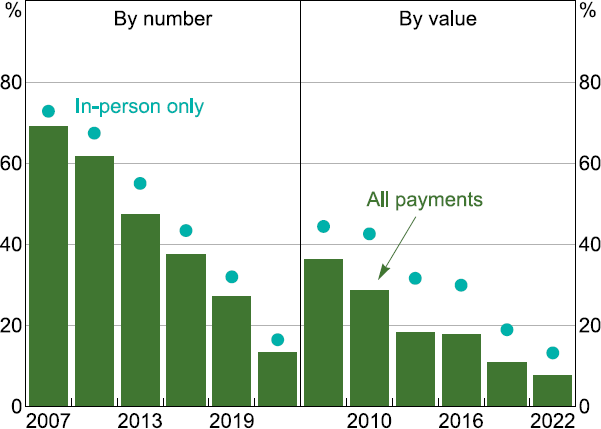
The decline of transactional cash use accelerated over the three years to 2022, with cash accounting for 13 per cent of the total number of consumer payments, compared to 27 per cent in 2019 (Figure 6). When measured by the value of consumer payments, the share of total payments made with cash declined more modestly from 11 per cent to 8 per cent. For in-person transactions, Australians halved their share of cash payments by number from 32 per cent to 16 per cent.
The decline in cash use was particularly pronounced for lower-value transactions, with consumers now more likely to use other payment methods for these payments. Indeed, non-cash methods (of which cards make up the overwhelming majority) overtook cash as the most frequently used payment method for all payment sizes for the first time in the 2022 CPS (Figure 7). Across all payment sizes, cash payments are most likely for round value transactions where change or coins are less likely to be needed (i.e. $5, $10, $20, $50 and $100 payments). The shift away from cash for lower-value payments reflects increased adoption of contactless electronic payments during and following the pandemic.
Source: RBA calculations, based on data from Colmar Brunton, Ipsos and Roy Morgan Research.
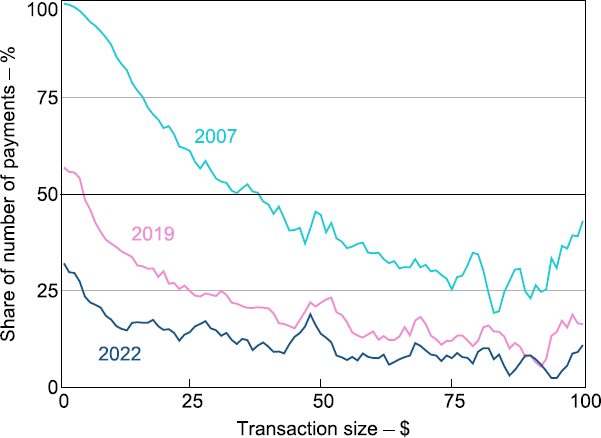
Note: $5-centred moving average; for example, the $6 share is an average of the payment method share at $4, $5, $6, $7 and $8.
Source: RBA calculations, based on data from Ipsos and Roy Morgan Research.
The decline in cash use was evident across key demographic groups, with consumers of all ages, income groups and locations using cash less frequently than previously (Figure 8). There was a particularly pronounced shift away from cash for groups typically associated with higher cash use, such as older age groups, those in regional and/or remote Australia, and those with lower household incomes. For example, consumers aged over 50 made just under 22 per cent of their in-person weekly payments in cash in 2022, compared with around 42 per cent three years earlier (and around 74 per cent in 2007). Similar declines were observed for people with lower household incomes and in regional/remote Australia.
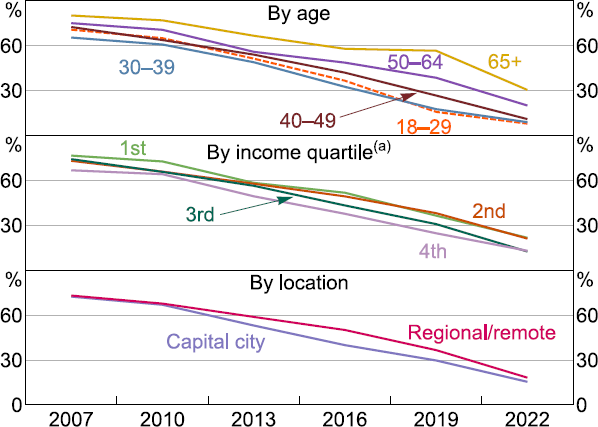
Note: (a) Age-adjusted income quartiles.
Source: RBA calculations, based on data from Colmar Brunton, Ipsos and Roy Morgan Research.
The CPS suggests that the decline in cash use was accelerated by the pandemic. If cash use had followed its pre-pandemic trend, we would have expected the share of the number of in-person transactions made with cash to be 6 percentage points higher in 2022 (at 22 per cent) than eventuated (16 per cent). Higher frequency data – such as monthly aggregate ATM withdrawals across Australia and alternative surveys – indicate that the steep decline in cash use was due to a sharp decline at the beginning of the pandemic and then a relatively steady level of cash use at the lower level (Guttmann, Livermore and Zhang 2023). This suggests a ‘bring forward’ of a decline in cash use, rather than a change in trend per se.
The pandemic may have played a role in the relatively larger cash use decline for the elderly and those in regional and/or remote Australia. During the pandemic, consumers in general shifted away from cash partly because of hygiene concerns with handling cash. Fears of virus transmission were likely more acute for those in certain demographics, specifically the elderly (since the consequences are greater) and those in regional/remote areas (where distances to medical care may be greater) (McGrail and Humphreys 2015; Mueller, McNamara and Sinclair 2020).
4.2 Cash users and their attitudes towards cash
Most Australians used cash infrequently in 2022, if at all. Indeed, just over half of the respondents did not use cash at all during the diary week (‘no cash user’) in 2022, up from about one-third in 2019 and around one-fifth in 2016 (Figure 9). Including no cash users, almost three-quarters of Australians used cash for 20 per cent or less of their in-person transactions (‘low cash users’) in 2022, compared with half in 2019. The higher share of Australians using cash infrequently or not at all is consistent both with consumers preferring to pay with electronic methods and industry policies that encouraged and facilitated non-cash payment methods.
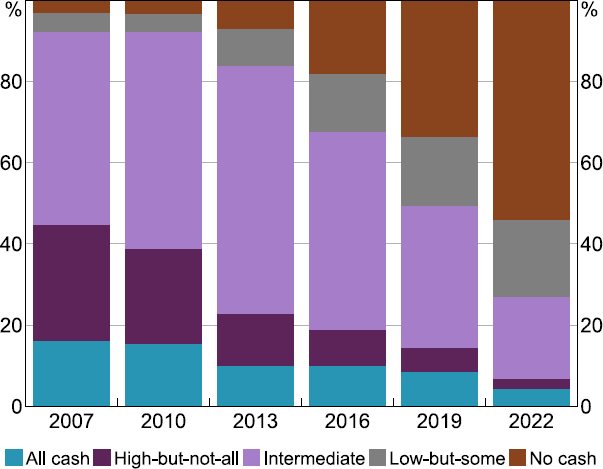
Note: Category based on share of in-person payments made with cash (no cash = 0 per cent, 0 per cent < low-but-some ≤ 20 per cent, 20 per cent < intermediate < 80 per cent, 80 per cent ≤ high-but-not-all < 100 per cent, all cash = 100 per cent).
Source: RBA calculations, based on data from Colmar Brunton, Ipsos and Roy Morgan Research.
However, some people still use cash for a significant share of their in-person payments. For example, around 5 per cent of CPS participants used cash for all their in-person transactions (‘all cash users’) in 2022 – the share having steadily declined from 16 per cent of people in 2007. Including all cash users, the share of people who used cash for 80 per cent or more of their in-person payments (‘high cash users’) declined to 7 per cent in 2022, from a little under half of the respondents in 2007.
The no cash and all cash user groups represent most of the low and high cash user groups respectively.[4] In the remainder of this paper, we focus the discussion on low cash users (including no cash users) and high cash users (including all cash users).[5]
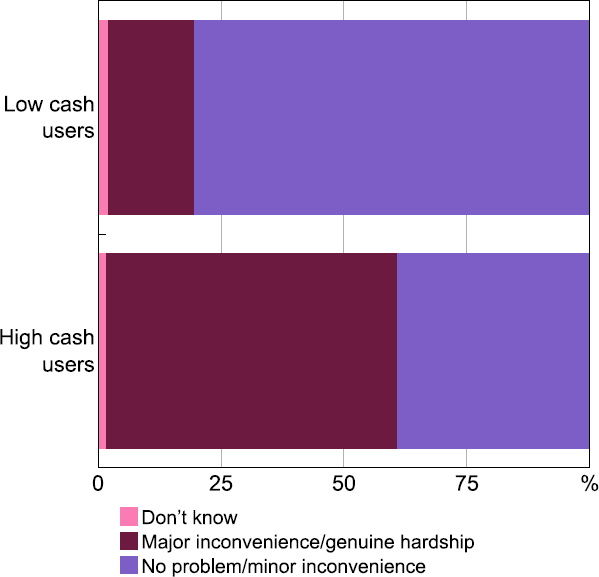
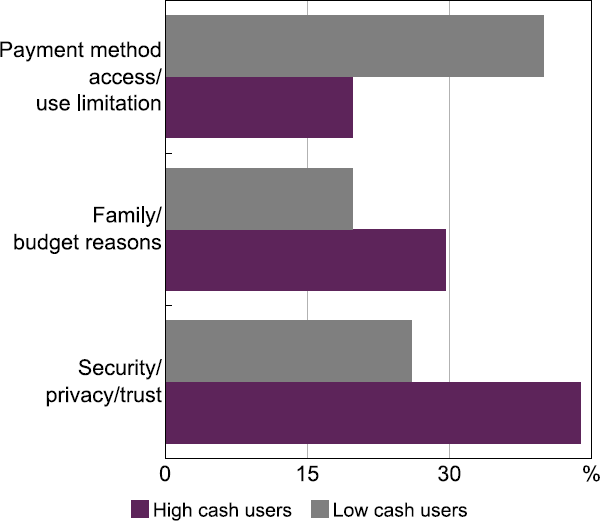
While about 80 per cent of low cash users say they would be largely unaffected if cash became hard to use or access, a sizeable minority indicate some inconvenience (Figure 10). Of those who would experience a ‘major inconvenience’ or ‘genuine hardship’, high cash users are more likely to cite privacy/security concerns or family/budget reasons for needing cash (Figure 11).
Note: Category based on share of in-person payments made with cash (low ≤ 20 per cent, high ≥ 80 per cent).
Source: RBA calculations, based on data from Ipsos.
Notes: Share of respondents answering that they would experience a major inconvenience or genuine hardship to the question ‘Would it be difficult for you if shops stopped accepting cash and you could no longer withdraw cash?’. ‘Other’ category omitted. Category based on share of in-person payments made with cash (low ≤ 20 per cent, high ≥ 80 per cent). Payment method access/use limitation includes having no non-cash way to pay, not having enough money in bank account, not confident with non-cash methods, having a disability that makes it difficult to use non-cash methods, poor internet access, some businesses only accept cash and unable to get a bank account.
Source: RBA calculations, based on data from Ipsos.
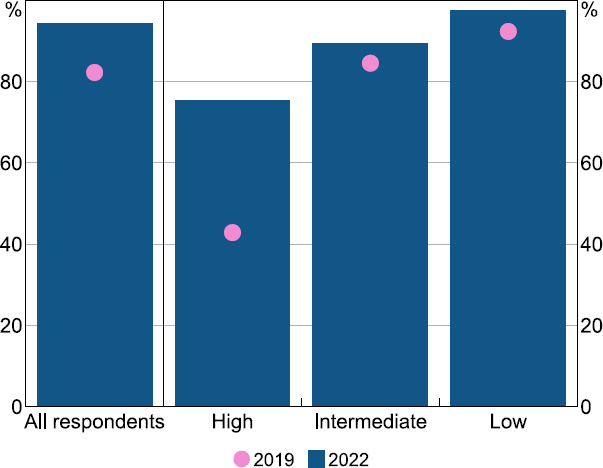
While barriers to non-cash methods, like poor internet access or that some merchants only accept cash, still prevent some people from adopting other payment methods, they are relatively less important than in the past. For example, about 6 per cent of people stated they needed cash because ‘they have no other way to pay’ in 2019 – that share was under 1 per cent in 2022. One possible structural factor for this shift is that differences in ownership of internet-compatible mobile phones between the cash user groups are less evident than they were in 2019 (Figure 12). Additionally, government investment in regional/remote telecommunications infrastructure has increased (Australian Government 2022).
Note: Category based on share of in-person payments made with cash (low ≤ 20 per cent, 20 per cent < intermediate < 80 per cent, high ≥ 80 per cent).
Source: RBA calculations, based on data from Ipsos and Roy Morgan Research.
4.3 Cash holdings
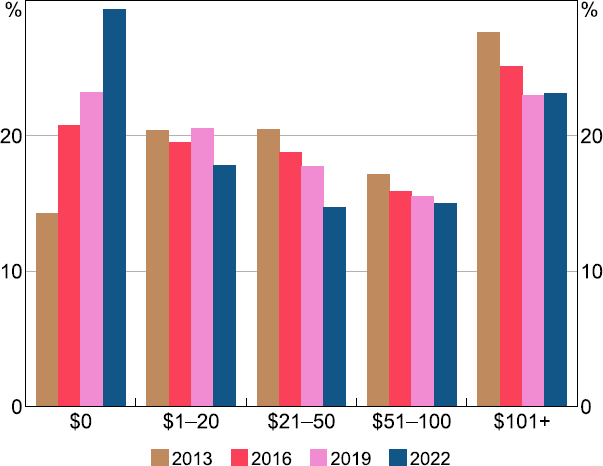
Consistent with lower transactional cash use, fewer people held cash in their wallet or purse compared with 2019. Indeed, the share of people holding no cash on their person increased to 29 per cent in 2022 from 22 per cent in 2019 (Figure 13).[6] The share of lower-value holdings (under $50) decreased most, while higher-value on-person holdings remained relatively stable. The share of people holding cash in other places was unchanged from 2019 at around 40 per cent.
The stability in out-of-wallet cash holdings between 2019 and 2022, despite the sharp decline in transactional cash usage, is consistent with strong precautionary or store-of-wealth demand for banknotes. This is seen most in the growth of high denomination banknotes in circulation, particularly during times of crisis (Guttmann et al 2023). Indeed, the CPS suggests that many consumers perceive cash to be important as a backup payment method for when electronic payment methods are unusable. For example, of the people who held cash in their wallet, the most important reason for doing so – other than for day-to-day purchases – was for emergency transactions (about 20 per cent of respondents), followed by concerns about payments systems reliability. Emergency transactions was also the most important reason for holding cash outside the wallet.
Source: RBA calculations, based on data from Colmar Brunton, Ipsos and Roy Morgan Research.
4.4 Cash access
Consistent with the decline in the use of cash for transactions, the share of respondents making cash top-ups (i.e. receiving or withdrawing cash) during the survey week decreased: 29 per cent of respondents in the 2022 survey made at least one top-up, compared with 48 per cent in 2019 and 86 per cent in 2007 (Table 2). Similarly, the average number of top-ups halved – from 0.8 top-ups per week in 2019 to 0.4 per week in 2022. By age, older individuals were more likely to make at least one top-up during the week. By household income, those with lower income made more top-ups, although the relationship between income and top-ups is weaker than with age. In any case, these results are consistent with more transactional cash use in these demographics.
| 2007 | 2010 | 2013 | 2016 | 2019 | 2022 | |
|---|---|---|---|---|---|---|
| Share of respondents making one or more top-ups (%) | 86 | 72 | 76 | 45 | 48 | 29 |
| Average number of top-ups per person per week | 1.4 | 1.6 | 1.5 | 0.7 | 0.8 | 0.4 |
| Median value of top-ups ($) | 100 | 100 | 60 | 100 | 80 | 100 |
|
Source: RBA calculations, based on data from Colmar Brunton, Ipsos and Roy Morgan Research. |
||||||
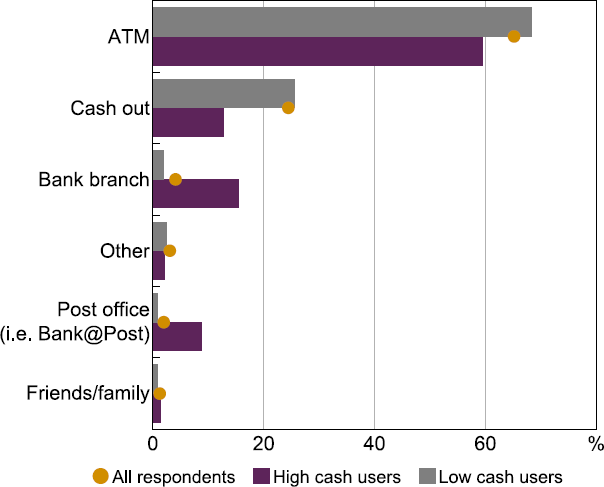
To complement these top-ups data, in the 2022 CPS, respondents were asked to reflect on where they usually, and where they most prefer to, access their cash even if they did not do so during the survey week.[7] Across all cash user groups, people usually access cash from ATMs or cash out at the point-of-sale; these were also cited as the two most preferred ways to access cash (Figure 14).
Note: Category based on share of in-person payments made with cash (low ≤ 20 per cent, high ≥ 80 per cent).
Source: RBA calculations, based on data from Ipsos.
By cash use intensity, high cash users were more likely to state that they usually, and most prefer to, access cash at a bank branch or Bank@Post than low cash users. One possible reason this could be the case is if high cash users prefer the face-to-face service offered at these outlets. High cash users may also prefer bank branches because they are not faced with withdrawal limits. Low cash users, on the other hand, may prioritise convenience of the nearest cash access point over the features of the service. The recorded top-ups in the diary data reinforce this finding – of those who recorded a top-up, 93 per cent of high cash users topped-up from their most preferred top-up source, compared to about 70 per cent for low cash users.
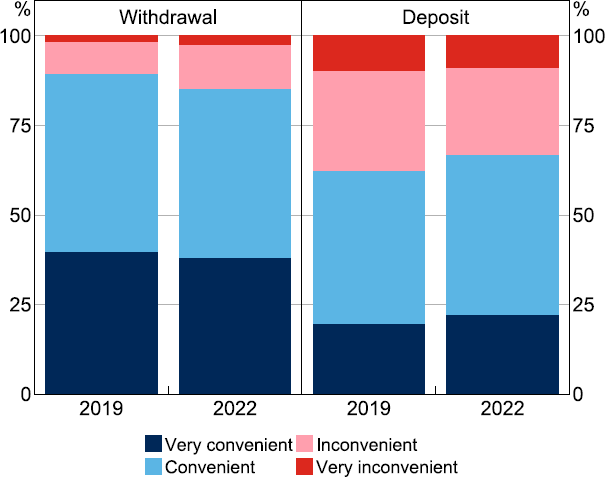
The CPS suggests that the convenience of access to cash services differs between withdrawal and deposit services, although the difference has lessened in the recent survey. Almost all people use cash withdrawal services, and access is generally rated as convenient or very convenient; however, the share rating withdrawal services as convenient or very convenient has declined to 85 per cent in 2022 from 89 per cent in 2019 (Figure 15). By comparison, only around three-quarters of people use deposit services, and a smaller share of people rate these as convenient relative to withdrawal services. In 2022, 67 per cent of people rated deposit services as convenient or very convenient, which is an increase from 62 per cent in 2019. The shares of people who don't use withdrawal and deposit services increased since 2019, consistent with the decline in transactional cash use.
Source: RBA calculations, based on data from Ipsos and Roy Morgan Research.
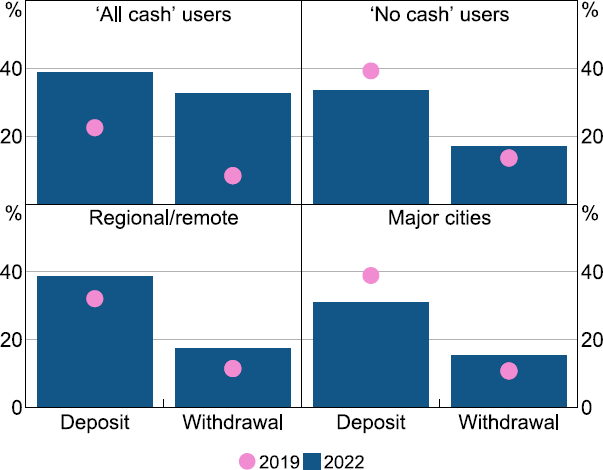
Important vulnerabilities in cash access are emerging: the highest cash users and those in regional/remote areas find their access to both withdrawal and deposit services more inconvenient than they did in 2019 (Figure 16). For those in regional/remote areas, it is likely that the declining number of cash access points, and the distance to the next alternative, contributed to the increased inconvenience of access. While the decline in bank branches has been mostly concentrated in metropolitan areas, the greater distance to the ‘next closest’ access point in regional/remote Australia means closures are more acutely felt in these areas (Guttmann et al 2023).
For more intensive cash users, the ways they prefer to access cash, particularly via bank branches, may explain the decreased convenience of cash access. Access to bank branches has declined in recent years (Guttmann et al 2023). Indeed, other access points are not perfect substitutes for bank branches, which offer a broader range of services (e.g. no withdrawal limits). This might mean when a branch closes, people who rely on those services find cash access more inconvenient than before.
Note: Share of respondents answering that deposit or withdrawal services are inconvenient or very inconvenient.
Source: RBA calculations, based on data from Ipsos and Roy Morgan Research.
Footnotes
This is somewhat expected, since the average number of transactions per person in the diary is relatively low (about 13). Therefore, small changes in the absolute number of cash transactions cause large changes in the cash share of transactions. [4]
Generally, results for the high and all, and the low and no, cash user groups are similar. [5]
This is the value of wallet cash holdings as reported at the end of the payments diary. In past research, the Reserve Bank reported the value of wallet cash holdings as reported at the beginning of the payments diary. The change occurred because of issues in data collection during the 2022 survey. [6]
The declining frequency of cash top-ups has reduced the CPS's visibility of the access points that respondents use and so these questions were asked to address this emerging gap. [7]