
Bulletin – November 2026 Finance Recent Developments in Small Business Economic and Financial Conditions
Transcript
What are small businesses telling us about current economic conditions?
Every year we speak with small businesses to better understand how they’re experiencing the economy and accessing finance.
Together with insights from our surveys, our liaison program and other data, this helps us to understand how small businesses are faring.
Business conditions have weakened over the past year for smaller businesses. Confidence has fallen, and many businesses are concerned about global developments and higher interest rates.
The economic environment has become more challenging, and softer customer demand has occurred at the same time as their costs have increased.
This has put pressure on profit margins, and many small businesses have found it difficult to pass the full increase in their costs on to customers.
Some are instead looking for ways to reduce costs, for example by reducing waste, tightening inventory or reducing the amount of hours they offer to their employees.
Are small buisinesses using AI to improve productivity and reduce costs?
AI adoption is still at an early stage, but many small businesses report that they are beginning to explore its use to reduce costs and improve their productivity.
Small businesses we spoke to reported that they are using AI for marketing, administration, and basic legal and accounting functions.
In broader surveys, many small and medium businesses report that they are in the early stages of adopting AI.
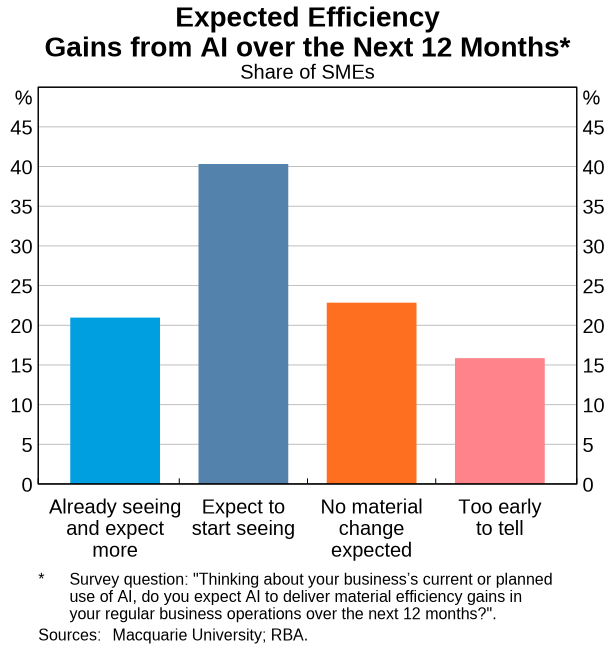
Around one in five have reported efficiency gains from AI, with more expecting to see benefits over the coming year.
So while the economic environment is challenging, small businesses are continuing to adapt.
What are you hearing about access to finance?
The cost of finance has increased this year as interest rates have risen, and some small businesses still struggle to access finance on terms that suit their needs.
One ongoing challenge is that many loans require a home to be provided as collateral.
That said, small businesses’ access to finance has continued to improve.
An important reason has been strong growth in non-bank lenders that specialise in lending to small businesses.
There has also been greater competition among banks and non-bank lenders, and lenders have invested in technology that has made loan approvals faster and simpler.
Abstract
Economic conditions for small businesses have weakened over the past year and business confidence has fallen. Higher input cost growth, higher interest rates and weaker demand are putting pressure on profit margins as businesses are unable to fully pass through cost increases to prices. Availability of finance had improved for small businesses in recent years, driven in part by greater competition among banks and non-banks, and growth in credit for small and medium enterprises (SMEs) was strong. Despite this, some small businesses continued to report difficulties in obtaining finance that suits their needs. This article discusses recent trends in economic and financial conditions for small businesses, drawing on insights from the RBA’s 34th Small Business Finance Advisory Panel.
Introduction
This article provides an update on the economic environment and availability of finance for small businesses. It draws on information from the RBA’s 34th annual Small Business Finance Advisory Panel held in August 2026, the RBA’s regular liaison program, economic indicators, business surveys and data from financial institutions.1
Understanding developments in economic and financial conditions for small businesses is important because small businesses account for a large share of output, employment and income in the Australian economy (Commonwealth of Australia 2025; Chan, Chinnery and Wallis 2023). Small businesses can also face greater challenges accessing finance, which can hamper their growth and limit their ability to innovate (Jones 2024).
Economic conditions for SMEs
Panellists from the Small Business Finance Advisory Panel highlighted a range of challenges for small businesses in the current economic environment, consistent with information from the RBA’s liaison program and broader macroeconomic trends. Panellists generally reported that customer demand had weakened over the past year, particularly in the discretionary spending and interest-sensitive sectors. They also reported broad-based input cost pressures and a limited ability to pass these on to customers amid weak demand. Instead, panellists reported absorbing higher costs through compressed margins and/or seeking to cut costs by reducing waste or cutting labour hours. Several noted that artificial intelligence (AI) had led to productivity improvements and cost savings.
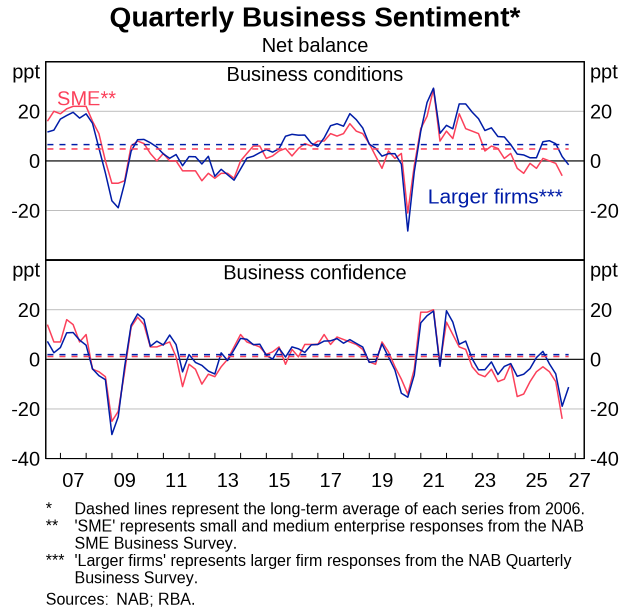
Survey measures of business conditions declined this year and were below their long-run averages and much weaker for SMEs than for larger firms in the June quarter (Graph 1).2 Weaker business conditions reflected softer profitability and trading conditions (such as turnover and gross earnings), consistent with slowing growth in domestic demand (NAB 2026a; NAB 2026b; RBA 2026a). Business confidence deteriorated to well below long-run average levels and was lower for SMEs than for larger firms. The fall in reported confidence reflected uncertainty stemming from the Middle East conflict, recent government policy changes and higher interest rates (NAB 2026a). Panellists also noted that similar factors were weighing on confidence.
Input costs and profit margins
Input cost pressures have been broadly based, reflecting both capacity pressures in the domestic economy and global cost pressures related to the Middle East conflict. Panellists noted that input cost growth had increased over the past year, particularly for freight, labour, materials and land.
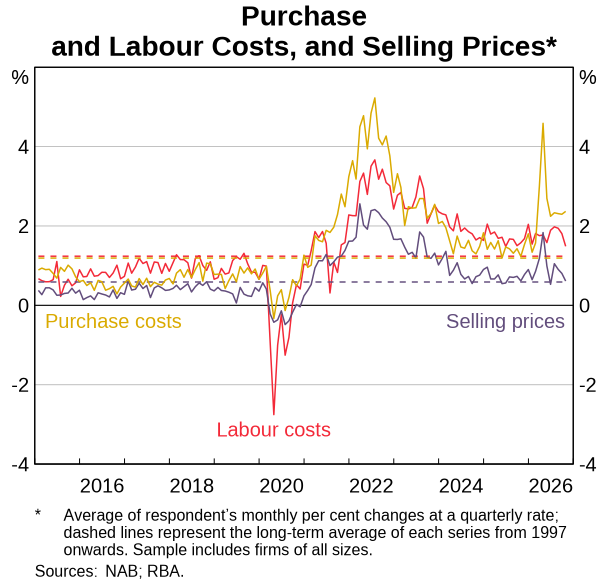
Many firms in the RBA’s liaison program report that higher input costs are putting pressure on profit margins (RBA 2026a).3 Survey data suggests that selling prices have not grown as fast as labour and purchase costs (Graph 2). Similarly, panellists reported that a limited scope to pass cost increases through to customers had put pressures on their profit margins. Several had instead looked for ways to reduce costs, such as by reducing waste, tightening inventory, and cutting labour hours.
Use of AI
Several panellists noted that AI has supported cost reduction and productivity improvement in some areas of their businesses. They have used AI for some tasks previously undertaken by external contractors or permanent staff, particularly in marketing, administration, and basic legal and accounting functions.
Similarly, survey data indicate that AI use among SMEs is widespread and increasing, although its integration into business processes generally remains limited. In one recent survey, around half of SMEs reported using AI tools to assist with administrative tasks or forecast cash flows (Prospa 2026). And in Macquarie University’s Business Outlook Scenarios Survey (BOSS), more than two-thirds of SMEs reported some use of AI in their operations. In that survey, around one in five SMEs reported that they have experienced material efficiency gains in their regular operations because of AI use, and a further two-fifths expected to start seeing material efficiency gains over the coming year (Graph 3). Many businesses in the RBA’s liaison program (which covers businesses of all sizes) report that they are in the early stages of incorporating AI into their business processes. To date, firms have reported mixed experiences with AI’s impact on productivity and most have reported no impact on their headcount (RBA 2026b). Several panellists and liaison contacts reported that implementation costs, technology requirements, and risk and governance concerns remain barriers to more extensive AI adoption.
Financial stress for small businesses
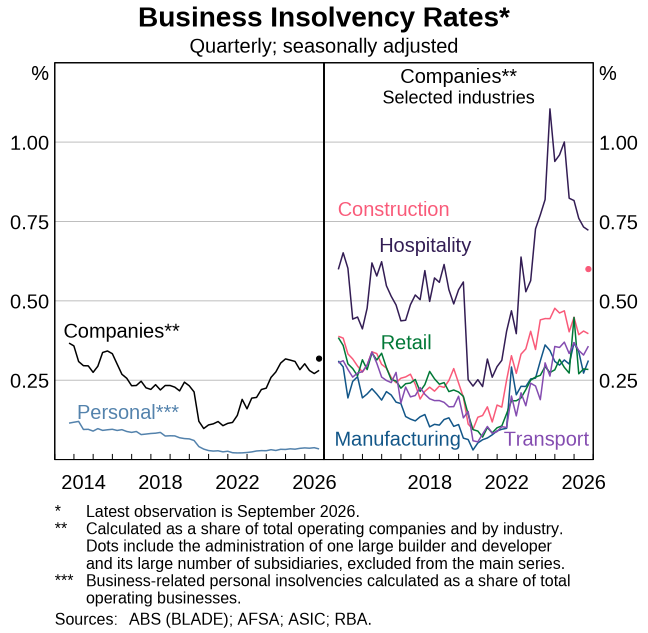
Financial stress is expected to increase for smaller businesses amid the weakening in economic conditions, increase in interest rates and pressure on profit margins (RBA 2026c). The rise in financial stress is likely to be more pronounced for smaller than larger businesses, particularly among more cyclical industries, such as construction, hospitality and retail, and energy-intensive businesses, such as those in transport and manufacturing, which are more exposed to cost increases related to the Middle East conflict.
To date, increased financial stress has not been widely evident in rates of insolvency (RBA 2026c). Rates of company insolvency generally declined a little since early 2025, after earlier increases following the pandemic, and rates of personal insolvency of business owners remain low (Graph 4). However, weaker economic conditions and pressure on margins may not yet be fully captured in current insolvency rates, since insolvency represents the final stage of severe financial stress for firms. Rates of insolvency are highest in the construction, hospitality and transport sectors, which are more exposed to recent wage and input cost pressures.
Cost, availability and use of SME finance
Demand for and use of finance
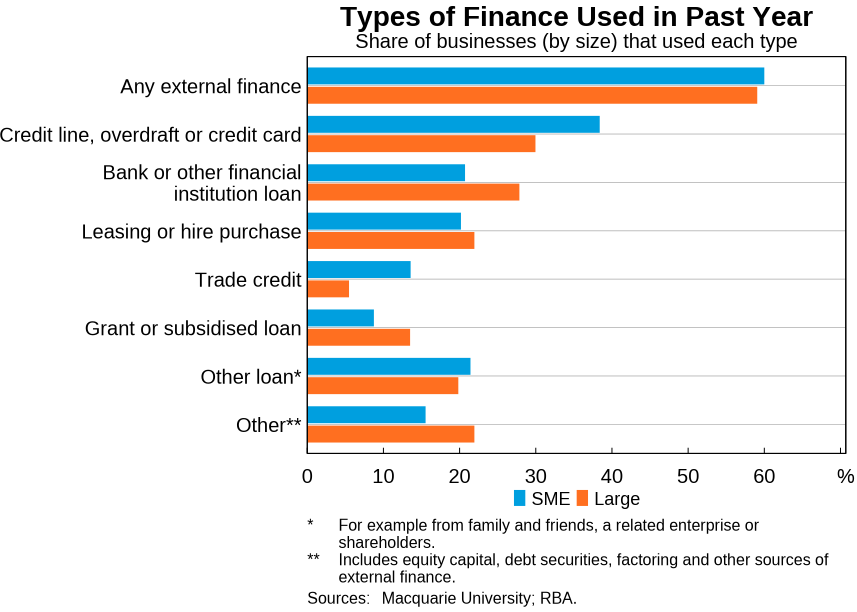
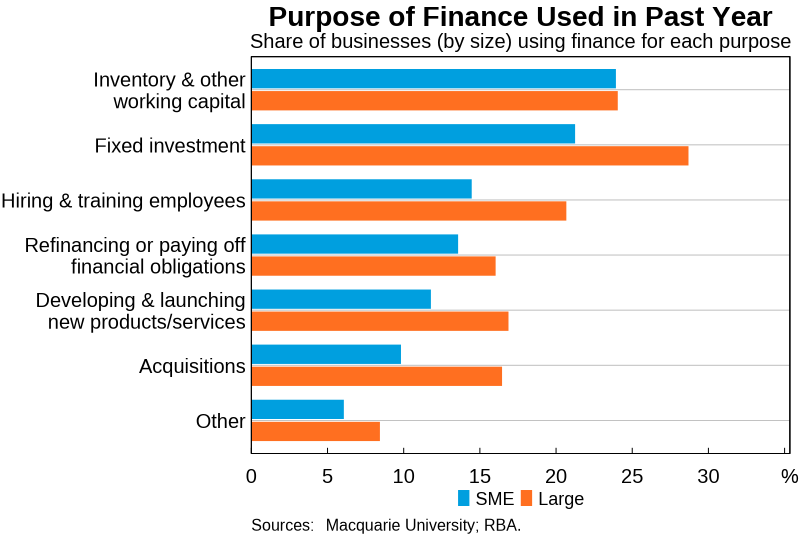
Survey data suggest that more than half of SMEs used external financing during the past year (Graph 5). The most commonly reported sources of finance were banks and other financial institutions, from which businesses borrowed fixed-term loans, lines of credit and finance leases. Many SMEs also borrowed from other sources, including family and friends. External finance was used for a range of purposes; the most frequently reported uses were for working capital and to fund fixed investment (Graph 6). Businesses also reported using external finance to refinance or pay off other financial obligations. Consistent with this, panellists and contacts in the RBA’s liaison program have suggested that because the Australian Taxation Office (ATO) has resumed enforcement actions on unpaid taxes, it has become increasingly common for small businesses to borrow from financial institutions to help pay down their tax liabilities (RBA 2026d).
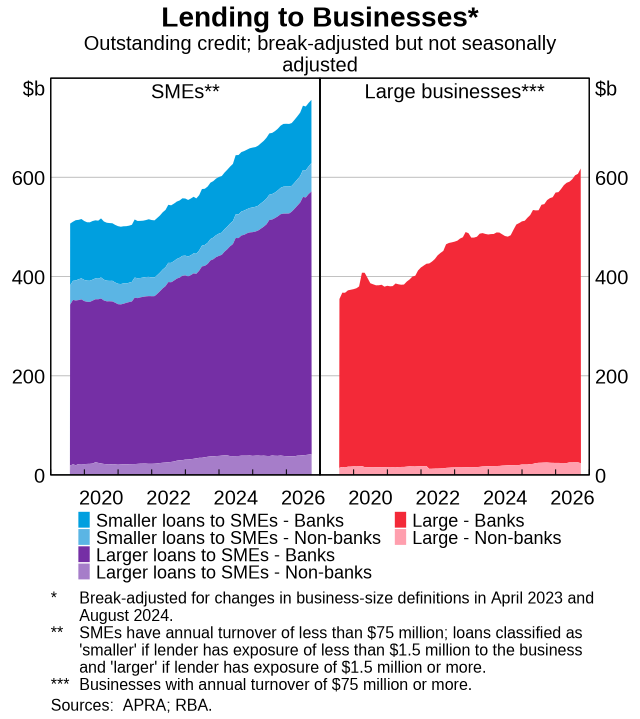
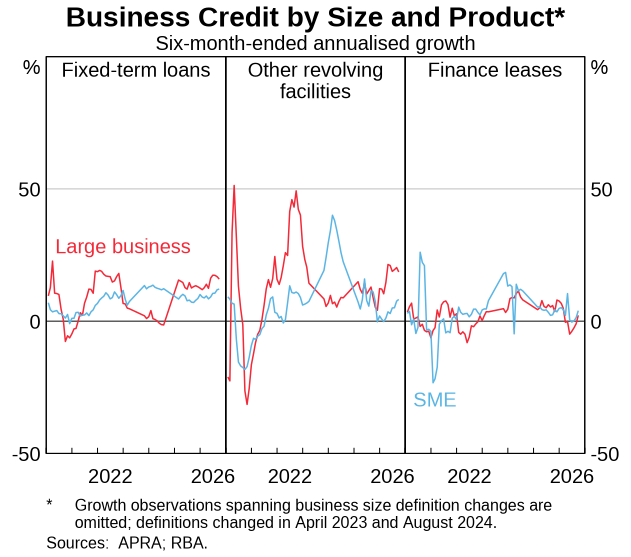
SME credit from banks and other financial institutions had grown quickly over recent years, reflecting strength in both the demand for business finance and the supply of credit from lenders (discussed below; Graph 7). Over the past year, growth in SME credit held up, though it was somewhat below its 2024 peak and slower than growth in large business credit. The growth in SME credit was led by fixed-term lending, while growth in revolving credit (which is typically used to fund businesses’ ongoing operations) had also picked up in 2026 to date (Graph 8). In liaison, a few lenders noted that smaller businesses’ demand for credit had moderated recently. In part, this may relate to a delay or reassessment of investment plans by some businesses, given the uncertain economic environment and sharp deterioration in small business confidence. For example, in a recent survey, SMEs reported a noticeable reduction in plans to grow through acquisition (Banjo Loans 2026).
Access to finance
SME access to credit had improved over recent years, reflecting a range of factors (Harvey, Lai and Spiller 2025). These included:
- the continued growth of specialist non-bank SME lenders, supported by generally favourable funding conditions for these lenders (Jennison, Spiller and Wallis 2026)
- greater competition among banks for business customers due, in part, to banks pivoting towards business lending as margins on housing lending declined
- an increase in broker activity for business loans, particularly for SME loans, likely supporting lender competition and helping to match borrowers with lenders that can provide suitable finance
- lender investments in technology and staff to support simpler and faster loan processing.
Panellists noted that lower barriers to accessing credit, including unsecured credit, can help to manage cash flow pressures. However, increased access can also lead to financial risks. For example, panellists noted some small businesses were less likely to seek financial advice before taking on debt that was more readily available than traditional bank loans (e.g. automated loan offers linked to a businesses’ revenues). And while access to unsecured credit had improved, these facilities still attract higher interest rates reflecting the increased financial risk borne by the lender.
Despite some improvements in the availability of finance, some SMEs continued to report difficulty in accessing finance on terms that suited their needs. According to a recent survey, one in five SMEs experienced challenges in obtaining finance (Banjo Loans 2026). Strict lending requirements were the most common challenge that SMEs faced in accessing finance, and the share of businesses that reported this challenge increased from last year (Graph 9). In liaison, lenders have reported that SME lending standards have been little changed over the past year.
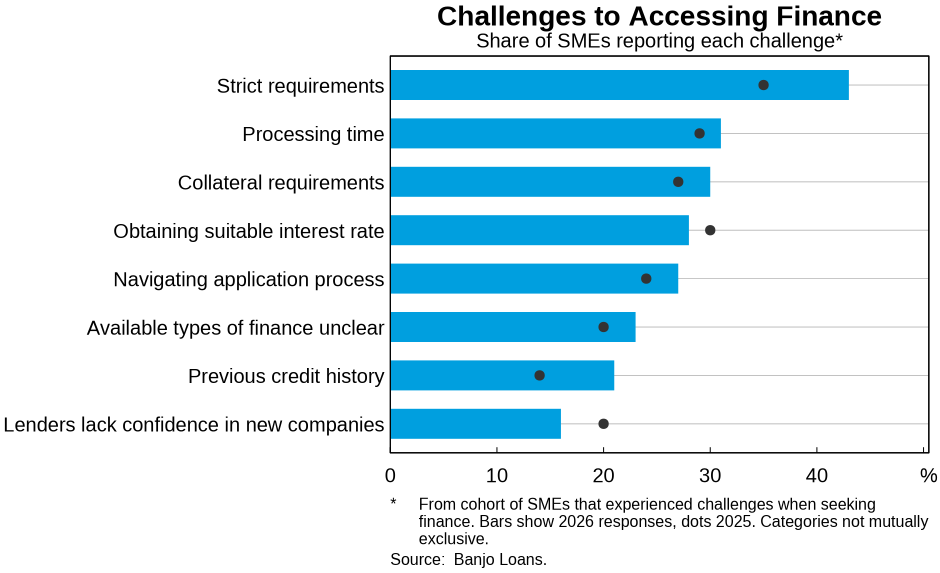
Small businesses continue to report that the requirement to provide residential property or other physical assets as collateral is a key challenge to accessing finance. While housing prices have grown strongly over recent years, the recent declines could exacerbate this challenge in the period ahead. Almost half of small business credit outstanding is secured by residential property and a similar amount is secured by other assets (such as vehicles and equipment).
While information from liaison suggests that access to unsecured finance had improved over recent years, the share of unsecured SME credit has remained below 5 per cent. This could suggest that unsecured finance has become only marginally more accessible or that demand for unsecured finance has not increased materially (Harvey, Lai and Spiller 2025). It is also possible that borrowers take out unsecured loans for relatively short periods (e.g. to manage temporary cash flow issues) given that they typically have relatively high interest rates, and rely on secured lending for larger or longer-term financing. Furthermore, some non-bank providers of unsecured lending are not well captured in official data sources.
Cost of finance
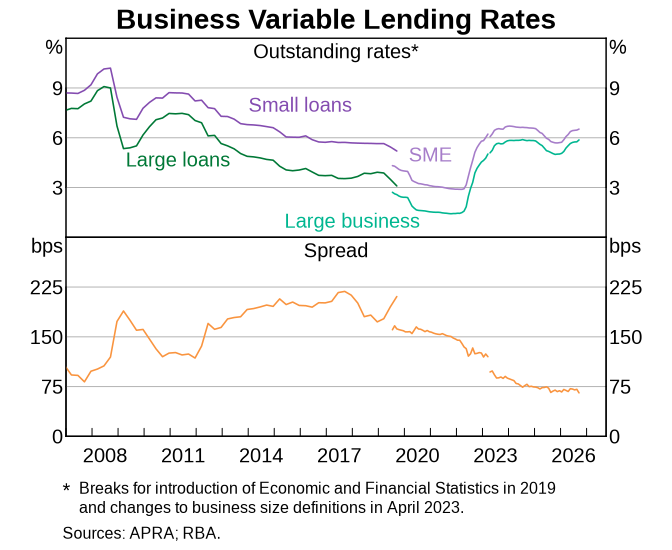
Difficulty obtaining a suitable interest rate is another key challenge reported by SMEs (Graph 9). On average, loans to SMEs are currently about 75 basis points higher than loans to large businesses (Graph 10). However, the spread between SME and large business lending rates has narrowed over the past decade to a historical low. This trend partly reflects measurement changes, with definitions of business size changing in 2023 and 2024, resulting in some large business loans (which pay lower interest rates on average) being reclassified as SME loans. But it also reflects the increased competition for SME loans noted above and a reduction in the Australian Prudential Regulation Authority’s (APRA) capital requirements for banks’ SME loans in 2023. Rates on loans to SMEs have increased this year broadly in line with increases in the cash rate.
Conclusion
Economic conditions for small businesses have weakened over the past year. Survey measures of small business confidence have deteriorated to well below long-run averages, and SMEs report worse business conditions and confidence than large businesses. Elevated growth in input costs is putting pressure on profit margins as businesses feel unable to fully pass them onto customers. Despite weaker economic conditions and pressure on margins, company insolvencies stabilised recently after earlier increases following the pandemic.
Borrowing from banks and other financial institutions grew at a fast pace over recent years, reflecting strength in both the demand for business finance and the supply of credit from lenders. The increase in the availability of credit reflected greater competition among lenders, an increase in broker activity, and favourable conditions in wholesale debt markets. However, borrowing costs have risen this year as interest rates have increased, and some SMEs continue to report difficulty in obtaining finance on terms that suit their needs.
Endnotes
* The authors are from Domestic Markets Department and would like to thank Peter Wallis, Michael Thornley, Elena Ryan, Fred Hanmer, Ravi Ratnayake, Sophie Doherty, Amardeep Johal and Bailey Knell for assistance and feedback on this article. They would also like to thank members of the 2026 Small Business Finance Advisory Panel for their participation in this year’s discussion and lenders for their participation in liaisons related to SME finance.
1 The 2026 Panel and most of the information considered in this article predate the removal of card payment surcharging from 1 October 2026. The Panel comprised representatives from nine SMEs across Australia, covering a range of sectors (RBA 2026e).
2 The SME series was discontinued in June 2026.
3 Contacts in the RBA’s liaison program tend to be medium- to larger-sized firms (Dwyer, McLoughlin and Walker 2022).
References
ABS (Australian Bureau of Statistics) (2026), ‘Counts of Australian Businesses, Including Entries and Exits’, Cat No 8165.0.
Banjo Loans (2026), ‘SME Compass Report 2026’.
Chan P, A Chinnery and P Wallis (2023), ‘Recent Developments in Small Business Finance and Economic Conditions’, RBA Bulletin, September.
Commonwealth of Australia (2025), ‘National Small Business Strategy’, 3 February.
Dwyer J, K McLoughlin and A Walker (2022), ‘The Reserve Bank’s Liaison Program Turns 21’, RBA Bulletin, September.
Harvey N, S Lai and J Spiller (2025), ‘Small Business Economic and Financial Conditions’, RBA Bulletin, October.
Jennison S, J Spiller and P Wallis (2026), ‘Recent Changes in Credit Markets and Their Implications for Monetary Policy’, RBA Bulletin, February.
Jones B (2024), ‘Financing SME Innovation in Australia – Challenges and Opportunities’, Speech at COSBOA National Small Business Summit, Sydney, 4 April.
NAB (National Australian Bank) (2026a), ‘NAB Quarterly Business Survey: Q3 2026’, September.
NAB (2026b), ‘SME Business Insights Report: June Quarter 2026’, June.
Prospa (2026), ‘SME Industry Outlook: 2026 Autumn Edition’, June.
RBA (Reserve Bank of Australia) (2026a), ‘Chapter 2: Economic Conditions’, Statement on Monetary Policy, November.
RBA (2026b), ‘Box C: Insights from Liaison’, Statement on Monetary Policy, November.
RBA (2026c), ‘Chapter 2: Resilience of Australian Households and Businesses’, Financial Stability Review, October.
RBA (2026d), ‘Chapter 2: Resilience of Australian Households and Businesses’, Financial Stability Review, March.
RBA (2026e), ‘Small Business Finance Advisory Panel’.
Underlying data
Underlying data for selected graphs. Other data may be available upon request via our general enquiry page.